Table of Contents
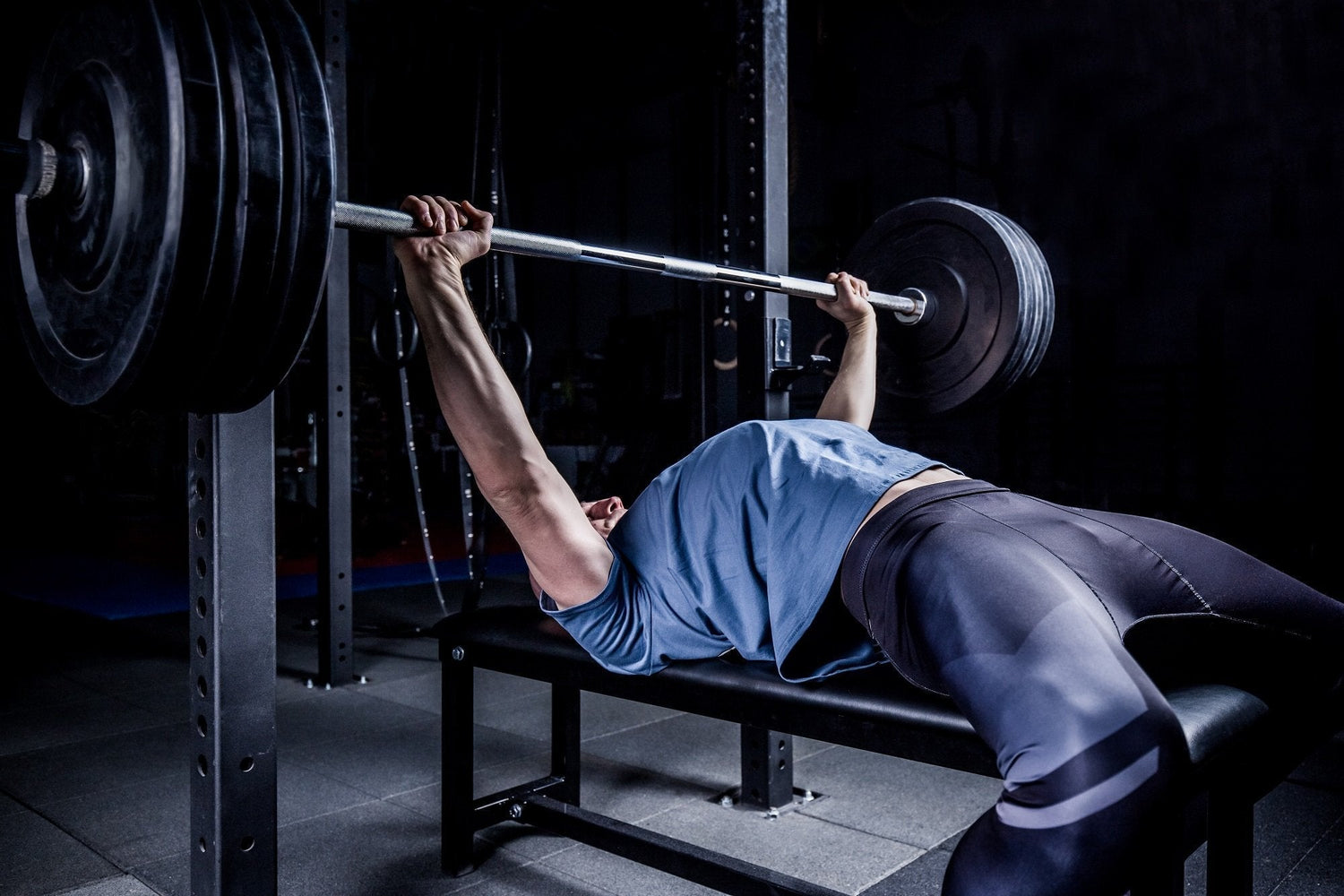
It is a truth universally acknowledged that strength is size. Bench press, hailed as one of the most effective ways of gaining upper body strength, has become prevalent among fitness enthusiasts. Novice lifters and elite athletes alike try to lift heavier to get close to those with rippling muscles in the ads. But more is not necessarily better. Forcing yourself to do heavy lifting beyond your limit could backfire. Therefore, knowing how much you’re able to bench can clear the way for building muscles effectively with proper form.
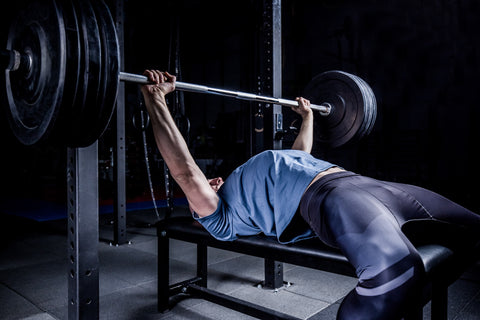
This article will delve a little bit more into the following three main questions you have:
- How much should I be able to bench?
- What is the average bench press by age?
- What is my one-rep max?
Now let's dive in.
1. How Much Should I Be Able to Bench?
While gauging how much you should be able to bench, multiple factors, including body weight, goals, gender, age, and training experience, need to be considered.
1.1 How Much Bench Press for Beginners?
As a beginner, you should start light and build up your activity level gradually. It is recommended that you lower the weight (<50% of body weight), especially at your first attempt, to get used to the bench press technique and adapt your muscle tendon to the specific exercise gesture. As you gain more experience, you can add more weight.
There’s no need to be sorry or ashamed if you can only lift the bar in the very beginning. Constantly comparing yourself with others around you is a fast track to frustration and disappointment.
In this stage, spotters and a power cage can help improve your form and ensure your safety when you are in a tight spot.
1.2 How Much Can the Average Man Bench Press?
As of 2020, the latest data from Gallup puts the average American woman's body weight at 162 pounds, while the average male clocks in at 200 pounds (self-described weight). With that information and your stats in mind, you can then pop on over to ExRx.net official Bench Press Standards chart, which estimates the one-rep max lift for adults.
These standards allow you to compare your one-rep max lift with other lifters at your body weight, but do remember: the strength standard is not the strength norm, nor does it present the highest possible level of strength performance. Instead, it is merely a rough baseline of expectation for an average healthy adult.
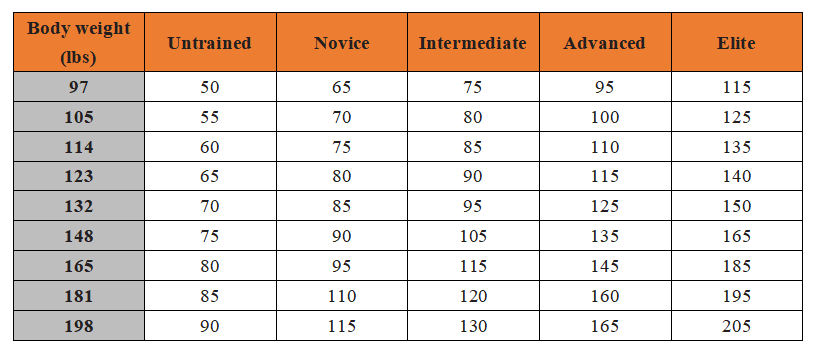
Here’s a simplified version of the men’s and women’s bench press standard tables so you can see the trend at a glance.
Chart I. Bench Press Standards for Men
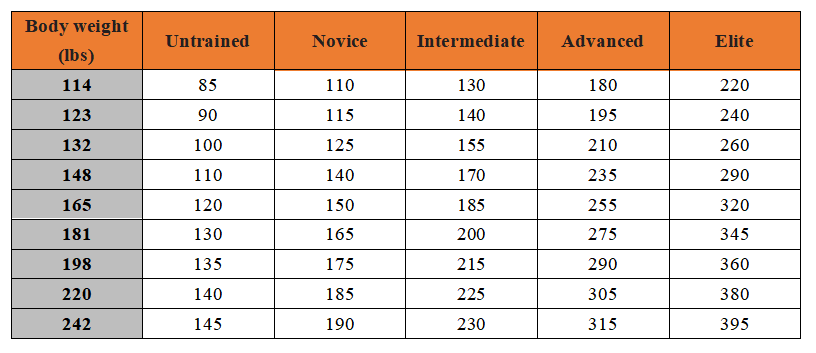
Chart II. Bench Press Standards for Women
According to the chart, for a 198-pound man (close to the average American man’s weight) who hasn’t trained to bench press before, the standard is at 135 pounds. For the novice (has trained for several months), intermediate (has trained for several years), and advanced male lifters (has trained multiple years), the baseline is 175 pounds, 215 pounds, and 290 pounds respectively. For elite athletes (athletes that compete in strength sports), the standard is about 360 pounds, twice that of a novice lifter.
Women generally lift lighter compared with men. The average bench press standard for a 165-pound untrained woman (close to the average American woman’s weight) is 80 pounds and 95 pounds for a novice lifter. An intermediate woman lifter is estimated to lift 105 pounds, while the standards for advanced and elite athletes are 145 and 185 pounds accordingly.
Don’t get too bent out of shape if you fall a bit below these numbers. They’re all just generalities.
How to Use These Bench Press Standards in Your Training
- Don’t chase the elite column overnight—treat those numbers as a multi-year goal rather than a 3-month sprint.
- Pick the right column for your stage. For example, “untrained” means little to no lifting experience, “novice” usually means several months of consistent training, “intermediate” is typically 1–2 years of consistent 2–3x/week training, “advanced” is multiple years of dedicated training, and “elite” often refers to athletes who compete in strength sports.
- Set realistic short-term goals. For instance, if you’re a 198-pound beginner at 175 pounds, aim to reach the intermediate range of 215 pounds in the next 12 to 18 months with structured training.
- Link your goals to your programming. A simple progression pattern might include adding 5 pounds to the bar every 1–2 weeks, or increasing your working weight by a small percentage over each training block.
2. What Is the Average Bench Press by Age?
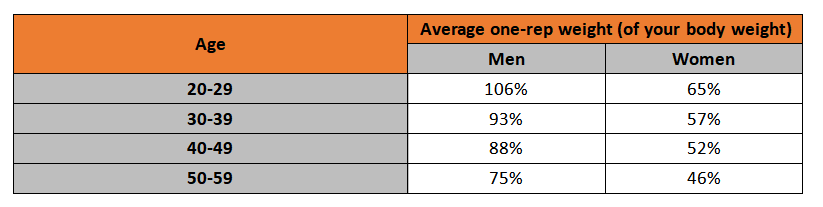
As we age, sarcopenia (natural muscle loss) affects our strength output. It is vital to adjust your expectations based on your decade of life. Research indicates that after age 30, muscle mass decreases by approximately 3–8% per decade, with strength declining even faster than mass, making age-adjusted standards essential[1].
Chart III. Average Bench Press by Age (from American College of Sports Medicine)
3. What Is My One-Rep Max?
In asking “How much should I be able to bench,” what you may really want to find out is your One Repetition Maximum (1RM), which is the maximal weight you can lift for only one repetition with proper form.
To work out your one-rep max, you may need to take the one-rep max test, which is often considered the gold standard for assessing the strength capacity of individuals in non-laboratory environments.
Now it’s time to take the test.
Chart IV. One-Rep Max Test
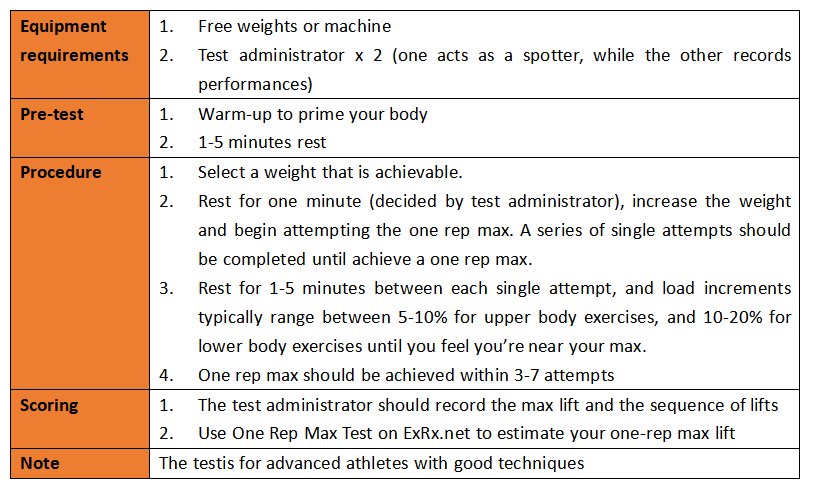
The test is regarded as a valid and reliable measure of performance. It can help you:
- Assess your strength capacity
- Test whether you have a strength imbalance
- Evaluate your progress in the weight training program
All of us dream of bench pressing twice our body weight. But Rome was not built in a day. It takes time and perseverance to increase bench press gradually. Here I would like to quote Stuart Phillips, a professor of kinesiology at McMaster University, and say that consistent practice with proper form and good nutrition, and working to fatigue generate the majority of results, no matter what the load.
Bear in mind that bench pressing is by no means something to make you feel frustrated or anxious, but something that empowers you to pursue upper-body strength and incredible body shape.
Many lifters, especially beginners and older adults, do not need to test a true 1RM. Studies validated that prediction equations based on submaximal repetitions (e.g., lifting a weight 3–5 times) provide an accurate estimate of 1RM with significantly less orthopaedic stress[2]. It is safer to find your "3-Rep Max" or "5-Rep Max" and use an online calculator to estimate your 1RM.
Step-by-Step Mini-Protocol
- Warm up with 5–10 minutes of light cardio.
- Perform 2–3 warm-up sets (empty bar, then 50–70% of your estimated max).
- Take 2–3 heavier attempts with full 3–5 minute rest, increasing weight gradually.
- Stop after you miss a lift or complete one solid rep with good form.
Direct one-rep max testing is demanding on your joints and nervous system and isn’t necessary for everyone. Many lifters, especially beginners and older adults, can use a submaximal test or formula instead.
Checklist for Safety When Doing the Bench Press
- Before you try to lift heavy weights, always warm up with 5 to 10 minutes of light cardio and 2 to 3 lighter bench sets.
- Your feet should be flat, your shoulder blades should be pulled back, and you should control the path of the bar. Don't let it bounce off your chest.
- When you lift close to your max, have someone watch you or set up safety bars in a power rack.
- Stop immediately if you feel sharp pain in your shoulder, elbow, or wrist.
- If you have heart, joint, or other medical conditions, talk to your doctor before testing a max.
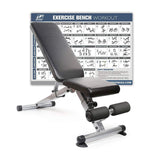
Want to get more information about RitFit sports? To enjoy bench pressing, you don’t want to miss the RitFit@ fitness gears, your perfect partners for weight bench exercises!
 |
 |
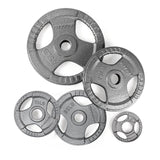 |
| RitFit Adjustable Bench | RitFit Olympic Barbell Bar | RitFit Weight Plates |
References
- Volpi E, Nazemi R, Fujita S. Muscle tissue changes with aging. Curr Opin Clin Nutr Metab Care. 2004;7(4):405-410. doi:10.1097/01.mco.0000134362.76653.b2
- Whisenant MJ, Panton LB, East WB, Broeder CE. Validation of submaximal prediction equations for the 1 repetition maximum bench press test on a group of collegiate football players. J Strength Cond Res. 2003;17(2):221-227. doi:10.1519/1533-4287(2003)017<0221:vospef>2.0.co;2