Most people forget that a leg press machine already has weight on it before a single plate goes on. That moving sled or carriage is part of the resistance, and it changes machine to machine.
This guide breaks down the empty starting weight by machine type, explains why the 45 degree angle changes what you feel, and shows you exactly how to find your own machine's number.
Quick Answer
A leg press machine already has weight on it before you load plates, because the moving sled or carriage is part of the resistance. On most plate loaded 45 degree machines the empty sled weighs roughly 75 to 125 pounds, while seated and stack style presses start lighter and differ by model.
Key Takeaways
- The sled counts: The moving carriage on a leg press is part of the resistance you push, so it adds weight before any plates.
- Type decides the number: A 45 degree sled often weighs 75 to 125 pounds, while seated and stack machines start lighter.
- Angle reduces the feel: On a 45 degree press only part of the total load reaches your legs, so the number overstates effort.
- Find your own figure: Search the brand and model number to get the exact sled weight from the manufacturer specs.
- Stay consistent: Log your load the same way every session so progress stays meaningful across machines.
Does Your Leg Press Already Have Weight On It?
Yes, your leg press almost always has weight on it before you add a single plate. The sled or carriage you push is itself part of the resistance, so you are moving it on every rep even when the machine looks empty.
- Plate loaded machines: The sled holds the plates and slides on rails, so its own mass adds to whatever you load.
- Stack and lever machines: The moving seat or arm still carries a baseline load even at the lowest pin setting.
One peer reviewed study determined total leg press load as the weight of the loaded plates plus the weight of the sled on a plate loaded hip sled machine, confirming the carriage is real resistance you cannot ignore.[1] If you want a machine with a known, fixed starting point, browse the RitFit leg press machine collection.
How Much Does an Empty Leg Press Weigh By Machine Type?
An empty leg press weighs anywhere from roughly 45 to 125 pounds, and the exact figure depends entirely on the machine type. One equipment guide reports that most sleds fall in that range, and the number is rarely printed on the machine itself.
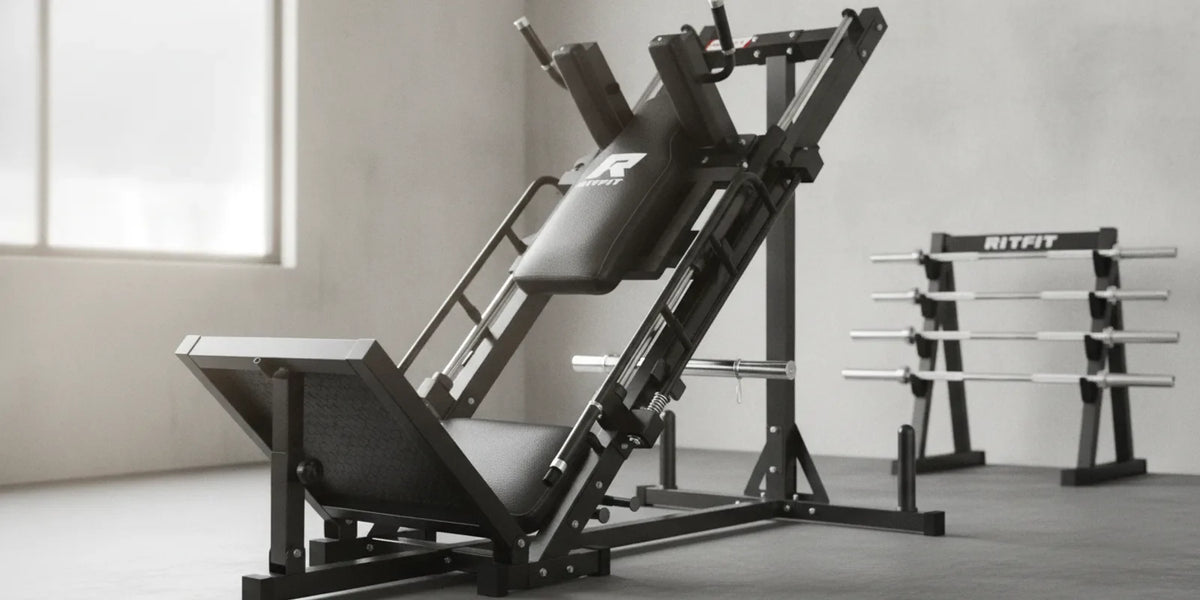
45 Degree Angled Sled Leg Press
The 45 degree sled press is the most common gym version, and its empty sled usually weighs around 75 to 125 pounds. One equipment guide notes that common commercial models from large manufacturers often sit near 100 to 125 pounds, so you should verify the exact figure for your specific brand.
- Why it is heavy: The carriage is built strong to hold many plates safely, so the structure itself adds significant load. A plate loaded model like the RitFit 3-in-1 Leg Press and Hack Squat Machine lists its sled details so you start from a known figure.
- A documented example: One strength and conditioning program for older females used an inclined leg press with a starting weight under 60 pounds, lowering the sled to a point participants could still return before adding weight.[2]
Horizontal Seated Leg Press, Plate Loaded vs Weight Stack
A horizontal seated leg press starts lighter than a 45 degree sled, especially on weight stack models where the minimum pin setting defines the baseline. A seated leg press study calculated effective load by adding the moving seat weight and external stacks to body weight, confirming the seat is counted as part of the resistance even on a stack style machine.[3]
- Plate loaded seated: A moving carriage adds a modest baseline, lighter than a 45 degree sled but still real.
- Weight stack seated: The lowest selectable plate sets a defined minimum, often a clear printed number on the stack.
Vertical and Cable Leg Press
Vertical and cable leg presses move load straight up or through a pulley, so the starting weight is usually the lightest of the common types. The platform or cable carriage adds a small baseline, but you fight gravity more directly than on an angled track.
- Vertical press: You push the load nearly straight up, so almost the full posted weight reaches your legs.
- Cable or selectorized: The stack minimum is the starting point, easy to read and adjust. Compare options in the broader RitFit leg machines range.
Why Does the 45 Degree Angle Change What You Actually Lift?
The 45 degree angle changes what you actually lift because the sled travels along an inclined track rather than straight up. As a result, only part of the combined sled and plate weight acts directly against your legs.
- The working estimate: One guide suggests roughly 70 percent of the total load reaches you on a 45 degree press, used as a rough rule rather than an exact constant.
- A quick illustration: If the sled is around 100 pounds and you add around 200 pounds of plates, the total is around 300 pounds, but the effective resistance feels closer to around 210 pounds.
This is why two lifters quoting the same plate number can be doing very different work depending on machine angle and sled weight. The video below walks through correct 45 degree leg press setup so the angle works for you, not against you.
How Do You Measure Your Machine's Starting Weight?
You measure your machine's starting weight by identifying the model and reading its official spec, since the sled weight is rarely posted on the frame. A few minutes of checking gives you a number you can trust for every future session.
- Step 1, find the model: Read the brand name and model number printed on the frame or near the seat.
- Step 2, check the spec: Search that exact model online and open the manufacturer specs, which usually list the sled or carriage weight.
- Step 3, ask if needed: If nothing is published, ask gym staff or compare the unloaded feel against a known 45 pound barbell as a rough reference.
- Step 4, record it: Write the sled weight in your training log so every entry counts the same baseline.
Which Machine Gives a Known Starting Weight?
A machine with a published sled weight gives you the most reliable starting point, which matters most for tracking progress over time. Plate loaded home machines with clear specs make this easy.
- Documented sled weight: Choose a model whose manufacturer lists the carriage weight, like the RitFit Gazelle Pro Leg Press and Hack Squat.
- Consistent home use: A RitFit Gazelle Leg Press for home gyms lets you train on the same baseline daily.
- Stack readability: A selectorized stack shows the exact starting plate, removing guesswork entirely.
What Are the Common Mistakes When Counting Leg Press Weight?
The most common mistake is forgetting to count the sled weight, which makes your logged total lower than the real load. Several smaller errors also distort how you compare numbers between sessions and lifters.
- Ignoring the sled: Logging only plates undercounts the true load on plate loaded machines.
- Assuming all machines match: Sled weights vary widely, so the same plate stack means different work on different machines.
- Skipping the angle factor: Treating a 45 degree number as straight vertical load overstates effective resistance.
- Comparing across machine types: A 500 pound horizontal number is not the same as a 500 pound 45 degree number.
If you want context on how machines differ in feel and load, read our comparison of leg press vs Smith machine for a deeper look.
When Should You Stop Loading the Sled?
You should stop loading the sled the moment your form breaks down or you cannot control the descent, regardless of the number on the machine. Safe loading protects your knees and lower back far more than a bigger total.
- Lower back lifts off: Stop adding weight if your hips or lower back leave the pad at the bottom.
- Knees cave inward: Reduce the load if your knees collapse toward each other under tension.
- You cannot control the lowering phase: If the sled drops fast instead of moving under control, the weight is too high.
- Safety stops not set: Always set the catches before adding weight so the sled cannot trap you.
For most people, building from a manageable load with full range of motion beats chasing a heavy number with partial reps. New lifters can pair the press with accessory work from the RitFit Gazelle Pro Leg Press Set for balanced progress.
"Start with a weight you can handle and do challenging longer sets with a complete range of motion."
Jeff Cavaliere, MSPT, CSCS, Athlean-X, Athlean-X
FAQs About Leg Press Starting Weight
Does a leg press machine have weight on it before I add plates?
Yes, almost always. The sled or carriage you push is itself part of the resistance, and on most plate loaded machines it weighs somewhere between 45 and 125 pounds. Weight stack and some lever machines start lighter, but the moving part still adds load before you touch a single plate.
How much does an empty 45 degree leg press sled weigh?
Most 45 degree sleds fall between roughly 75 and 125 pounds, with common commercial models from large manufacturers often sitting around 100 to 125 pounds. The exact figure is rarely printed on the machine, so you should verify it using the brand name and model number in the official product specs.
Why does a 45 degree leg press feel lighter than the total weight loaded?
Because the sled travels along an inclined track, only part of the combined sled and plate weight acts directly against your legs. A common working estimate is that about 70 percent of the total load reaches you, so 300 pounds loaded feels closer to roughly 210 pounds of effective resistance.
How do I find the exact starting weight of my leg press?
Check the brand name and model number printed on the frame, then search that model online and open the manufacturer specs, which usually list the sled or carriage weight. If nothing is published, ask gym staff or compare the loaded versus unloaded feel against a barbell of known weight as a rough reference.
Should I count the sled weight in my logged total?
For consistency it helps, but most lifters simply log the plates they add and keep using the same machine. The key is to be consistent, since the starting weight differs between machines. If you switch machines or compare with others, note the sled weight so your numbers stay meaningful over time.
Conclusion
A leg press machine already carries weight before any plates, and how much depends on the machine type, with 45 degree sleds often near 75 to 125 pounds. The angle also means the posted number overstates what your legs truly feel.
Find your machine's sled weight, log it consistently, and stop loading once form slips. For buyers, see our guide to the best home leg press machine for women to start with a known baseline.
Disclaimer
This article is for general educational purposes and does not replace professional fitness or medical guidance. Consult a qualified trainer or healthcare provider before starting or changing a resistance training program.
Save on your next RitFit order
Tap the button to copy your code, then paste it at checkout.
References
1. Effects of Different Types of Lower Body Resistance Exercise on Upper-body Strength in Men and Women, with Special Reference to Anabolic Hormones. Int J Exerc Sci. 2021;14(3):1052-1069. https://pmc.ncbi.nlm.nih.gov/articles/PMC8439705/
2. Bray NW, Jakobi JM, et al. Practical Implications for Strength and Conditioning of Older Pre-Frail Females. J Frailty Aging. 2020;9(2):118-121. https://pmc.ncbi.nlm.nih.gov/articles/PMC12275756/
3. Migliaccio GM, Dello Iacono A, Ardigo LP, et al. Leg Press vs. Smith Machine: Quadriceps Activation and Overall Perceived Effort Profiles. Front Physiol. 2018;9:1481. https://pmc.ncbi.nlm.nih.gov/articles/PMC6206431/