








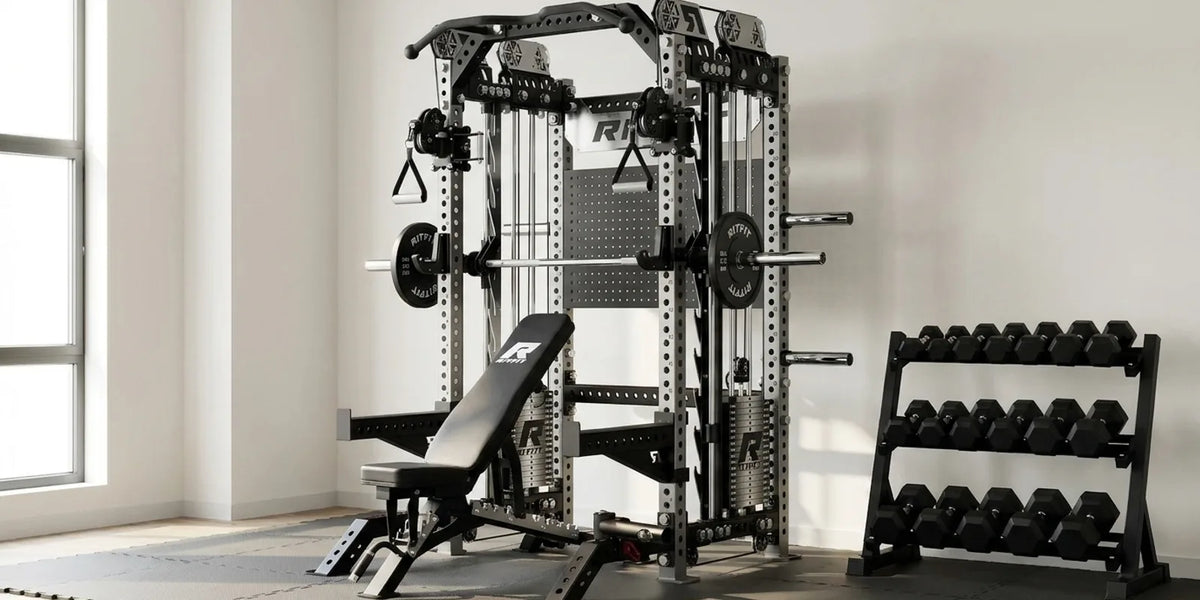
Knowing how to choose a Smith machine means judging ten specific specs instead of one headline number. Frame steel, bearing quality, and pulley material predict ownership satisfaction far better than a big weight rating on a listing.
This 10-point buying checklist walks each spec, ranks the five that matter most, and matches RitFit models to budgets, rooms, and training goals. Measure your ceiling before you price anything.
Quick Answer: The 10 specs that decide how to choose a Smith machine are upright size, steel gauge, linear bearings, bar path, starting bar weight, weight capacity, safety hook spacing, cable ratio, resistance source, and pulley material. Check frame quality and ceiling fit before price, because those two decide whether the machine lasts and fits your room.
Key Takeaways
- Frame first: upright size and steel gauge decide stability and attachment compatibility long before price does.
- Bearings and bar path: linear bearings keep the guide system smooth, and stability demand is a training variable rather than a defect.
- Cable system standards: a 2 to 1 ratio suits versatility, a 1 to 1 ratio suits heavy pulls, and machined aluminum pulleys with sealed bearings are the only pulley spec worth accepting.
- Fit before purchase: RitFit frames span 20.9 to 22.8 square foot footprints and 84 to 86.14 inch heights, so ceiling clearance and anchoring shape the shortlist.
- Value inside the line: compare spec-per-dollar from the 1600 lb M1 PRO to the 2500 lb M3 PRO instead of chasing a headline rating.
Why Do Smith Machine Specs Matter More Than the Price Tag?
Specs matter more than price because frame, bearing, and cable quality decide how a Smith machine ages. A headline weight rating describes a manufacturer limit under stated test conditions, never a recommended training load.
The guided bar itself is a legitimate training tool rather than a compromise. In one study of ten highly trained male sprinters, loaded squat jump height was similar between Smith machine and free-weight execution across loads from 40 to 120 percent of body mass.[1]
- Headline ratings mislead: capacity figures describe equipment limits under stated test conditions, not what you should load for working sets.
- Frame quality compounds: thicker uprights and lower-gauge steel keep the frame tight as years of squats, presses, and pulldowns add up.
- Cable hardware shows age first: pulleys and bearings, not the main frame, are where an underspecified machine starts to feel rough.
Every model in the RitFit Smith Machine collection publishes its frame, cable, and footprint specs, so you can check each number in this guide against the product page before you buy.
10 Specs That Decide Whether a Smith Machine Is Worth Buying
Ten specs decide a Smith machine purchase, and each one protects you from a specific expensive mistake. Work through them in order, from the frame outward to the cable station.
1. Upright Size: 2x2 vs 2.36 vs 3x3 Inches
Upright size sets the ceiling for frame stiffness and attachment compatibility. When you squat near your max in a garage gym, bigger steel holds its tolerances at the top of the rep.
- 2x2 inches: the RitFit M1 Smith machine format, a value build aimed at first serious home gyms.
- 2.36 x 2.36 inches: the RitFit M2 format, a middle path for modular growth and optional 3D movement.
- 3x3 inches: the RitFit M3 PRO Smith machine format, the stiffest setup for a permanent heavy station.
2. Steel Gauge: 11-Gauge vs 12 and 14-Gauge Steel
Steel gauge describes sheet thickness, and a lower number means thicker steel. If you press and squat heavy, 11-gauge steel stays planted where lighter gauge frames start to flex.
- 11-gauge: the M3 PRO frame uses 11-gauge Q235 steel and carries a published 2500 lb rating.
- 14-gauge: the M1 PRO and M2 frames balance cost and capacity with published 1600 lb and 2000 lb ratings.
- Ratings caveat: each rating is a manufacturer limit under stated test conditions, never a recommended training load.
3. Linear Bearings and the Bar Path
Linear bearings let the bar glide along the guide rods instead of grinding, and the bar path sets how much balance work each rep demands. Stability demand is a training variable rather than a defect, because a randomized trial in 59 men found 10RM loads increased 21.8 to 27.3 percent across Smith machine, free-weight, and unstable-surface training after a 7-week program with a familiarization phase.[2]
- Fixed vertical path: the M1 PRO and M3 PRO use the classic guided format for controlled squats, presses, and shrugs.
- 3D path option: M2 versions can add controlled horizontal travel for a closer-to-free-weight feel.
- Feel test: a smooth bar at the top hole with no rattle tells you the bearings and rods are matched.
4. Smith Bar Starting Weight
The starting bar weight is the load the empty bar presses into your hands before a single plate goes on. Counterbalance systems offset that weight, which protects beginners and high-repetition overhead work.
- Beginners: a lighter effective starting load keeps early sessions about form, not fighting the bar.
- Experienced lifters: know the bare bar number so plate math stays honest on pressing days.
5. Weight Capacity and Frame Ratings
Weight capacity frames the machine's ceiling, but it reads as a limit, not a goal. Match the frame rating to your long-term loads, then anchor the machine so the rating describes steel instead of a tipping risk.
- Across the line: published ratings run from 1600 lb on the M1 PRO through 2000 lb on the M2 to 2500 lb on the M3 PRO.
- Read the wording: manufacturer ratings describe equipment limits under stated test conditions, not recommended training loads.
- Anchor it: bolt the frame to a solid floor before your first heavy session.
6. Safety Hook Positions and Spacing
Safety hooks are the system that catches a failed rep, and their spacing decides how precisely you can set that catch. Closer spacing options mean a missed squat lands on steel a few inches lower instead of forcing a deeper fail.
- Position counts: the M1 PRO lists 11 Smith positions, the M2 lists 10 or 11 depending on version, and the M3 PRO lists 10.
- Set before you lift: place hooks just below your bottom squat depth and at chest level for bench.
7. Cable Ratio: 2 to 1 vs 1 to 1
The cable ratio sets how much resistance you feel at the handle and how far the cable travels. A 2 to 1 ratio halves felt resistance and doubles travel, while a 1 to 1 ratio delivers the true loaded weight.
- 2 to 1 for versatility: the M1 PRO, M2, and M3 PRO cable stations all run 2 to 1 for pushdowns, flyes, and high-repetition work.
- 1 to 1 for heavy pulls: the RitFit BPC06 with 260 lb weight stacks delivers true weight for heavy lat pulldowns and rows.
- Learn the math: the what does pulley ratio mean guide walks the full calculation.
8. Plate-Loaded vs Weight Stack
Plate-loaded stations cost less upfront and use the Olympic plates you already own, while selectorized stacks trade a pin pull for speed and independent sides. The honest tradeoff is effort per weight change against budget and shared use.
- Plate loaded start: the M1 PRO and M2 default to plates, with optional 264 lb and 286 lb stack systems available later.
- Stacks built in: the M3 PRO ships with 180 lb per side selectorized stacks, and the BPC06 ships with dual 260 lb stacks.
- Deeper comparison: the Smith machines with weight stacks guide breaks down both routes.
9. Pulley Material and Cable Adjustment System
Treat plastic and nylon pulleys as a disqualifying spec, and require machined aluminum pulleys with sealed bearings. Plastic and nylon are light-to-moderate-load components, and they sit below the loads a Smith machine cable system actually sees in squats, rows, and pulldowns, so aluminum is the honest long-term requirement.
- Sealed bearings: they keep pulleys tracking straight and quiet through daily cable work.
- Cable positions: count the adjustment options, 15 on the M1 PRO, 16 on the M2, and 29 on the M3 PRO, because stations only help if they reach your angles.
10. Footprint, Machine Height, and Integrated Stations
The footprint and the working height decide whether the machine fits your room before any other spec matters. Integrated cable, pulldown, and dip stations replace separate machines inside the same floor area.
- Floor space: the M1 PRO needs 20.9 square feet, the M2 needs 22.8, and the M3 PRO needs 21.5.
- Frame heights: the three frames stand 85.3, 86.14, and 84 inches tall respectively.
- Station count: more integrated stations mean fewer separate purchases later.
See the M2 3D Smith Machine in a full third-party review to watch the bar path, hooks, and cable stations working together.
Which Five Specs Matter Most When You Shortlist Machines?
The five specs that matter most are frame steel, linear bearings, safety hook spacing, cable ratio, and pulley material. Together they predict whether a machine stays tight, smooth, and safe as your loads climb.
- 1. Upright size and steel gauge: the frame is the foundation every other spec bolts onto, so it leads every shortlist.
- 2. Linear bearings and bar path: matched bearings and rods protect rep quality and keep the guide system serviceable.
- 3. Safety hook spacing: closer spacing means a failed rep lands on steel instead of on you.
- 4. Cable ratio: it decides how every attachment on the station will feel.
- 5. Pulley material and bearings: machined aluminum with sealed bearings is the cable system's lifespan spec.
Price and headline ratings enter the comparison only after these five pass, because no discount fixes a frame or a cable system that is underspecified for your training.
How Do You Match a Smith Machine to Your Room and Ceiling Height?
A Smith machine fits your room when listed machine height plus lockout clearance stays under your ceiling. The RitFit M1 PRO stands 85.3 inches tall, the M2 stands 86.14 inches, and the M3 PRO stands 84 inches.
- Overhead clearance: leave at least 12 inches above your standing overhead press lockout.
- Working height: plates and pulley housings can sit higher than the uprights, so measure the loaded machine, not the bare frame.
- Footprint: confirm 20.9 square feet for the M1 PRO, 22.8 for the M2, and 21.5 for the M3 PRO before you order.
- Anchoring: bolt the frame to a solid floor so tipping never becomes your failure mode.
For tight spare rooms and shared spaces, the compact RitFit PSR05 2.0 Smith machine pairs the guided frame with a lat pulldown in a smaller layout.
Which RitFit Smith Machine Fits Your Training and Budget?
The right RitFit Smith machine matches its frame, resistance source, and footprint to your loads, room, and plans. The matrix below compares the three core frames, and the routes after it cover stacks and packages.
| Model | Frame and rating | Footprint and height | Best fit |
|---|---|---|---|
| RitFit M1 PRO | 2x2 inch 14-gauge steel, 1600 lb rating, 11 Smith positions, 2 to 1 cable ratio with 15 positions | 20.9 sq ft, 85.3 in tall | Value buyers and first serious home gyms |
| RitFit M2 | 2.36 x 2.36 inch 14-gauge steel, 2000 lb rating, 10 or 11 Smith positions, 2 to 1 cable ratio with 16 positions | 22.8 sq ft, 86.14 in tall | Buyers who want modular growth or a 3D bar path |
| RitFit M3 PRO | 3x3 inch 11-gauge Q235 steel, 2500 lb rating, 10 Smith positions, 2 to 1 cable ratio with 29 positions, 180 lb per side stacks | 21.5 sq ft, 84 in tall | Frequent lifters building a permanent premium station |
Manufacturer ratings describe equipment limits under stated test conditions, not recommended training loads. Package contents and optional attachments can change, so confirm current specs on each linked product page before checkout.
- Weight stack route: the BPC06 pairs its dual 260 lb stacks with a 1 to 1 ratio for shared gyms that change resistance constantly.
- Package route: the RitFit M1 home gym package bundles plates and a bench with the frame.
- Buffalo route: the RitFit Buffalo Smith machine package adds a weight stack for a full training week on one frame.
- Model deep dive: the M3 PRO vs M2 vs M1 PRO full comparison covers every spec difference in detail.
Choose the M1 PRO if you want the most affordable entry into all-in-one training, the M2 if you want modular growth or a 3D bar path, and the M3 PRO if a permanent heavy station justifies 11-gauge steel. The BPC06 is best for shared home gyms that live on the pin stack, the Buffalo package suits a one-frame training week, and the PSR05 2.0 fits compact rooms where floor space wins.
For muscle-building goals, the guided station is a serious platform rather than a shortcut. A study in trained men reported comparable quadriceps activation between Smith machine squat and leg press, with predictive equations for matching perceived effort.[3]
Watch one owner's long-term fitness journey with a RitFit M1 Smith machine to see how a value frame holds up in a real home gym.
"For $1,800, this machine delivers a combination of build quality, stability, and versatility that is rare at this price. The BUFFALO is not a machine that excels at one thing. It is a platform that lets you program an entire training week without ever stepping off the frame."
BJ Nelson, Head of Field Testing, The Iron Clinic, RitFit Buffalo Smith Machine Review
"Solid all in one rack. The pulleys and smith machine are so smooth. Ample room to store attachments and barbells. Time consuming assembly but easy"
Khristian P. Verified Buyer, RitFit M1 PRO Multi-Functional Smith Machine with Cable Crossover System and Squat Rack for Home Gym
Is a Smith Machine Worth the Money Compared With a Power Rack?
A Smith machine beats a power rack for solo training, guided safety, and cable work in one footprint. A rack wins for barbell purists who already own safety equipment and never touch a cable station.
- More stations per square foot: a multifunctional Smith machine combines the guided bar, cable crossover, and pulldown in the floor area one rack would use.
- Safety when alone: the guided bar and safety hooks catch failed reps without a spotter, which is the core value for home lifters.
- Honest cost math: price a rack plus a separate cable machine and bench, then compare that total with one all-in-one frame.
"really love this power cage with smith machine attachment. The installation is straightforward actually it is part of the fun. The bar, the grip are solid, smith machine part moves very smooth. The cage is pretty sturdy for the price paid. Highly recommend for home gym!"
Xin F. Verified Buyer, RitFit 1000lbs Power Cage
What Does a Smith Machine Cost to Upgrade and Maintain Long Term?
Long-term Smith machine costs fall into three groups: resistance upgrades, maintenance parts, and floor setup. Plate-loaded frames start cheaper, but stack upgrades and accessories move the total over a multi-year build.
- Resistance upgrades: optional stacks add selectorized convenience later, with 264 lb M1 and 286 lb M2 stack systems available.
- Plates and bench: plate-loaded frames need Olympic plates and an adjustable bench, so count them as part of the machine's price.
- Cable care: inspect cables and pulleys periodically and keep spare hardware on hand, because the cable station is the part that moves most.
- Flooring and anchoring: quality flooring and anchor bolts protect both the frame and the floor underneath it.
What Are the Most Common Smith Machine Buying Mistakes?
The most common Smith machine buying mistakes are skipping the ceiling check, trusting a headline rating, and accepting plastic pulleys. Each one is cheap to avoid during the spec review and expensive to fix after delivery.
- Buying for the wrong ceiling: measure the loaded working height with plates and pulley housings before ordering.
- Chasing the rating: frame capacity is a manufacturer limit under stated test conditions, not a training target.
- Accepting plastic or nylon pulleys: treat machined aluminum with sealed bearings as a requirement, not an upgrade.
- Skipping the anchor: an unanchored tall frame turns a heavy squat into a tipping risk.
- Ignoring the cable ratio: a 2 to 1 station and a 1 to 1 station feel different, and buyers who skip this math often re-buy.
- Forgetting the bar's starting weight: a bare bar that is too heavy changes pressing and overhead work from day one.
FAQs About Choosing a Smith Machine
What is the most important spec on a Smith machine?
The frame is the foundation, so start with upright size and steel gauge. A machine built from 3x3 inch 11-gauge steel, like the RitFit M3 PRO with its 2500 pound rating, handles heavier loads and more attachments than 14-gauge alternatives. For most home gyms, a 2x2 or 2.36 inch frame with a 1600 to 2000 pound rating is still plenty.
Is a 2 to 1 or 1 to 1 cable ratio better for a Smith machine?
A 2 to 1 cable ratio halves the resistance you feel at the handle, which makes it smoother for triceps pushdowns, flyes, and high-repetition work while doubling cable travel. A 1 to 1 ratio delivers the true loaded weight, which suits heavy lat pulldowns and rows. Most all-in-one Smith machines, including the RitFit M1 PRO, M2, and M3 PRO, use a 2 to 1 ratio for versatility.
How much ceiling height do I need for a Smith machine?
Measure your ceiling and compare it with the listed machine height, then add clearance for the tallest movement you plan to perform. The RitFit M1 PRO stands 85.3 inches tall, the M2 86.14 inches, and the M3 PRO 84 inches. Allow at least 12 inches above your standing overhead press lockout, and remember plates and pulley housings can sit higher than the uprights.
Are plastic pulleys on a Smith machine a dealbreaker?
Yes. Treat them as a disqualifying spec. Plastic and nylon pulleys are light-to-moderate-load components, and they sit below the loads a Smith machine cable system actually sees in squats, rows, and pulldowns. Machined aluminum pulleys with sealed bearings run quieter, track straighter, and outlast plastic under daily use, so requiring them protects your long-term investment.
Should I choose plate loaded or a weight stack?
Plate loaded systems cost less upfront and use plates you already own, but every weight change means pinching plates and collars. Dual weight stacks, like the 260 pound stacks on the RitFit BPC06 or the 180 pound per side stacks on the M3 PRO, let you switch resistance with a pin in seconds and train both sides independently. Choose stacks for convenience and shared home gyms.
Is a Smith machine good for beginners?
Yes. The guided bar path removes the balance demand of free weights and the safety hooks catch a failed rep without a spotter. One study of trained sprinters reported similar loaded squat jump performance between Smith machine and free weight execution, and coaches value the fixed path for pushing close to failure safely. Start with a light starting bar weight and focus on setup height before each set.
Conclusion
Choosing a Smith machine is a spec-by-spec decision, and the ten specs above turn a confusing listing into a working checklist. Judge the frame first, the cable hardware second, and the price last, because steel, bearings, and pulleys decide how the machine ages in your gym.
Measure your ceiling, shortlist by frame, and compare models inside the RitFit line before you spend. Then check current offers in the RitFit discount guide so your spec-per-dollar math gets even better.
Disclaimer
This guide is for general fitness information only and does not provide medical, training, or professional advice. Consult a qualified professional before starting any new exercise program or purchasing equipment, and always follow the manufacturer's instructions and published limits.
References
1. Loturco I, McGuigan MR, Freitas TT. Squat and countermovement jump performance across a range of loads: a comparison between Smith machine and free weight execution modes in elite sprinters. Biology of Sport. 2022. PMCID: PMC9536377
2. Saeterbakken AH, Olsen A, Behm DG. The short- and long-term effects of resistance training with different stability requirements. PLoS ONE. 2019. PMCID: PMC6443166
3. Migliaccio GM, Dello Iacono A, Ardigò LP. Leg Press vs. Smith Machine: Quadriceps Activation and Overall Perceived Effort Profiles. Frontiers in Physiology. 2018. PMCID: PMC6206431





