








Important disclaimer: This article is for general educational purposes only and is not medical advice. If you have shoulder, neck, back, elbow, or wrist pain, a recent injury or surgery, numbness or tingling, unexplained weakness, or dizziness, consult a qualified clinician before starting. Stop any exercise that causes sharp pain.
The front squat is one of the most effective squat variations for building quads, improving posture, and training strong upright mechanics without loading the spine as heavily as many back squat styles. It works best when you stay honest with the weight, keep your elbows high, and treat position as the priority from the first rep to the last.
Key Takeaways
- The front squat emphasizes the quads, upper back, and core more than many lifters expect.
- A strong front rack and high elbows matter more than chasing heavier weight.
- Common front squat problems usually come from limited ankle mobility, weak bracing, or poor upper-back position.
- Goblet squats and double dumbbell front squats are excellent ways to learn the pattern before loading a barbell heavily.
- Most lifters get better results from clean, controlled sets than from trying to match their back squat numbers.
What Is a Front Squat?
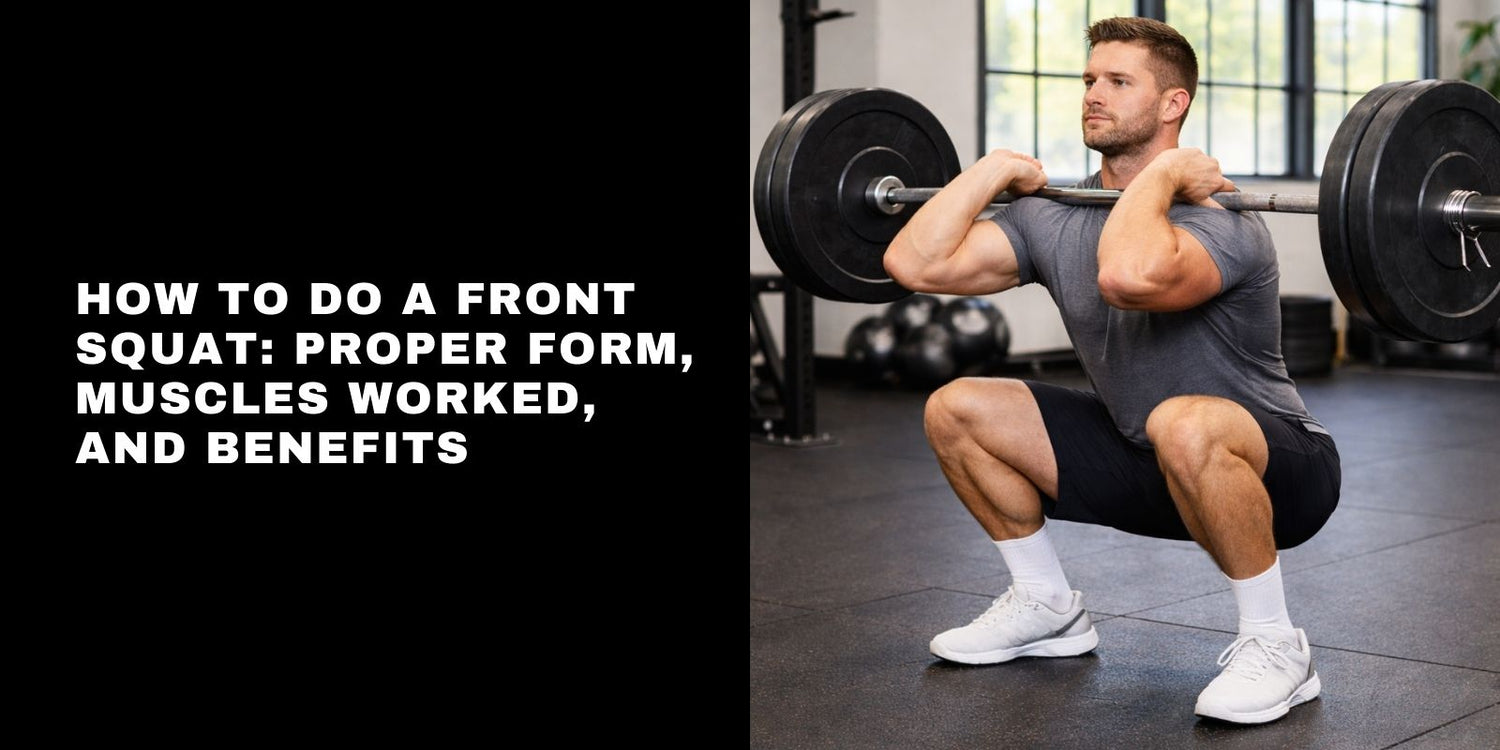
The front squat is a compound lower-body exercise where the barbell rests across the front deltoids instead of the upper back. This bar position keeps the load farther forward, so you must stay more upright to keep the bar balanced over the mid-foot.
That forward load is why the front squat is a staple in Olympic lifting and a common tool in CrossFit. It is also highly useful for general strength training because it builds the legs hard while teaching strong posture, bracing, and bar control.
While the classic barbell version uses a front rack position, the movement pattern can also be trained with a cross-arm grip, a goblet squat, or a double dumbbell front squat. These variations make the exercise more accessible when wrist mobility, equipment, or experience is limited.
Front Squat Benefits
Lower Body Strength and Hypertrophy
The front squat is one of the best squat variations for quad development because it keeps the torso more vertical and allows the knees to travel forward naturally. That combination increases the training demand on the quadriceps while still involving the glutes through the full squat pattern.
Many lifters also find that front squats create a strong training effect with less total load than back squats. That makes them useful for building leg size and strength without needing maximal bar weight to feel challenged.
Core and Postural Improvements
The front squat demands constant upper-back tension and strong abdominal bracing. If the torso collapses or the elbows drop, the bar drifts forward and the rep becomes unstable.
That makes the lift especially valuable for improving posture under load. Over time, better thoracic extension, stronger bracing, and improved body awareness can carry over to other squats, cleans, and everyday lifting mechanics.
Joint and Lower-Back Considerations
The front squat usually encourages a more upright torso than many back squat styles. For some lifters, that can reduce lower-back stress and make the movement feel more manageable when heavy back-loaded squats are not ideal.
It also limits ego loading because most people cannot front squat as much as they can back squat. In practice, that often creates a productive training effect with less total spinal loading.
Practical Training Advantages
The front squat is a practical lift for solo training because missed reps can usually be dumped forward safely when performed inside a rack with proper setup. It is also useful in home gyms because lighter loads can still produce a strong stimulus.
This combination of efficiency, safety, and carryover makes the movement a smart choice for many lifters. If your goal is stronger legs, better squat mechanics, and more honest training, the front squat deserves regular space in your program.
Muscles Worked in the Front Squat
The front squat is still a full-body compound exercise, but its muscle emphasis is different from the back squat.
Primary muscles: Quadriceps and gluteus maximus.
Secondary muscles: Adductors and hamstrings.
Stabilizers: Spinal erectors, traps, rhomboids, deep core muscles, rectus abdominis, and obliques.
The main training feel usually comes from the quads, upper back, and core. If your position stays solid, you will often feel the front squat challenge your trunk and posture almost as much as your legs.
How to Do a Front Squat: Step-by-Step Technique
Set Up the Bar
Set the bar in a rack around shoulder height so you can unrack it without standing on your toes or half-squatting it out. Step under the bar and let it rest across the front of your shoulders, not in your hands.
Build the Front Rack
Use a clean grip if your mobility allows it by placing your fingertips under the bar just outside shoulder width and driving your elbows forward and up. If that position is limited, use a cross-arm grip or lifting straps while still keeping the elbows high and the chest tall.
Unrack and Find Your Stance
Brace your core, stand up with the bar, and take one or two controlled steps back. Set your feet around shoulder width and turn your toes slightly out so you can squat to depth without losing balance.
Descend Under Control
Break at the knees and hips together and sit down on your heels. Keep your chest up, elbows high, and whole foot connected to the floor as you descend.
Aim for at least parallel, and go deeper if your mobility allows you to stay stable and upright. The bar should stay balanced over the middle of the foot throughout the rep.
Drive up strong.
Push through the midfoot and stand up while keeping the elbows lifted and the torso tall. Finish the rep by extending the knees and hips together without letting the chest collapse forward.
Front Squat Form Tips and Cues
Elbows Up
This is the most important front squat cue because elbow position controls bar position. When the elbows drop, the chest usually drops with them, and the rep starts to fall apart.
Chest Tall
Keep the chest tall from the unrack to the finish of every rep. This helps maintain a stable torso angle and keeps the bar from rolling forward.
Sit Between the Hips.
Think about dropping straight down rather than sitting far back. This cue usually helps lifters stay more upright and use the front squat the way it is intended.
Push the floor. Apart
Drive the knees out in line with the toes as you rise. This helps maintain balance, keep the hips active, and avoid collapsing inward under load.
Common Front Squat Mistakes and How to Fix Them
Elbows Dropping.
This is one of the most common front squat errors and one of the fastest ways to lose the lift. It usually happens because of limited front rack mobility, weak upper-back tension, or simply losing focus during the set.
Fix it by reducing the load, strengthening the upper back, and practicing a better rack position every session. Front squats improve quickly when you treat elbow position as non-negotiable.
Excessive Forward Lean
Too much forward lean usually shifts the lift away from the front squat pattern and turns it into a fight to save the bar. Poor ankle mobility, weak bracing, and trying to use too much weight are common causes.
Fix it by elevating the heels with weightlifting shoes if needed, bracing harder before each rep, and using a load you can control. If your torso angle breaks early, the weight is likely too heavy for your current position.
Heels Rising Off the Floor
When the heels lift, balance usually shifts forward and depth becomes unstable. Limited ankle dorsiflexion is often the main reason.
Fix it with ankle mobility work, a slightly adjusted stance, and weightlifting shoes if necessary. You should also slow the descent and make sure you are not rushing into the bottom position.
Knees Caving In
Knee valgus under load often comes from weak hip control, poor awareness, or a weight that exceeds what you can stabilize. It tends to show up most during the ascent.
Fix it by lowering the weight and actively driving the knees in line with the toes. Controlled reps and better glute engagement usually solve this faster than simply adding more load.
Mobility and Flexibility for Better Front Squats
Ankle Mobility
Good ankle mobility makes it easier to stay upright and reach depth without the heels rising. Wall dorsiflexion drills, calf work, and loaded squat holds can all help.
Thoracic Extension
A stiff upper back makes it harder to keep the chest lifted and elbows high. Foam rolling the thoracic spine and practicing front rack holds can improve this position over time.
Wrist Flexibility
Wrist discomfort is common when lifters force a clean grip before they have the mobility for it. Gradual front rack practice, wrist mobility drills, and temporary use of straps can make the transition smoother.
Front Squat Variations
Goblet Squat
The goblet squat is the best beginner-friendly front squat variation because it teaches an upright torso and strong bracing with less technical demand. It is an excellent entry point for learning depth, balance, and control.
Double Dumbbell or Kettlebell Front Squat
Holding two weights at the shoulders increases loading potential while keeping the same front-loaded pattern. This variation works especially well for home gym training or when a barbell is not available.
Zombie Front Squat
The zombie front squat teaches pure torso discipline because the arms cannot help secure the bar. If your position is correct, the bar stays on the shoulder shelf; if your chest drops, the rep immediately tells on you.
Front Squat vs. Back Squat
The biggest difference between the front squat and the back squat is where the load sits. A back squat places the bar on the upper back, which usually allows more forward lean, heavier loads, and greater contribution from the hips and posterior chain.
A front squat places the load on the front of the body, which demands a more upright torso and usually shifts more emphasis toward the quads, upper back, and core. Neither movement is better in every case, but they serve different priorities well.
Choose the back squat if your main goal is maximum loading and broad lower-body strength. Choose the front squat if your goals include quad development, upright squat mechanics, cleaner posture under load, and strong transfer to Olympic lifting patterns.
How to Program Front Squats
For Beginners
Start with a goblet squat or an empty bar and focus on movement quality first. Perform 2 to 3 sets of 8 to 10 reps and make every rep look the same before increasing the load.
For Intermediate and Advanced Lifters
Most lifters do well with front squats in lower rep ranges because upper-back fatigue and position loss often show up before true leg failure. Sets of 3 to 6 reps are usually excellent for strength and high-quality practice.
A simple starting point is 3 to 5 working sets. You can place front squats first in the session for strength or second after a heavier main lift for quad-focused accessory work.
Volume and Intensity
Do not judge your front squat by your back squat numbers. A front squat is usually much lighter, and that is normal.
For many lifters, the front squat falls around 80 to 85 percent of back squat capacity. The better rule is to increase load only when you can keep the elbows high, hit depth consistently, and stand up without the chest folding.
Safety, Equipment, and Practical Considerations
Weightlifting shoes can make front squats more comfortable if ankle mobility is limited, while flat shoes can work well for lifters with good natural mobility. A belt can also help on heavier sets by improving bracing, but it should support good technique rather than replace it.
Always perform front squats inside a rack with safety pins set appropriately or learn how to dump the bar forward under control. If wrist pain remains sharp or persistent, switch to a more manageable variation and address mobility before forcing the classic rack position.
Sample Front Squat Workouts
Leg Hypertrophy Session
Front Squat: 4 sets of 6 to 8 reps with a controlled descent and powerful ascent
Romanian Deadlift: 3 sets of 8 to 10 reps
Walking Lunge: 3 sets of 12 steps per leg
This session works well when the goal is quad growth with added posterior-chain support. Keep rest periods long enough to maintain clean front squat mechanics.
Strength and Power Focus
Front Squat: 5 sets of 3 reps with heavy but crisp loading
Box Jump: 4 sets of 3 reps
Plank: 3 sets of 45 seconds
This setup emphasizes force production and position under heavier loads. Treat every front squat rep as a technical strength rep, not a grind.
FAQs
Why do my wrists hurt during the front squat?
Your wrists hurt because you lack upper back and shoulder mobility. You can fix this by elevating your elbows to create a proper shelf on your shoulders. You should try using lifting straps or a cross arm grip until your flexibility improves. This takes the pressure off your hands entirely.
How to stop falling forward in the front squat?
You stop falling forward by keeping your chest tall and your elbows pointed up. Dropping your elbows causes your upper back to round and shifts the barbell forward. You must strengthen your core bracing and lower the weight to maintain an upright torso throughout the entire movement.
What muscles does the front squat work compared to the back squat?
The front squat targets your quadriceps and upper back much more than the back squat. The forward barbell position forces a vertical torso. This vertical posture reduces lower back stress while making your anterior core and leg muscles work harder to keep you perfectly balanced during the lift.
How much weight should I use for the front squat?
You should use roughly eighty percent of your maximum back squat weight. Most people cannot lift as heavily with this variation because upper back fatigue usually happens before leg failure. You must prioritize high elbows and a tall chest instead of simply adding more plates to the barbell.
Why do my heels lift off the floor during the front squat?
Your heels rise because you have limited ankle mobility. This restriction shifts your balance forward and ruins your squat depth. You can fix this issue by wearing weightlifting shoes with elevated heels. You should also stretch your calves and practice descending slowly to maintain proper foot contact.
Conclusion
The front squat is a highly effective lift for building stronger quads, a more resilient core, and better squat posture with less room for sloppy reps. Start lighter than your ego wants, keep the elbows up, and earn progress through clean positioning, and the front squat will become one of the most useful lower-body tools in your program.





