
Dragon flags on a weight bench are an advanced bodyweight core exercise that builds a rigid midsection through one long lever. This guide covers the exact grip and shoulder pivot, a three step path from knee raises to the full flag, and the bench setup that keeps every rep safe.
Dragon flags are demanding, so treat them as a skill to earn rather than a move to jump into. You will need a stable bench and solid reverse crunch control first, and everything below assumes flat bench training in a home gym.
Quick Answer: Dragon flags on a weight bench are done by gripping the bench behind your head, setting the upper back and shoulders as the pivot, and lowering the rigid body until it hovers over the pad. Build up from bent knee raises to single leg lowers before attempting the full flag.
Key Takeaways
- The Move: The dragon flag is an advanced bodyweight core exercise that keeps the body rigid from shoulders to toes over a bench.
- Setup: Grip the bench behind your head, pivot on the upper back and shoulders, and keep the bench heavy or braced so it cannot tip.
- Progression: Earn the bent knee raise first, then single leg lowers, then the full flag.
- Form Rule: The set ends at the first form break, such as sagging hips or an arched lower back.
- Bench Choice: A heavy bench with a wide rear base and rubber feet stays planted best during the long lever pull.

What the Dragon Flag Trains and Why It Feels So Hard
The dragon flag is an advanced bodyweight core exercise that trains the entire midsection while the body stays rigid from shoulders to toes. The rectus abdominis holds the torso in line, the obliques keep the hips from twisting, and the hip flexors help control the legs. Muscle activation shifts with body position, and a peer-reviewed EMG comparison found that prone hip extension exercises produced greater abdominal, oblique, and lumbar paraspinal activity than the crunch or bent knee sit-up.[1]
The move feels so hard because of the lever arm. With the legs extended, body weight acts far from the pivot at the shoulders, and the demand on the core climbs fast.
- Rectus abdominis: keeps the torso rigid while the legs travel through the arc.
- Obliques: hold the body in line so the hips do not twist mid rep.
- Hip flexors: help control the legs, especially in the extended position.
- Core stabilizers: lock the ribs and pelvis together around the pivot point.
Because the whole body works as one long lever, dragon flags belong to advanced core training. Build them in stages, and treat each clean rep as progress.
Why Do Dragon Flags on a Weight Bench?
A weight bench gives dragon flags a fixed grip behind your head and a padded pivot point for your shoulders, which is exactly what the move needs. The bench also lifts the body so the legs can travel through a full range of motion without touching the floor.
- Overhead grip anchor: the bench edge behind the head gives the hands something fixed to hold while the body hangs.
- Shoulder support: the pad takes the pivot of the movement right at the upper back.
- Room to move: the elevated platform lets the legs hover just over the pad at the bottom of each rep.
- One bench, many moves: the same setup serves presses, rows, and ab moves across a normal home gym week.
Before attempting dragon flags, build solid reverse crunch control and general core strength first. The move is optional by nature, so patience here pays off in cleaner reps later.
"They're good for everything from chest presses, dumbbell bench presses, incline bench supersets, skull crushers, glute bridges, incline rows to hit your back, ab moves, quad and leg moves like split squats, and more biceps moves than you can imagine."
Ebenezer Samuel, C.S.C.S. Fitness Director, Men's Health, The Best Weight Benches of 2026
"Very solid weight bench. Quick adjustments, quick to move with sturdy wheels. Adjustments to declines to seated presses in 10 seconds."
Richard S. Verified Buyer, RitFit 1300LB Adjustable Weight Bench BWB01
Choose a Bench That Stays Put
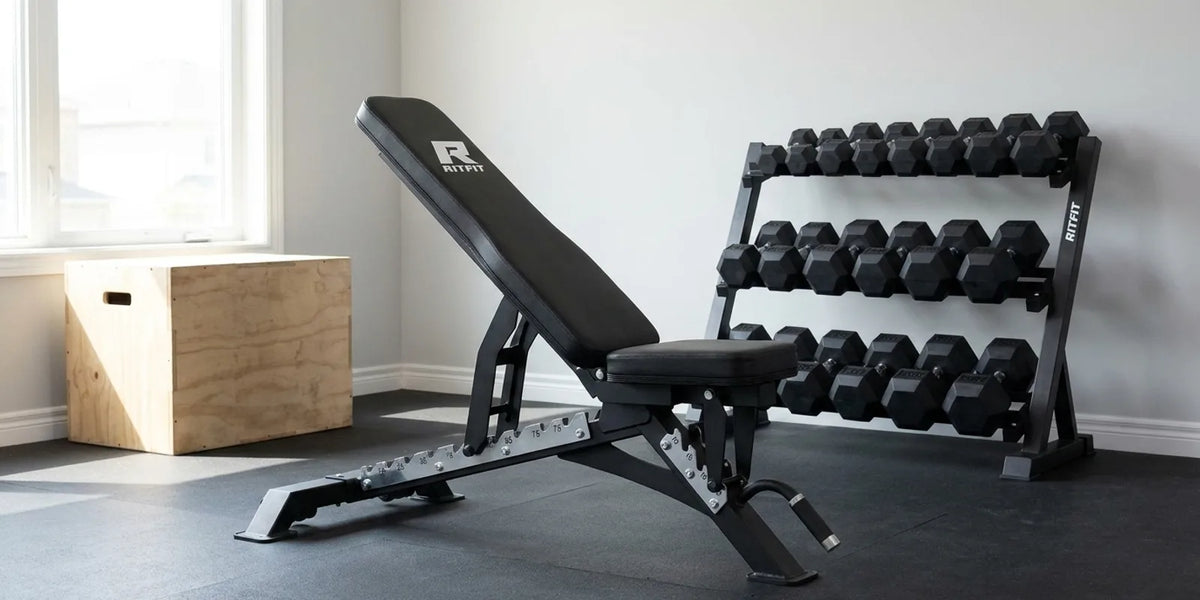
Dragon flags work best on a heavy, stable bench that will not shift when the body hangs off the end. Bench weight, frame construction, and the feet decide whether a platform stays planted through the long lever pull of the move.
- Bench weight: heavier benches stay put while the body hangs off the head end.
- Wide rear base and welded support: spread the pulling force right where the hands grip.
- Rubber feet: grip the floor instead of sliding during the lowering phase.
- Flat, firm pad: gives the shoulder pivot a consistent platform rep after rep.
Is the RitFit GATOR Adjustable Weight Bench Stable Enough for Dragon Flags?
The RitFit GATOR 1600LB Adjustable Weight Bench is built for heavy work, and the official spec sheet lists a 1600 lb total load capacity, a 396 lb rating for the headrest rear base, and 21 adjustment positions. Its 109.1 lb bench weight, 50 x 70 mm reinforced steel frame, welded support with a widened rear base, and anti-scratch rubber feet keep the bench planted while the body hangs off the end.
If you want a lighter bench for the same setup, the RitFit 1300LB Adjustable Weight Bench is a straightforward flat option. For color matched rooms, the same frame comes as the RitFit GATOR Pink 1600LB Adjustable Weight Bench.
Browse the weight benches collection when you are picking a platform, and use our weight bench guide for the full buying checklist.
"Wow! This is not my first weight bench, but I am confident it will be my last. The ease of use and ability to move around the cable machine from one exercise to the next is awesome. Regardless of the exercise I am performing I feel secure and stable. It is an awesome product."
Richard R. Verified Buyer, RitFit GATOR 1600LB Adjustable Weight Bench
Set Up the Bench for Dragon Flags
The bench setup for dragon flags starts with two things, a fixed grip on the edge behind your head and a pivot at the top of your shoulders. The bench must also be immobile before you start, because your whole body will hang off one end.
Set the Grip Point
Lie on the bench so the top of the shoulders sits near the end of the pad, then reach back and grip the sides of the bench next to your head. Lock the arms in that overhead position, because the grip is the anchor for the entire set.
Set Your Shoulder Pivot
Only the upper back and shoulders should contact the pad once the set starts. That contact point is the pivot of the movement, so keep it fixed from the first rep to the last.
Keep the Bench From Moving
The bench must be heavy enough to stay planted or braced against a wall before you attempt dragon flags. Push the bench firmly toward the wall and test the base once, because a bench that shifts under a hanging body turns a hard exercise into an unsafe one.
Perform the Dragon Flag Step by Step
One clean dragon flag repetition has four parts, a locked overhead grip, a rigid body, a controlled lowering, and a clean stop. Every rep starts and ends with the same grip and the same shoulder pivot.
- Step 1: Grip and set the pivot. Lie with the top of the shoulders at the end of the pad and grip the bench edges behind the head.
- Step 2: Drive the legs up. Contract the midsection and lift the legs and hips toward the ceiling in one reverse crunch motion. Keep the body rigid from shoulders to toes and point the toes to hold the line.
- Step 3: Lower under control. Slowly lower the body in a controlled eccentric until it hovers just over the bench. Nothing but the upper back and shoulders should touch the pad.
- Step 4: Stop at the first form break. Once the hips sag or the back arches, the set is over, because the working muscles have stopped doing the job.
Work in low rep ranges at first, since one clean rep beats five sloppy ones. Slow the lowering phase over time to keep the demand climbing.
Scale From Knee Raises to the Full Flag
Dragon flag progressions scale by leverage, moving from bent knee raises to single leg lowers and finally the full flag. Shortening the legs shortens the lever arm and drops the demand on the core until the strength catches up.
Start With Bent Knee Raises
Begin with the knees bent at about 90 degrees and the feet hanging to reduce the load. Lift the hips in one effort, hold for a second, and lower until the body hovers over the bench.
Move to Single Leg Lowers
Keep one leg bent while the other extends, then lower slowly and under control. Switch legs between reps so both sides learn the full arc before you combine them.
Earn the Full Flag
Extend both legs only when the single leg lowers feel clean and rigid. Add reps before you add speed, then slow the eccentric to keep the whole set honest.
Substitute Moves While You Build Up
Simple core moves build the same control without the long lever, and one EMG comparison found that the Ab Roller, ABslide, and FitBall produced similar or lower rectus abdominis activation than conventionally performed trunk curls.[2] Use hanging knee raises, reverse crunches, hip lifts, and V sits between dragon flag sessions.
This ladder is progressive overload by leverage, and a network meta-analysis found similar hypertrophy gains across a wide load range when sets were taken close to failure.[3] When the full flag feels controlled for sets, add a small ankle weight from our exercise weights collection.
| Stage | What Changes | Move Up When |
|---|---|---|
| Bent knee raise | Knees bent at 90 degrees, short lever | The hips lift and lower with a rigid body |
| Single leg lower | One leg extends, the lever grows | Each side lowers slowly without sagging |
| Full flag | Both legs straight, full lever | Reps stay clean from grip to toes |
| Ankle weight challenge | Added load at the ankles | The full flag feels controlled for full sets |
Progression stages for dragon flags on a weight bench. Move up only when the current stage stays rigid for every rep.
Common Mistakes and Fixes for Dragon Flags
Most dragon flag mistakes come from losing body rigidity, and the biggest one is arching the lower back as the legs lower. Fix the position before adding reps, because sloppy reps teach the wrong pattern.
- Arching the lower back: arching takes the emphasis off the abs and shifts it to the lower back, so shorten the lever by bending the knees more.
- Bending at the hips: the body should stay rigid from shoulders to toes, so think of one straight line instead of a hinge.
- Dropping too fast: the lowering phase carries most of the work, so keep the descent slow and controlled.
- Using momentum: drive the legs up under control instead of kicking, because momentum robs the muscles of the work.
- Skip the warm up: warm up the midsection and shoulders before the first set, and rest one to three minutes between sets so each attempt starts fresh.
A side view on video catches hip sag and back arch immediately, so check one set now and then. End the set at the first form break rather than grinding out bent reps.
Program Dragon Flags: Sets, Rest, and When to Stop
A sensible dragon flag schedule is two or three sessions per week with at least a day of rest between them. Treat every set like a strength skill, and stop at the first form break rather than chasing rep counts.
How Many Sets and How Often
Start with two or three sets of one to a few clean reps on training days. Add reps only while the body stays rigid, because extra sloppy reps add fatigue without building skill.
When to Stop the Set
The set is done the moment the hips sag, the back arches, or the descent speeds up. Dragon flags load the torso through a long lever and are not for everyone, so treat the move as optional and leave it out if it does not suit your back.
Pair these sets with the rest of your home gym work, and browse our weight lifting accessories for small upgrades that keep training comfortable.
FAQs About Dragon Flags on a Weight Bench
Can you do dragon flags on a weight bench?
Yes, a weight bench works well for dragon flags because it gives you a firm edge to grip behind your head and a padded surface for your shoulders. Just make sure the bench is heavy or braced against a wall so it cannot tip while your body hangs off the end.
What muscles do dragon flags work?
Dragon flags train the whole midsection. Your rectus abdominis keeps the torso rigid while the obliques hold your body in line and the hip flexors help control the legs. Your upper back and shoulders anchor the movement while your arms hold the bench behind your head throughout.
How do I work up to a full dragon flag?
Start with bent knee raises on the bench, lifting your hips while your knees stay bent at about ninety degrees. Move to single leg lowers where one leg stays bent, then lower both legs together with straight knees. Add repetitions only while your body stays rigid.
How often should you do dragon flags?
Two or three sessions per week is a sensible start for most trained lifters, with at least a day of rest between sessions. Treat every set like a strength skill and stop as soon as your hips sag or your back arches, then rest one to three minutes before the next set.
What if dragon flags do not feel right for my back?
Dragon flags load the torso through a long lever and they are not for everyone. Keep the range small and the knees bent so the position stays comfortable for you, and treat the exercise as optional. If it does not suit your back, leave it out and pick a simpler core move.
Do I need a special bench for dragon flags?
Any flat, stable bench that stays put when you grip the end behind your head can work. Heavy benches with wide rear bases and rubber feet stay planted best, and you can brace a lighter bench against a wall. A bench that wobbles makes the exercise unsafe.
Conclusion
Dragon flags on a weight bench reward patience, because the move is earned one lever at a time. Lock the grip and the shoulder pivot, scale from knee raises to the full flag, and end every set at the first form break.
Pick a bench that stays planted, then start with the bent knee raise this week. Check our discount guide before adding any home gym gear.
Disclaimer
This article provides general fitness information and is not medical, rehabilitation, or injury treatment advice. Consult a qualified healthcare professional before starting this or any exercise program, especially if you have back, neck, or shoulder concerns.
References
1. Escamilla RF, Lewis C, Pecson A, Imamura R, Andrews JR. Muscle Activation Among Supine, Prone, and Side Position Exercises With and Without a Swiss Ball. Sports Health. 2016;8(4):372-9. doi:10.1177/1941738116653931. PMCID: PMC4922527
2. Hildenbrand K, Noble L. Abdominal Muscle Activity While Performing Trunk-Flexion Exercises Using the Ab Roller, ABslide, FitBall, and Conventionally Performed Trunk Curls. J Athl Train. 2004;39(1):37-43. PMCID: PMC385260
3. Lopez P, Radaelli R, Taaffe DR, et al. Resistance Training Load Effects on Muscle Hypertrophy and Strength Gain: Systematic Review and Network Meta-analysis. Med Sci Sports Exerc. 2021;53(6):1206-1216. doi:10.1249/MSS.0000000000002585. PMCID: PMC8126497