
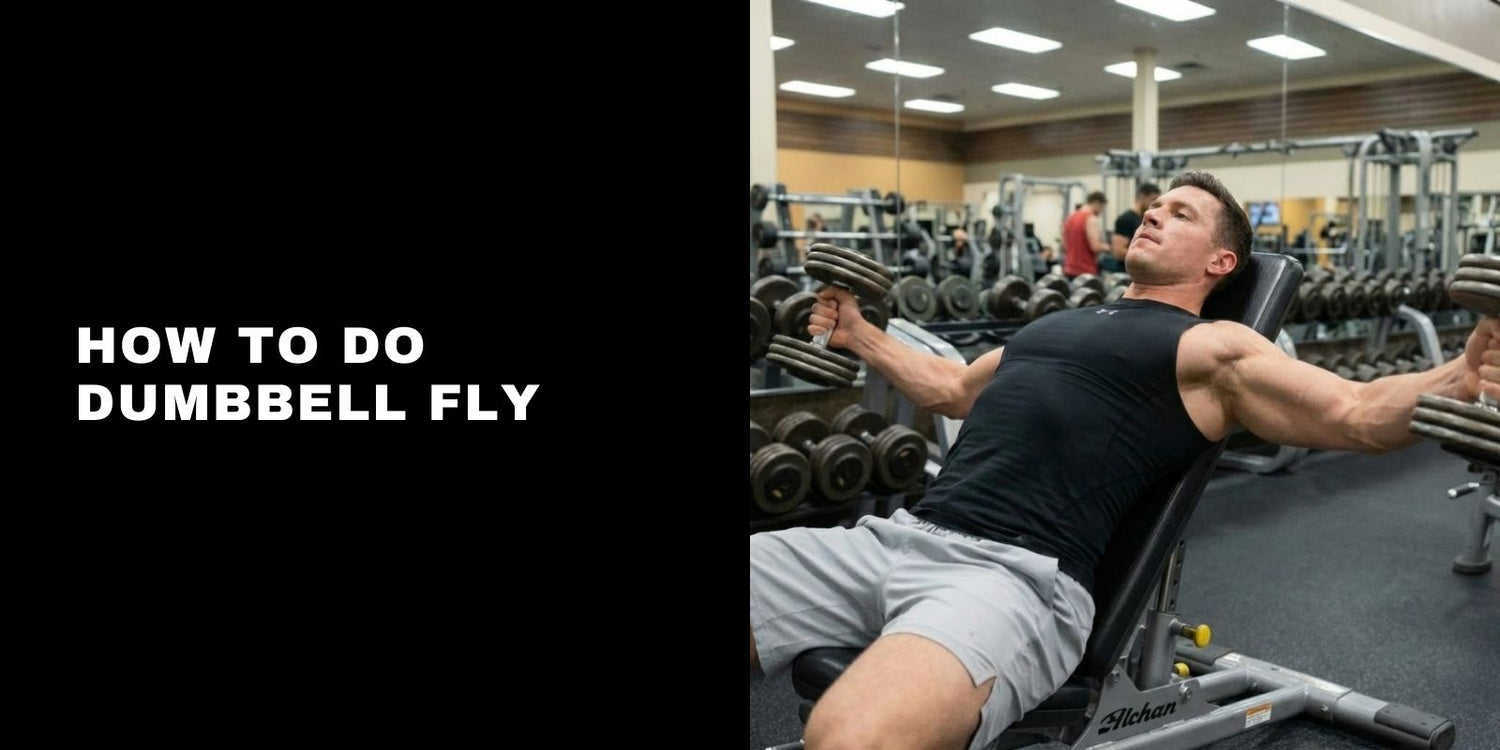
To do a dumbbell fly, lie on a flat bench, press two dumbbells above your chest, and lower them out to the sides in a wide arc with the elbow bend held steady. The exercise is an isolation pattern, so control and a comfortable stretch matter far more than the weight on the handles.
This guide covers the muscles involved, the setup, the step-by-step technique, the mistakes that irritate shoulders, and how to program the movement. Stop the set on sharp shoulder pain and clear new chest work with a clinician if you have a shoulder injury.
Quick Answer: To do a dumbbell fly, lie flat with your feet planted, hold a dumbbell in each hand above your chest with a neutral grip, and keep a small fixed bend in your elbows. Lower the weights out to the sides until you feel a strong chest stretch, then squeeze the pectorals to bring them back together.
Key Takeaways
- Isolation Focus: The dumbbell fly loads the pectoralis major directly, so the chest works while the triceps stay out of the rep.
- Fixed Elbow Bend: Keep a small, unchanging bend in the elbows and think about hugging a barrel rather than pushing one away.
- Stretch Limit: Stop the descent at a strong chest stretch, before you feel shoulder pinching or lose control.
- Best Placement: Most lifters get the most from flies after pressing movements, using higher reps and a strict tempo.
- Shoulder Backup: If the flat bench version irritates your shoulders, a floor fly or cable fly with a shorter range is the safer substitute.
What Muscles Does the Dumbbell Fly Work?
The dumbbell fly muscles worked are the pectoralis major, with the anterior deltoids assisting the arc and the biceps and serratus anterior stabilizing the shoulder blades. On a flat bench the load lands on the sternal head, so the tension should register across the chest rather than at the front of the shoulder. Electromyography research confirms that the fly isolates the sternal head of the chest by minimizing triceps involvement, even though absolute force output stays lower than the bench press.[1]
- Primary mover: Pectoralis major.
- Assists: Anterior deltoids, which help the upper arm travel through the arc.
- Stabilizers: Biceps and serratus anterior, which hold the shoulder blades and elbow position steady.
Because the fly removes the triceps from the equation, it adds a stimulus that pressing cannot reproduce instead of replacing your presses. A chest session that uses both patterns covers heavy loading and a deep chest stretch, and you can pair either one with the RitFit dumbbells range if you train at home.
Which Part of the Chest Does the Dumbbell Fly Target?
A flat bench dumbbell fly targets the sternal head of the pectoralis major, the middle and lower fibers that run from the breastbone out toward the armpit. That is also where the stretch should hit hardest at the bottom of the arc, and where the squeeze shows up as the arms come back toward the midline.
Bench angle and arm path change which fibers take the most load while the dumbbell stays the same. The table below maps that trade so you can pick the angle that matches the part of the chest you want to bring up.
| Angle or arm path | Chest region emphasized | When to choose it |
|---|---|---|
| Flat bench | Sternal head, the middle and lower fibers | The default version, and the easiest to load and progress |
| Incline bench | Clavicular head, the upper fibers near the collarbone | When the upper chest lags behind the rest |
| Decline bench | Lower fibers, with less range at the top of the rep | When you want more emphasis on the lower pec line |
| Floor with dumbbells | Sternal head, with the ground cutting the bottom range short | Shoulders that complain at the bottom of a full bench fly |
| Standing cable or band, high-to-low path | Lower and middle fibers, because the arms travel downward against tension | Constant tension through a shorter range |
| Standing cable or band, low-to-high path | Clavicular head, because the arms travel upward against tension | Bringing up the upper chest while standing |
Bench angle and arm path change the line of pull rather than the exercise itself, so the same shoulder adduction arc simply shifts the load between the target muscles of the chest.
What Equipment and Setup Do You Need for a Dumbbell Fly?
A pair of dumbbells and a flat bench are all you need for a standard dumbbell fly. An adjustable bench adds incline and decline angles, and a floor fly needs no bench at all.
Choosing the Right Weight
How heavy the dumbbells should be depends on control rather than on the number stamped on the handle, because the long lever arm makes a fly feel far heavier than a press with the same pair.
A practical test is to choose a load you can move through the full arc for your target rep range with the last rep looking like the first, then add weight only when that still holds, and back off if the elbows start bending to help.
Bench Setup
Set the bench flat for the standard version and plant both feet on the floor with the hips down. Incline and decline angles shift the emphasis to different regions of the chest, and a RitFit 1300LB Adjustable Weight Bench is what makes those angles available in a home setup.
Quick Setup Checklist
- Feet flat and stable
- Shoulder blades back and down
- Chest gently lifted
- Elbows softly bent and fixed
- Wrists stacked over the elbows
RitFit sells PVC-Coated Round Dumbbells in Pairs for the light loads this movement demands, and an adjustable dumbbells set lets you step up in small increments as your form improves.
How Do You Do a Dumbbell Fly on a Flat Bench?
Lie flat on the bench with your shoulder blades pulled back and down, hold the dumbbells above your chest with a neutral grip, and lower them in a wide arc with the elbow bend unchanged. Squeeze the chest to reverse the motion, and stop just short of vertical so the tension stays on the pectorals.
Starting Position
Plant your feet flat on the floor and press the dumbbells directly above your chest with your palms facing each other. Keep your wrists straight over your forearms and hold the shoulder blades tight against the bench.
Lowering Phase
Inhale and open your arms in a wide arc until your elbows are level with or slightly below your torso. Long muscle lengths create a strong growth stimulus, but that stretch has to stay controlled and pain free.[2]
Lifting Phase
Exhale and reverse the arc by squeezing the chest and driving the upper arms toward the midline. Stop the dumbbells just short of vertical, because tension on the chest drops away once gravity lines up with your arms.
Breathing and Tempo
Lower for 2-3 seconds and lift for 1-2 seconds, keeping the motion smooth and continuous. Use that slow tempo instead of bouncing, since momentum replaces muscle tension when the rep speeds up.
What Are the Most Common Dumbbell Fly Mistakes?
The mistakes that cause trouble in a dumbbell fly are using too much weight, bending the elbows into a press, and dropping the arms too far below the bench. Each one either shifts tension away from the chest or loads the shoulder joint in an unforgiving position.
- Going too heavy: Control disappears and the fly turns into a sloppy press. Reduce the load and keep the arc smooth.
- Turning it into a press: Extra elbow bend recruits the triceps. Keep a small fixed bend and think about hugging, not pushing.
- Overstretching at the bottom: Elbows far below bench height stress the shoulder joint. Stop at a big chest stretch instead.
- Flaring the ribs: An excessive arch usually compensates for heavy weight. Brace the core and keep a slight natural arch.
- Rushing the rep: Speed replaces tension. Slow the descent and keep continuous control of the dumbbells.
Weight selection drives most of these errors, and a matched pair keeps both sides symmetrical, so a light set such as RitFit Rubber Hex Dumbbells is a better starting point than one heavy pair.
"We have to train adduction. This is not an optional exercise if you want your biggest chest. I don't like the unsupported dumbbell flyes -- it actually creates a lot of instability at the shoulder."
Jeff Cavaliere, MSPT, CSCS, Physical Therapist and Strength Coach, Creator of ATHLEAN-X, Jeff Cavaliere Chest Cable Crossover (Generation Iron)
Is the Dumbbell Fly Safe for Your Shoulders?
The dumbbell fly is safe for most healthy shoulders when the load stays light and the range stops before pinching. Sharp joint pain, a feeling of instability, or losing control at the bottom are signals to end the set rather than push through it.
- Warm up first: Spend 5-10 minutes on light cardio plus dynamic shoulder and chest preparation.
- Watch the grip: Use a neutral grip and keep the wrists stacked over the elbows with no bend back.
- Respect your range: Depth is individual, so stop before the shoulder starts to complain.
- Stop when form breaks: End the set if you lose control or cannot keep the arc smooth.
If flat bench flies consistently bother your shoulders, a floor fly shortens the range and lets the ground support your upper arms, which keeps the shoulder in a friendlier position throughout the rep.
How Many Sets and Reps of Dumbbell Fly Should You Do?
Most lifters do 3-4 sets of 8-15 reps of dumbbell fly, stopping 1-2 reps short of failure. Beginners can start with 2-3 sets of 10-15 reps at a light load while they learn to control the arc.
- Beginners: 2-3 sets of 10-15 reps with light weight to build control and range.
- Hypertrophy: 3-4 sets of 8-15 reps at a moderate load, stopping 1-2 reps short of failure.
- Placement: After compound presses such as the bench press or push-ups, usually as a finisher.
- Frequency: 1-2 sessions per week, with 1-2 isolation chest movements per session.
Progress with small jumps instead of large ones, which is simpler when your rack covers several weights the way hexagon dumbbell sets do.
"My wife wanted some quality dumbbells for a decent price and these hit the mark on both points. She loves them and is happy we ordered them."
Daniel H. Verified Buyer, RitFit Rubber Hex Dumbbells Pairs and Sets
What Are the Best Dumbbell Fly Variations?
The main dumbbell fly variations are the incline fly for the upper chest, the decline fly for the lower chest, the floor fly for a shorter shoulder friendly range, the cable fly for constant tension, the single arm fly for core stability, and the standing version for a vertical arm path.
- Incline dumbbell fly: More emphasis on the upper chest and anterior deltoids.
- Decline dumbbell fly: Targets the lower chest fibers.
- Floor dumbbell fly: Limits the bottom range and is often kinder to the shoulders.
- Cable fly: Standing or lying versions hold tension through the whole rep.
- Standing fly: Best done on a cable or band, where the pulley height decides whether the upper or lower chest does the work.
- Single arm dumbbell fly: Adds a core stability challenge to the same arc.
Standing changes the line of pull, and that is the catch with this version: with dumbbells in your hands the arms travel across gravity, so the chest barely loads, while a cable or band keeps tension on the pecs through the same arc. The floor fly makes the opposite trade, keeping true dumbbell tension and only cutting the bottom range short, which is why it is the usual substitute when full depth bothers your shoulders.
Bench angle changes the emphasis far more than the dumbbell itself, so a standard set of rubber hex dumbbells covers every version on this list.
How Do You Adjust the Dumbbell Fly for Your Level?
Adjust a dumbbell fly by changing the load and the range rather than the exercise, so beginners use very light weights or a floor fly, lifters with shoulder issues shorten the range, and advanced lifters add slow eccentrics or pauses.[3]
- Beginners: Use very light dumbbells, cut the range, or choose the floor version.
- Shoulder issues: Shorten the range, try cables for smoother tension, and seek professional guidance if pain persists.
- Advanced lifters: Add 3-4 second eccentrics, pause near the bottom without relaxing, or finish with high rep sets.
Small jumps in weight matter more here than in pressing, and a PVC coated dumbbells set in light pairs is an easy way to keep every rep controlled.
How Do You Build a Chest Workout With Dumbbell Fly?
Place the dumbbell fly third in a chest session, after two pressing movements and before a final high rep finisher. That order lets you press heavy while you are fresh and finish with the isolation work that the fly does best.
- Barbell bench press: 3 sets of 6-8 reps
- Incline dumbbell press: 3 sets of 8-10 reps
- Dumbbell fly: 3 sets of 10-15 reps
- Push-ups or cable fly: 2-3 sets to near failure
For a home setup, a RitFit 3-Tier Dumbbell Rack keeps the pairs organized so you can move from press to fly without hunting for weights. If you are building the collection from scratch, the RitFit Rubber Hex Dumbbells Set with Rack covers 60LB to 300LB in a single purchase.
FAQs About Dumbbell Fly
Is dumbbell fly necessary if I already bench press?
While the bench press is a strong compound lift, the dumbbell fly adds a different stimulus by isolating the chest, emphasizing the stretch, and improving mind-muscle connection. It's not strictly necessary, but it can be very beneficial.
Is it bad for the shoulders?
With poor form (too heavy, overstretching, locked elbows), flies can irritate shoulders. With controlled motion, appropriate load, and a shoulder-friendly range, they can be safe and effective.
What's better: dumbbell fly or cable fly?
Dumbbell flies provide a strong stretch and free-weight stability demands. Cable flies provide constant tension. The best choice depends on goals and comfort; many lifters rotate both.
How heavy should I go?
Never sacrifice form for weight. Start light and increase only when you can maintain perfect technique across your rep range.
Should I lock my elbows?
No. Keep a slight, consistent bend in your elbows to protect the joints and keep tension on the chest.
Can beginners do dumbbell fly?
Yes. Beginners can do a dumbbell fly with light weights, a shortened range, or the floor version, and the movement teaches chest control that carries over to pressing. Start with 2-3 sets of 10-15 reps and add weight only when the arc stays smooth on every rep.
How many times a week should I do dumbbell fly?
Two weekly chest sessions is plenty for most lifters, with 1-2 fly movements in each session and 48 hours between heavy chest workouts. Extra frequency only helps if you recover from it, so keep your total weekly chest volume in mind and stop adding sets once progress stalls.
Is a dumbbell fly a push or a pull?
By joint action the dumbbell fly is closer to a pull pattern, because the upper arm travels across the body in shoulder horizontal adduction while the elbow angle stays fixed. The chest is normally described as a pushing muscle group, which is why the push or pull question comes up, but the fly still sits inside a chest session as the isolation movement beside your presses.
Is a floor or standing dumbbell fly as effective as the bench version?
The floor fly keeps real dumbbell tension and only cuts the bottom range short, so it is a fair substitute when your shoulders dislike full depth on the bench. A standing dumbbell fly is a different case, because the arms travel across gravity with almost no load on the chest, so most lifters get more from a standing cable or band fly through the same arc.
What can I use instead of dumbbells for a chest fly?
Cables and resistance bands reproduce the same arc with constant tension, and a machine fly or pec deck does the job with even less balance demand. If you train at home with a bench, the guide to dumbbell chest exercises with a bench covers the pressing movements that pair with a fly in the same session.
Conclusion
The dumbbell fly is a chest isolation exercise that rewards control over load, and it delivers a stretch that pressing alone cannot reproduce. Keep the elbow bend fixed, stop at a strong but comfortable stretch, and place the movement after your presses.
Add it to your next chest session, progress only while the arc stays smooth, and stock the weight range you need before you load the bar. New lifters can also read the RitFit discount guide before building out a home gym.
Disclaimer
This article is general fitness information rather than medical advice, and it cannot account for your individual shoulder health or training history. Consult a qualified physician or physical therapist before starting a new chest program, especially if you have a previous shoulder injury.
References
1. Solstad TE, Andersen V, Shaw M, Hoel EM, Vonheim A, Saeterbakken AH. A Comparison of Muscle Activation between Barbell Bench Press and Dumbbell Flyes in Resistance-Trained Males. J Sports Sci Med. 2020;19(4):645-651. PMCID: PMC7675616
2. Warneke K, Lohmann LH, Lima CD, et al. Physiology of Stretch-Mediated Hypertrophy and Strength Increases: A Narrative Review. Sports Med. 2023;53(11):2055-2075. doi:10.1007/s40279-023-01898-x. PMCID: PMC10587333
3. Pinto RS, Gomes N, Radaelli R, Botton CE, Brown LE, Bottaro M. Effect of range of motion on muscle strength and thickness. J Strength Cond Res. 2012;26(8):2140-2145. doi:10.1519/JSC.0b013e31823a3b15