
To do a hex press on a weight bench, lie back on a flat bench, press two dumbbells together with a neutral grip, and keep squeezing them through every rep of the set. The constant inward pressure turns an ordinary dumbbell press into a high tension chest builder that lifters also call the squeeze press.
This guide covers the step by step setup, the muscles trained, how the movement differs from the dumbbell bench press and chest flyes, common mistakes, and sensible starting loads. Stop any set that produces sharp joint pain.
Quick Answer: The hex press on a weight bench is a dumbbell chest press performed on a flat bench with the dumbbells squeezed together for the entire set, and it trains the chest, front delts, and triceps with lighter loads than a standard dumbbell bench press.
Key Takeaways
- Squeeze First: The hex press keeps constant inward pressure between two dumbbells through every rep, and that pressure is the single detail that defines the movement.
- Muscles Worked: The press trains the pectoralis major, anterior deltoid, and triceps brachii, while the rotator cuff and upper back hold the shoulder stable.
- Lighter Loads: One coaching guide suggests a working weight 20 to 30 percent below your dumbbell bench press, since the squeeze raises the effort of every rep.
- Honest Differences: Pressing variations are not interchangeable, and the squeeze press trades load and shoulder extension for constant chest tension.
- Bench Choice: Any stable flat bench works for the movement, and an adjustable bench adds incline settings for the incline hex press variation.
What Is a Hex Press?
The hex press is a neutral-grip dumbbell press performed on a flat bench while both dumbbells stay pressed together for the whole set. That constant inward pressure keeps the chest under tension from the bottom of the rep to lockout.
- Many Names: The movement is also called the squeeze press, crush press, or champagne press, and every name describes the same continuous squeeze.
- Simple Equipment: A flat weight bench and one pair of dumbbells are all you need, and hexagonal pairs like the RitFit Rubber Hex Dumbbells give the flat contact faces the name refers to.
- You Control the Load: Squeezing harder makes any weight harder to hold, so light dumbbells can still produce a demanding set.
Coaching descriptions note that keeping the dumbbells together demands shoulder internal rotation near the chest and horizontal adduction near lockout, which is why the squeeze feels different from an ordinary dumbbell press.
What Muscles Does the Hex Press Work?
The hex press trains the pectoralis major, the anterior deltoid, and the triceps brachii as the main movers of the press. The squeeze adds shoulder internal rotation and horizontal adduction to the set, so both heads of the chest stay involved while the rotator cuff and upper back stabilize the shoulder.
- Pectoralis Major: The clavicular head assists the pressing motion while the sternocostal head works hardest as you squeeze the dumbbells together near the chest.
- Anterior Deltoid: The front delts flex the shoulder through the press and assist the inward squeeze.
- Triceps Brachii: The triceps extend the elbows to lockout, so unlike a flye the hex press still trains the arms.
- Rotator Cuff and Upper Back: The front of the shoulder contracts to hold the squeeze while the rhomboids and mid-traps keep the shoulder blades retracted.
One study measured shoulder muscle activation across dumbbell press variations in both novice and resistance-trained women, a useful reminder that pressing variations are not interchangeable.[1] For the barbell version of the movement, see our guide to what muscles the bench press works.
No study has directly tested the hex press itself, so the muscle emphasis above comes from coaching practice and anatomy rather than hex press trials.
How to Do a Hex Press on a Weight Bench Step by Step
The hex press setup starts on a flat bench with five points of contact and two dumbbells pressed firmly together just above your sternum. From that position you squeeze hard, press to lockout without letting the weights separate, and lower under control back to the chest.
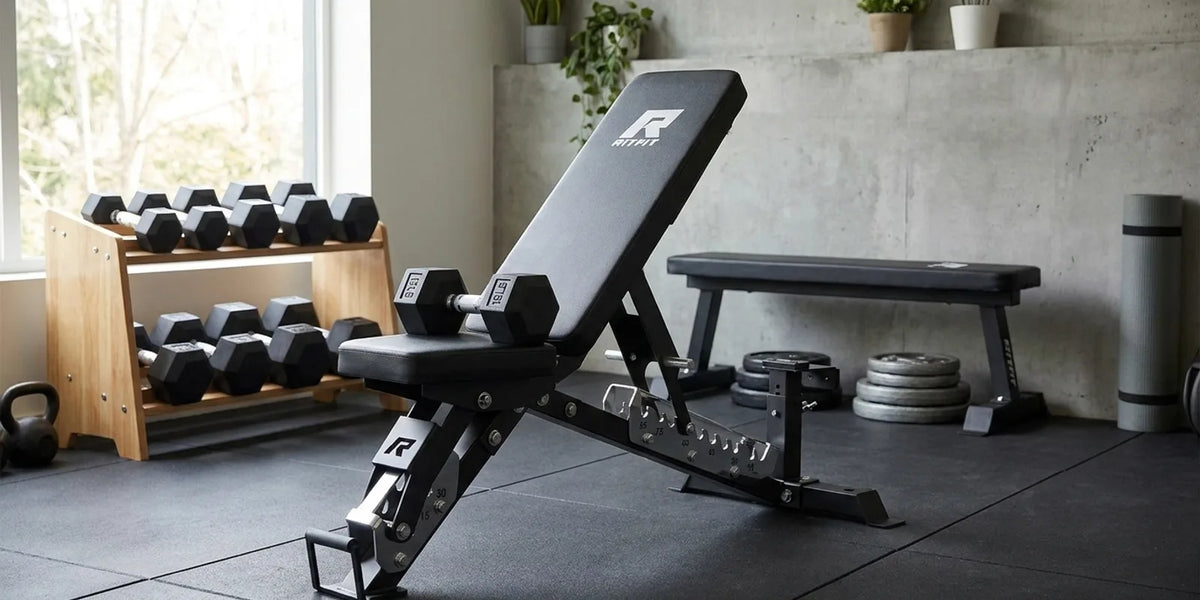
- Equipment: Any stable flat bench works for the movement, and if yours rocks or sinks, the weight benches collection has flat and adjustable options built for pressing.
- Grip: Hold the dumbbells with a neutral grip, palms facing each other, and align the flat faces so the contact is clean.
- Tempo: Press and lower under control, because a fast rep makes the dumbbells drift apart and kills the squeeze.
Step 1: Set Five Points of Contact on a Flat Bench
Lie back on the bench with your head, shoulder blades, and glutes on the pad and both feet planted on the floor. Hold one dumbbell in each hand at chest level with your palms facing each other.
Step 2: Squeeze the Dumbbells Together at Your Sternum
Press the flat faces of the dumbbells together just above your sternum and squeeze them hard before anything moves. Arch your upper back slightly and pin your shoulder blades to the bench so the chest stays high and the shoulders stay packed.
Step 3: Press to Lockout and Keep the Pressure
Flex your shoulders and extend your elbows to press the joined dumbbells up while keeping your elbows tucked toward your ribs. Do not relax the inward squeeze at the top, because the pressure at lockout is part of the training effect.
Step 4: Lower Without Letting the Dumbbells Separate
Lower the dumbbells along the same path back to the middle of your chest, actively pulling them down as if rowing. Keep pressing the weights together through the entire descent, then repeat for the target reps.
Cueing alone does not guarantee chest activation, since a bench press study found that verbal instructions increased triceps activity but did not significantly increase pectoralis major activity.[2] The physical squeeze is what forces the chest to stay involved, so treat the pressure between the dumbbells as the main focus of every set.
Does the RitFit GATOR Adjustable Weight Bench Work for Hex Presses?
The RitFit GATOR Adjustable Weight Bench handles hex presses easily, with a flat setting among its 10 backrest angles from 0 to 85 degrees and a 1600 lb total load capacity that covers your body weight plus dumbbells. The 2.7 inch pad foam and 2 inch seat to backrest gap keep your upper back supported while you press.
- Stable Setup: The enclosed ladder brackets and welded rear base keep the bench still while you bring the dumbbells together overhead.
- Room to Grow: The same flat setting supports dumbbell bench presses and flyes, so one bench covers your whole chest session.
- Lighter Option: The RitFit 1300LB Adjustable Weight Bench covers the same flat setup at a lower price point.
Investing in a weight bench like the RitFit Gator makes a home gym space substantially more versatile. Not only can you do standard moves like bench pressing and seated shoulder pressing, but it also opens up the opportunity to do things like Bulgarian split squats and even some core exercises.Amanda Capritto, CPT, CNC, CES, CF-L1, Editor and Certified Personal Trainer at Garage Gym Reviews, RitFit Gator Adjustable Weight Bench Review 2026 at Garage Gym Reviews
"This bench is great and sturdy and does everything I need out of it for me and my son. I really like the arm rest especially for my son while he is learning and starting out in working out I think it's great that this product has something that can help with his form. It moves and adjust easily and very simple any one can do it. I use this in a limited space so I am moving it around to store it so bigger wheels would have been nice but It's also not a make or break. It still moves around great I just need to adjust the angle a bit. Over all great product and it's definitely worth the money to add to my home gym."
Rey O. Verified Buyer, RitFit GATOR 1600LB Adjustable Weight Bench
Hex Press vs Dumbbell Bench Press and Chest Flyes
The hex press differs from the dumbbell bench press and the dumbbell flye mainly in the squeeze, the range of motion at the shoulder, and the loads you can use. The dumbbell bench press lets the weights travel deeper and heavier, while flyes stretch the chest without the triceps, and the hex press sits between the two.
| Detail | Hex Press | Dumbbell Bench Press | Dumbbell Flyes |
|---|---|---|---|
| Squeeze between weights | Constant through the whole set | None | None |
| Shoulder stretch at the bottom | Limited, dumbbells stay over the chest | Deeper stretch behind the chest | Long stretch in the lowered position |
| Triceps involvement | High, elbows extend to lockout | High | Minimal |
| Typical load compared with the dumbbell bench press | About 20 to 30 percent lower | Baseline | Lighter |
| Best used for | Constant chest tension and pressing skill | Heavy pressing strength | Chest stretch and isolation |
Comparison blends coaching descriptions of the hex press with activation findings from the cited studies, and the hex press itself has not been directly studied.
One study of 17 resistance-trained men found the barbell bench press produced 8 to 81 percent higher activation of the pectoralis major, anterior deltoids, and triceps brachii than dumbbell flyes, while flyes raised biceps brachii activation 57 to 86 percent and were performed with lighter loads.[3]
The hex press has not been directly tested in that comparison, so treat it as a pressing variation with flye-like squeezing demands rather than a proven upgrade over either lift. Its arm path resembles the close-grip bench press, and the barbell version builds lockout strength with heavier loads.
"I love the diversity. I can just about do anything I did at a gym. Incline, decline, dips, etc... A little learning curve. I use it with a ironmaster bench with the leg extension, preacher curl, and mx 55 dumbbells. Ritfit is jewel of my small room gym. Total cost is $1500 and now fully independent of gym nonsense. Great job!"
Chris B. Verified Buyer, RitFit Gorilla 2-in-1 Chest and Shoulder Press Machine
Common Hex Press Mistakes to Avoid
The most common hex press mistakes break the squeeze, flare the elbows, or cut the range of motion short. Each one shifts the work away from the chest and turns the set back into a plain neutral-grip press.
- Losing the Squeeze: The moment the dumbbells stop pressing together the exercise becomes a plain neutral-grip dumbbell press. Pressure is hardest to hold at the bottom and at lockout, but it must stay constant.
- Uneven Pressure: Pushing harder with one hand lets the dumbbells roll or slip apart, which can end the set early. Apply equal force from both sides and rehearse the squeeze with light dumbbells first.
- Flaring Elbows: Elbows drifting outward spreads the shoulder blades and lets the chest drop, and the squeeze usually disappears at the same moment. Reset by arching the upper back, pinning the shoulder blades, and tucking the elbows toward the ribcage.
- Cutting the Rep Short: Barring an injury or physical limitation, bring the dumbbells down to the middle of your chest on every rep so the chest works through a full range of motion.
- Going Too Heavy Too Soon: Heavy dumbbells before the squeeze is learned turn the movement into a shaky neutral-grip press. Hone the pattern with light loads, then progress the weight.
Round dumbbells work but roll more easily than hexagonal ones, so learn the squeeze with flat-faced pairs from the hex dumbbells collection before mixing in round heads.
How Much Weight Should You Use for a Hex Press?
One coaching guide suggests a working load about 20 to 30 percent below your usual dumbbell bench press, and beginners should start lighter still while the squeeze is new. The constant squeeze makes every rep harder than a normal dumbbell press, so the weights you normally press will not move the same way.
- Start Light: Practice with light dumbbells until the squeeze never breaks, then build toward a challenging load.
- Squeeze Harder: Applying more inward pressure raises the difficulty without adding a pound, which makes the movement useful when only light dumbbells are available.
- High Rep Work: One coaching guide suggests light to moderate dumbbells around 40 to 70 percent of your standard dumbbell bench press load for high repetition sets.
- Add Reps: If you normally run 8 to 12 reps and finish the last set with reps in reserve, shift the target toward 12 to 16 reps.
When to Move Up in Weight
Move up when your final working set hits the top of the target rep range with two or three clean reps in reserve and the squeeze holds on every rep. The next dumbbell pair should drop you back toward the bottom of the range.
If your current dumbbells sit outside that window, the exercise weights collection fills the gap with pairs that step up in small jumps.
How to Program the Hex Press: Sets, Reps, and Frequency
The hex press fits push days, chest sessions, or full body workouts as a low to moderate load accessory for most lifters. Programming is simple because the movement responds to high effort sets close to failure, and it never needs to replace your main heavy press.
Sets and Reps by Goal
For beginners one training guide suggests 3 sets of 10 reps with moderate weight, while muscle building work runs 4 sets of 8 close to failure and strength work runs 5 sets of 6 with longer rest.
Where the Hex Press Fits in Your Week
Place the movement after your main press of the day so it adds chest work without stealing load from heavy pressing. A light primer use also works, one to three easy sets before the bench press to wake up the chest.
When to Stop for Pain
End the set if you feel sharp pain at the front of the shoulder, in the elbow, or in the chest instead of normal muscular effort, and rest before training again. Persistent pain deserves an assessment from a qualified sports medicine provider rather than pushing through.
"RitFit Rubber Hex Dumbbell with Metal Handle For Free Weights Exercises|10-60 lbs Weights Range"
Romaine Hall, Verified Buyer, RitFit Rubber Hex Dumbbells Pairs and Sets
Hex Press Variations and Alternatives
The best hex press variations change the bench angle or the tool while keeping the squeeze, and the closest alternatives copy the arm path with different equipment. Incline hex presses shift the work toward the upper chest, and options like the close-grip bench press cover the same pressing pattern when dumbbells are busy.
- Incline Hex Press: Set an adjustable bench to a low incline around 15 to 30 degrees and press the dumbbells together as usual, expecting lighter loads than the flat version.
- Cable Hex Press: Two low cable pulleys keep constant tension on the chest through the squeeze, though the walkout from the weight stack takes practice.
- Diamond Push-Up: A bodyweight option that puts the arms in a similar position, and a weight plate on the back adds resistance when the basic version gets easy.
- Single-Arm Dumbbell Floor Press: Lying on the floor limits shoulder extension much like the hex press, and working one arm at a time keeps the load manageable.
- Medicine Ball Squeeze Push-Up: Hands on either side of a medicine ball recreate the isometric squeeze through a push-up pattern.
FAQs About the Hex Press
What is a hex press on a weight bench?
A hex press is a dumbbell chest press performed lying on a flat weight bench while the two dumbbells stay squeezed together for the entire set. The constant inward pressure keeps tension on your chest through the lowering and pressing phases, which is why lifters also call it a squeeze press.
How much weight should you use for a hex press?
Most lifters should drop the load, and one coaching guide suggests a working weight about 20 to 30 percent below your usual dumbbell bench press. Start even lighter while you learn the squeeze, then add weight only when every rep of your target set stays fully pressed together with solid form.
What muscles does the hex press work?
The hex press trains the pectoralis major, the anterior deltoid, and the triceps brachii, since you press with a neutral grip while squeezing the weights together. The squeeze also demands shoulder internal rotation and scapular retraction, so your upper back and rotator cuff muscles work as stabilizers throughout every repetition.
Do you need hexagonal dumbbells to do a hex press?
No. Round dumbbells work as long as you can press the heads firmly together, although hexagonal dumbbells are easier to control because their flat faces meet cleanly. If your dumbbells roll against each other, slow the tempo and apply even pressure from both hands so the weights never slip apart.
Is the hex press the same as a squeeze press or a crush press?
Yes. The hex press, squeeze press, and crush press all describe the same movement, a neutral-grip dumbbell press with continuous inward pressure between the weights. The names come from different gyms and coaches, but the flat bench setup and the squeeze through every rep stay identical.
Do you need a flat bench for the hex press?
Yes. The standard hex press is done on a flat bench because the dumbbells travel over the middle of your chest while you keep them pressed together. An adjustable bench works well since its flat setting covers the movement, and its incline settings let you run the incline hex press variation.
When should you stop a hex press set because of pain?
Stop the set if you feel sharp pain at the front of the shoulder, in the elbow, or in the chest instead of normal muscular effort. A hard pump and burn are expected, but joint pain is a signal to rest and have a qualified sports medicine provider assess the joint before training again.
Conclusion
The hex press on a weight bench is a simple way to add constant chest tension to your pressing without heavy loads. Set five points of contact, keep the dumbbells pressed together through every rep, and progress the weight only while the squeeze holds.
Start light, film one set to check your elbow path, and add the movement to your next push day. Check the RitFit discount guide before you add a bench or dumbbell pair to your home gym.
Disclaimer
This article provides general training information about the hex press and is not medical advice or a diagnosis of any shoulder, elbow, or chest condition. Stop any exercise that causes sharp pain and consult a qualified sports medicine professional or your physician before starting a new training program.
References
1. Luczak J, Bosak A, Riemann BL. Shoulder Muscle Activation of Novice and Resistance Trained Women during Variations of Dumbbell Press Exercises. J Sports Med (Hindawi Publ Corp). 2013;2013:612650. doi:10.1155/2013/612650. PMCID: PMC4590897
2. Paoli A, Mancin L, Saoncella M, et al. Mind-muscle connection: effects of verbal instructions on muscle activity during bench press exercise. Eur J Transl Myol. 2019;29(2):8250. doi:10.4081/ejtm.2019.8250. PMCID: PMC6615069
3. Solstad TE, Andersen V, Shaw M, Hoel EM, Vonheim A, Saeterbakken AH. A Comparison of Muscle Activation between Barbell Bench Press and Dumbbell Flyes in Resistance-Trained Males. J Sports Sci Med. 2020;19(4):645-651. PMCID: PMC7675616