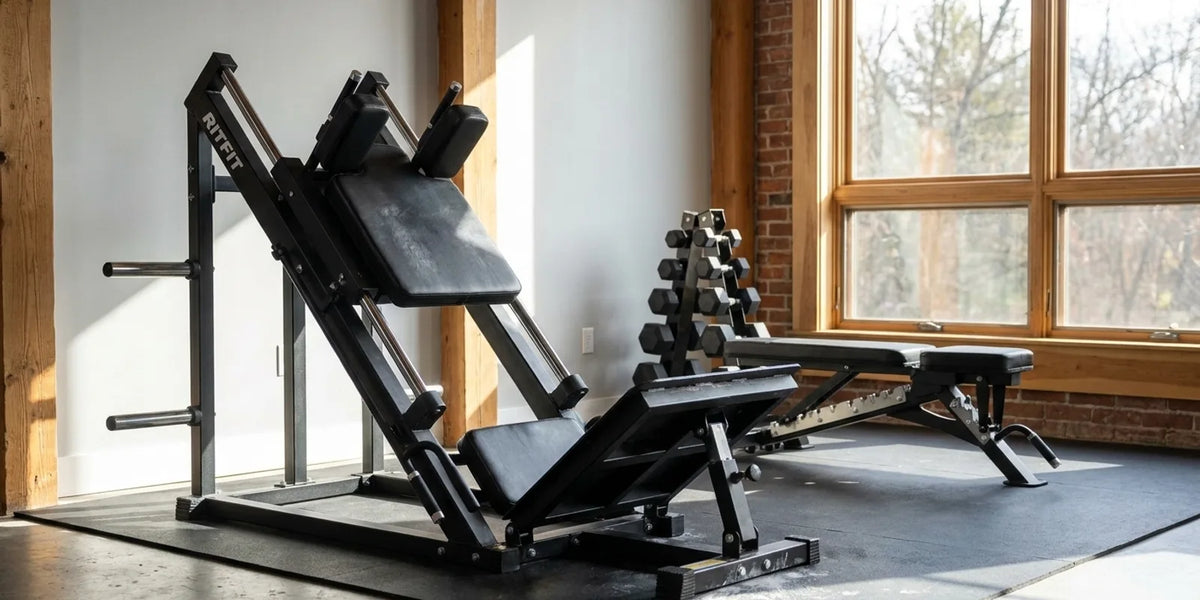
Yes, you can do standing calf raises on a leg press and hack squat combo machine, and many lifters find it a convenient way to train the calves with real load.
This guide covers machine setup, the step-by-step movement, the muscles trained, the benefits, common mistakes, and how to program the exercise. Set the safety stops before every session and treat sharp tendon pain as a stop signal.
Quick Answer: Yes, you can do standing calf raises on a leg press and hack squat combo machine by switching it into hack squat mode, resting your shoulders under the pads, placing the balls of your feet on the platform edge, and raising your heels with your knees straight.
 Click the image to visit the RITFIT Black Friday Deals page.
Key Takeaways
- Setup: Use hack squat mode with the balls of your feet on the platform edge, heels free, knees straight, and the safety stops verified before you load the sled.
- Primary Mover: Straight knees put the work on the gastrocnemius, while bending the knees shifts it toward the soleus.
- Advantage: The machine carries the load on your shoulders along a fixed path, so the calves rather than balance become the limiting factor.
- Top Mistake: Bouncing out of the bottom lets the Achilles tendon do the work, and cutting the range of motion trains only the top half.
- Programming: Train calves two to four times per week in the 8 to 15 rep range and add load only when every rep stays clean and full range.
Machine Setup for Standing Calf Raises
The standing calf raise on a leg press and hack squat combo machine uses the machine's hack squat configuration with your shoulders under the padded rests. You set the shoulder pad height, the safety stops, and the foot position before you load a single plate.
The first decision is which mode to use. A leg press and hack squat combo machine typically offers at least two movement patterns, a seated leg press and a standing hack squat.
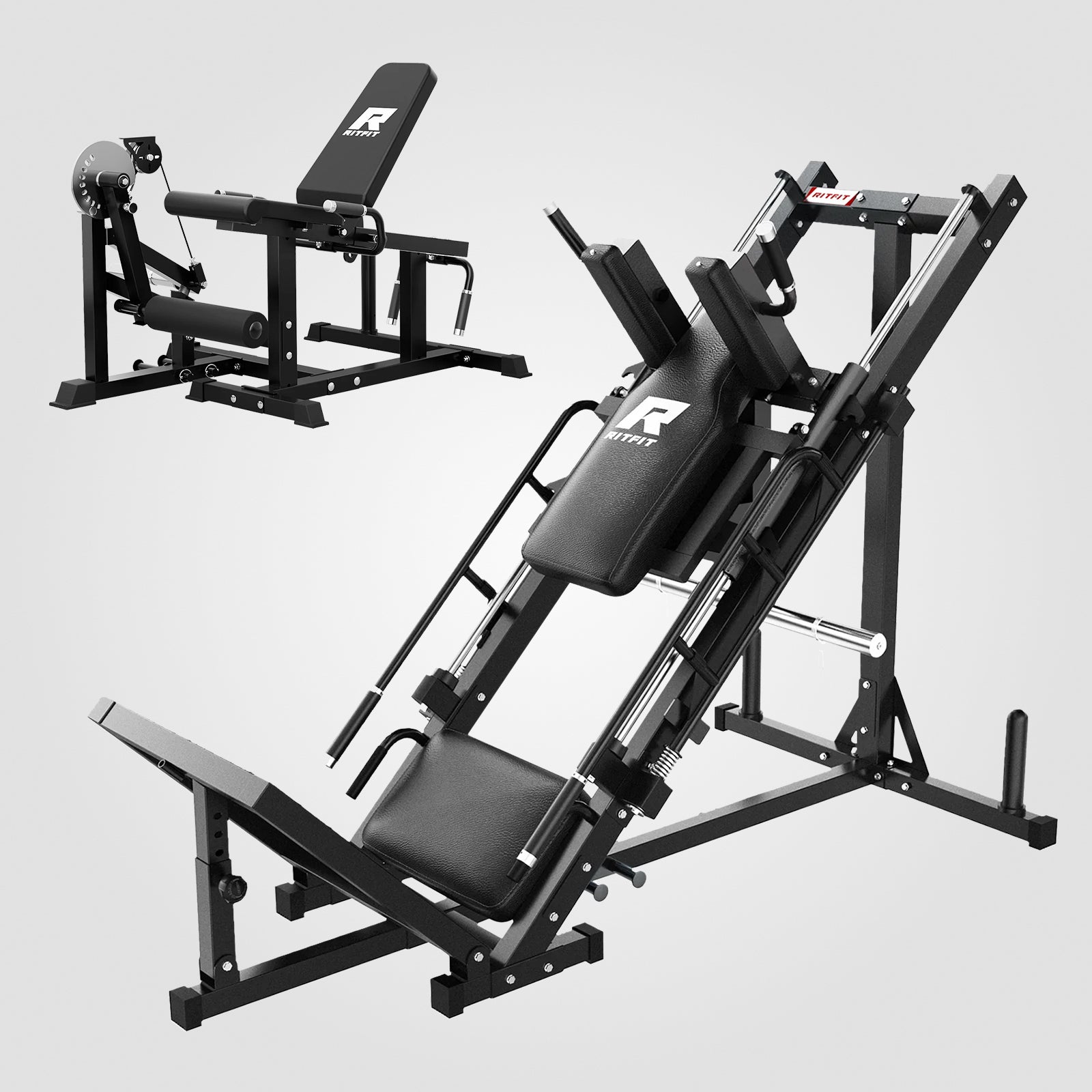
On three-in-one units, such as the RitFit GAZELLE PRO 3-in-1, the standing calf raise is a dedicated function built on the hack squat configuration. The setup is the same as you would use for a hack squat minus the squat itself.
If you need a refresher on the machine's overall operation, see our full walkthrough on how to use a leg press hack squat machine.
Set the machine up in hack squat mode rather than leg press mode so the sled travels on a fixed path while your shoulders sit under padded rests. This is exactly the position you need to load the calves in a standing, straight-leg pattern.
Adjust the shoulder pad height so you can step onto the platform with your shoulders comfortably under the pads. The pads should sit firmly on your shoulders and upper traps without pressing on your neck.
Set the safety stops or limiters before you load a single plate. The stops should catch the sled slightly below the lowest point you plan to reach with your heels, so the sled cannot pin you if your calves fail mid-set.
Test the stops once with an empty sled or light load before working sets. This one check prevents the only setup error with real consequences.
Foot placement is the part most people get wrong on a first attempt. Place only the balls of your feet on the lower edge of the platform or add-on foot plate, with your heels hanging free off the edge.
Keep the feet roughly hip-width apart and pointed straight ahead. A neutral, hip-width stance is the best default to learn on.
Load conservatively on the first set. The fixed path removes the balance demand, and it is easy to underestimate how much resistance the calves can handle once the setup is solid.
Step-by-Step Form
The standing calf raise on a hack squat machine runs in nine steps, from locking in the sled to re-racking under control. Keep the knees straight, lower the heels slowly, and drive up through the balls of the feet.
- Step 1: Lock in the machine. Set the sled to hack squat mode, confirm the safety stops are in place, and load the plates you plan to use.
- Step 2: Step onto the platform. Position the balls of your feet on the platform edge with your heels hanging off, feet about hip-width apart.
- Step 3: Get under the pads. Bend your knees just enough to slide your shoulders under the padded rests, then straighten your legs to lift the sled off the safety catches.
- Step 4: Set your posture. Stand tall with your hips, spine, and head in a straight line under the pads, keeping the knees straight but not hyperextended.
- Step 5: Lower your heels. Let the heels drop below the level of the platform under control until you feel a full stretch through the backs of your lower legs.
- Step 6: Pause briefly at the bottom. This pause removes the elastic bounce that lets the Achilles tendon do the work the muscle should be doing.
- Step 7: Drive up through the balls of your feet. Push the platform away by pointing your toes and raising your heels as high as you can, with the pressure traveling through your first and second toes.
- Step 8: Squeeze at the top. Hold the fully raised position for a beat and squeeze the calves hard before starting the next rep.
- Step 9: Re-rack safely. Lower the sled under control onto the safety stops before stepping out.
The lowering phase is where most of the quality is built, and the straight-knee position is what defines the exercise. Breathe out as you raise the heels and breathe in as you lower them, and reduce the load rather than cutting the range short.
Muscles Worked
The standing calf raise trains the calf complex, and the straight-knee position makes the gastrocnemius the primary mover. The soleus works as a synergist, while the tibialis posterior, peroneals, and foot muscles stabilize the ankle.
The gastrocnemius is the large, visible two-headed muscle that crosses both the knee and the ankle joint. The soleus sits underneath it and crosses only the ankle.
Because the standing version is performed with straight knees, the gastrocnemius takes the lead and the soleus supports it. The tibialis posterior, the peroneal muscles along the outside of the lower leg, and the small muscles of the foot all assist in stabilizing the ankle through the range of motion.
The practical takeaway is to keep the knees straight to bias the gastrocnemius on every rep. Bending the knees significantly during the movement quietly turns the exercise into a more soleus-dominant press.
"The gastrocnemius, the visible diamond, crosses both the knee and ankle, is dominant in fast, powerful plantarflexion, and works best with straight knees. The soleus lies beneath, crosses only the ankle, is heavily slow-twitch, and takes over when the knee is bent."
Heather Cherry, Certified Personal Trainer and Content Strategist at the National Academy of Sports Medicine (NASM), in Calf Training: How to Program This Stubborn Muscle Group for Clients at the NASM Resource Center
Benefits of Machine Standing Calf Raises
Machine standing calf raises load the calves heavily and safely without extra equipment, on a fixed path that keeps every rep consistent. The convenience is the main reason three-in-one leg press and hack squat machines list the calf raise as their third function.
The obvious advantage is convenience. If the machine is already in your gym or home gym, the calf raise function needs no dumbbells, no step platform, and no separate calf raise station.
That is true both of dedicated three-in-one units like the RitFit GAZELLE PRO and of combo models like the RitFit BLP01. These machines list the calf raise as their third function alongside leg press and hack squat.
You can compare the current combo units in our leg press machine collection. Heavy loading on the machine is also safer and simpler than the free-weight alternatives.
Most lifters outgrow bodyweight standing calf raises quickly and end up improvising with a backpack or dumbbells while balancing on one leg. With a barbell, the load passes through your spine, and grip and balance become the limiting factors long before the calves are truly challenged.
On the machine, the load is carried on the shoulders and guided by rails, and the safety stops give the sled somewhere to go if your calves give out. You can push close to genuine muscular failure without dumping a barbell.
If you enjoy the Smith machine version for similar reasons, our guide to Smith machine calf raises compares the two setups in detail.
The fixed path also delivers a consistent resistance curve from the bottom stretch to the top squeeze, with no wobble to absorb and no technique drift as the set gets hard. Progressive overload is as simple as adding a plate when the current load stops challenging you.
For a deeper look at how the seated-on-a-sled version compares and how to build a complete plan around it, see our leg press calf raise setup and growth plan.
Why Choose the RitFit GAZELLE PRO 3-in-1 for Standing Calf Raises
The Gazelle Pro 3-in-1 builds the standing calf raise in as a dedicated function, so the movement is designed into the unit rather than improvised on the side. If one machine has to cover your leg presses, hack squats, and calf work, it handles all three in a single footprint.
"Whether it is leg presses, hack squats, or calf raises, this machine handles them all perfectly. It is truly a versatile piece of equipment for building a professional grade home gym!"
Michael Johnson, Verified Buyer, RitFit GAZELLE PRO 3-In-1 Leg Press and Hack Squat Machine
Common Mistakes and Safety
Bouncing out of the bottom is the most common mistake on machine standing calf raises, and cutting the range of motion is the second. Set the safety stops, keep the knees straight, and control every inch of the movement, because a quality rep is a full stretch at the bottom and a full squeeze at the top.
Bouncing out of the bottom is the single most common mistake. Rapid, bouncy reps let the Achilles tendon's elasticity catapult you upward, so the calf muscle itself registers far less effort than the rep count suggests.
Use a controlled lowering, a short pause at the stretch, and a deliberate squeeze at the top.
Cutting the range of motion is the second big one. If your heels never drop below the level of the platform, you are training only the top half of the movement.
Bending the knees turns the exercise into a different movement. Even a small, creeping knee bend as the set gets tiring shifts work away from the gastrocnemius.
If you cannot keep the legs straight under the current load, the load is too heavy. Start lighter than you think you need, own the tempo, and add weight gradually.
Neglecting the safety stops is the one setup error with real consequences. Always verify the limiters before loading, re-rack under control at the end of every set, and never stand directly under an unlocked sled while adjusting your feet.
Programming (Sets, Reps, Frequency)
A common evidence-informed guideline from NASM is to train calves two to four times per week with roughly eight to sixteen weekly sets in total. Split that volume between straight-leg work such as the standing calf raise and bent-knee work such as the seated calf raise.
Calves are accustomed to thousands of loaded contractions every day just from walking, so they need deliberate, consistent programming rather than an occasional afterthought set.
Standing calf raises are typically programmed in the 8 to 15 rep range with a controlled tempo. A practical starting point is 2 to 3 sets of 10 to 15 controlled reps at the end of a lower-body session, or earlier in the workout if calf growth is the priority.
Add a rep or a small amount of load when all sets are completed with full range of motion and a clean squeeze at the top. Calves recover relatively quickly between sessions, which is one reason higher frequencies tend to work well for them.
Our guide on how many calf raises you should do breaks down the volume trade-offs in detail.
FAQs About Standing Calf Raises on a Leg Press and Hack Squat Machine
Can you really do standing calf raises on a leg press and hack squat machine?
Yes. The standing calf raise is performed in the machine's hack squat configuration, with the shoulders under the pads, the balls of the feet on the platform edge, and the knees straight while the heels rise and lower against the sled's resistance. On three-in-one machines the calf raise is a designed function of the unit, so the movement is intended rather than improvised.
Should I do calf raises in leg press mode or hack squat mode?
Use hack squat mode for a standing calf raise with straight legs and shoulder loading. Leg press mode is a different, seated pattern where you push the platform away with the legs and feet. If you prefer the seated version, follow the dedicated leg press calf raise setup instructions instead.
What is the difference between machine standing calf raises and bodyweight or barbell calf raises?
Bodyweight calf raises are a good entry point but quickly become too light unless you add load by hand. Barbell calf raises allow heavy loading but demand balance, grip, and spinal tolerance, and a failed rep is awkward to escape. The machine loads the calves through the shoulders on a fixed path with safety stops to catch the sled, so the limiting factor is genuinely the calf muscle rather than balance.
How much weight should I use?
Start with an empty sled or light load and master the full range of motion first, with the heels below the platform at the bottom, a full squeeze at the top, and a controlled tempo throughout. Increase the load only when you can complete all planned reps with straight knees and no bouncing.
Are hack squat machine calf raises safe for the knees and ankles?
Yes. The exercise is generally knee-friendly because the knees stay straight and do not bend under load. The ankles move through a large range of motion, so build up range and load gradually. As with any training, sharp or lasting pain is a signal to stop and consult a qualified professional rather than train through it.
Conclusion
A leg press and hack squat combo machine is a perfectly good, and often better, home for the standing calf raise. Set it to hack squat mode, place the balls of your feet on the platform edge with your heels free, verify the safety stops, and move through a full, controlled range of motion with straight knees.
Avoid bouncing and program the movement two to four times a week in the 8 to 15 rep range. When you are ready to add a combo machine, the RitFit discount guide covers the current savings options.
Disclaimer
This article provides general training guidance, not medical advice. Sharp or persistent pain in the Achilles tendon, heel, or ankle is a sign to stop the exercise and seek assessment from a qualified healthcare professional before training the area again.