








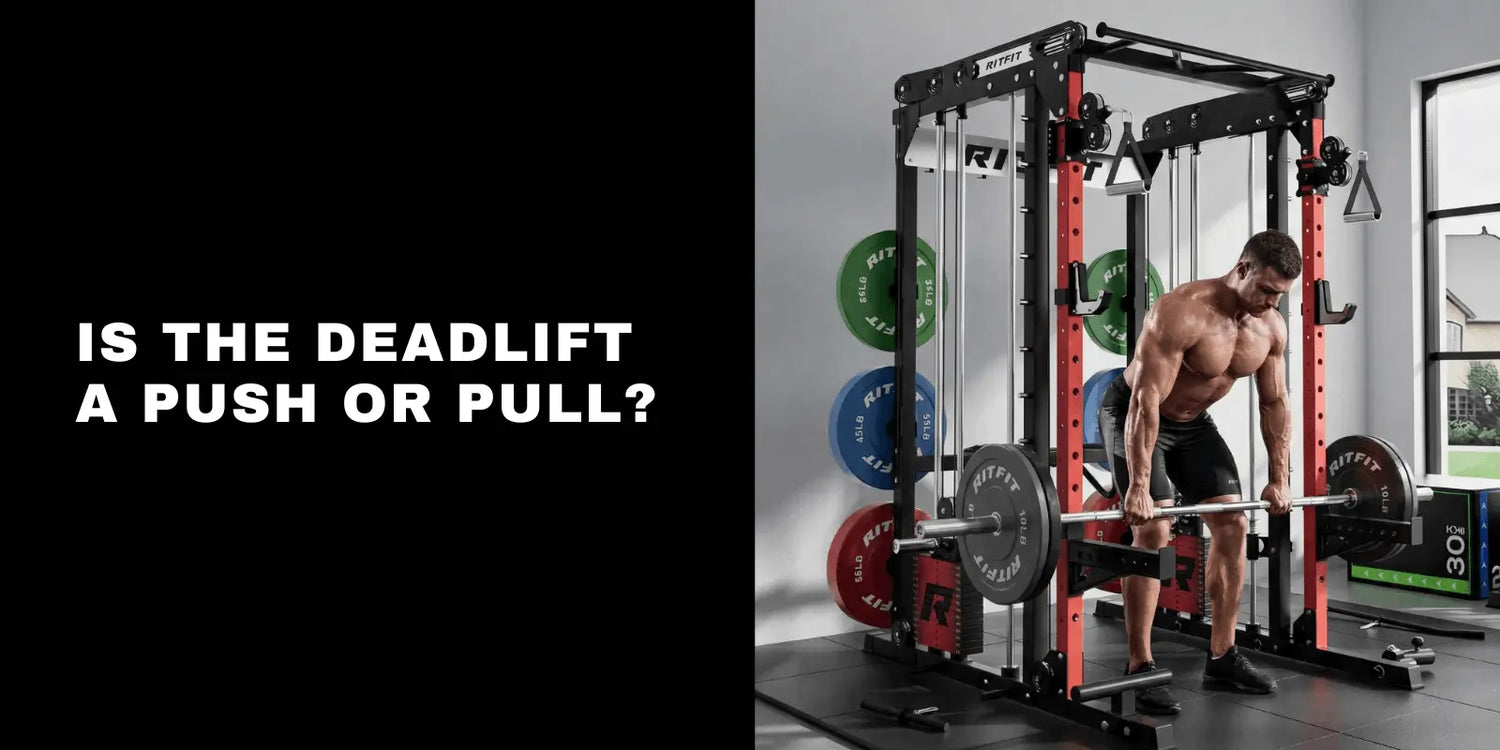
The deadlift is one of the most effective strength exercises for building full body power, muscle, and resilience. It is also one of the most misunderstood, largely because people try to squeeze it into a simple label: push or pull.
That label matters more than it seems. How you classify the deadlift affects how you program it, how you recover from it, and which technical cues you prioritize to stay safe and get stronger.
Quick Answer: The deadlift is classified as a pull exercise because it is a hip hinge that emphasizes the posterior chain (glutes, hamstrings, spinal erectors) and upper back bracing. It includes a push component off the floor, but the dominant pattern is hinge, so program it with pull and lower body sessions.
Key Takeaways
- Pull classification: Most training plans classify the deadlift as a pull exercise because it is a hip hinge built around the posterior chain.
- Real push component: The deadlift includes a visible push off the floor, but the dominant muscular emphasis is hinge and posterior chain.
- Programming impact: Classifying the deadlift as pull affects fatigue management and which cues you prioritize.
- Variation matters: Sumo feels more push-like and conventional more pull-like, yet both remain hinges programmed as pull.
- Start rule: Place deadlifts on pull or lower day, use double progression, and keep 1 to 3 reps in reserve.
Is the deadlift a push or pull exercise?
The deadlift is a pull exercise, because it is a hip hinge that places most of the work on the posterior chain and trunk bracing. This classification is standard across most training plans.
Most training plans classify deadlifts as a pull because:
- Posterior chain emphasis: The lift strongly targets the glutes, hamstrings, and spinal erectors, with the upper back working for stability.
- Fatigue profile: It creates fatigue similar to other pull-day staples like rows and pull ups due to heavy loading and bracing demands.
- Recovery fit: Recovery needs often align better with pull and lower sessions than with pressing-focused days.
That said, the deadlift is not just pulling with your back. If you deadlift that way, your lower back usually pays the price.
Why do people get confused about push versus pull?
People get confused because the deadlift combines a visible push off the floor with a dominant pull pattern, so both labels feel partly true. The classification depends on muscular emphasis, not physics.
Push and pull are training categories, not physics laws.
A push day usually means movements dominated by pressing musculature and joint actions such as horizontal or vertical presses (chest, shoulders, triceps) and sometimes knee dominant lower body work (squats, leg press).
A pull day usually means movements dominated by pulling musculature and joint actions such as rows and pull ups (back, biceps) and often hip dominant lower body work (deadlifts, hip hinges).
Deadlifts blur the line because:
- Your feet push into the floor
- Your hips extend powerfully
- Your hands grip and your lats pull the bar in
- Your torso stays rigid through bracing, not by lifting with the back
So yes, there is a push component, but the primary pattern is hinge and the dominant muscular emphasis is posterior chain.
What makes the deadlift a hip hinge?
The deadlift is a hip hinge because the hips travel back and forward while the spine stays braced and relatively neutral. Your knees bend, but they do not drive the movement the way they do in a squat.
In a clean deadlift hinge:
- The hips move back to load the hamstrings and glutes
- The torso inclines forward while staying rigid
- The bar stays close to your body
- You stand by driving the hips forward and squeezing the glutes, not by yanking with the arms
Seeing the deadlift as a hinge immediately improves your technique cues and reduces the common risk of rounding and overusing the lower back.
"The knee joint itself is a consequential joint. That means it is simply a hinge joint that is at the mercy of what is going on at the ankle below and the hip above."
Jeff Cavaliere, MSPT, CSCS, Physical Therapist and Strength Coach, former Head Physical Therapist for the NY Mets, Athlean-X
What muscles does the deadlift work?
The deadlift is a compound lift that works multiple joints, with the posterior chain doing most of the work. Several muscle groups share the load in every rep.
Primary muscles
- Glutes: Hip extension and lockout power
- Hamstrings: Hip extension support and tension off the floor
- Spinal erectors: Isometric bracing to maintain spinal position
- Lats: Keep the bar close and stabilize the upper body
- Adductors: Contribute to hip extension, especially in sumo
Secondary muscles
- Quadriceps: Knee extension during the initial pull, more in some variations
- Upper back and traps: Maintain shoulder position and posture
- Forearms and grip: Keep hold of the bar under heavy load
- Core musculature: Creates intra abdominal pressure and trunk stiffness[1]
This is another reason deadlifts belong with pull and hinge programming. They tax the posterior chain and trunk bracing heavily, similar to rows and other pulling work, but on a larger systemic scale.
How does the deadlift feel different by phase?
The deadlift feels different by phase, starting push-like off the floor and turning hinge-dominant past the knees. Understanding phases helps you coach yourself and shows why push or pull is an incomplete description.
Phase one: setup and tension
Your goal here is not to rush. It is to create tension before the bar leaves the floor.
Key actions
- Brace your trunk as if preparing for a strong cough
- Pull slack out of the bar if using a barbell
- Engage your lats by thinking armpits tight
- Feel the whole foot on the floor, not just the toes or heels
If you skip tension, the lift becomes a jerky pull and your lower back often takes the hit.
Phase two: off the floor, the push feeling
The first few inches feel like pushing the floor away. EMG analysis of the sumo and conventional deadlift shows significantly higher quadriceps activation in the sumo variation[2].
Cues that usually help
- Push the ground away through the midfoot
- Keep the bar close enough to brush your shins
- Keep your chest proud without overextending your lower back
This is the phase that makes people say the deadlift is a push. Your legs are contributing, especially if your start position is more knee bent.
Phase three: past the knees, the hinge dominates
As the bar passes the knees, hip extension becomes the dominant motion. The hamstrings and glutes take over, and you finish by driving the hips forward.
Cues that usually help
- Keep the bar sliding up the legs
- Squeeze the glutes to stand tall
- Do not pull with the arms; the arms are hooks
Phase four: lockout, the stand
A clean lockout is simply standing tall with ribs down and glutes tight.
Avoid
- Leaning back and hyperextending the spine
- Shrugging aggressively at the top
- Racking the bar by dropping it forward
Lockout should feel controlled, not theatrical.
Conventional versus sumo: which feels more push or pull?
Sumo often feels more push-like and conventional more pull-like, yet both remain hinges that belong on pull day. The variation changes leverage, muscle emphasis, and which phase feels hardest.
Conventional deadlift
Typical characteristics
- Narrower stance
- Hands outside the knees
- More torso lean at the start
Common emphasis
- Posterior chain and back rigidity often feel more challenged
- Off the floor may feel harder for some lifters due to longer range of motion
Who often likes it
- Lifters who hinge naturally and have strong back bracing
- People who prefer a simpler setup and bar path
Sumo deadlift
Typical characteristics
- Wider stance
- Hands inside the knees
- More upright torso
Common emphasis
- More demand on adductors, hips, and quads
- Off the floor can feel more like leg drive for some lifters
- Shorter range of motion for many lifters
Who often likes it
- Lifters with strong hip mobility and good external rotation
- People whose conventional pull is limited by low back fatigue
Practical takeaway: Sumo often feels more push-like because you can stay more upright and use more knee bend. Conventional often feels more pull-like because the hinge and back rigidity are more noticeable.
Both are still hinges and are still commonly programmed as pull.
How do deadlift variations change the classification?
Deadlift variations stay hinges, but each shifts the muscular emphasis and how push-like or pull-like the lift feels. They all still belong with pull or posterior chain work.
Romanian deadlift
Typical characteristics
- Starts from standing
- Minimal knee bend
- Emphasizes hamstrings and hinge control
This is a pure hinge accessory and belongs with pull or posterior chain work. For more options, see the single leg Romanian deadlift guide.
Trap bar deadlift
Typical characteristics
- Neutral grip
- Load closer to your center of mass
- Often more upright torso
Many lifters experience this as more leg driven, but it still trains posterior chain heavily. It can fit well on lower body days when you want heavy hinge training with less low back stress.
Learn more with the trap bar deadlift tutorial.
Block pulls or rack pulls
Typical characteristics
- Shortened range of motion
- Often emphasizes lockout strength
Useful for overload but easy to abuse with sloppy bracing. Treat as a high intensity pull variation.
Smith machine deadlift
A fixed bar path changes the movement. It can be used for certain hypertrophy goals, but it may not match your natural hinge path and can increase shear forces for some bodies.
If you use it, go lighter, prioritize control, and keep your setup consistent. Review the smith machine deadlift guide and the smith machine Romanian deadlift walkthrough before loading up.
How should you program the deadlift in push pull splits?
Program the deadlift on pull day or lower day, usually as the first lift, and move it if recovery suffers. Here are common ways to place deadlifts without wrecking recovery.
Push pull legs split
Most lifters put deadlifts on pull day, usually as the first lift.
Example
- Pull day: Deadlift, row variation, pull ups or pulldowns, rear delts, biceps
- Push day: Bench or press, incline work, shoulders, triceps
- Legs day: Squat pattern, lunges, leg curls, calves
If your pull day becomes too heavy, you can move deadlifts to legs day and keep pull day focused on upper body pulling. Add extra pulling volume with the pull up progression guide or the smith machine pull up tutorial.
Upper lower split
Deadlift usually goes on lower day as the main hinge.
Example
- Lower day A: Deadlift, split squat, hamstring curl, core
- Upper day A: Bench, row, pull ups, accessories
- Lower day B: Squat, hip thrust, single leg work, calves
- Upper day B: Overhead press, row variation, arms
Full body training
Use lower volume and manage fatigue.
Example
- Day 1: Deadlift 3 to 5 sets, press, row
- Day 2: Squat lighter, pull ups, incline press
- Day 3: Deadlift variation light (RDL or trap bar), single leg work, overhead press
Which progression rules keep you strong and uninjured?
The deadlift responds best to steady progression, using double progression, reps in reserve, and volume cycling. It responds poorly to constant maxing.
Double progression
Pick a rep range like 4 to 6 or 6 to 8. Keep the weight the same until you hit the top of the range for all working sets, then increase weight slightly next week.
Rate of perceived exertion or reps in reserve
Stop most sets with 1 to 3 reps left in the tank. Save true grinders for occasional testing blocks, not weekly training.
Volume cycling
Alternate heavier lower volume weeks with moderate lighter higher volume weeks.
Simple example
- Week 1: 5 sets of 3
- Week 2: 4 sets of 4
- Week 3: 3 sets of 5
- Week 4: Deload or lighter technique week
What is the deadlift safety checklist?
Use a repeatable deadlift safety checklist covering warm up, setup, tension, lift, lockout, and lowering. It keeps every session consistent and reduces injury risk.
Step 1: warm up
- 3 to 5 minutes light cardio or brisk walking
- Hip hinge patterning with a dowel or bodyweight good mornings
- Glute activation (bridges) and core bracing practice (dead bug or plank)
- Gradual ramp up sets before work sets
Step 2: setup
- Midfoot under the bar
- Shins close but not pushing the bar away
- Hips back, chest over the bar, spine braced
- Grip the bar and set the shoulders down and back lightly
Step 3: create tension
- Big breath into the belly and sides
- Brace as if preparing for impact
- Pull slack out of the bar
- Feel lats tight and bar close
Step 4: lift
- Push the floor away
- Keep the bar close
- Maintain your brace through the hardest portion
Step 5: lockout
- Stand tall
- Glutes tight
- Ribs down
- No leaning back
Step 6: lower safely
- Hips back first
- Keep the bar close on the way down
- Reset before the next rep if technique drifts
How do you fix common deadlift mistakes?
Common deadlift mistakes have simple fixes, starting with bracing, bar path, and setup position. Address each cause before adding weight.
Rounding the lower back
Why it happens
- Poor brace
- Bar too far from the body
- Trying to lift with speed instead of tension
Fixes
- Practice bracing and lat tension
- Film from the side to check bar path
- Reduce load and rebuild positions
Hips shooting up too fast
Why it happens
- Weak quads off the floor
- Start position too low or too high
- Losing tension at the start
Fixes
- Pause deadlifts just off the floor
- Strengthen the leg drive with front squats or leg press
- Practice wedging into the bar before lifting
Bar drifting away from the legs
Why it happens
- Lats not engaged
- Poor starting bar position
- Trying to avoid shin contact
Fixes
- Think pull the bar into me
- Start with bar over midfoot
- Wear long socks if shin contact is a concern
Overextending at lockout
Why it happens
- Mistaking lockout for a backbend
- Trying to show completion
Fixes
- Finish by squeezing glutes, not arching
- Keep ribs down and core engaged
How do you decide where deadlifts belong in your week?
Choose where deadlifts belong in your week based on your main goal, back fatigue, and training experience. These rules help you place them without wrecking recovery.
Use these rules
- If your main goal is strength and you recover well, deadlift can be your first lift on pull day or lower day
- If your back fatigues quickly, place deadlifts on lower day and keep upper body pull day lighter
- If you are new, start with one deadlift focused session per week and build slowly
- If you train hard squats and hard deadlifts in the same week, separate them by at least 48 to 72 hours when possible
Assistance work by weak point
- If you struggle off the floor: pause deadlifts at mid shin, deficit deadlifts, quad strength work
- If you struggle past the knees: Romanian deadlifts, rows and lat focused work, tempo deadlifts
- If you struggle at lockout: hip thrusts or glute bridges, block pulls, hamstring curls and back extensions
For more hinge variety, the suitcase deadlift guide adds anti-rotation work, and pull up bands can support your upper back pulling volume on lighter days.
FAQs About Deadlift Push or Pull
Is the deadlift a pull exercise in a push pull routine
Yes, most lifters and programs place deadlifts on pull day because the posterior chain and back bracing demands align more with pulling sessions, and recovery overlap is easier to manage.
Does it matter if I think of it as push or pull
It matters for cues and programming.
Thinking "push the floor away" often improves your start, while thinking "pull the bar close" improves bar path and lat engagement.
For programming, classify it with pull and hinge work to manage fatigue properly.
Are deadlifts a back exercise
They train the back isometrically.
Your back's job is to resist movement and keep a strong position, not to curl the weight up.
You should feel your posterior chain and trunk working, but you should not feel sharp back pain.
Should beginners deadlift
Many beginners can deadlift safely with good instruction and conservative loading.
Start with light weights, use a simple hinge pattern, and prioritize technique.
If your anatomy or mobility makes floor pulls difficult, start with a higher handle variation or blocks.
Should I deadlift with straps or mixed grip
For general training, build grip strength with double overhand as long as possible.
Straps are useful when your grip limits your posterior chain training.
Mixed grip can be effective but may increase asymmetry stress for some lifters; use it carefully and consider alternating sides.
Is sumo safer than conventional
Neither is universally safer.
The best variation is the one you can perform with strong positions, consistent bracing, and minimal joint irritation.
Try both with moderate loads and choose based on comfort, leverage, and performance.
Which muscles does the deadlift work most?
The glutes and hamstrings do the most work, with spinal erectors bracing isometrically and lats holding the bar close.
The quads contribute off the floor, especially in sumo.
This posterior chain emphasis is why the deadlift is programmed as pull and hinge work on lower body days.
How often should you deadlift per week?
Most lifters train the deadlift one to two sessions per week, with one heavier hinge day and one lighter variation day if needed.
Beginners should start with one session per week.
Let at least 48 to 72 hours pass between hard squat and hard deadlift sessions to protect recovery.
Conclusion
The deadlift is a pull exercise because it is a hip hinge that emphasizes the posterior chain, even though it carries a visible push component off the floor. Classify it with pull and lower body work, place it early in the session, and progress it with double progression and reps in reserve.
Start light, film your sets, and build one deadlift focused day before adding more. Browse the RitFit sale to outfit your home gym for safe hinge training.
Disclaimer
This article is for general educational purposes only and is not medical advice. Consult a qualified clinician before starting if you have back, shoulder, neck, or joint pain, a recent injury, or any medical condition.
References
1. Zemková E. Strength and Power-Related Measures in Assessing Core Muscle Performance in Sport and Rehabilitation. Front Physiol. 2022;13:861582. doi:10.3389/fphys.2022.861582
2. Escamilla RF, Francisco AC, Kayes AV, Speer KP, Moorman CT 3rd. An electromyographic analysis of sumo and conventional style deadlifts. Med Sci Sports Exerc. 2002;34(4):682-688. doi:10.1097/00005768-200204000-00019





