








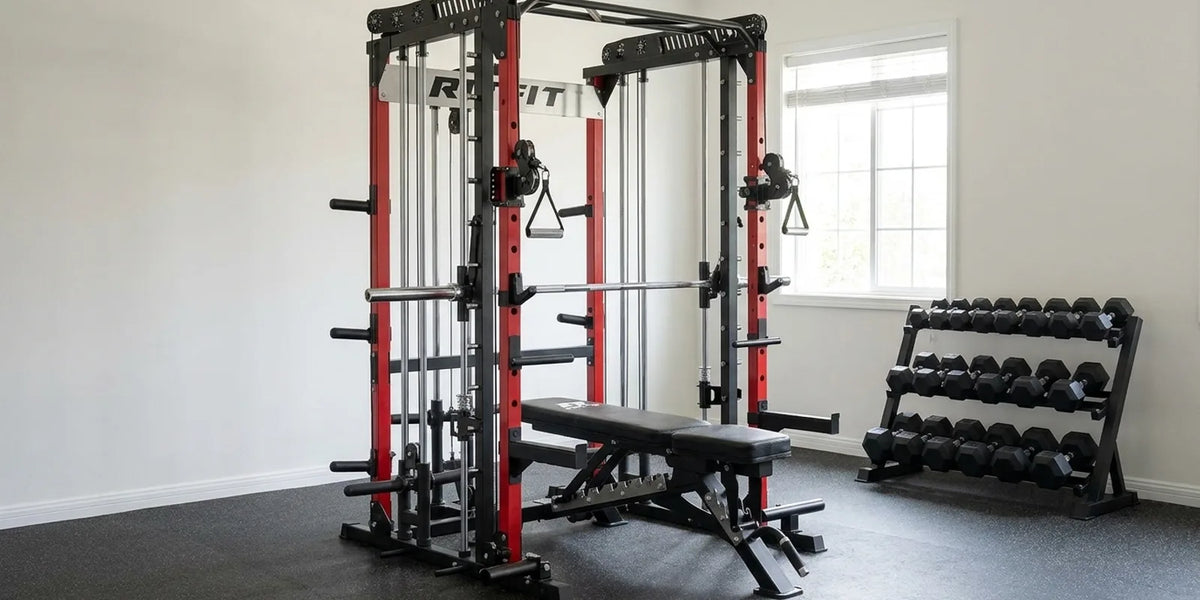
Nordic hamstring curls on a Smith machine let you train the hamstrings eccentrically without a partner, because the fixed bar anchors your ankles in place. This guide covers the exact bar height, ankle setup and knee padding, plus how to control the descent and progress the movement over time.
You will also see the regressions that make the first full rep realistic, the mistakes that stall progress, and how to tell when the setup is working for your garage or home gym.
Quick Answer: Nordic hamstring curls on a Smith machine work by hooking your ankles under a low-set fixed bar, padding your knees, and lowering your torso slowly under control. The bar replaces the partner a standard Nordic curl needs, and a band or a light hand push makes the first reps easier.
Key Takeaways
- No partner required: the fixed bar of a Smith machine holds your ankles, which is the job a training partner normally does during a Nordic curl.
- Setup first: bar near ankle height, a thick pad under the knees, and the bar across the back of the heels rather than the shoes.
- Eccentric focus: the hamstrings do their hardest work while the knees extend, so the slow lowering phase is the part worth training.
- Regress before you load: a band, a hand push or a slight hip hinge lowers the demand without changing the exercise pattern.
- Consistency beats volume: a systematic review and meta-analysis of 13 studies reported very large eccentric strength gains after six weeks or more of Nordic hamstring training [1].
What Are Nordic Hamstring Curls and Why Use a Smith Machine for Them?
Nordic hamstring curls on a Smith machine are a solo version of the Nordic curl, with the fixed bar holding your ankles instead of a partner. The hamstrings work while the knees extend, which makes this an eccentric knee flexion exercise. A systematic review and meta-analysis of 13 studies found very large eccentric hamstring strength gains after six weeks or more of Nordic hamstring exercise training [1].
- Main muscles: the hamstrings, with the biceps femoris long head and semitendinosus carrying most of the load.
- Why the Smith machine: the bar runs on fixed rails, so it stays at the height you set and never needs a second person to pin your heels.
- Why train it: the hamstrings produce their hardest work while lengthening, and this movement loads that exact position under body weight.
The Smith machine removes one common barrier in a garage gym, because a Nordic curl normally needs someone to hold your heels down. Set the bar low enough to kneel under, and the machine becomes the anchor.
If you want to know how much the bar itself contributes before you adjust the pin, how much a Smith machine bar weighs explains the counterbalanced bar math.
"Next, I do Smith machine squats for the quads and glutes. Here I get as deep as I can and explode out of the hole. Doing these on the Smith allows me to push my last set to failure without worrying about dumping the bar."
Jeff Nippard, Science-Based Natural Bodybuilder and Powerlifter, JeffNippard.com, Jeff Nippard's Science-Backed Leg Workout for Massive Quads (Men's Health UK)
How Do You Set Up a Smith Machine for Nordic Hamstring Curls?
Setting up a Smith machine for Nordic hamstring curls takes three adjustments: bar height, ankle anchor and knee padding. A bar set near ankle height on the lowest usable hole lets you lock your heels under it while you kneel on a pad. Start low, then raise the bar by one notch only if your ankles keep slipping.
- Bar height: begin at the lowest hole you can kneel behind, which puts the bar at roughly ankle level.
- Ankle anchor: kneel back far enough that the bar sits across the back of your heels, not on your shoes.
- Knee padding: use a thick mat or a bench under the knees so the descent does not grind your kneecaps.
- Footwear: thin shoes or bare feet keep the ankles close to the bar and reduce the gap.
- Temperature check: do a few easy reps with light assistance to confirm the bar does not roll away.
Kneel on the pad with the bar behind your ankles and your torso tall, then press gently into the bar to test the anchor. On a Smith machine with adjustable J-hooks, changing the height between sets takes one hand, which matters when you are dialing in the setup for the first time.
How Do You Perform a Smith Machine Nordic Hamstring Curl Step by Step?
A Smith machine Nordic hamstring curl starts tall on your knees with the hips extended, then lowers the torso forward as slowly as you can control. The bar holds your ankles, so the remaining work is resisting gravity with the hamstrings. In a study of elite athletes, peak knee flexor force measured at the ankle reached 678 N in the eccentric-only variation and 600 N in the combined version [2].
- Step 1: kneel on the pad and slide your ankles under the bar until it rests across the back of your heels.
- Step 2: squeeze the glutes and hold a straight line from knees to shoulders before you move.
- Step 3: lower the torso forward as slowly as possible, resisting the whole way rather than falling.
- Step 4: catch yourself with your hands, push back to the start, and reset your position before the next rep.
- Stop signal: end the set when the lowering phase turns into a drop rather than a controlled descent.
Most lifters feel the hamstrings working hardest in the last few inches before the hands take over. That final portion is the part worth repeating, and it is also the portion most people skip when they rush the rep.
How Do You Control the Eccentric and Progress the Movement?
Eccentric control comes down to lowering slower than you think you can and stopping the set the moment the descent speeds up. Progress by reducing assistance first, then by adding small amounts of external load once full reps feel controlled. Changing the setup shifts the demand more than most people expect: in a case study of one experienced long jumper, shank inclination, added load and hip flexion moved the peak moment from 69 percent to 154 percent of a standard Nordic curl [3].
- Slow the lowering: take three to five seconds from tall knees to your point of control before the hands catch you.
- Reduce assistance: move from a band to a fingertip hand push, then to no hands at all.
- Add load: a light plate hugged to the chest or a weighted vest raises the demand once clean reps feel easy.
- Frequency: two sessions a week is enough to start, with at least one rest day between them.
- Track it: log bar height, assistance level and controlled reps so progress is visible week to week.
The progression order matters, because adding load before you can control body weight mostly trains the catch. Note your setup in the same way you would track a hamstring workout with a home workout bench, then change one variable at a time.
What Regressions and Alternatives Work If You Cannot Do a Full Rep?
Band assistance, a light hand push on the floor, and a slight hip hinge are the three easiest regressions for a Smith machine Nordic curl. Each option lowers the peak moment, so the eccentric phase stays controllable while you build the strength to finish a rep unassisted.
- Band assistance: run a resistance band from the Smith machine upright to your chest to counter your body weight.
- Hand push: press the floor at the last moment to slow the descent instead of dropping into it.
- Hip hinge: bending at the hips shortens the lever and reduces the moment on the hamstrings.
- Shorter range: lower only partway and stop while you still control the descent.
- Different tool: a Swiss ball leg curl trains the same eccentric pattern with far less ankle demand.
If you would rather build baseline knee flexion strength on a machine first, the RitFit Mustang Pro leg extension and curl machine is a seated alternative that trains the same muscle group. Use it for a few weeks, then return to the Smith machine variant and reassess your full reps.
Which Common Mistakes Slow Your Nordic Hamstring Curl Progress?
The mistakes that stall progress are a bar set too high, missing knee padding, and chasing reps after the descent turns into a fall. Fixing the setup usually adds more to your numbers than adding effort does, because the exercise rewards control rather than volume.
- Bar too high: a high bar lets your heels lift, so the anchor disappears mid rep.
- No padding: bare knees on a hard floor cut the set short for the wrong reason.
- Rushing the descent: a fast drop trains your hands to catch, not your hamstrings to resist.
- Adding load too early: more weight cannot fix a descent you do not control with body weight.
- Too much volume too soon: add reps only after two consecutive controlled sessions.
- Ignoring sharp pain: stop the set if you feel sharp knee or hamstring pain and reset the setup.
A controlled three-rep set does more for the hamstrings than ten sloppy reps, because the adaptation follows the tension you can hold at long muscle lengths. Treat every set as an eccentric rep first and a got-to-the-bottom rep second.
Why Choose the RitFit PSR05 2.0 Smith Machine for Nordic Curls?
The RitFit PSR05 2.0 Smith machine suits Nordic curls because its fixed bar creates a stable ankle anchor and its adjustable J-hooks set the bar to ankle height. The frame also stays put under the forward pull of a hard eccentric, which matters every time you approach a controlled failure rep.
- Durability: a heavier steel frame resists the forward pull that builds through a slow eccentric.
- Versatility: the same bar and J-hooks cover squats, presses, rows and anchored hamstring work.
- Performance: verified buyers describe it as a full-body home machine rather than a single-purpose station.
- Value: one frame provides the anchor for this movement plus the rest of your leg day.
- Footprint: a self-supporting design fits a garage or basement gym where a spotter never would.
The RitFit PSR05 2.0 Smith machine uses a fixed bar path, so the height you set on Monday is the height you get on Friday. If you are comparing frames, the RitFit M1 PRO Smith machine follows the same fixed-rail logic in a different footprint, and the guide to best leg machines for a home gym covers the wider setup.
"If you're short on space, this compact Smith machine delivers everything you need for a complete strength-training experience. The machine is well designed with a small footprint, making it ideal for my home gym. Very happy with this purchase."
Maria del Carmen S. Verified Buyer, RitFit PSR05 2.0 Smith Machine Home Gym Package
FAQs About Nordic Hamstring Curls on a Smith Machine
Can you do Nordic hamstring curls on a Smith machine?
Yes. A Smith machine works well for Nordic hamstring curls because the fixed bar holds its own weight, so you can hook your ankles under it and lower yourself without a training partner. Set the bar low, pad your knees, and start with band assistance or a hand push until you control the descent.
What muscles do Nordic hamstring curls work?
Nordic hamstring curls train the hamstrings, especially the biceps femoris long head and semitendinosus, through eccentric knee flexion. The movement also recruits the glutes and calves for stability. Because the hamstrings work while lengthening, the exercise builds strength at long muscle lengths, which supports eccentric strength gains.
How many sets and reps of Smith machine Nordic curls should I do?
Start with two to three sets of three to five reps once or twice a week, stopping the set when you can no longer control the lowering phase. A 2020 systematic review found very large eccentric strength gains after six weeks or more of Nordic hamstring training, so consistency matters more than high volume.
How do you make Nordic curls easier on a Smith machine?
Make Nordic curls easier by pushing off the floor with your hands, adding a resistance band from the Smith machine upright to your chest, or bending slightly at the hips to shorten the lever. Each option lowers the peak moment on the hamstrings, so you can still train the eccentric phase with control.
What if Nordic curls hurt your knees?
Knee discomfort usually comes from pressing bare knees into a hard floor or from an uncontrolled descent. Use a thick pad or a bench under your knees and lower only as far as you can control. Stop the set if you feel sharp pain and adjust your setup before adding reps.
Is the RitFit PSR05 Smith machine good for Nordic curls?
Yes. The RitFit PSR05 2.0 Smith machine gives you a fixed bar to hook your ankles under, a stable frame, and adjustable J-hooks for setting bar height. That combination makes solo Nordic hamstring curls practical in a garage or home gym.
How do you set the bar height and anchor your ankles for Nordic curls?
Set the bar close to ankle height on the lowest hole you can kneel behind, then kneel back until it crosses the back of your heels. Raise it one notch only if your ankles slip. A bar that is too high lets your heels lift and removes the anchor.
Conclusion
Nordic hamstring curls on a Smith machine turn a two-person exercise into a solo one, because the fixed bar does the job a partner normally does. Set the bar at ankle height, pad your knees, lower under control, and stop the set when the descent runs away from you.
Once two or three clean reps feel easy, reduce the band assistance before you add load. Pair the movement with a balanced leg day routine, and check the RitFit discount guide before you order.
Disclaimer
This article provides general fitness information and is not medical advice. Consult a qualified health professional before starting a new training program, especially if you have a previous knee or hamstring injury.
References
1. Cuthbert M, Ripley N, McMahon JJ, Evans M, Haff GG, Comfort P. The Effect of Nordic Hamstring Exercise Intervention Volume on Eccentric Strength and Muscle Architecture Adaptations: A Systematic Review and Meta-analyses. Sports Med. 2020;50(1):83-99. doi:10.1007/s40279-019-01178-7. PMCID: PMC6942028
2. Augustsson J, Andersson H. Differences in Peak Knee Flexor Force between Eccentric-Only and Combined Eccentric-Concentric Nordic Hamstring Exercise. Sports (Basel). 2023;11(2). doi:10.3390/sports11020041. PMCID: PMC9961423
3. Alt T, Roos T, Nolte K, Modenbach D, Knicker AJ, Jaitner T. Modulating the Nordic Hamstring Exercise From Zero to Hero: A Stepwise Progression Explored in a High-Performance Athlete. J Athl Train. 2023;58(4):329-337. doi:10.4085/1062-6050-0010.22. PMCID: PMC11215643





