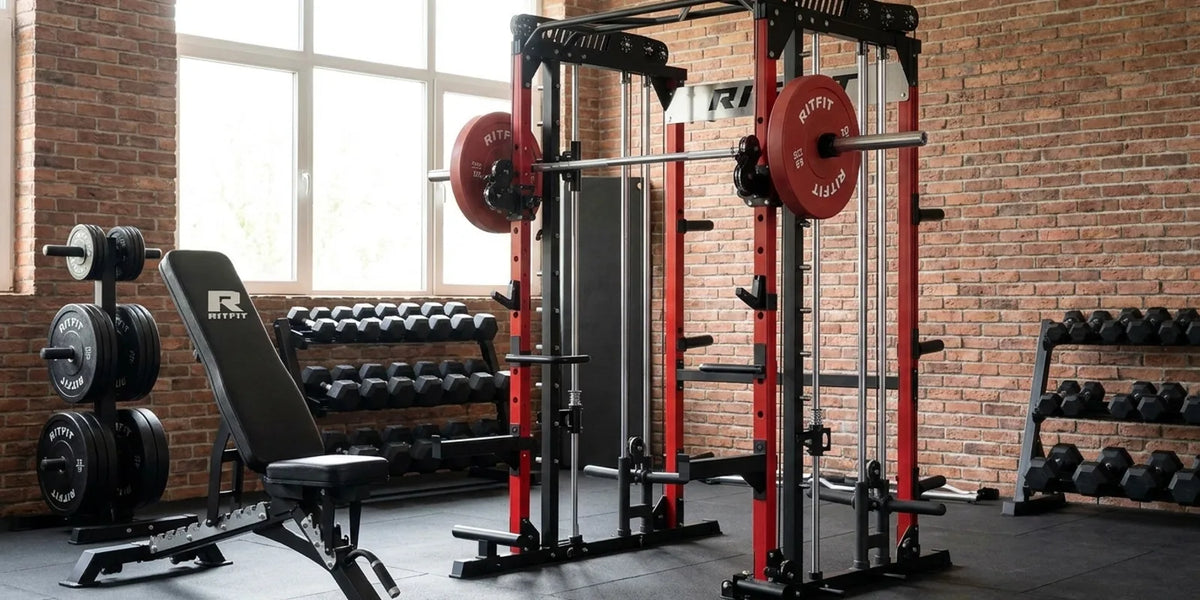
A Smith machine overhead squat is a full depth squat performed with the bar locked out overhead, and it is a real, trainable lift on a guided machine. The rails hold the bar on one vertical plane, so the balance half of the lift disappears and the overhead position becomes the whole job.
This guide covers the hook height, the grip, the foot position, and the safety catches, then explains how to move the position onto a free barbell and where the guided version stops helping.
Quick Answer: A Smith machine overhead squat works because the fixed rails remove the balance demand, so you can focus on ankle, hip, and thoracic mobility with the bar staying over your midfoot. Set the hooks just below your standing reach, take a grip that lets you lock the bar with straight wrists, squat to a controlled depth, and treat the safety catches as your bail out plan.
Key Takeaways
- It is a position drill, not a power lift: the guided bar removes the balance demand, so the Smith machine version teaches the overhead shape and leaves the explosive half of the lift out.
- Hook height comes first: set the bar so you can stand under it and press it overhead without rising onto your toes.
- Grip follows shoulder range: take the narrowest grip that lets you lock the bar out with straight wrists and a tight upper back.
- The catches are the spotter: set them so a failed rep stops at a height you can still escape from.
- Load is not the point early on: the guided bar often feels far lighter than a 45 lb Olympic bar, so add weight only after the bottom position repeats.
What Is an Overhead Squat and Can You Do It on a Smith Machine?
An overhead squat is a squat performed with the bar held overhead and the arms locked out, and yes, it can be trained on a Smith machine. The bar rides on fixed rails, so it cannot drift forward or back while you work on the position itself. The overhead deep squat is also one of the movements inside the Functional Movement Screen, and a 2015 study found that overhead deep squat performance predicted overall screen score.[1]
- What it trains: ankle dorsiflexion, hip mobility, thoracic extension, and scapular upward rotation, which together let the arms travel overhead without a mobility restriction cutting the position short.
- What it asks of the torso: an upright trunk with the ribs stacked over the pelvis, because a forward lean tips the bar off the midfoot.
- What it is not: a substitute for the barbell snatch or clean and jerk, which need bar speed and free bar stabilization the rails take away.
- Who gets the most from it: beginners learning the overhead shape, lifters with a restricted overhead position, and anyone training alone in a garage or basement.
If your shoulders or thoracic spine cannot reach the overhead position yet, the Smith machine front squat trains the same squat pattern with a much shorter lever arm.
Why the Smith Machine Works for Overhead Squats
The Smith machine works for overhead squats because it removes the balance variable and leaves the position itself as the thing to learn. The bar travels on fixed vertical rails, so it stays on one plane while you work on ankle, hip, and thoracic range. A 2025 kinematic study examined how load variation changes lower limb joint torque during overhead squats, which is why position and load have to be progressed together.[2]
- Teaching tool: trainers often use a guided bar path to teach the overhead position before asking a lifter to hold a free bar overhead.
- Mobility focus: with balance handled, the limit is usually joint range rather than coordination, so the weak link shows up immediately.
- Scope: the movement builds the overhead position, the upright torso, and the ankle and hip range that support it.
- Boundary: it develops none of the snatch or clean and jerk qualities, because the rails supply the stabilization those lifts demand.
"I love Smith machine front squats.
I do them with a medium stance and my toes pointed outward.
By doing so, I'm really trying to focus on the outer sweep.
I do these very deep, as deep as I can go.
"
Jay Cutler, Four-time Mr. Olympia, Cutler Nutrition, Jay Cutler Answers 10 Questions About His Quad Training (SimplyShredded)
How to Set Up an Overhead Squat on a Smith Machine
Setting up a Smith machine overhead squat comes down to four decisions: hook height, grip width, foot position, and the brace. Get those four right and the descent almost organizes itself, because the rails remove the steering work a free bar would add.
- Hook height: set the bar where you can stand underneath it, press it up, and lock out without rising onto your toes or shrugging hard.
- Grip width: start narrow, then widen until the wrists stay straight and the upper back stays tight at full lockout.
- Foot position: stand so the bar sits over the middle of your foot, which usually means the feet directly under or just in front of the hooks.
- Brace: take a big breath into the belly, pull the ribs down, and hold that anterior core bracing through the whole rep.
Build the overhead position on the same machine you squat on, and keep the Smith machine collection in mind if you are still choosing a frame with enough overhead room. A Smith machine shoulder press is the simplest way to rehearse the lockout before loading the squat.
Warm the position up rather than forcing it. A 2017 study found that different volumes of self-massage produced acute changes in overhead deep squat performance, which fits the common coaching habit of spending a few minutes on soft tissue and thoracic range before the first working set.[3]
How to Squat Down and Bail Out Safely on the Smith Machine
Descend under control, keep the bar over the midfoot, and set the safety catches so a failed rep stops at a height you can still escape. The guided bar cannot be dumped sideways, so the catches do the job a spotter would normally do, and midfoot balance becomes a deliberate check instead of a reflex.
- Unhook: press the bar up and rotate the wrists to release it from the hooks, then settle the bar over your midfoot before the first rep.
- Descend: sit down and back at a controlled tempo, aiming for the deepest position you can hold with a neutral spine and heels down.
- Bottom position: keep the elbows locked, the chest tall, and the bar stacked over the middle of the foot rather than in front of the toes.
- Catch height: set the pins just below your bottom position, then check them with an unloaded rep before you add plates.
Plan the exit before the set, not during it. If a rep stalls, let the bar settle onto the catches and step out from underneath rather than fighting a bar that is already drifting forward, and review the basics of training safely on a Smith machine at home before your first heavy attempt.
"The Smith machine has been amazing! I've been loving all the different ways to use it for the full total body workout experience. We also paired the multiple grip pull-down bar with it and it's been perfect!"
Danielle H. Verified Buyer, RitFit PSR05 2.0 Multifunctional Smith Machine Power Rack with LAT-Pull Down System
Is the RitFit PSR05 Smith Machine the Right Pick for Overhead Squats?
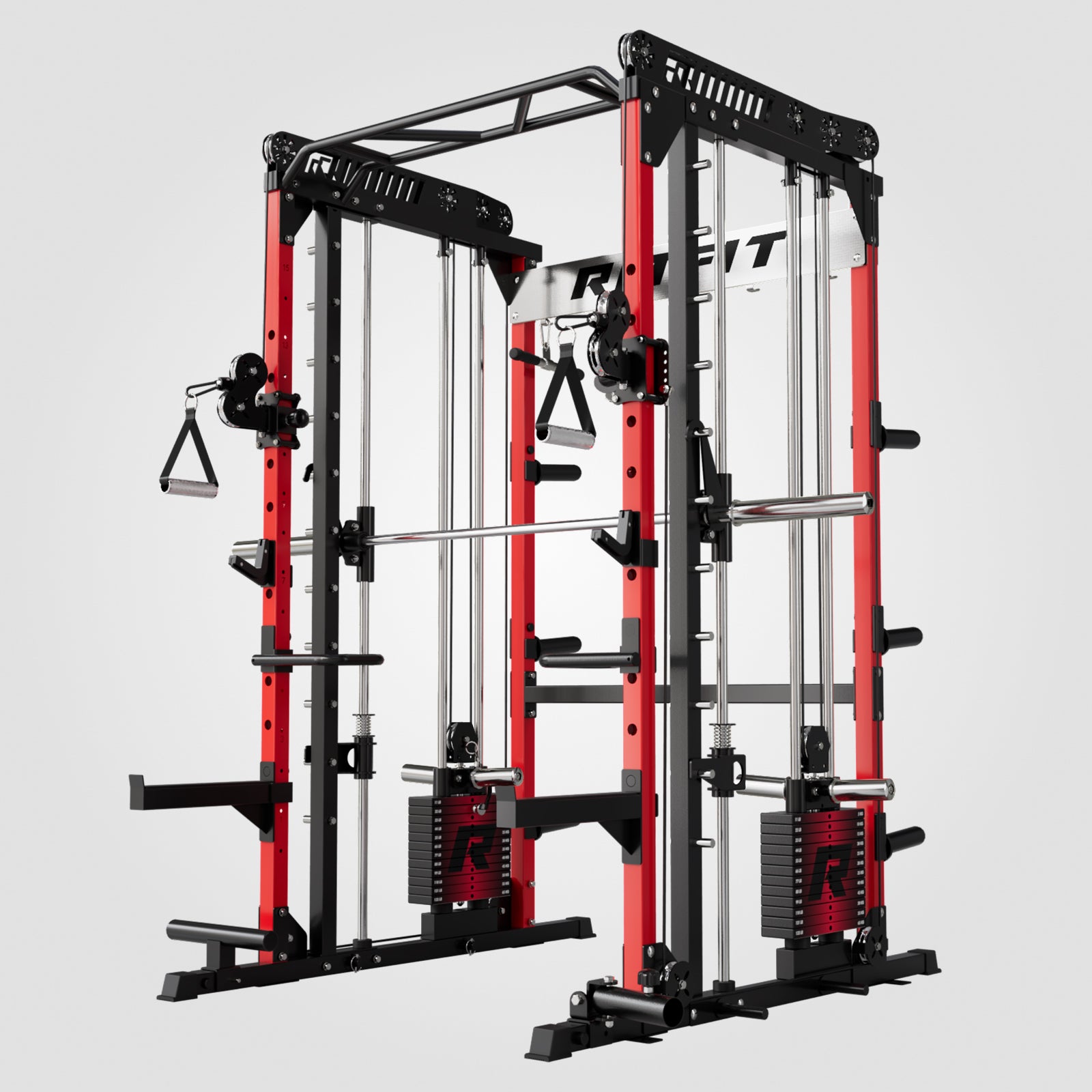
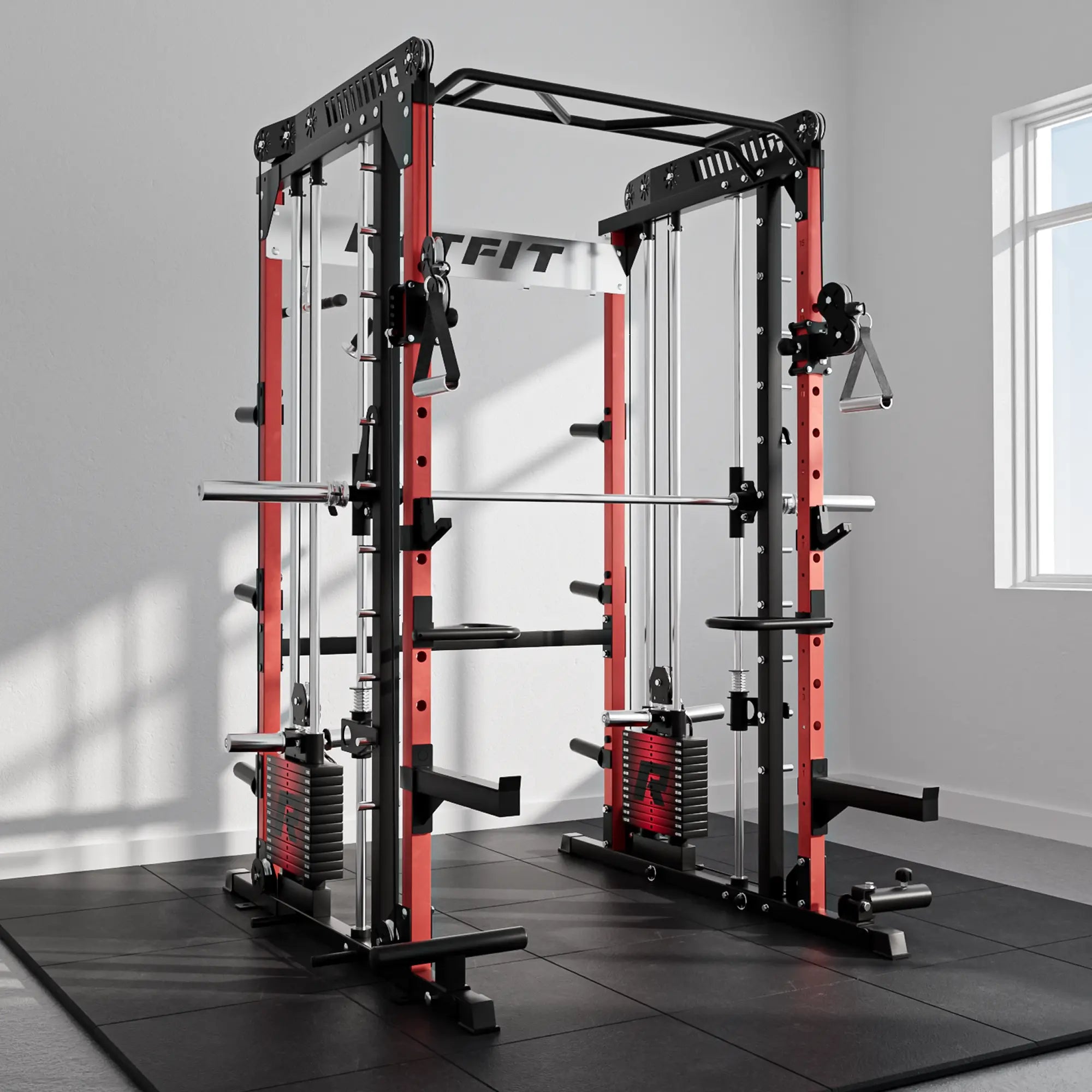
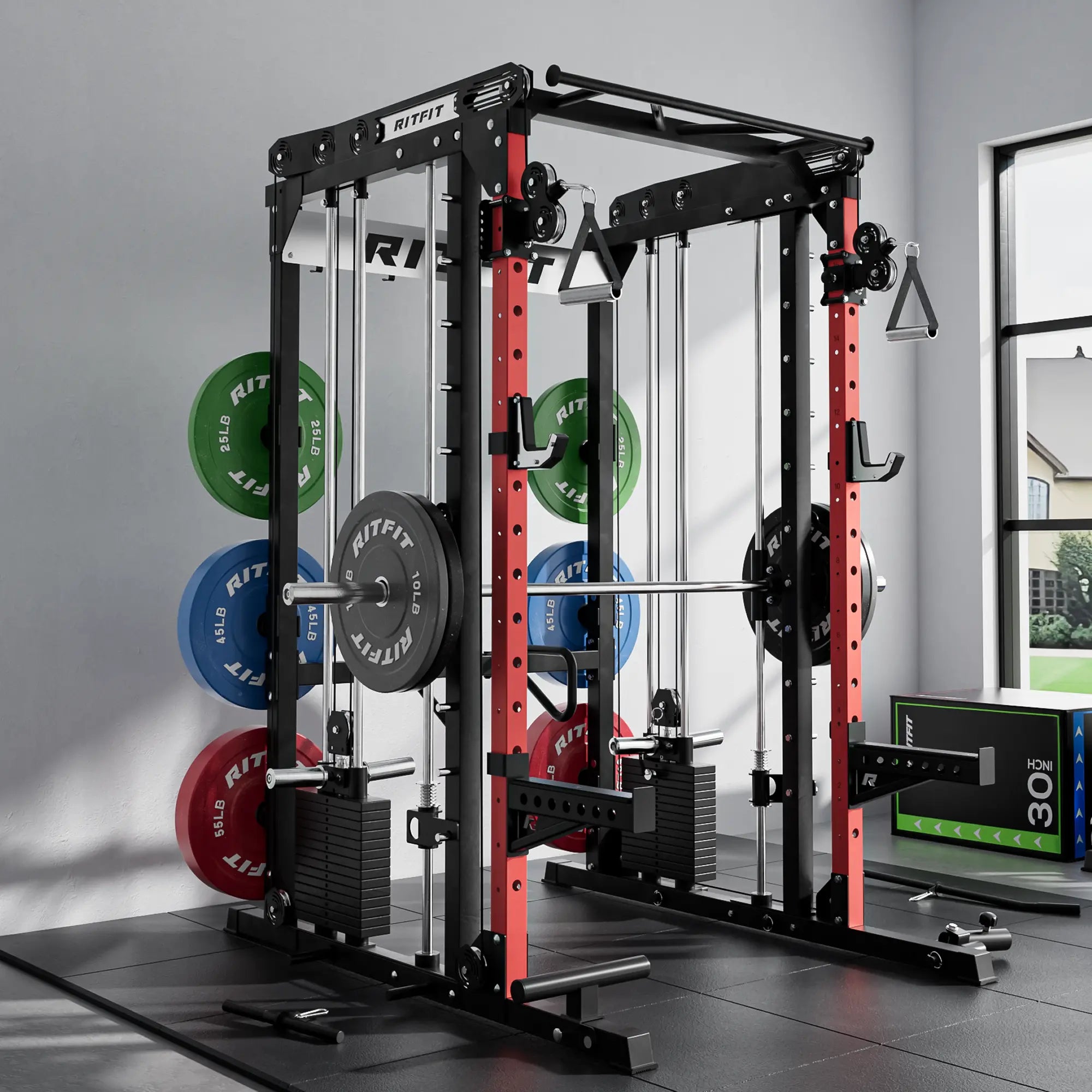
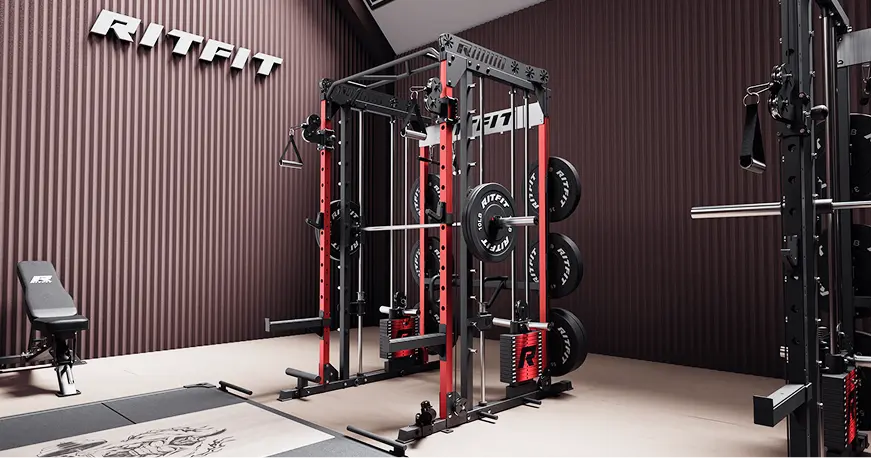
The RitFit PSR05 2.0 Multifunctional Smith Machine suits overhead squat practice because its guided bar and safety catches let a solo lifter unrack, descend, and bail without help. RitFit lists the frame at roughly 82 to 83 inches tall, which fits many 7 to 8 ft rooms, and lists a 353 lb pulley capacity rating for the cable system. Verified buyers rate the machine 4.6 out of 5 across 131 reviews, and the reviews repeatedly mention a smooth bar glide and straightforward assembly.
- Overhead room: a frame under 83 inches tall matters in a low ceiling basement, because you need clearance for your own hands above the bar, not just for the machine.
- Bar feel: buyers describe the guided bar as smooth on the rails, which is what makes a slow overhead descent easy to control.
- Safety catches: the adjustable catches set the bottom of a failed rep, so an overhead position you cannot yet hold is a recoverable mistake rather than an emergency.
- Versatility: the same footprint also carries the lat pulldown, low row, and landmine work, so the machine earns its space on days you are not squatting.
If you want a taller all-in-one frame with cable crossovers, the RitFit M1 PRO Smith machine covers the same guided bar work in a bigger package. Either way, pair the overhead squat with the standard patterns in the complete Smith machine squat guide so the position work sits inside a normal leg day.
"This is amazing I love having my own smith machine it's smooth and lets me get the piece of mind to get that mind muscle connection! Ritfit customer service is spectacular especially when I didn't get tracking for the smith machine and it ended up shipping within the second day after ordering and I look downstairs (I live in a apartment) and it was sitting right there! Fantastic won't recommend this product more especially for a apartment home gym. Video reviews coming soon on YouTube on epk!"
Sam w. Verified Buyer, RitFit PSR05 2.0 Pink Smith Machine with LAT-Pull Down
How Much Weight, How Many Reps, and How Often Should You Practice
Start with the empty guided bar and treat load as the last variable, because a Smith bar often carries far less effective starting resistance than a 45 lb Olympic bar. One RitFit guide suggests a guided bar usually delivers about 6 to 45 lb of effective starting resistance, and that many home machines feel closer to 25 to 35 lb.
- Load: bar only for the first few sessions, then small jumps of 5 to 10 lb once the position repeats.
- Sets and reps: 3 to 5 sets of 3 to 5 reps with a brief pause at the bottom is plenty for a position drill.
- Frequency: 2 to 3 short sessions each week, placed before or after your main squat work rather than instead of it.
- When to add weight: after three controlled reps reach the same depth with the bar still over the midfoot.
Check the numbers on your own machine before you load anything, and use the how much a Smith machine bar weighs breakdown to set a realistic starting point.
How to Move From the Smith Machine to a Free Bar
Move to a free bar once the guided version looks identical on every rep, then expect the load to drop sharply at first. Because you cannot snatch a barbell into position safely, most lifters press or push press it overhead first and squat from there. A 2021 study compared lower limb kinematics during the overhead deep squat across movement screen score groups, which is a reminder that the position keeps changing as the underlying range changes.[4]
- Test the shape first: run the empty barbell overhead and see whether the wrists, elbows, and trunk still hold the same positions without the rails.
- Set up by pressing: a push press or a strict press gets the bar overhead, and the descent begins from a locked out position.
- Drop the load: cut well below the guided weight for the first free bar sessions, because the stabilization work is new again.
- Keep both: the guided version stays useful as a warm up or a technique reset, even after you can hold a free bar.
If you are still deciding which frame earns the floor space, the Smith machine vs power rack comparison covers the tradeoffs for a home gym.
Common Mistakes and When to Stop
The most common mistakes are forcing an overhead position the shoulders cannot reach and letting the bar drift in front of the midfoot. A 2025 kinematic study examined the shoulder kinetic chain during overhead squat exercise with elastic resistance, which is a useful reminder that the shoulders work as a linked system rather than an isolated joint.[5]
- Chasing depth before range of motion: squatting past the point where the trunk can stay upright tips the bar forward and turns a mobility drill into a grind.
- Widening the grip too far: an extra wide grip feels easier overhead but shortens the range you actually need to build.
- Loading too early: adding plates before the bottom position repeats trains a bad position under more weight.
- Ignoring the catches: skipping the unloaded check means you find out where the pins sit during a real miss.
Substitute rather than force.
Swap in the front squat, a shoulder press, or a heel elevated goblet squat on days when the overhead position is not there, and stop the set for sharp shoulder pain, numbness or tingling down the arm, or a low back that rounds under load.
None of those signals improve with more reps, so end the session and let a qualified professional look at them.
FAQs About Overhead Squats on a Smith Machine
Can you do an overhead squat on a Smith machine?
Yes. The Smith machine fixes the bar on vertical rails, so it removes the balance demand that makes a free weight overhead squat hard to learn. You still need the ankle, hip, and thoracic mobility to sit under the bar, but you can practice the overhead position without fighting a drifting bar.
How wide should your grip be for a Smith machine overhead squat?
Start with the narrowest grip that lets you lock the bar overhead with straight wrists and a tight upper back, and widen it only if your shoulders or thoracic spine cannot reach that position. A wider grip feels easier overhead but demands more shoulder stability as you descend.
How much weight should a beginner use for overhead squats on a Smith machine?
Most beginners should start with the empty guided bar and add 5 to 10 lb only after they can hold the bottom position with a vertical torso for three controlled reps. Because a Smith bar is often counterbalanced, the starting resistance feels far lighter than a 45 lb Olympic bar.
Is a Smith machine overhead squat the same as a barbell overhead squat?
No. A Smith machine overhead squat trains the position, the overhead stability, and the mobility you need, but the fixed rails do the balancing for you. Freestyle barbell overhead squats add a stabilization demand that carries over to the snatch, so use the Smith version to learn the shape rather than to replace barbell work.
What should you do if you cannot get your arms overhead with the bar?
Work on the limiting joint first instead of forcing the position. Limited thoracic extension and ankle dorsiflexion are the two most common blocks, so add thoracic mobility drills and heel elevated practice, and keep the load light until the bar can sit over your midfoot with straight wrists.
How often should you practice Smith machine overhead squats?
Two or three short practice sessions each week are plenty when you are learning the position, and each session can be three to five sets of three to five reps with light load. Add weight only after the bottom position looks the same on every rep.
Why do overhead squats feel easier on a Smith machine?
Because the balance demand is removed. The rails hold the bar on a fixed vertical plane, so you are not steering the bar while you manage a deep squat. That makes the Smith machine version a useful way to practice the position when you cannot yet control a free bar overhead.
How do you set the hook height and grip for a Smith machine overhead squat?
Pick a hook height that lets you stand under the bar and lock it out without rising onto your toes. Then take the narrowest grip that keeps the wrists straight and the upper back tight, and place the feet so the bar tracks over the middle of the foot.
Conclusion
A Smith machine overhead squat is a practical way to build the overhead position, the upright torso, and the ankle and hip range the movement demands, because the guided bar takes balance out of the equation and leaves technique as the only variable.
Set the hooks, pick a grip your shoulders can hold, check the catches with an empty bar, and keep the load light until the bottom position repeats. Start with the RitFit discount guide if you are building the rest of the setup.
Disclaimer
This article is general fitness information and not medical, rehabilitation, or personal training advice. Consult a qualified healthcare or fitness professional before starting a new overhead training program, especially if you have a history of shoulder, spine, or ankle injury.
References
1. Clifton DR, Grooms DR, Onate JA. OVERHEAD DEEP SQUAT PERFORMANCE PREDICTS FUNCTIONAL MOVEMENT SCREEN SCORE. Int J Sports Phys Ther. 2015;10(5):622-7. PMCID: PMC4595915
2. Ikeda Y, Kawabe M, Hisamitsu T. Impact of Load Variation on Lower Limb Joint Torque during Overhead Squats. J Hum Kinet. 2025;99:5-18. doi:10.5114/jhk/195877. PMCID: PMC12612806
3. Monteiro ER, Skarabot J, Vigotsky AD, Brown AF, Gomes TM, Novaes JD. ACUTE EFFECTS OF DIFFERENT SELF-MASSAGE VOLUMES ON THE FMS OVERHEAD DEEP SQUAT PERFORMANCE. Int J Sports Phys Ther. 2017;12(1):94-104. PMCID: PMC5294950
4. Heredia C, Lockie RG, Lynn SK, Pamukoff DN. Comparison of Lower Extremity Kinematics during the Overhead Deep Squat by Functional Movement Screen Score. J Sports Sci Med. 2021;20(4):759-765. doi:10.52082/jssm.2021.759. PMCID: PMC8488845
5. Salles FLP, Pascoal AG. A Kinematic Study on the Use of Overhead Squat Exercise with Elastic Resistance on the Shoulder Kinetic Chain Approach. J Funct Morphol Kinesiol. 2025;10(1). doi:10.3390/jfmk10010097. PMCID: PMC11943263