








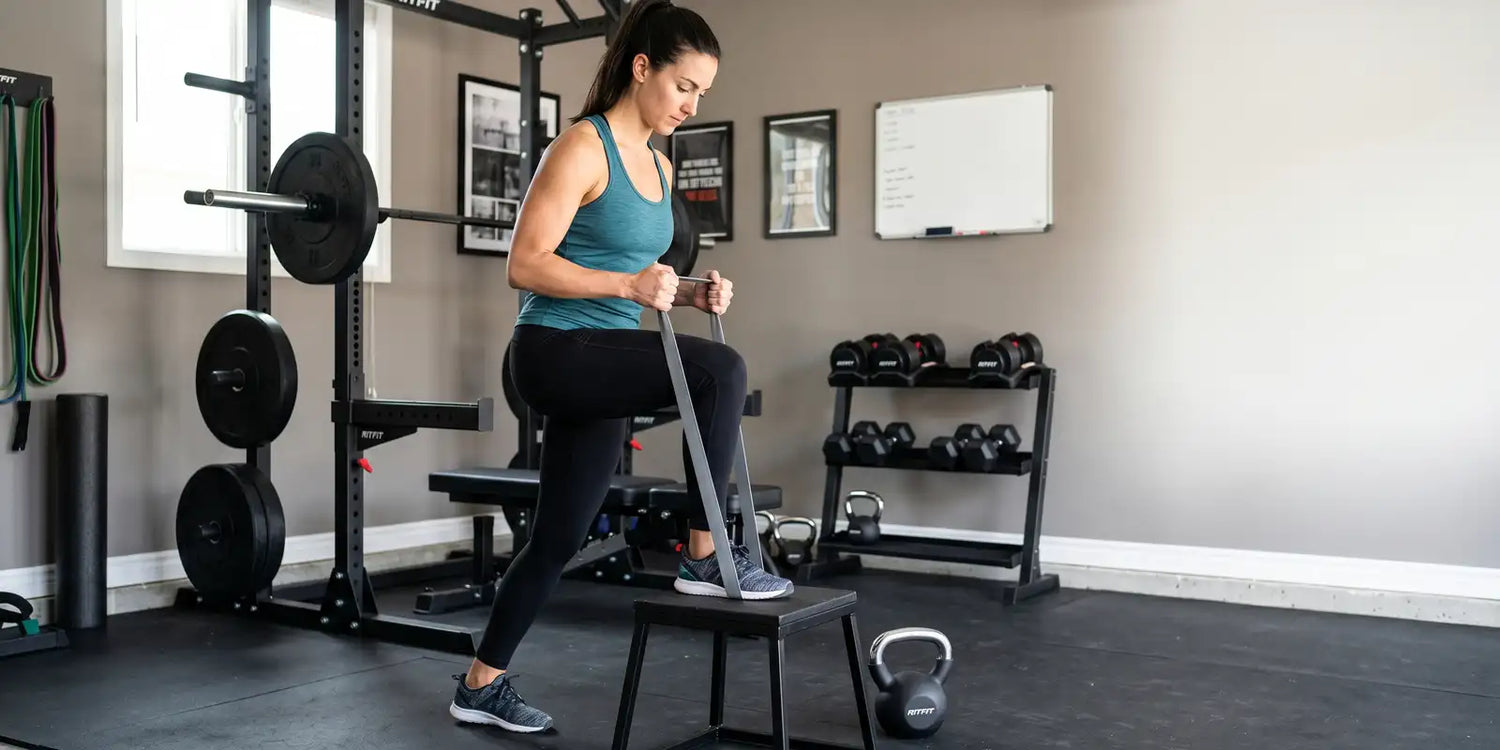
Knee strengthening exercises at home build the muscles that control and protect the knee, and they work whether you are following a physical therapy plan or building your own leg day.
This guide covers the nine moves to start with, how to add resistance with bands, a step, dumbbells, or a leg machine, how often to train, how to progress, and the mistakes that stall progress.
Quick Answer: The best knee strengthening exercises at home are the quad set, straight leg raise, short arc quad, wall sit, glute bridge, side lying hip abduction, step down, step up, and split squat. Train them two or three times per week, start with bodyweight, then add bands, dumbbells, or one leg machine as the movement gets easy.
Key Takeaways
- Nine moves cover the whole joint: The quad set, straight leg raise, short arc quad, wall sit, glute bridge, side lying hip abduction, step down, step up, and split squat train the quadriceps, the glutes, and the hamstrings with almost no gear.
- Bodyweight is already a real load: A study found that in 24 patients, band and bodyweight leg exercises produced higher peak quadriceps activity than the machine versions of the same movements.[3]
- Both exercise styles work: Open kinetic chain moves like the quad set and closed kinetic chain moves like the step down both improved strength and thigh girth, and the three modes tested over 12 weeks did not differ significantly.[1]
- Frequency does the work: A quadriceps protocol run over 8 weeks with twice-weekly sessions improved pain, function, and quality of life.[4]
- Progress one variable at a time: Add reps first, then resistance, and keep every rep inside a range of motion you can control.
What are the best knee strengthening exercises at home?
The best knee strengthening exercises at home are nine moves that cover the quadriceps, the glutes, and the hamstrings without needing a gym. Each one starts at bodyweight and can be loaded later with a band, a step, a pair of dumbbells, or one leg machine. A randomized trial found that 96 patients with knee osteoarthritis who trained for 12 weeks improved quadriceps strength and thigh girth, with thigh girth up a mean of 1.32 cm, and open kinetic chain, closed kinetic chain, and combined training all produced similar results.[1]
- Quad set: Sit with the leg straight, press the back of the knee down, and tighten the thigh for 5 seconds. Work up to 10 slow squeezes per set.
- Straight leg raise: Keep the knee locked and lift the straight leg about 12 inches, then lower it over three seconds. Perform 2 to 3 sets of 10 reps.
- Short arc quad: Place a rolled towel under the knee and straighten the leg through the final part of the range. This is the gentlest way to load the quadriceps when a full range feels rough.
- Wall sit: Slide down a wall to a knee angle you can hold comfortably, then keep the whole foot flat. Start with 20 seconds and build toward 45 seconds.
- Glute bridge: Lie on your back, drive through the heels, and lift the hips until knees, hips, and shoulders line up. Pause for one second at the top.
- Side lying hip abduction: Lie on your side and raise the top leg against gravity to train the gluteus medius. Keep the hips stacked so the movement stays at the hip, not the lower back.
- Step down: Stand on a low step and lower the other foot slowly to the floor, controlling the knee on the way down. A three second descent is the whole exercise.
- Step up: Drive through the whole foot to stand on the step, then lower yourself down instead of stepping back. Keep the knee tracking over the middle of the foot.
- Split squat: Step into a staggered stance and lower the back knee toward the floor with the front shin close to vertical. Add a dumbbell in each hand once bodyweight feels controlled.
Open kinetic chain work and closed kinetic chain work both belong in the plan, since the trial above found no meaningful difference between the modes.[1] Start with the two or three easiest moves, then add one new exercise each week until all nine are in rotation.
Which muscles should you strengthen for healthy knees?
The quadriceps, the gluteus medius and the other hip muscles, and the hamstrings matter most for healthy knees. Together they control how the kneecap tracks and how force reaches the joint. A clinical review reports that resistance exercise for the hip extensors, hip abductors, hip external rotators, and the quadriceps is backed by a large body of evidence in anterior knee pain.[2]
- Quadriceps and VMO: These extend the knee and guide the kneecap through its groove. The quad set, short arc quad, and leg extension are the most direct way to load them.
- Gluteus medius and hip abductors: Weak hips let the thigh rotate inward and change how the knee lines up under load. Side lying hip abduction and banded lateral walks train them.
- Hamstrings: These balance the pull of the quadriceps and support the back of the knee. Leg curls and hip hinges cover them.
- Calves and ankles: Stiff ankles change knee position during squats and step downs, so add heel raises to the program.
Because the weak link often sits above or below the joint, a plan that trains only the knee leaves the real problem untouched. Add one hip exercise and one hamstring exercise to every session, and use this library of hip exercises for strength and glute activation when you want more options.
How do you add resistance with home gym equipment?
Home knee strengthening progresses from bodyweight to elastic bands, then to a low step, dumbbells, or a leg machine. A study found that in 24 patients, band and bodyweight versions of leg exercises produced higher peak quadriceps activity than the machine versions, so a machine is a progression tool rather than a requirement.[3]
- Resistance bands: The cheapest way to load knee extensions, terminal knee extensions, and lateral walks. Use a light band first, then step up one band level at a time.
- A low step or box: Turns step downs, step ups, and calf raises into controllable single leg work. The lower the step, the easier the range of motion.
- Adjustable dumbbells: Load split squats, step ups, and hip hinges. Small jumps matter here, since the knee feels every extra pound on the way down.
- Leg extension and curl machine: Trains the quadriceps and hamstrings through a fixed path, which makes it easy to add a small amount of resistance and repeat the same movement every week.
- Smith machine or rack: Useful for split squats and partial range squats when both legs need to be loaded with support. The fixed bar path takes balance out of the equation.
The RitFit Mustang PRO Leg Extension Curl Machine covers knee extension and knee flexion in one footprint, and the wider leg machines category covers the rest. If you only buy one thing, start with a set of resistance bands and follow these resistance band exercises you can do at home.
The point of gear is simple: keep adding resistance after bodyweight stops being enough. This guide to what resistance bands help with explains why a band is enough to start.
How often should you train your knees and how do you progress?
Knee strengthening exercises should be trained two or three times per week, with at least one rest day between sessions. A study found that a quadriceps strengthening protocol delivered over 8 weeks with twice-weekly sessions improved pain, function, and quality of life in patients with knee osteoarthritis.[4]
- Frequency: Two or three sessions per week with roughly 48 hours between them gives the tissue time to recover and adapt.
- Sets and reps: 2 to 3 sets of 10 to 15 reps per exercise is a general starting range for the loaded moves.
- When to add resistance: Once you can finish the top of the rep range with a slow, even tempo and the same range of motion every rep.
- How much to add: The smallest jump your equipment allows, then rebuild from the bottom of the rep range before you add again.
- Back off weeks: Every fourth or fifth week, cut the sets in half and keep the movement patterns. This is a reset, not a step back.
Keep the same nine moves and change only one variable at a time, so you know what caused the improvement. If a movement stops feeling controlled, drop back a progression step and rebuild from there.
What common mistakes stall a home knee strengthening program?
The common mistakes that stall a home knee strengthening program are training only the quadriceps, never adding resistance, rushing the lowering phase, and pushing through sharp pain. Fixing the sequence is usually easier than adding another exercise.
- Only chasing the quadriceps: Skipping the glutes leaves the hip control problem unsolved, which is the same mistake trainers see most often.
- Never adding resistance: Staying on the same band or bodyweight version for months stops the strength gains that the knee needs.
- Rushing the lowering phase: Step downs and split squats only build control when the descent takes two to three seconds.
- Training through sharp pain: Sharp or rising pain is a signal to reduce the range of motion or the resistance, not to push harder.
- Skipping the warm up: Five minutes of easy walking, cycling, or heel raises makes the first working set feel smoother.
"Strengthening the muscles around the knee is the way to go to get rid of some of this knee pain. A lot of us are probably using the wrong exercises and focusing on the wrong muscles."
Jeff Cavaliere, MSPT, CSCS, Physical Therapist and Strength Coach, former Head Physical Therapist for the New York Mets, Jeff Cavaliere Shows How To Fix Knee Pain With Simple Exercises
Some lifters add a pair of knee sleeves for heavy leg days, mostly for warmth and a sense of support. They do not replace the training itself, and the strength work is what changes the knee over time.
How do you build a small weekly knee strengthening plan at home?
A small weekly knee strengthening plan fits into three sessions of about 20 minutes each, split into floor work, single leg control, and loaded strength. Each session uses three or four of the nine moves, so nothing takes longer than a warm up plus a few sets.
| Session | Focus | Exercises | Sets and reps |
|---|---|---|---|
| Day 1 | Floor work | Quad set, straight leg raise, short arc quad, glute bridge | 2 to 3 sets of 10 to 15 reps |
| Day 2 | Single leg control | Wall sit, side lying hip abduction, step down | 2 to 3 sets of 8 to 12 reps |
| Day 3 | Loaded strength | Step up, split squat, then leg extension and leg curl when a machine is available | 2 to 3 sets of 10 to 15 reps |
A starting template for three sessions per week with a rest day between each one. Keep the same nine moves and change one variable at a time.
Run the plan for four weeks before you judge it, and log the resistance and reps for every session. If you want a second angle on the loaded day, these weight bench exercises at home cover split squats and step ups in more detail.
What equipment supports a home knee strengthening program?
A home knee strengthening program needs a non slip surface, one light resistance source, and a low step to start. Everything else is optional and only matters once the basics stop being enough.
- Floor work surface: A cushioned, non slip exercise mat makes quad sets, glute bridges, and side lying abduction comfortable enough to repeat three times a week.
- Light resistance: A set of RitFit resistance bands adds the first real load and stores in a drawer. Versatility is the whole point at this stage, because one band covers knee extensions, lateral walks, and hip work.
- Single leg control: A low step, a plyo box, or the bottom stair. Pick a height where you can control the descent for three seconds on every rep.
- Loaded strength: A pair of adjustable dumbbells, or a RitFit Mustang PRO Leg Extension Curl Machine when you want the quadriceps and hamstrings trained in isolation with small, repeatable load jumps.
Warranty terms and build details differ from model to model, so check the current product page for the frame rating and coverage before you buy anything. Judge each piece on what it unlocks for the nine moves, not on how it looks in a photo.
For the wider setup, the home gym guide covers space planning, and this list of leg strengthening exercises and these best home exercises for knee pain relief add more variations to the same nine patterns.
"Easy set up! Using it is even easier! Honestly I'd compare it to a piece of equipment you'd find in a commercial gym! So smooth and easy to change weight and configurations between leg extension and leg curl. I'm very happy with my purchase that's why I decided to review it."
Jesus S. Verified Buyer, RitFit Mustang PRO Leg Extension Curl Machine
FAQs About Knee Strengthening at Home
Can physical therapy really fix knee pain?
For many common causes such as patellofemoral pain and early osteoarthritis, physical therapy is a first line approach.
Strengthening the quadriceps, hips, and hamstrings reduces pain and improves function.
It is not a guaranteed cure for every cause, so a licensed therapist should assess your specific knee before you begin.
How long does it take for knee PT exercises to work?
Many evidence based programs run for roughly eight to twelve weeks of consistent training, often two to three sessions per week.
Some people feel less pain within a few weeks, while structural conditions take longer.
Progress depends on consistency, correct technique, and addressing the hip and ankle, not just the knee itself.
What muscles should I strengthen for knee pain?
Focus on the quadriceps, the gluteus medius and other hip muscles, and the hamstrings.
These muscles control how the kneecap tracks and how forces pass through the joint.
Many therapists emphasize the hips, since weak glutes can cause the thigh bone to track poorly and create knee pain even when the knee itself is healthy.
Should I exercise if my knee hurts?
Gentle, controlled strengthening is usually encouraged for mild aches, but sharp pain, swelling, locking, or a knee that gives way are signals to stop and seek professional care. A general rule is that mild discomfort that settles quickly is acceptable, while pain that lingers or worsens after exercise means you should consult a licensed physical therapist.
How often should I do knee strengthening exercises?
A common starting point in the research is about three sessions per week, allowing rest days between for recovery.
Begin with bodyweight or light resistance, perform two to three sets of each exercise, and progress reps before adding load.
Always prioritize pain free range of motion over the amount of weight you lift.
What are the best knee strengthening exercises at home?
The best knee strengthening exercises at home are the quad set, straight leg raise, short arc quad, wall sit, glute bridge, side lying hip abduction, step down, step up, and split squat. Start with bodyweight versions, then add bands, dumbbells, or a leg machine once each movement feels controlled and pain free.
Can you strengthen your knees without any equipment?
Yes. Bodyweight moves like the quad set, straight leg raise, glute bridge, and wall sit load the quadriceps, glutes, and hamstrings using nothing but floor space and a wall. Once those feel easy, a light resistance band, a step, or a pair of dumbbells adds the extra resistance your knees need to keep getting stronger.
How much resistance should I start with for knee strengthening?
Start with bodyweight or the lightest band setting you own, and use a range of motion you can control without pain. When you can finish two or three sets of 12 to 15 reps with a slow, even tempo, add a small amount of resistance and drop back to 8 to 10 reps.
Conclusion
Knee strengthening exercises work because they build the quadriceps, glutes, and hamstrings that keep the knee tracking well under load. Start with the quad set, straight leg raise, and glute bridge, train two or three times per week, and add resistance only when the current version feels controlled.
Add a band, a step, or a leg machine when bodyweight stops being enough, and keep every rep inside a range you can own. If you are building the space around that plan, check the RitFit discount guide before you buy.
Disclaimer
This article is general educational information only and is not medical advice, diagnosis, or treatment for any individual condition. Always consult a licensed physical therapist or doctor before starting any exercise program, especially if you have existing knee pain or injury.
References
1. Olagbegi OM, Adegoke BO, Odole AC. Effectiveness of three modes of kinetic-chain exercises on quadriceps muscle strength and thigh girth among individuals with knee osteoarthritis. Arch Physiother. 2017;7:9. doi:10.1186/s40945-017-0036-6. PMCID: PMC5759897
2. McClinton SM, Cobian DG, Heiderscheit BC. Physical Therapist Management of Anterior Knee Pain. Curr Rev Musculoskelet Med. 2020;13(6):776-787. doi:10.1007/s12178-020-09678-0. PMCID: PMC7661565
3. Jakobsen TL, Jakobsen MD, Andersen LL, Husted H, Kehlet H, Bandholm T. Quadriceps muscle activity during commonly used strength training exercises shortly after total knee arthroplasty: implications for home-based exercise-selection. J Exp Orthop. 2019;6(1):29. doi:10.1186/s40634-019-0193-5. PMCID: PMC6606685
4. Imoto AM, Peccin MS, Trevisani VF. Quadriceps strengthening exercises are effective in improving pain, function and quality of life in patients with osteoarthritis of the knee. Acta Ortop Bras. 2012;20(3):174-9. doi:10.1590/S1413-78522012000300008. PMCID: PMC3718434





