








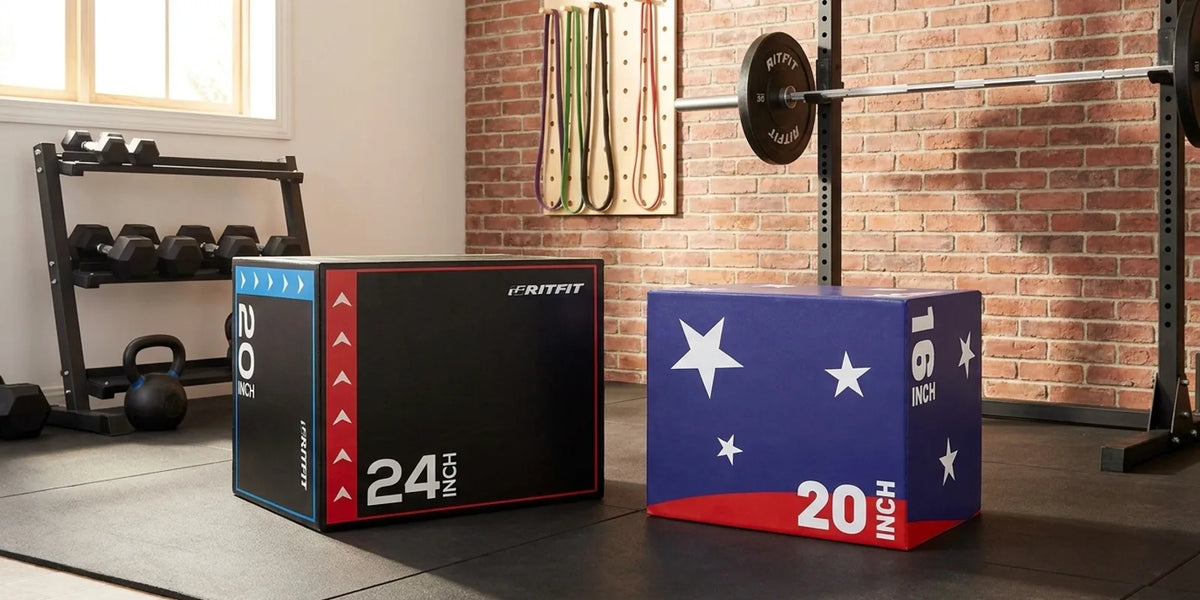
Choosing the right plyo box height starts with your landing, not your ego. Standard boxes come in 20, 24, and 30 inch heights, and a 3-in-1 box covers all three in a single footprint so you can size up as your landing gets quieter.
This guide compares 3-in-1 and fixed boxes, weighs wood against foam for a garage gym, and sets the landing boundary where a beginner should stop and reset the height. No exercise list, no guesswork.
Quick Answer: Pick a plyo box height you can land on with both feet flat and knees bent, which is usually 20 inches for beginners, 24 inches for regular jumpers, and 30 inches for advanced athletes. A 3-in-1 box covers all three heights in one footprint.
Key Takeaways
- Start at 20 inches: Most adults can land on a 20 inch box with flat feet and bent knees, so that is the default beginner setting.
- Height is not a power lever: A study of recreationally active college students found that box height did not change jump performance when maximal effort was emphasized[1].
- 3-in-1 wins on space: One flip box replaces three fixed boxes and gives you 20, 24, and 30 inch settings in a single footprint.
- Foam suits home gyms: A foam box protects your shins on a missed jump and stays quieter on a concrete floor than a wooden box.
- Landing sets your ceiling: Move up a height only when every landing is quiet, flat footed, and controlled.
How Do You Choose the Right Box Height?
The right plyo box height is the one you can land on with flat feet and bent knees. Start at 20 inches if you are new to jumping, then treat 24 and 30 inches as settings you earn by landing quietly.
Height is a confidence tool as much as a training variable. A study of 31 recreationally active college students tested box jumps at 0, 20, 40, 60, and 80 percent of each person's maximal jump height and found that box height did not change jump performance when maximal effort was emphasized[1].
The three standard heights: 20, 24, and 30 inches
- 20 inches: The beginner setting. Most adults clear it with a shallow dip and land with the whole foot flat on the surface.
- 24 inches: The everyday training setting once 20 inches feels automatic, and where most home gym jumpers stay long term.
- 30 inches: The advanced setting. Use it only when your landing is silent and your knees stay behind your toes.
A two minute test to set your starting height
- Step 1: Stand facing the box with your feet hip width apart and roughly one foot back from the face.
- Step 2: Jump, then land with both feet flat, hips pushed back, and chest up.
- Step 3: Hold the landing for two seconds. If you wobble or your heels lift, the box is too tall.
- Step 4: Repeat five times and move up one height only when all five landings look and sound identical.
Common mistakes when picking a box height
- Chasing the tallest box: Height alone does not build power, so a box you cannot land on cleanly teaches your body nothing.
- Jumping down instead of stepping down: Stepping down protects your knees more than an extra rep on a tall box ever will.
- Ignoring the floor surface: Traction matters as much as height, so check for sliding before you add inches.
Once you know your height, the next decision is which box design delivers it. Browse the full plyo box collection before you commit to a single size.
"Box jumps are a great exercise, especially for added power. However, they will NOT add power unless you do them powerfully. Sets of 10, 20, or 30 are absolutely useless for this particular goal. If the goal is max power development, jump as high as you can. Rest. Repeat. The box height doesn't even really matter, it's just a tool to help mentally. Higher boxes don't necessarily mean more power output."
Andy Galpin, PhD, Professor of Exercise Science and Human Performance, Parker University, What You Need to Know About Box Jumps
What Is the Difference Between 3-in-1 and Fixed Boxes?
A 3-in-1 box gives you three heights from one unit because you flip it onto a different face. A fixed box is built at one height and stays that way, so you buy a second box to move up.
The trade is space against simplicity, and most home gyms cannot afford to store three separate platforms.
| Feature | 3-in-1 box | Fixed box |
|---|---|---|
| Heights per unit | Three, set by flipping the box | One, set at build |
| Storage footprint | One footprint for three heights | One footprint per height |
| Height changes | Flip to a new face, no tools | Buy or store another box |
| Best for | Garage gyms with limited floor space | Gyms with room and one working height |
Comparison reflects how each design is built and sold, not a performance ranking of any brand.
If you train several jump heights in one session, the flip design removes the dead time of swapping boxes. Two RitFit examples of the fixed style are described on the TF jump box specification page, which is useful when you want a single dedicated height.
When your sessions change every week, follow the height progression instead with the beginner plyo box exercise guide.
Is a Wood or Foam Box Better for a Home Gym?
Foam is the better default for a home gym because a missed jump dents foam instead of your shin. Wood is firmer underfoot and gives a more precise landing surface, but it is far less forgiving when your foot clips the edge.
Foam boxes: forgiving surface, garage friendly weight
Rebonded foam with a PVC cover keeps the box light enough to move alone but heavy enough to stay planted. The foam plyo box specification page lists the covered surface and the load ratings for each size, which is the number that matters when several people share the box.
Wood boxes: firm landing, fixed footprint
A wooden box does not compress, so the landing response is immediate and predictable for an experienced jumper. It also does not absorb a shin scrape, and it tends to be louder on a concrete floor in a shared space.
Neither material fixes a bad height choice, so choose the height first. Let the surface match how much control you already have.
If you train other modalities alongside jumping, the workout type overview shows where plyometric work fits in a weekly plan.
"I bought the heavier 30/24/20 foam plyo box for home use. i wasnt sure what to expect compared to much more expensive ones. I am happy with the quality so far and delivery was good too."
Mark K. Verified Buyer, RitFit 3-in-1 Plyo Box Soft Foam Box Jump Platform
How High Should Beginners Jump, and When Should You Stop?
Beginners should jump at a height where every landing stays flat footed and quiet. That is usually 20 inches at first, and the ceiling rises with control rather than with confidence.
Load climbs with box height, and the knee absorbs most of that climb. A study of 16 experienced male participants found that raising the drop jump landing height from 0.15 m to 0.75 m increased both vertical ground reaction force and contact force in the medial compartment of the knee[2].
A second study of 32 athletes jumping from 26 cm, 35 cm, and 42 cm boxes found that knee joint moments grew with every step up and peaked at the 42 cm box[3]. The same study reported that the knee joint drove force generation while the ankle joint mostly stabilized the landing.
That does not mean you should never go higher, because control is trainable. In a study of 24 male lacrosse athletes jumping from a 0.42 m box, a self selected landing style produced jump height on par with a soft landing and power output on par with a stiff landing[4].
- Landings turn loud: A thud means the joints are absorbing the jump instead of the muscles.
- Heels lift or knees cave in: Both signals mean the box sits above your current level of control.
- The box shifts under you: Stop the set and reset it on a flat, non slip surface before the next rep.
- Sharp pain anywhere: End the session rather than forcing a height your landing cannot own yet.
Drop back one height, rebuild five clean landings, and only then move up again. If the jump itself needs work before you add inches, drill these box jump workouts at your current height.
Is the RitFit Classic 3-in-1 Soft Plyo Box Worth It?
The RitFit Classic 3-in-1 Soft Plyo Box is worth it if you need three heights without three footprints. Verified buyers rate it 4.9 out of 5 across 92 reviews on the product page, and the soft foam surface removes most of the shin risk that scares beginners away from jumping.
The box uses a rebonded foam core with a PVC cover and weighs 26 to 60 pounds depending on size, which is heavy enough to stay planted and light enough for one person to flip between faces.
| Size | Dimensions | Product weight | Weight capacity |
|---|---|---|---|
| Size S | 20 x 18 x 16 inches | 26 lb | 200 lb |
| Size M | 24 x 20 x 16 inches | 35 lb | 300 lb |
| Size L | 30 x 24 x 20 inches | 60 lb | 440 lb |
Dimensions, weights, and capacity ratings come from the RitFit product specification page. Every size uses a rebonded foam core with a PVC cover.
- First box with tight floor space: Size S covers the 16, 18, and 20 inch faces and is the easiest to store.
- Sharing with a stronger training partner: Size M adds a 24 inch face and a 300 lb capacity for a modest step up in price and footprint.
- Advanced jumpers and heavier athletes: Size L reaches 30 inches and is rated to 440 lb, so it also covers depth jumps and box squats.
- Matching an existing setup: The RitFit Patriotic Color 3-in-1 Foam Plyo Box uses the same flip design if you care about how the box looks in the room.
Skip it if you already train at one set height every week, because a fixed box does that job for less money and takes up no more floor. Check the jump box general info page when you want the product details side by side before ordering.
"3 in 1 Extra Firm Soft Plyo Box Excellent value. High quality and durable, but light enough to transport."
Erik Stevens, Verified Buyer, RitFit 3-in-1 Plyo Box Soft Foam Box Jump Platform
FAQs About Plyo Box Height
What is the most common plyo box height for beginners?
Twenty inches is the usual starting point for most beginners, because most adults can land on a 20 inch box with flat feet and bent knees. Move up to 24 inches only after ten clean repetitions feel easy. The 30 inch setting is a long term goal, not a first week target.
Is a 3-in-1 plyo box as sturdy as a fixed box?
A well built 3 in 1 box is stable in every orientation, but the flip design adds one check a fixed box does not need. Set the box down so the landing face sits flat, then press a corner with your hand. At 26 to 60 pounds the RitFit box stays planted.
Does a higher plyo box build more power?
No. A study of 31 recreationally active college students found that box height did not change jump performance when maximal effort was emphasized. Andy Galpin, PhD, makes the same point, saying the box height is a mental tool and that higher boxes do not necessarily mean more power output.
Wood or foam plyo box for a garage gym?
Foam suits most home gyms. A foam box has a forgiving surface that protects your shins on a missed jump, it is quieter on a concrete floor, and the RitFit 3-in-1 Soft Plyo Box covers three heights in one footprint. Wood is firmer underfoot, but it is less forgiving on contact.
When should you stop jumping on a plyo box?
Stop the set when your landings stop being quiet and controlled, or when you have to reach with your knees to get up. Stop the session if any landing causes sharp pain, or if the box moves or tilts under you. Reset the height lower before the next attempt.
Conclusion
Your plyo box height should match the landing you can control today, not the jump you hope to hit next month. Start at 20 inches, earn 24 and 30 inches with quiet landings, and let a 3-in-1 design cover all three settings without eating your floor space.
Measure your space, run the two minute test, and buy the box type that fits your ceiling and your floor. If you are still deciding what to add next, start with the RitFit discount guide before you order.
Disclaimer
This article covers plyo box selection and jump training mechanics for general fitness education, not medical advice. Consult a qualified physician or physical therapist before starting a jumping program, especially if you have a history of knee, ankle, or shin problems.
References
1. Dos Santos ML, Shields J, Berton R, et al. Does Box Height Matter? A Comparative Analysis of Box Height on Box Jump Performance in Men and Women. Int J Exerc Sci. 2024;17(1):720-729. doi:10.70252/MTLS9089. PMCID: PMC11166134
2. Bi G, Hua L, Sun J, Xu Q, Li G. Impact of different landing heights on the contact force in the medial tibiofemoral compartment and the surrounding muscle force characteristics in drop jumps. PLoS One. 2024;19(7):e0307538. doi:10.1371/journal.pone.0307538. PMCID: PMC11259252
3. Günay A, Kahraman MY, Aşçı A. The effect of box height on joint stiffness performance in drop jumping: a cross sectional study. BMC Sports Sci Med Rehabil. 2026;18(1). doi:10.1186/s13102-026-01624-w. PMCID: PMC13036913
4. You CH, Huang CH. Effects of Leg Stiffness Regulated by Different Landing Styles on Vertical Drop Jump Performance. J Hum Kinet. 2022;83:29-37. doi:10.2478/hukin-2022-0066. PMCID: PMC9465758





