








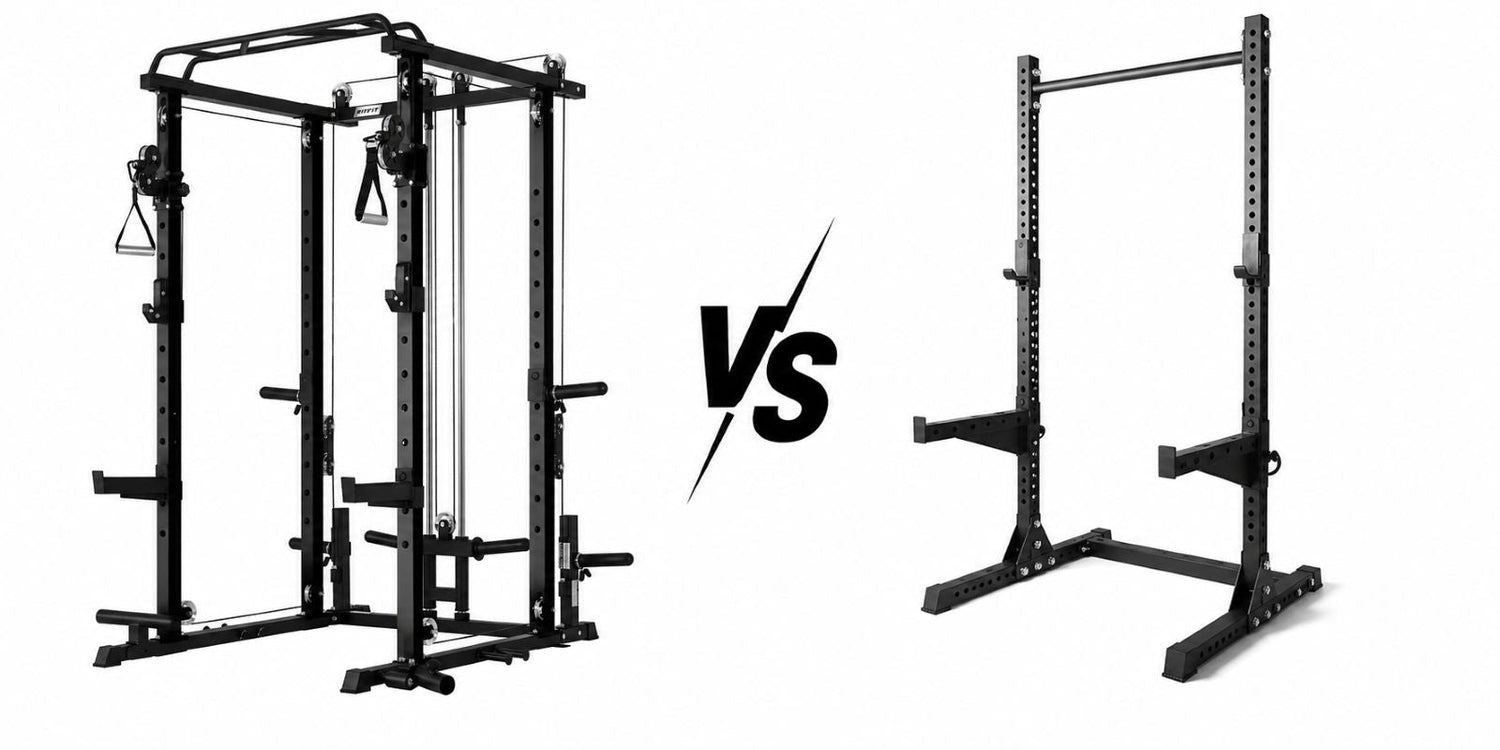
A power cage is usually the safer choice for heavy solo lifting, while a power rack is the broader category that can include full cages, half racks, and compact folding systems. The best pick for your home gym depends on your training style, floor space, ceiling height, and whether you want cable attachments or a smaller footprint.
This guide compares power cage vs power rack across safety, space, strength training, and muscle growth so you can choose the right station for squats, bench press, pull ups, rows, and long term home gym training.
Quick Answer: A power cage surrounds you inside a full four post frame and is the safer choice for heavy solo squats and bench press. A power rack is the broader term that can include cages, half racks, and folding racks, so it fits better when compact space matters more than maximum enclosed safety.
Key Takeaways
- Best for safety: A full power cage is the strongest choice for heavy solo squats and bench press because the bar stays inside an enclosed frame.
- Best for small spaces: A compact power rack, half rack, or folding rack fits better when floor space, parking space, or ceiling height is limited.
- Term clarity: Power cage and power rack are often used interchangeably, but power rack is usually the broader category that includes cages, half racks, and squat racks.
- Best for versatility: A power cage with a cable system adds pulldowns, rows, curls, and accessory work to barbell training in one station.
- Best buying rule: Choose based on safety setup, footprint, ceiling height, attachment compatibility, and the exercises you will actually run each week.
Power Cage vs Power Rack: What Is the Difference?
The biggest difference between a power cage and a power rack is structure. A power cage usually surrounds the lifter with four uprights and inside safeties, while a power rack can describe a full cage, a half rack, a folding rack, or a wider rack system.
| Feature | Power Cage | Power Rack |
|---|---|---|
| Structure | Usually a full four post or six post enclosed frame. | Can refer to a full cage, half rack, squat rack, or rack system. |
| Safety | Generally stronger for solo lifting when safety bars are set correctly. | Safe when paired with proper spotter arms, pins, or straps. |
| Space | Requires more floor space and walk around clearance. | Can be more compact, especially half racks and folding racks. |
| Best For | Heavy squats, bench press, pull ups, rack pulls, and cable upgrades. | General barbell work, smaller gyms, lighter setups, and flexible layouts. |
| Buying Priority | Choose when safety and long term training variety matter most. | Choose when compact size and budget flexibility matter most. |
Use the comparison table to match each rack style to your training room and lifting routine.
What Is a Power Cage?
A power cage is a strength training rack with an enclosed frame that lets you lift a barbell inside the rack. It is built for squats, bench press, overhead press, rack pulls, pull ups, and accessory work.
- Full frame: A power cage normally has four uprights that create an inside lifting zone.
- Safety support: Safety bars, straps, or pins can catch the bar if a rep fails.
- Exercise range: Most cages support squats, presses, pull ups, rows, and rack based barbell work.
- Upgrade potential: Many cages accept attachments such as dip handles, landmine attachments, cable systems, and storage.
For buyers who want one central strength station, the RitFit P3 1200LBS Power Cage With Smooth Cable System is the most relevant RitFit option because it combines the enclosed cage format with cable training capability.
What Is a Power Rack?
A power rack is the broader term for rack based strength equipment, and a power cage is one type of power rack. Half racks, folding racks, and squat racks are also grouped under the same category on many product pages and gym conversations.
- Full power rack: This often means the same thing as a power cage, especially when it has four uprights and inside safeties.
- Half rack: This has a more open structure and usually uses external safety arms.
- Folding rack: This mounts or folds closer to the wall to save space when not in use.
- Squat rack: This is usually simpler and may not offer the same enclosed safety zone as a cage.
If space saving matters more than a full enclosed frame, browse the RitFit Power Rack Package collection for compact rack options.
Power Cage vs Half Rack vs Squat Rack: What Is the Difference?
A power cage gives the most complete safety zone, a half rack saves space, and a squat rack is usually the simplest barbell station. The right choice depends on how heavy you lift, whether you train alone, and how much room you can dedicate to strength equipment.
| Rack Type | Best Use | Main Limitation |
|---|---|---|
| Power Cage | Heavy solo lifting, long term strength training, full rack safety. | Requires more floor space and planning. |
| Half Rack | Garage gyms, moderate lifting, open front access. | Less enclosed than a full cage. |
| Squat Rack | Basic squats, presses, and entry level barbell work. | Usually fewer attachment and safety options. |
| Folding Rack | Tight spaces, shared garages, flexible layouts. | May offer less built in storage and accessory depth. |
If a cable driven multi station appeals instead, the best power rack and smith machine combo guide compares combined free weight and machine setups.
How Safe Are Power Racks for Solo Lifting?
A full power cage is usually the safer choice for solo lifting because the bar can be caught inside the frame by properly set safety bars. Research on resistance training safety points to proper instruction, load control, and safe lifting procedures as key factors in reducing risk.[1]
- For squats: Set the safety bars just below the lowest controlled depth of your squat.
- For bench press: Set the safeties low enough for full range of motion, but high enough to stop the bar before it traps the chest.
- For rack pulls: Use the same rack height on both sides and load the bar evenly before every set.
- For solo training: Avoid max attempts unless your safeties are tested, locked, and correctly positioned.
Fitness center injury reviews also emphasize that exercise choice, technical execution, and training context matter when managing risk in resistance training.[2] For solo lifters weighing enclosed versus open designs, the best all in one power rack for home gym guide breaks down safety features by station.
How Much Space Do You Need for a Power Cage or Power Rack?
A rack must fit your room, your barbell, and your movement path, so you should measure more than the product footprint. You need rack height, bar sleeve clearance, plate loading space, ceiling height, and walking room around the station.
- Measure rack height: Confirm the top of the rack fits below the ceiling with room for pull ups if you plan to do them.
- Measure barbell width: A standard Olympic bar needs side clearance for sleeves, plates, collars, and loading.
- Measure training depth: Leave enough space to unrack, walk in, adjust plates, and move safely around the station.
- Measure storage needs: Plates, benches, cable handles, and rack attachments can add more required space than the rack alone.
For rooms where overhead height matters, the best power cage with pull up bar for home gym guide helps you confirm pull up clearance before you buy.
Which Is Better for Strength Training?
A power cage is usually better for strength training if you plan to squat, bench, press, and pull heavy over time. Traditional strength training methods are generally safe when compared with higher risk resistance training categories, but safe setup and controlled progression still matter.[3]
- For powerlifting style training: Choose a full cage with reliable safeties and enough interior space.
- For bodybuilding: Choose a cage or rack that supports barbell work, cable work, and adjustable bench positions.
- For general fitness: Choose the rack that gives you the exercises you repeat most often.
- For beginners: Choose the system that makes setup simple, safe, and easy to repeat.
To match a rack to your budget and strength goals, the best power rack for home gym under $1,000 guide compares RitFit P3 options by price and capacity.
Which Is Better for Muscle Growth?
A power cage and a power rack can both build muscle when you train with progressive overload, proper technique, and enough weekly volume. An umbrella review of resistance training variables found that total volume, exercise execution, and programming choices influence hypertrophy outcomes.[4]
- Squats: Train quads, glutes, adductors, spinal erectors, and trunk bracing.
- Bench press: Train chest, shoulders, triceps, and upper body pressing strength.
- Rows: Train lats, traps, rear delts, rhomboids, and grip support.
- Pull ups: Train back, biceps, core tension, and shoulder control.
- Cable work: Add pulldowns, rows, curls, triceps pressdowns, face pulls, and isolation work.
To add accessory volume without extra equipment, see power rack exercises beyond the big 3 for movements that fill the gaps between your main lifts.
When Should You Choose a Power Cage?
A power cage is the right choice when safety, heavy lifting, and long term versatility matter more than saving the smallest possible footprint. It is the most complete rack choice for a serious home gym built around barbell strength training.
- You train alone: A full cage gives you inside safety support when no spotter is available.
- You lift heavy: The enclosed structure is better suited for serious squats and bench press.
- You want one main station: A cage can become the center of a garage gym or basement gym.
- You want attachments: Cable systems, dip bars, landmines, and storage options can expand training variety.
- You plan to keep upgrading: A cage gives you a stronger long term equipment foundation.
If a full cage plus a complete package appeals, the RitFit P3 Power Cage 1200lbs Home Gym Package 1 bundles the rack with compatible training pieces in one order.
When Is a Smaller Power Rack the Better Choice?
A smaller power rack is the right choice when space control matters more than maximum enclosed safety. This is common in shared garages, low ceiling rooms, small apartments, and rooms where equipment must stay close to a wall.
- You have limited floor space: A compact rack can leave more room for dumbbells, plates, and movement work.
- You share the garage: A folding rack can help preserve parking or storage space.
- You lift moderate loads: You may not need a full cage if your training is controlled and conservative.
- You want a simpler build: A smaller rack can reduce assembly size and visual bulk.
Remember that the most compact rack is the one that still gives you safe setup room. Measure your room first, then compare open and enclosed designs against your weekly routine.
How to Choose Between a Power Cage and a Power Rack?
A good rack must match your room, training plan, safety expectations, and future attachment needs, so use this checklist before you choose. The biggest mistake is buying on price or appearance alone.
- Room size: Measure ceiling height, wall clearance, rack depth, and side clearance.
- Barbell clearance: Confirm that you have enough room to load plates on both ends of the bar.
- Safety system: Check whether the rack uses safety bars, straps, pins, or spotter arms.
- Training goals: Match the rack to squats, bench press, pull ups, rows, cable work, or general fitness.
- Attachment compatibility: Think about dip bars, landmine attachments, pulley systems, storage, and J hooks.
- Bench fit: Make sure your bench can slide into the rack at the right position for flat and incline pressing.
- Assembly path: Check doorways, stairs, garage access, and floor protection before delivery.
If you ignore ceiling height, a rack can technically fit the room but still be too low for pull ups, so never skip barbell clearance or future upgrades. For a structured walkthrough, start with the RitFit Home Gym Guide before you place an order.
RitFit Power Cage and Power Rack Recommendations
The best RitFit choice depends on whether you want maximum cage style safety, compact storage, or a complete strength station. Use these recommendations as a buying shortcut before comparing full product pages.
- Best colorful full cage package: Choose the RitFit P3 Pink Power Cage 1200lbs Home Gym Package for the same 1200 lb capacity with a distinctive look.
- Best full cage with cable: The P3 Power Cage with Smooth Cable System, reviewed above, is the top pick when pulldowns and rows matter as much as squats.
- Best space conscious direction: A folding rack or half rack fits tighter rooms, and the power rack package collection lists both styles.
- Best upgrade path: Add dip bars, landmines, and storage attachments over time instead of replacing the whole rack.
Pair your rack with a compatible Olympic barbell and weight plates, because the bar is the part of the setup that touches every lift.
1lbs.
5 or 29mm bar will be the most durable and provide the best service over time.
NEVER buy a 32mm bar.
"
Mark Rippetoe, Strength Coach and Author of Starting Strength, Starting Strength
FAQs About Power Cages and Power Racks
What is the main difference between a power cage and a power rack?
A power cage is usually a full enclosed rack, while power rack is often a broader category. Many buyers use both terms interchangeably, but the key difference is whether the rack surrounds the lifter with inside safety bars or uses a more open frame.
Is a power cage safer than a power rack for solo lifting?
Yes.
A full power cage is usually safer for solo lifting because the bar can be caught inside the frame by properly set safety bars.
A half rack can also be safe, but it depends more on long safety arms, correct setup, and conservative loading.
Can beginners use a power cage safely?
Yes.
Beginners can use a power cage safely when they learn rack height, safety bar height, and basic barbell form before adding heavy weight.
The cage does not replace technique, but it gives a controlled training area for squats, presses, rows, and pull ups.
Which is better for a garage gym, a power cage or a power rack?
A power cage is better for a garage gym if you have enough floor space and want one main strength station. A smaller power rack or folding rack is better when parking space, ceiling height, or storage clearance matters more than maximum inside lifting safety.
Do I need a power cage for bench press and squats?
No. You do not always need a power cage, but it is the better choice for heavy squats and bench press without a spotter. The enclosed frame lets you set safety bars near the bottom of your range, which can reduce risk during failed reps.
How much space do I need for a power cage?
You need enough space for the rack footprint, bar sleeve clearance, plate loading, and walking room around the station. Measure ceiling height, rack height, barbell width, and storage depth before buying, because a rack that fits on paper may still feel cramped during training.
Should I choose a power cage with a cable system?
Yes.
Choose a power cage with a cable system if you want more exercise variety from one footprint.
It can support pulldowns, rows, curls, triceps work, and accessory training, which is useful when you do not want a separate cable machine.
What RitFit rack is best for a complete home gym?
The RitFit P3 1200LBS Power Cage With Smooth Cable System is the most relevant choice when you want a power cage plus cable training in one station. For tighter spaces, the RitFit Multi Functional Folding Squat Rack PMW02 is a more compact rack option.
Can I add a cable system to a power cage later?
Yes.
Many power cages accept bolt on cable attachments, and some models such as the RitFit P3 ship with a cable system built in.
A cable upgrade adds pulldowns, rows, curls, and pressdowns without buying a separate machine, which saves floor space.
Should I bolt my power rack to the floor?
It depends on your rack and training loads.
Most floor mounted cages work well on rubber mats, while freestanding racks may shift during heavy squats or pull ups.
Check the manual, and secure the frame when you lift near capacity or train in a small space.
Conclusion
For most serious home gym owners, a full power cage is the better long term choice because it offers stronger solo lifting safety and more upgrade potential. A smaller power rack or folding rack is still the smarter pick when your space is tight, your training is moderate, or your garage must stay flexible.
Choose the rack that fits your room first, then match it to your safety needs, weekly exercises, and future attachments. If you are ready to build or expand your home gym, check the RitFit sales page for current rack deals.
Disclaimer
This article is for general fitness and equipment education only, and it is not a substitute for professional advice. Always follow the product manual, inspect your rack before use, and consult a qualified fitness professional if you are new to barbell lifting.
References
1. Faigenbaum AD, Myer GD. Resistance training among young athletes: safety, efficacy and injury prevention effects. Br J Sports Med. 2010;44(1):56-63. doi:10.1136/bjsm.2009.068098
2. Bonilla DA, Cardozo LA, Velez Gutierrez JM, et al. Exercise selection and common injuries in fitness centers: a systematic integrative review and practical recommendations. Int J Environ Res Public Health. 2022;19(19):12710. doi:10.3390/ijerph191912710
3. Serafim TT, de Oliveira ES, Maffulli N, Migliorini F, Okubo R. Which resistance training is safest to practice? A systematic review. J Orthop Surg Res. 2023;18(1):296. doi:10.1186/s13018-023-03781-x
4. Bernardez Vazquez R, Raya Gonzalez J, Castillo D, Beato M. Resistance training variables for optimization of muscle hypertrophy: an umbrella review. Front Sports Act Living. 2022;4:949021. doi:10.3389/fspor.2022.949021





