








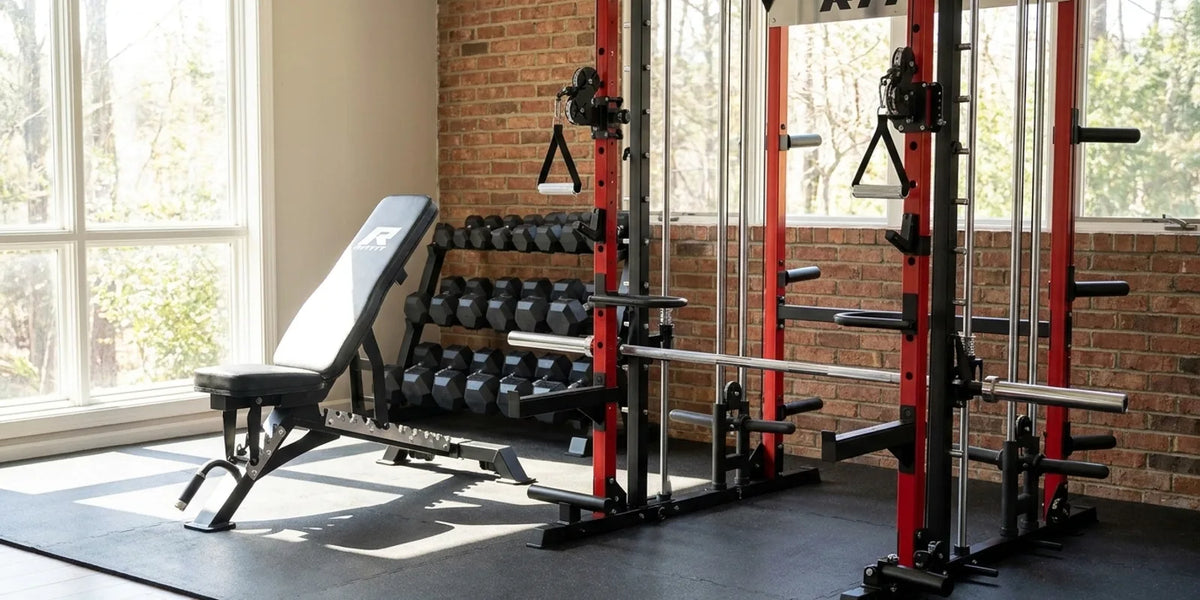
Push-ups on a Smith machine are a smart entry point for anyone building toward a full floor push-up. The bar locks at any height along the uprights, turning it into an adjustable hand platform that the rails keep from sliding.
This guide covers bar height and grip setup, step-by-step form, four variations, and a clear ladder down to floor level. It also states plainly when the machine helps and when the plain floor is the better tool.
Quick Answer: Yes, you can do push-ups on a Smith machine. Lock the bar at a height you can press for clean reps with hands slightly wider than your shoulders, then lower it rung by rung toward a full floor push-up.
Key Takeaways
- Bar Height Is the Dial: Hands on a high bar make the push-up easier, and every step down adds load until the floor version is the hardest.
- The Rails Do the Stabilizing: The guided bar cannot roll away, so beginners can focus on body position instead of balance.
- One Bar, Four Variations: Incline, decline, wide-grip, and narrow-grip setups cover the main chest and triceps emphasis.
- Progress by Lowering, Not Rushing: Move the bar down one or two holes once 8-12 clean reps feel controlled.
- Honest Scope: Floor push-ups need no machine, and this setup earns its keep for beginners, limited-loading situations, and homes without a bench or box.
Can You Do Push-Ups on a Smith Machine?
Yes, push-ups on a Smith machine work well because the bar locks at any height and doubles as a stable hand platform for incline and decline variations. The guided rails keep the bar from sliding, so the setup removes the balance problem that makes floor push-ups hard to learn.
- Hands on the bar, incline push-up: The higher the hands sit, the less body weight the arms press, which makes the movement easier to control.
- Feet on the bar, decline push-up: The body angles downward and the shoulders and upper chest take a larger share of the load.
- Guided rails, fixed path: The bar travels only vertically and cannot roll, which keeps the platform steady under the hands.
Any guided station with a locking bar works, including the M3 Power Rack Cable Crossover Smith Machine. The same frame also handles pulling work, as shown in our guide on how to do pull-ups on a Smith machine.
Set the Bar Height and Grip Width for Your Level
Bar height decides how much body weight the arms press, so the right starting height is the one that lets a lifter complete clean reps with controlled form. One equipment guide suggests starting with the bar high and locked, then lowering it as strength increases toward the floor version.
A 2025 Scientific Reports study tested incline push-ups at 10, 20, and 30 degree inclines and modeled the vertical ground reaction force from body mass, incline angle, and tempo[1]. The practical takeaway is simple: raising the hands reduces the load, and each step down adds it back.
| Bar Height | Difficulty | Who It Fits |
|---|---|---|
| Chest height, around 45 inches | Easiest | First reps, warm-ups, and sensitive wrists or shoulders |
| Waist height, around 34 inches | Moderate | Building controlled mid-range pressing strength |
| Knee height, around 22 inches | Hard | Preparing for the floor push-up |
| Floor | Hardest | The standard push-up |
Heights are approximate training guidance measured from the floor and should be adjusted to the lifter's own proportions.
- Grip width: Place the hands slightly wider than the shoulders for balanced chest and triceps work.
- Wide grip: Moving the hands out shifts emphasis toward the chest and shortens the range of motion.
- Narrow grip: Moving the hands in shifts emphasis toward the triceps and demands more shoulder control.
Every station in the Smith machine collection locks the bar at even height increments, so the progression stays repeatable from workout to workout.
How to Do a Smith Machine Push-Up Step by Step
A Smith machine push-up starts with the bar locked at chest height and the hands slightly wider than the shoulders. According to NASM, the pectoralis major, anterior deltoids, and triceps brachii do the pressing while the core holds a straight line from head to heels.
- Step 1: Lock the bar: Set the height and turn both hooks into the uprights so the bar cannot drift downward.
- Step 2: Set the hands: Grip the bar firmly just outside shoulder width with the elbows slightly bent.
- Step 3: Walk the feet back: Extend the legs until the body forms one straight line, with the feet about hip-width apart.
- Step 4: Lower with control: Bend the elbows and bring the chest toward the bar until the elbows reach about a 90-degree angle.
- Step 5: Press back up: Exhale and push through the palms to full extension while the core stays braced.
The 90-degree elbow target gives a consistent depth cue as the bar moves lower over the coming weeks. Keep the shoulder blades drawn slightly down and back so the shoulders stay supported through every rep.
4 Push-Up Variations on the Guided Bar: Incline, Decline, Wide, and Narrow
Four Smith machine push-up variations cover the main setups: incline, decline, wide-grip, and narrow-grip. Each one changes the angle or the hand spacing, which shifts the emphasis between the chest, the triceps, and the shoulder stabilizers.
- Incline push-up, hands on the bar: The easiest version and the natural starting point for beginners working toward floor reps.
- Decline push-up, feet on the bar: Lock the bar low, face away from it, and place the feet on the bar behind the body to load the upper chest and shoulders more.
- Wide-grip push-up: Set the hands well outside shoulder width to emphasize the chest through a shorter range of motion.
- Narrow-grip push-up: Bring the hands inside shoulder width to shift work toward the triceps while the bar stays locked in place.
A 2022 scoping review pooled 30 studies of push-up variations and reported the highest serratus anterior activation during incline push-ups and push-up plus[2]. The hands-elevated version also challenges the shoulder stabilizers, which supports its role early in the progression ladder.
You can hit the upper chest muscle fibers if you change the direction of your arm in relation to your body when you do your push-ups. You want to perform a pushing movement at an upward angle.
Jeff Cavaliere, MSPT, CSCS, Physical Therapist and Strength Coach at Athlean-X, on Best Pushup Workout For Insane Gains (Athlean-X)
How to Progress From Smith Machine Push-Ups to Floor Push-Ups
Smith machine push-ups progress by lowering the bar in small steps until the floor version feels controlled. A 2015 study of 22 healthy adults found the traditional push-up plus produced 17 percent more vertical ground reaction force than the knee-based modified version[3], which shows how much lighter a regression can make the load on the arms.
- Rep milestone: Move the bar down one or two holes after 8-12 clean reps feel controlled at the current height.
- Weekly dose: Train the pattern 2-3 sessions per week with 2-4 sets close to technical failure.
- Bridge option: Knee push-ups on the floor sit between the low bar and the full version and add extra volume.
- Finish line: When knee-height reps feel controlled, test the floor push-up and keep the bar version as a warm-up.
This stepwise loading is progressive overload in its simplest form. Each small drop in bar height adds load without adding plates, which keeps the joints and the core adapting at the same pace.
Does the RitFit PSR05 2.0 Multifunctional Smith Machine Work for Push-Up Progressions?
Yes, the RitFit PSR05 2.0 Multifunctional Smith Machine works for push-up progressions because its bar locks at evenly spaced heights along the uprights. The guided bar gives a steady platform at every rung of the ladder, from chest height down to the floor.
The product listing shows a rating of 4.6 out of 5 from 131 reviews, and the same station includes a lat pull-down system for balanced pulling work. For a complete kit with a bench and plates, the RitFit PSR05 2.0 Smith Machine Home Gym Package bundles what push-up progressions and pressing days both need.
RitFit's own channel demonstrates an upper-body session on a RitFit smith machine, the same guided-bar setup the PSR05 uses. Watching the bar lock and move is the fastest way to see why it doubles as a push-up rail.
"The Smith machine has been amazing! I've been loving all the different ways to use it for the full total body workout experience. We also paired the multiple grip pull-down bar with it and it's been perfect!"
Danielle H. Verified Buyer, RitFit PSR05 2.0 Multifunctional Smith Machine Power Rack with LAT-Pull Down System
Smith Machine Push-Ups vs Floor Push-Ups and Bench Push-Ups
Smith machine push-ups differ from floor and bench push-ups in three ways: continuous height adjustment, rail guidance that prevents sliding, and one bar that covers wide and narrow grips. The floor version needs no equipment at all, and a fixed bench offers only the heights the bench happens to provide.
- Height control: The bar moves in small increments, while a bench gives one or two fixed heights.
- Stability: The rails hold the bar still, while a floor setup on a sliding surface demands more balance from the shoulders.
- Grip changes: One bar covers wide and narrow hand positions without extra equipment on the floor.
- Cost and space: Floor push-ups are free and take zero setup, which is the right default when space or budget is tight.
A station like the M1 Multi Functional Home Gym Smith Machine pairs the same adjustable bar with a fuller home gym build. The bar setup then slots into a complete training week alongside squats, rows, and pull-ups on the same frame.
Common Mistakes and Safety Rules
Most Smith machine push-up mistakes come from an unlocked bar, hips sagging below the line, or dropping the bar too low too soon. Each one is easy to fix once the lifter knows what to watch for.
- Unlocked hooks: Turn both hooks into the uprights before every set so the bar cannot drift downward.
- Sagging hips: Brace the abs and squeeze the glutes to keep one straight line from head to heels.
- Flared elbows: Keep the elbows at a comfortable angle rather than winging them straight out to the sides.
- Skipping levels: Drop the bar only after the current height feels controlled, not on the first hard set.
- Pushing through pain: Wrist, shoulder, or elbow pain is a stop sign, so regress the height or rest instead.
End the set the moment form breaks down or a joint hurts. Sore muscles are normal after training, but sharp or lingering joint pain deserves a professional evaluation before the next session.
Who Should Do Push-Ups on a Smith Machine?
Smith machine push-ups suit beginners building toward floor push-ups, people training around a lower-body injury, and home gyms without a bench or a box. They also help anyone who wants a repeatable, measurable way to scale a bodyweight movement.
- Beginners: The high bar builds pressing strength and confidence before the full version.
- Lower-body limitations: The incline versions keep the feet on level ground, so the legs load little while the upper body keeps training.
- Minimal spaces: A locked bar replaces the bench, box, or wall a decline setup would need and fits a garage gym footprint.
- Who can skip it: Lifters who already own the floor push-up and simply want chest growth do not need a machine for it.
The same station comes in a pink finish for design-led spaces via the RitFit PSR05 2.0 Pink Smith Machine. Lifters who want stacked cables for pulling work can also shortlist the RitFit BPC06 All-In-One Smith Machine with 260LB Weight Stacks.
The cable machine collection covers the accessory pulling that balances all of this pressing.
FAQs About Push-Ups on a Smith Machine
How low should the Smith machine bar be for push-ups?
Set the bar at a height where you can perform 8 to 12 clean reps without your hips sagging. Start around chest height and lower the bar one or two holes at a time as each level becomes comfortable, moving toward knee height before trying the floor.
Are Smith machine push-ups easier than floor push-ups?
Yes. Smith machine push-ups with hands on the bar are incline push-ups, so your hands support less of your body weight the higher the bar sits. Floor push-ups load the most body weight, which makes the Smith machine setup a useful stepping stone for beginners.
Can Smith machine push-ups build chest muscle?
Yes. Push-ups train the pectoralis major, anterior deltoids, and triceps brachii on any stable surface, and the incline and decline setups shift emphasis across the chest. Add reps, a slower lowering phase, or a lower bar each week to keep the training stimulus moving forward.
What muscles do Smith machine push-ups work?
Smith machine push-ups work the pectoralis major, anterior deltoids, and triceps brachii while the core braces to hold a straight line from head to heels. Incline variations with the hands high on the bar also emphasize the serratus anterior and the lower chest fibers.
Can you do decline push-ups on a Smith machine?
Yes. Lock the bar low, stand facing away from it, and place your feet on the bar behind you with your hands on the floor. This feet elevated position loads the upper chest and shoulders more, so master the incline versions first and keep your hips level throughout.
How often should you do Smith machine push-ups?
Two to three sessions per week works well for most beginners, with at least one rest day between sessions. Perform two to four sets close to technical failure at each bar height, and lower the bar once you can complete 10 to 12 controlled reps.
Do you need a Smith machine to do push-ups?
No. Floor push-ups need no equipment, and this setup only helps specific situations. A locked Smith bar makes sense for beginners building toward floor push-ups, people training around a lower-body injury, and homes without a bench, a box, or clear wall space.
Conclusion
Push-ups on a Smith machine work because the bar is an adjustable hand platform with rails that never slide. Set it high, master the reps, and lower it rung by rung until the floor version is yours.
Start at chest height this week and log the reps at each level. If a home gym upgrade is next, check the RitFit discount guide before buying.
Disclaimer
This article provides general fitness information and is not medical advice. Stop any exercise that causes sharp pain, and consult a qualified professional before starting a new program if you have an injury or health condition.
References
1. Wu H, Zhai H, Ma R, Wei H. A predictive model for vertical ground reaction force during incline push-ups. Sci Rep. 2025;15(1):44454. doi:10.1038/s41598-025-28012-7. PMCID: PMC12738558
2. Kowalski KL, Connelly DM, Jakobi JM, Sadi J. Shoulder electromyography activity during push-up variations: a scoping review. Shoulder Elbow. 2022;14(3):326-340. doi:10.1177/17585732211019373. PMCID: PMC9121296
3. San Juan JG, Suprak DN, Roach SM, Lyda M. The effects of exercise type and elbow angle on vertical ground reaction force and muscle activity during a push-up plus exercise. BMC Musculoskelet Disord. 2015;16(1):23. doi:10.1186/s12891-015-0486-5. PMCID: PMC4327800





