








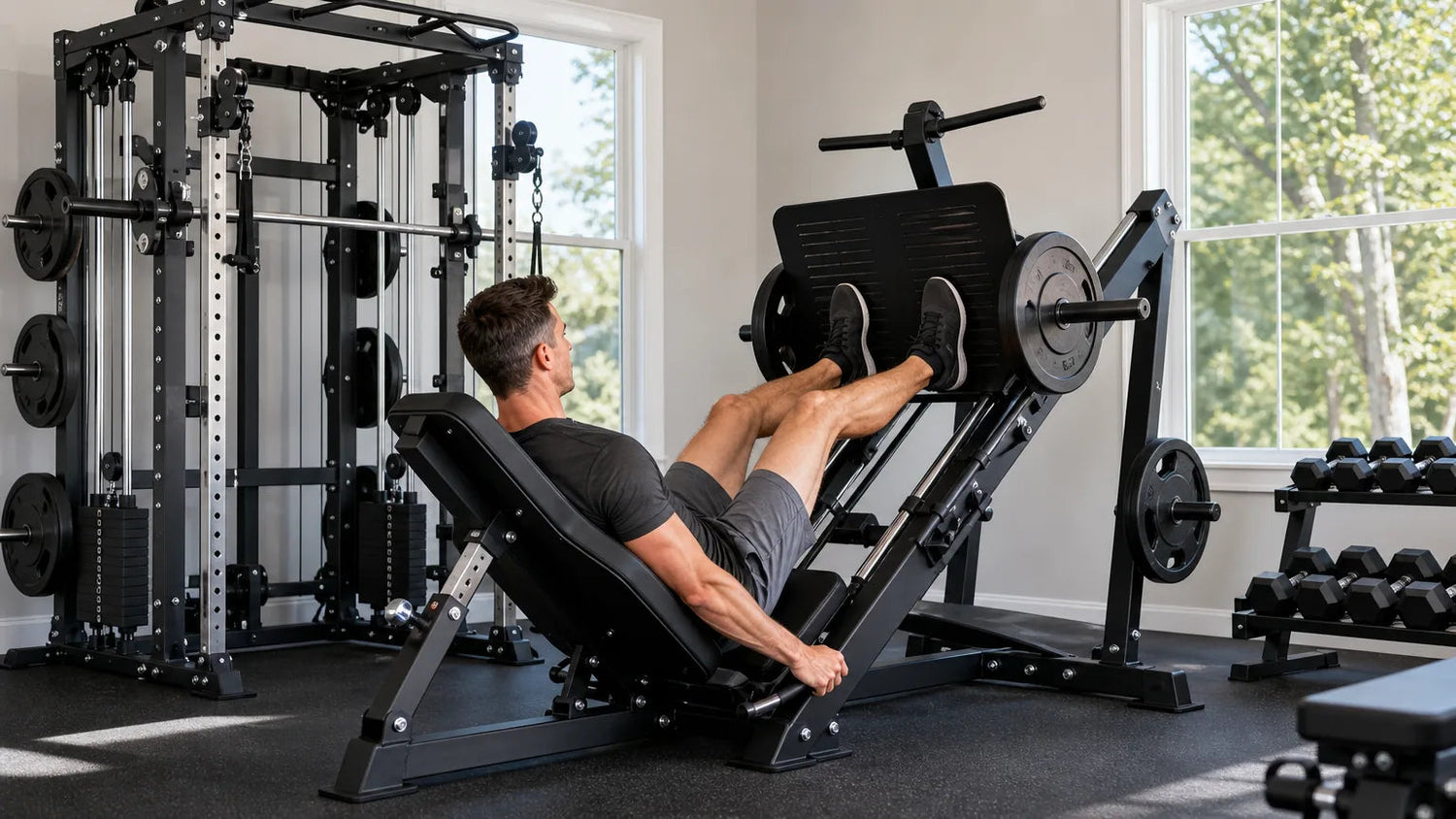
Finding the right quad machine for sale means knowing what types of equipment actually target the quadriceps, which specs matter for a home gym, and which RitFit model fits your budget and floor space.
This guide covers every major quad machine type, a side-by-side look at RitFit options at different price points, and the key buying checklist so you can order with confidence.
Quick Answer: The best quad machine for sale depends on your budget and floor space. The RitFit PLC01 leg extension and curl combo under $400 is the top pick for pure quad isolation, while the RitFit GAZELLE PRO 3-in-1 leg press and hack squat machine delivers the highest load capacity and training variety for serious lower-body development at home.
Key Takeaways
- Isolation vs. Compound: Leg extension machines isolate the quads directly, while leg press and hack squat machines load the quads through compound pushing movements with greater total weight capacity.
- Best Budget Pick: The RitFit PLC01 leg extension and curl combo costs under $400 and handles both quad isolation and hamstring curls in one compact, plate-loaded unit.
- Best for Serious Development: The RitFit GAZELLE PRO 3-in-1 machine combines leg press, hack squat, and calf raise, offering the highest load capacity and training variety for intermediate to advanced lifters.
- Pivot Alignment Matters: The machine's pivot point must align with your knee joint to maximize quad activation and reduce patellofemoral stress, especially important for tall users.
- Plate-Loaded Wins for Home Gyms: Plate-loaded quad machines cost significantly less than selectorized models, use plates you already own, and take up less space, making them the practical choice for most home gym setups.
What Types of Machines Target the Quadriceps?
Quad machines fall into three main categories, each targeting the quadriceps through a different movement pattern and range of motion. Understanding each type helps you choose the one that fits your training goals and available floor space.
Leg Extension and Curl Machines
A leg extension machine is an open-chain exercise tool that isolates the quadriceps by extending the lower leg against resistance from a seated position. Paired with a leg curl station, a combo unit covers both quad and hamstring development in one compact footprint.
- Primary muscle: Quadriceps (vastus lateralis, vastus medialis, rectus femoris) with no significant hip involvement.
- Resistance type: Plate-loaded or selectorized; plate-loaded models are far more common in home gyms due to lower cost and smaller footprint.
- Best for: Finishing sets after compound lifts, building the teardrop VMO shape, and rehabilitation contexts where isolated knee extension is prescribed.
- Toe position tip: Pointing toes inward slightly shifts emphasis to the outer vastus lateralis, while a neutral or outward position targets the inner vastus medialis more directly.
- Space profile: Standalone combo units typically need around 4 to 6 square feet of floor space, making them one of the most compact dedicated quad options.
Leg Press Machines
The leg press is a closed-chain exercise that loads the quadriceps, glutes, and hamstrings simultaneously through a pushing movement, allowing heavier loads than a leg extension machine. A 2020 systematic review found that the vastus lateralis and vastus medialis showed the greatest EMG activation during the leg press, with activation increasing as the knee flexion angle increased.[1]
- Movement pattern: Closed-chain pushing; feet stay fixed on a footplate while the sled or seat travels through the range of motion.
- Quad emphasis: A narrower, more centered foot placement with feet slightly lower on the footplate increases quad recruitment over glutes and hamstrings.
- Load capacity advantage: Most home-use leg press machines handle 300 to 500 lb or more of plate load, far exceeding what a leg extension machine can manage.
- Rehabilitation use: Leg press is widely used in knee rehabilitation because the closed-chain movement reduces anterior shear forces on the ACL compared to open-chain knee extension.
- Space profile: Requires more room than a leg extension combo, roughly 6 to 8 square feet plus clearance in front for safe sled travel and plate loading.
Pair your leg press work with accessories from the leg machines collection to cover every lower-body training angle.
Hack Squat Machines
A hack squat machine places the user on a padded shoulder platform and pushes a weighted sled upward through a fixed rail, closely mimicking the squat pattern while providing back support and a consistent movement path. The upright torso position and fixed sled angle shift load heavily onto the quads, making hack squat machines one of the most effective tools for quad mass.
- Torso angle advantage: The fixed incline keeps the torso more upright than a free barbell squat, reducing lower-back involvement and increasing direct quad stress.
- Foot position flexibility: Low and narrow foot placement maximizes quad recruitment; higher and wider positioning adds glute and hamstring involvement.
- Safety features: Most units include shoulder pads, back pad, and safety stops, making them accessible for users who cannot safely barbell squat.
- Space profile: Standalone hack squat machines have a larger footprint than a leg press combo, typically 8 to 10 square feet or more depending on the sled travel path.
3-in-1 Combo Machines
A 3-in-1 leg press, hack squat, and calf raise machine combines all three movements in one unit, giving home gym owners the most training versatility per square foot of floor space. These combo machines are the best value for serious quad development when space is limited to one large machine.
- Training range: One unit covers quad compound loading (leg press and hack squat), calf raise, and with foot position adjustments, selectively targets different quad and glute emphasis zones.
- Cost efficiency: A 3-in-1 unit costs significantly less than buying three separate machines and occupies one footprint instead of three.
- Best for: Intermediate to advanced home gym users who want to replicate a full commercial leg day in a single piece of equipment.
Browse the full leg press machines collection to compare sizes, load ratings, and 3-in-1 configurations.
Which RitFit Quad Machine Is Right for You?
The right RitFit quad machine depends on your budget, available floor space, and whether you need pure isolation, compound loading, or both. The table below maps each model to the user type most likely to get the best return from it.
| Model | Price Range | Resistance | Primary Function | Floor Space | Best For |
|---|---|---|---|---|---|
| RitFit PLC01 | Under $400 | Plate-loaded | Leg extension + curl | ~4-5 sq ft | Beginner-intermediate, budget buyers, quad isolation |
| RitFit Mustang PRO | Under $500 | Plate-loaded | Leg extension + curl | ~5-6 sq ft | Intermediate, taller users, upgraded isolation |
| RitFit BLP01 | ~$500-700 | Plate-loaded | Leg press | ~6-8 sq ft | Beginner-intermediate, compound quad and glute loading |
| RitFit GAZELLE PRO | $700-1,000+ | Plate-loaded | Leg press + hack squat + calf raise | ~8-10 sq ft | Intermediate-advanced, maximum versatility, serious quad development |
Source: RitFit product specifications and Garage Gym Reviews independent testing data.
RitFit PLC01: Best Budget Quad Isolation Machine
The RitFit PLC01 is a plate-loaded leg extension and curl combo priced under $400, making it the most accessible dedicated quad isolation machine in the RitFit lineup. According to Garage Gym Reviews, the PLC01 earned a versatility rating of 4.5 out of 5, and it was described as the best budget option for leg extension and curl combos at $399.99 with a 109-lb frame and 12 back-pad angle settings.
- Resistance system: Cable-driven plate-loaded, which provides more consistent resistance throughout the range of motion compared to direct-lever plate-loaded designs.
- Dual function: Both seated leg extensions and prone leg curls are available without moving to a different machine, covering quads and hamstrings efficiently.
- Value proposition: At under $400, the PLC01 costs roughly half the price of comparable standalone commercial-style units from other brands, without sacrificing the core isolation function most home gym users actually need.
- Who it is not for: Advanced lifters wanting very high progressive overload capacity or those who primarily train with heavy compound movements and do not need dedicated open-chain isolation.
RitFit Mustang PRO: Best Mid-Range Isolation Upgrade
The RitFit Mustang PRO is a plate-loaded leg extension and curl machine priced under $500, offering enhanced adjustability over the PLC01, particularly for taller users who need more seat depth range and a better pivot-to-knee alignment. The Mustang PRO is the right upgrade path when the PLC01's adjustment range feels limiting or when you want a more robust frame for longer-term use.
- Adjustability advantage: Wider range of seat and shin-pad positions accommodates users above 6 feet more comfortably than the entry-level PLC01.
- Progressive overload headroom: The Mustang PRO's frame and load capacity support heavier plate loading as you get stronger, making it a better long-term investment for intermediate lifters.
- Best for: Intermediate home gym users who want a durable, adjustable isolation machine and are willing to spend slightly more for a better fit.
RitFit BLP01: Best Budget Leg Press for Compound Quad Mass
The RitFit BLP01 is a plate-loaded leg press machine in the $500-700 range, designed for home gym users who want compound quad and glute loading without the full 3-in-1 footprint or price of the GAZELLE PRO. The BLP01 is the right choice when your primary goal is driving quad and glute hypertrophy through heavy compound pressing rather than isolation work.
- Compact leg press geometry: The BLP01's design keeps the footprint smaller than a full 3-in-1 combo while still accommodating serious plate loading for progressive overload.
- Foot position variety: High, low, wide, and narrow foot positions let you shift emphasis between quads, glutes, and hamstrings within the same machine.
- Best for: Budget-conscious buyers who prioritize compound quad loading and already have a squat rack or other equipment for accessory isolation work.
Compare the BLP01 and GAZELLE PRO before deciding on your footprint commitment, and check the cable machine attachments for accessory lower-body exercises if you already own a cable stack.
RitFit GAZELLE PRO: Best 3-in-1 for Serious Quad Development
The RitFit GAZELLE PRO is the most versatile quad machine in the lineup, combining leg press, hack squat, and calf raise in one plate-loaded unit priced in the $700 to $1,000+ range. It is the top pick for intermediate to advanced lifters who want to replicate a full commercial leg day without leaving their home gym.
- Three movements in one: Leg press, hack squat, and calf raise from the same machine means you can run a complete lower-body session without any equipment changes.
- Hack squat angle: The fixed sled angle and shoulder pads replicate the upright torso position that loads the quads more directly than a traditional barbell squat.
- High load capacity: The GAZELLE PRO is built for heavy progressive loading, making it a long-term investment that grows with your strength level.
- Calf raise bonus: The integrated calf raise position lets you train calves without a separate machine, maximizing the return on your floor space investment.
Watch the RitFit GAZELLE PRO in action to see how the leg press, hack squat, and calf raise positions work in a real home gym setup:
Also consider pairing the GAZELLE PRO with a multifunctional Smith machine for a complete upper and lower body home gym setup.
What Key Specs Should You Check Before Buying?
Checking the right specs before purchasing a quad machine prevents the most common buyer mistakes: picking a machine that does not fit your body, running out of progressive overload headroom too quickly, or buying a unit that wobbles under load.
Pivot Point Alignment and Knee Health
The pivot point on a leg extension machine must align directly with your knee joint to maximize quad activation and minimize shear stress on the patellofemoral joint. A 2020 study in young trained females found that the inclined leg press effectively activates the vastus medialis oblique (VMO) regardless of foot position, which may help reduce knee muscle imbalances when the movement is performed correctly.[2]
- Adjustment check: Before buying, confirm the seat depth and shin-pad position adjustments are wide enough to align the pivot with your knee, especially if you are over 6 feet tall.
- Wobble test: A machine that flexes or wobbles under load shifts stress away from the quad and onto stabilizing joints. Check owner reviews specifically for comments on frame rigidity under heavy use.
- Pad quality: Dense foam pads that hold their shape prevent shin-pad slippage during extension, which is a common cause of form breakdown and knee discomfort on cheaper machines.
"Leg extensions create hypertrophy in the quads and can be overloaded. However, there are some potential safety issues for people with tendonitis or knee issues, as it places a lot of force and tension on the patella. It's a good exercise for some, definitely not all."
Jeff Cavaliere, MSPT, CSCS, Physical Therapist and Strength Coach, Athlean-X
Weight Capacity and Resistance Type
Weight capacity determines how long a machine can support your progressive overload before you outgrow it. Checking the maximum plate load rating before buying prevents investing in a machine you will need to replace in 12 to 18 months as you get stronger.
- Plate sleeve length: Short sleeves that only hold two or three 45-lb plates will cap your progression earlier than a machine with longer loading posts. Confirm the sleeve length accommodates the total load you expect to reach within the next year.
- Cable-driven vs. direct-lever: Cable-driven plate-loaded machines like the RitFit PLC01 provide more consistent resistance throughout the rep, particularly at the top of the range where direct-lever machines sometimes feel lighter. This matters for maximizing peak quad contraction at full extension.
- Selectorized trade-off: Selectorized machines with weight stacks allow faster weight changes between sets but cost roughly double the price of equivalent plate-loaded models and are significantly heavier to ship and position in a home gym.
Seat and Pad Adjustability
Multiple seat depth positions and an adjustable shin roller allow a single machine to fit a range of user heights correctly, which matters for both quad activation quality and long-term knee comfort. One industry guide suggests that for users over 6 feet tall, a multi-position back pad and adjustable shin roller are non-negotiable specifications to look for.
- Back-pad positions: The RitFit PLC01 offers 12 back-pad angle settings, giving a wide range of seat configurations for different body proportions.
- Shin-roller position: A shin roller that sits too far from the ankle or too close to the knee will shift load off the quad and onto the joint itself, reducing training effectiveness and increasing discomfort.
- Assembly tolerance: Check that adjustment pins engage cleanly and that moving parts do not shift under load. Loose adjustment mechanisms are the most common complaint in owner reviews of budget isolation machines.
For cable-based quad training options, the cable machines collection and cable machine handles offer additional lower-body exercise variety when paired with a functional trainer.
How Much Space Does a Quad Machine Need?
Space requirements for quad machines vary widely by type, and measuring your available floor area before ordering prevents the most frustrating home gym mistake: discovering the machine does not fit after delivery.
- Leg extension and curl combo (e.g., PLC01, Mustang PRO): Approximately 4 to 6 square feet of base footprint. Leave at least 18 to 24 inches in front of the shin pad for comfortable entry and exit.
- Standalone leg press (e.g., BLP01): Approximately 6 to 8 square feet plus additional clearance in front for the sled travel path and safe dismount when loaded with heavy plates.
- 3-in-1 combo machine (e.g., GAZELLE PRO): Approximately 8 to 10 square feet base footprint. Factor in overhead clearance for the sled's highest travel point and side clearance for loading and unloading plates.
- Ceiling height: Hack squat machines with tall shoulder pad frames may require at least 8-foot ceilings to allow full upright shoulder-pad positioning without contact.
- Weight loading access: Leave at least 24 inches of clear space on each side of the weight sleeves so you can add and remove plates without repositioning other equipment.
- Traffic flow: The machine's footprint alone understates the space it consumes in use. A leg press machine that fits a 6 x 4-foot corner may still block the path to your squat rack if not positioned thoughtfully.
The current sale on strength equipment is a good time to compare the GAZELLE PRO and BLP01 side by side on price before committing to a specific footprint.
Plate-Loaded vs. Selectorized: Which Is Better for Home Gyms?
Plate-loaded quad machines are the better choice for most home gyms because they cost significantly less, use Olympic plates you likely already own, and occupy a smaller footprint than selectorized models with weight stacks. One industry guide notes that selectorized machines typically cost double their plate-loaded equivalents and are significantly heavier and harder to ship, making the plate-loaded option the practical choice for home use.
- Cost difference: A quality plate-loaded leg extension and curl combo like the RitFit PLC01 starts under $400. Comparable selectorized machines start at $700 and often exceed $1,100 for commercial-quality units.
- Use existing plates: If you already own Olympic plates from a barbell set or squat rack, a plate-loaded machine adds function without requiring a separate plate inventory.
- Smaller footprint: Selectorized machines include a built-in weight stack that adds width and depth to the unit. Plate-loaded machines carry the same or larger plate capacity in a tighter, lighter frame.
- Progressive overload flexibility: Plate-loaded machines can be loaded in any increment you choose. Selectorized machines restrict you to the fixed weight-stack increments built into the unit, which may jump 10 to 20 lb per selection.
- When selectorized makes sense: A shared home gym used by multiple people at different training weights, or a commercial setup where fast weight changes between sets are a priority, may justify the higher cost and larger footprint of a selectorized unit.
For accessory training options that complement your quad machine, the RitFit cable machine handles add leg extension variations when paired with a cable stack.
How Do You Get the Best Results from a Quad Machine?
Getting the best results from a quad machine requires correct setup, controlled rep tempo, and a structured progressive overload plan that adds load incrementally over weeks rather than jumping weight too aggressively. Research comparing the leg press and Smith machine squat found that both exercises produce comparable quadriceps activation at matched nominal loads, confirming that machine-based training drives meaningful quad development when programmed correctly.[3]
Leg Extension Form Tips
Set up the machine so the pivot point aligns with your knee joint before loading any weight, and use a controlled 2-second eccentric (lowering) phase to maximize time under tension in the quadriceps.
- Starting position: Sit with your back flat against the pad, shins vertical, and shin roller positioned just above the ankle. Adjust the seat depth until your knee aligns with the machine pivot.
- Contraction at the top: Pause briefly at full extension to maximally activate the vastus medialis and reinforce the terminal knee extension pattern, which carries over to running, jumping, and squat performance.
- Eccentric control: Lower the weight slowly over 2 to 3 seconds rather than letting it drop. The eccentric phase is where much of the muscle damage that drives hypertrophy occurs.
- Avoid momentum: Swinging the shin pad up by rocking the hips forward reduces quad activation and shifts load onto the hip flexors, defeating the purpose of the isolation movement.
- Unilateral option: Training one leg at a time identifies and corrects strength imbalances between legs that bilateral training can mask.
Progressive Overload on a Quad Machine
Progressive overload on a quad machine means increasing total training stimulus over time through added weight, additional reps, more sets, or slower rep tempo rather than staying with the same load indefinitely.
- Starting load: Begin with a weight that allows 3 sets of 12 to 15 clean reps with controlled form. If you cannot maintain alignment on rep 10, the load is too heavy to start.
- Weekly progression: Add one rep per set before adding weight. When you can complete 3 sets of 15 clean reps, increase the plate load by the smallest available increment (typically 2.5 to 5 lb) and reset to 3 sets of 12.
- Frequency: Training quads with dedicated machine work 2 to 3 times per week with at least 48 hours of recovery between sessions supports consistent strength and hypertrophy gains.
- Pairing with compound lifts: Leg extensions and leg press work best as complements to compound movements. Perform squats or hack squats first when energy is highest, then follow with isolation machine work as a finisher.
- Deload awareness: Every 4 to 6 weeks, reduce your training load moderately for one week to allow connective tissue recovery, then return to progressive loading.
For a complete lower-body home gym setup, read about 2-in-1 combo machine workouts and explore the best Smith machine for bodybuilding if you want to add a compound pressing and squatting station to your home gym.
Also check out what a Smith machine is if you are deciding between dedicated quad machines and a more versatile compound training platform for your space.
FAQs About Quad Machines for Sale
What is a quad machine?
A quad machine is any gym equipment designed to isolate or heavily load the quadriceps, the four muscles on the front of the thigh. Common examples include leg extension machines, leg press machines, hack squat machines, and 3-in-1 combo units, each targeting the quads through a different movement pattern and range of motion.
Is a leg extension machine worth buying for a home gym?
Yes, for most home gym owners wanting dedicated quad isolation, a leg extension machine is a practical addition. A combo leg extension and leg curl machine like the RitFit PLC01 doubles the value by covering both quads and hamstrings in one compact unit under $400, making it an efficient choice for limited-space setups.
How much space does a quad machine take up?
Space requirements vary by machine type, ranging from roughly 4 to 6 square feet for a leg extension and curl combo to 8 to 10 square feet for a 3-in-1 hack squat machine, plus additional clearance in front for safe operation and weight loading.
What is the difference between a leg extension machine and a leg press for quads?
A leg extension machine is an open-chain exercise that isolates the quadriceps directly by extending the lower leg against resistance, while a leg press is a closed-chain exercise loading the entire lower body through a compound pushing movement. Both build quad strength and size but work best as complementary tools rather than substitutes.
Which RitFit machine is best for building quads at home?
The best choice depends on your budget and space. The RitFit PLC01 under $400 suits pure quad and hamstring isolation, while the RitFit GAZELLE PRO 3-in-1 leg press and hack squat machine suits lifters wanting heavier compound quad training, greater load capacity, and multi-function versatility for a complete lower-body workout.
Are plate-loaded leg extension machines better than selectorized ones for home gyms?
Plate-loaded machines are generally the better choice for home gyms because they cost significantly less, use Olympic plates you likely already own, and have a smaller footprint than selectorized models. Selectorized machines with weight stacks offer faster weight changes but typically cost twice as much and are heavier to ship and install.
Conclusion
Choosing the right quad machine for sale means matching your budget, space, and training goals to the correct machine type. The RitFit PLC01 is the best entry point for pure quad isolation under $400, while the GAZELLE PRO 3-in-1 delivers the highest training variety and load capacity for serious lower-body development at home.
Start with your floor space measurement, then browse the Smith machine collection if you also want a compound pressing and squatting option, and build your quad training program around consistent progressive overload from week one.
Disclaimer
This article is for general fitness information purposes only and does not constitute medical advice, diagnosis, or treatment. Consult a qualified healthcare professional before beginning any new exercise program, especially if you have a history of knee pain, joint injuries, or other medical conditions.
Save on your next RitFit order
Tap the button to copy your code, then paste it at checkout.
References
1. Martínez-Fuentes I, Oliva-Lozano JM, Muyor JM. Evaluation of the lower limb muscles' electromyographic activity during the leg press exercise and its variants: a systematic review. Int J Environ Res Public Health. 2020;17(13):4626. doi:10.3390/ijerph17134626
2. Martínez-Fuentes I, Oliva-Lozano JM, Muyor JM. Muscle activation and kinematic analysis during the inclined leg press exercise in young females. Int J Environ Res Public Health. 2020;17(22):8698. doi:10.3390/ijerph17228698
3. Migliaccio GM, Dello Iacono A, Ardigò LP, et al. Leg press vs. Smith machine: quadriceps activation and overall perceived effort profiles. Front Physiol. 2018;9:1481. doi:10.3389/fphys.2018.01481




