Resistance bands are the most space-efficient way to add progressive resistance to a home workout, and choosing the right set comes down to a few clear decisions. This 2026 buying guide breaks down the four main band types, explains how resistance is rated in pounds, and shows you how to match a set to your training goals and budget.
We focus on what actually matters when you buy: which band type suits which exercise, how heavy each band should be, latex versus TPE material, and how a set should be sized and stored.
Quick Answer: The best resistance bands are a set that combines long loop bands for pull-up assistance and lower body work with a handled tube band for upper body exercises. Choose resistance you can stretch through a full range for eight to twelve controlled reps, pick latex for durability or TPE for sensitive skin, and store bands out of direct sunlight.
Key Takeaways
- Band type drives your decision: long loop bands handle pull-up assistance and lower body work, tube bands with handles cover upper body exercises, and mini bands suit glute and hip work.
- Resistance is rated in pounds: pick a band you can stretch through a full range of motion for eight to twelve controlled reps, and move up a level when it gets easy.
- Latex lasts longer, TPE suits sensitive skin: natural latex holds its tension and elasticity best, while TPE is the latex-free alternative for people with allergies.
- A set beats a single band: you want several resistance levels so you can progress, stack bands for heavier work, and cover different exercises with one purchase.
- Replace bands that show wear: inspect regularly for loss of elasticity, thinning, cracks, or micro-tears, and store bands away from direct sunlight and heat.
Why Resistance Bands Earn a Place in Your Home Gym
Resistance bands earn a place in a home gym because they deliver progressive resistance in a fraction of the space, cost, and weight of a rack of dumbbells. A band set folds into a drawer or a travel bag, yet it can cover everything from a warm-up to heavy pull-up assistance, which makes it the most versatile piece of budget equipment most lifters will own.
Beyond convenience, bands are backed by real evidence. A 2024 systematic review of elastic band resistance training found improvements in muscle strength, flexibility, balance, and cardiorespiratory function, which makes bands a credible training tool rather than a novelty.[1]
- Space efficient: a full set stores flat in a drawer, a closet, or a gym bag, ideal for apartments, garages, and travel.
- Budget friendly: a complete band set costs a fraction of a single dumbbell pair or a machine, with room to progress built in.
- Variable resistance: the band gets harder as you stretch it, which adds load at the top of a lift where you are strongest.
- Beginner to advanced: light bands suit rehabilitation and mobility, while heavy loops assist pull-ups and add load to barbell work.
Bands also pair naturally with other home gym equipment. If you train on a rack, loop bands over the bar for accommodating resistance, or use them alongside a machine like the M1 Multi-Functional Home Gym Smith Machine for accessory work.
"I want people doing progressive resistance training two to three times per week with weights, machines or bands, because strong muscles create strong bones."
Susan Bukata, MD, Chair, Department of Orthopedic Surgery, UC San Diego
The 4 Main Types of Resistance Bands and What Each Does Best
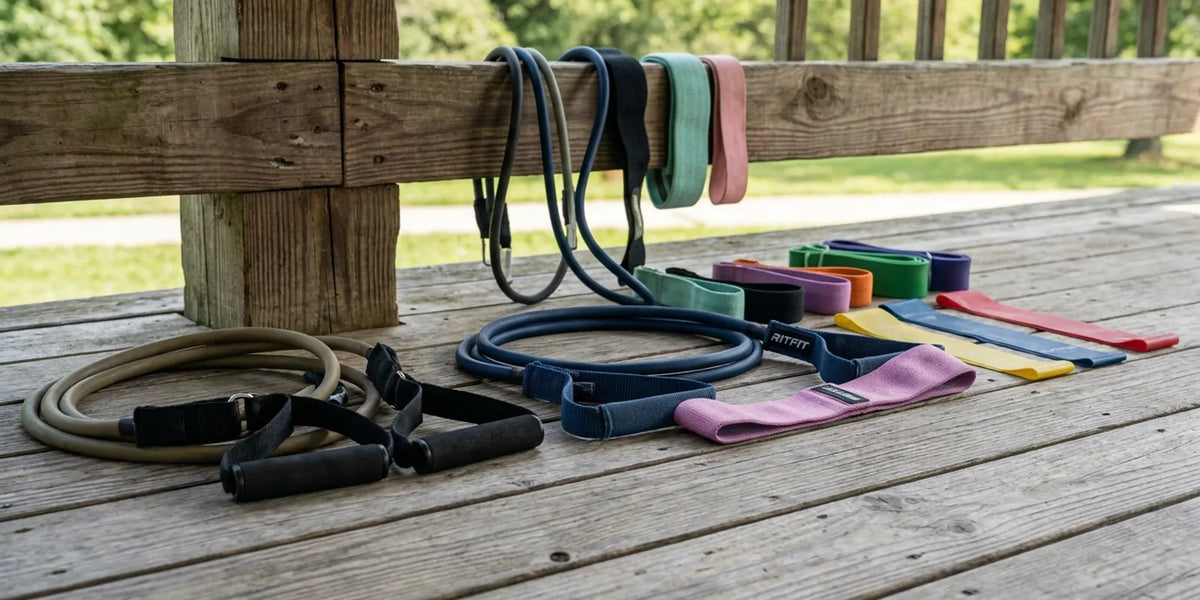
The four main types of resistance bands are long loop bands, tube bands with handles, mini loop bands, and flat therapy bands, and each one is built for a different set of exercises. The fastest way to buy the right set is to match the band type to the movements you actually do, because no single band type does everything well.
Long Loop Bands
Long loop bands are continuous latex loops, usually around 40 to 81 inches long, and they are the workhorse of the category. They are the best choice for pull-up assistance, banded squats and deadlifts, and wrapping around a barbell or rack to add accommodating resistance.
- Pull-up assistance: loop the band over the bar and step a foot or knee into the bottom to take weight off the movement.
- Banded squats and deadlifts: anchor the loop under your feet or around a rack to add load at the top of the lift.
- Combining bands: stack two loops together to reach a heavier resistance than any single band provides.
Tube Bands with Handles
Tube bands with handles look most like a portable cable machine, with a handle at each end and a foam or rubber grip. They are the best pick for upper body exercises such as bicep curls, rows, chest presses, and shoulder work, because the handles give you a stable, comfortable grip.
- Curls and presses: the defined handles make them the easiest band type to grip for upper body movements.
- Anchored rows: loop the middle of the tube around a pole or door anchor and row toward your body.
- Door anchor option: some tube sets include a door anchor so you can do cable-style pulls and presses.
Mini Loop Bands
Mini loop bands are small, continuous loops designed to sit around your thighs or ankles, and they are the go-to for glute and hip work. They are ideal for glute activation before a session, lateral walks, and leg alignment during squats.
- Glute activation: place the band above your knees and perform lateral walks or clamshells before lower body work.
- Squat form: banding above the knees can help you keep the knees tracking in line with the feet.
- Low cost: mini bands are typically the least expensive type, so they are an easy first addition.
Flat Therapy Bands
Flat therapy bands are wide, flat strips of latex without handles, and they are commonly used for rehabilitation, mobility, and low-load work. They are the best choice if your main goal is recovery, flexibility, or a very light starting resistance.
- Rehabilitation: the low resistance and flat profile make them suitable for controlled, joint-friendly movements.
- Stretching and mobility: you can wrap or tie them around a bar or limb for assisted stretching.
- Beginner friendly: the lightest therapy bands are gentler than most loop or tube bands.
Once you have the right set, learn the movements properly by reading our guide on how to use a resistance band, then try a routine like our 8 resistance band exercises you can do at home.
How to Choose the Right Resistance Level in Pounds
The right resistance level in pounds is the heaviest band you can stretch through a full range of motion for eight to twelve controlled repetitions. If you can finish fifteen or more reps with clean form, the band is too light, and if you cannot reach eight reps without strain, it is too heavy.
Resistance bands are typically sold with a pound rating per band, which tells you the force at a given stretch, and a set covers a range of those ratings. Independent testers judge a set on how consistent the resistance is across the bands, how wide the resistance range is, and how evenly the bands progress from one level to the next.[2]
- Start with a rating you can control: for most lifts, aim for a band you can move for eight to twelve reps in good form.
- Use the range of the set: a set spanning light to heavy lets you warm up light, train heavy, and stack bands for more load.
- Match the band to the exercise: heavy loops for pull-up assistance and lower body work, lighter bands for upper body isolation and rehab.
- Progress over time: when a band becomes easy for your target rep range, move up to the next resistance level in the set.
The RitFit Pull Up Assist Band Set is a practical example of a loop-band range. It ships with three bands covering 10-35 lbs, 20-60 lbs, and 25-65 lbs of resistance, each 81.6 inches in circumference, which gives you a clear path from light assistance to heavier load.[3]
Latex vs TPE: What the Material Means for You
The two main band materials are natural latex and TPE, a synthetic thermoplastic rubber, and the choice comes down to feel, durability, and allergies. Latex is the classic choice for its elasticity and long-lasting tension, while TPE is the latex-free alternative that suits people with sensitive skin or a latex allergy.
- Natural latex: stretches smoothly, snaps back reliably, and holds its rated tension for years, which is why most serious loop band sets use it.
- TPE (thermoplastic elastomer): latex-free, softer to the touch, and available in a wider range of colors, though it can feel slightly less springy and may not hold tension as long.
- Cloth-covered bands: a fabric sleeve over latex or TPE feels more comfortable against the skin and reduces rolling on the legs.
If latex is fine for your skin, it usually offers the best durability and feel per dollar. If you have a latex allergy or simply prefer a softer material, choose a TPE or cloth-covered set and check the warranty, because the material is the biggest factor in how long the band keeps its tension.
Set Size, Lengths, and What to Look For
A good resistance band set gives you several resistance levels rather than a single band, because you need range to progress and to cover different exercises. Most practical sets ship with three to five bands, and the best ones include a clear poundage label on each band so you know what you are working with.
- Resistance range: look for a set that spans light through heavy, so one purchase covers warm-ups, strength work, and progression.
- Band lengths: longer loops around 80 inches suit pull-up assistance and anchoring, while shorter loops work around the limbs.
- Labels and thickness: stamped poundage on each band makes it easier to program workouts and track progress.
- Accessories: handles, door anchors, and a carry bag add versatility, especially if you want cable-style exercises.
For a complete home setup, pair your bands with a rack that gives you an anchor point, such as the M1 Multi-Functional Home Gym Smith Machine, and add a set from the Resistance Bands collection to round out your equipment.
Durability, Care, and Storage: When to Replace a Band
Resistance bands last for years when you store them correctly, but every band eventually wears out and must be replaced before it fails. The two habits that extend band life are storing them out of sunlight and heat, and inspecting them regularly for the first signs of wear.
- Store out of direct sunlight and heat: ultraviolet light and high temperatures degrade latex and TPE faster than use does.
- Avoid overstretching: do not pull a band far beyond its rated length, because overstretching is the most common cause of breakage.
- Keep bands clean and dry: wipe them down after sweaty sessions and store them loose rather than tightly coiled.
- Inspect before each use: check for loss of elasticity, thinning, cracks, or micro-tears, which can lead to band failure.
Testers recommend replacing any band that shows these signs rather than continuing to train on it.[4] A band that feels stiff, looks brittle, or has visible cracks is past its safe lifespan, and the small cost of a replacement is far cheaper than a sudden snap mid-rep.
How to Buy Resistance Bands for Your Training Goals
The best resistance band set for you depends on your training goal, and you can match a set to your goal with three quick questions: what movements do you want to do, how heavy do you need to go, and does anyone in the house have a latex allergy. Use the decision matrix below to shortlist a set before you buy.
| Training Goal | Band Type to Prioritize | Resistance Level | Set Sizing |
|---|---|---|---|
| Beginner building general strength | Long loop bands plus a handled tube band | Light to medium, start at the lowest level | 3 to 5 bands covering a wide range |
| Pull-up assistance and heavy work | Heavy long loop bands | Medium to heavy, stacked as needed | Heavy loops from about 10 to over 60 lbs |
| Mobility, glutes, and rehabilitation | Mini loop bands and flat therapy bands | Light resistance for controlled work | Multiple light bands, often cloth-covered |
Decision matrix based on common training goals and typical band specifications; the RitFit Pull Up Assist Band Set covers a 10-65 lbs loop range as an in-house example.
For Beginners Building General Strength
If you are new to training, buy a set with several resistance levels so you can start light and progress without buying more equipment. Start with the lightest band for each movement, learn the exercise with good form, and move up a level once the band feels easy for your target reps.
For Pull-Up Assistance and Heavy Work
If your main goal is pull-up assistance or adding load to barbell lifts, prioritize heavy long loop bands. A thicker band supports more of your body weight, so beginners start heavy and switch to lighter bands as they get stronger, and heavier lifters can stack bands to reach higher resistance.
For Mobility, Glutes, and Rehabilitation
If your goal is mobility, glute work, or rehabilitation, choose mini loop bands and flat therapy bands in light resistance. Mini bands sit above the knees for glute activation and lateral walks, while flat bands are gentle enough for controlled rehab and stretching work.
Once you know your goal, see how the pieces fit together by reading our guides on what resistance bands help with and whether you can gain muscle with resistance bands.
Common Buying Mistakes to Avoid
Most buyers regret a band purchase because they bought the wrong type, the wrong resistance, or a set that cannot hold its tension. Avoiding these mistakes starts with matching the band type to your exercises and checking the material before you commit.
- Buying one band instead of a set: a single band gives you one resistance level, which limits progression and exercise variety.
- Buying only one band type: a loop set covers pull-ups and lower body work but is clumsy for strict curls, so a handled tube band is worth adding.
- Ignoring the poundage: resistance in pounds is the number that matters, not the color or thickness alone, so read the label on each band.
- Choosing cheap, poorly cured rubber: thin bands lose tension and fray at the edges within months, which makes the initial savings pointless.
- Storing bands in the sun: heat and UV light degrade the material quickly, so keep bands in a drawer or bag out of direct light.
For a deeper look at the common errors lifters make, read our article on resistance band mistakes and the basics in pull up bands what are they.
FAQs About Resistance Bands
What type of resistance band is best for a beginner?
Beginners usually do best with a full resistance band set that includes loop bands and a handled tube band. Start with the lightest band to learn each movement with good form, then move up a level once you can finish your target reps cleanly. A set with several levels gives room to progress.
How do I choose the right resistance level in pounds?
Pick a band you can stretch through a full range of motion for eight to twelve controlled reps. If you can finish fifteen or more reps with ease, move to a heavier band. If you struggle before eight reps, use a lighter one. Match the labeled pound range to your strength.
Are loop bands or tube bands better?
They serve different jobs. Long loop bands are better for pull-up assistance, banded squats and deadlifts, and wrapping around a bar or your legs, because you can anchor them easily. Tube bands with handles feel more like a cable machine for curls, rows, and presses. A loop set covers the most ground.
What are latex free resistance bands made of?
Latex-free bands are usually made from TPE or synthetic rubber compounds instead of natural latex. They still stretch and provide resistance, but they suit people with latex allergies or sensitive skin. They may feel slightly less springy than latex, so check the material and warranty before you buy.
How much resistance do I need for pull up assistance?
For pull-up assistance, pick a band that takes enough of your body weight off so you can complete three to six clean reps. Heavier and shorter bands support more weight, so beginners start thicker and move lighter as they get stronger. A set covering ten to over a hundred pounds gives room to progress.
How long do resistance bands last?
Resistance bands can last for years if you store them away from direct sunlight and extreme heat, and avoid overstretching them past their rated length. Check each band regularly for loss of elasticity, thinning, cracks, or micro-tears. Replace any band that shows these signs before it snaps.
What resistance bands should I buy for home workouts?
For home workouts, choose a set that covers the main band types and a wide resistance range. Loop bands handle pull-up assistance and lower body work, while a handled tube band adds upper body exercises like curls and rows. Match the poundage to your strength and pick a set you can store easily.
Do resistance bands build muscle as well as weights?
Research shows resistance bands can build strength and muscle, especially for people new to training. A 2024 systematic review found elastic band training improved muscle strength and physical function.[1] Bands provide progressive resistance, so you can make exercises harder with heavier bands or more tension.
Conclusion
The best resistance bands for your home gym match your training goal, your strength, and your space. Choose loop bands for pull-up assistance and lower body work, add a handled tube band for upper body exercises, and pick a resistance you can control for eight to twelve reps.
Start with a set that covers a wide range of resistance levels, store it out of the sun, and inspect each band before you use it. Check the RitFit discount guide for savings on your order.
Disclaimer
The information in this article is for educational purposes only and is not a substitute for professional medical or fitness advice. Consult a qualified professional before starting any new exercise program, especially if you have a medical condition or injury.
References
1. Li A, Sun Y, Li M, Wang D, Ma X. Effects of elastic band resistance training on the physical and mental health of elderly individuals: A mixed methods systematic review. PLoS One. 2024;19(5):e0303372. doi:10.1371/journal.pone.0303372. PMCID: PMC11090353