








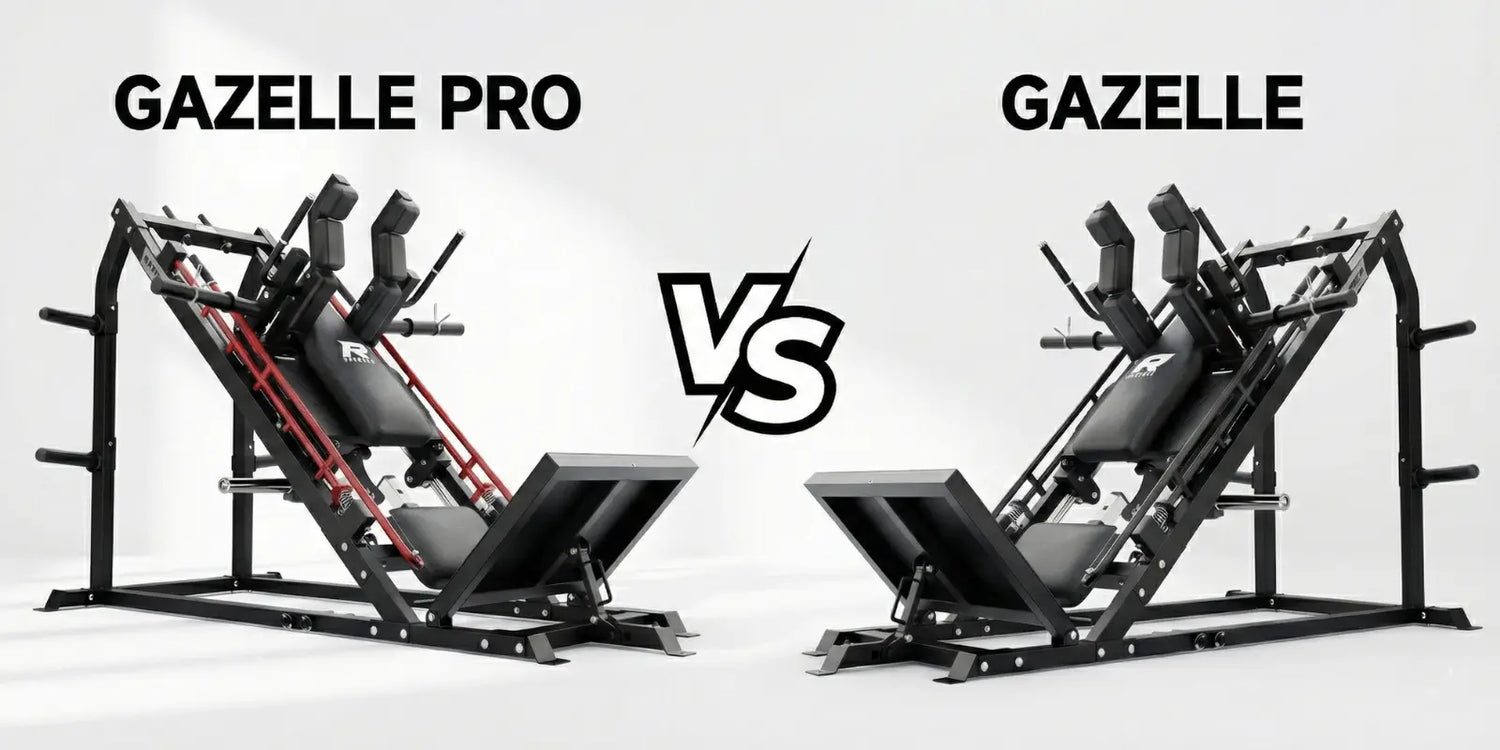
Gazelle Pro vs Gazelle comes down to training headroom, room size, comfort, and safety adjustment. The Gazelle Pro suits heavier long term progression, while the Gazelle suits buyers who want a smaller footprint and practical capacity for most home gym training.
This comparison uses current official RitFit specifications, explains the most important differences, and shows which machine better fits different bodies, spaces, and lower body goals.
Quick Answer: Choose the Gazelle Pro for higher listed load capacity, thicker back padding, a heavier frame, and more progression room. Choose the Gazelle for a smaller footprint, five safety stop positions, lower unloaded pull force, and a broader stated user height range for compact home gym training.
Key Takeaways
- Heavy progression: The Gazelle Pro lists a 1300 pound dynamic capacity, compared with 900 pounds for the Gazelle.
- Space efficiency: The Gazelle occupies about 25.9 square feet, while the Gazelle Pro occupies about 28.93 square feet.
- Frame difference: The Gazelle Pro uses a larger 2 by 3 inch frame with approximately 11 gauge steel, while the Gazelle uses reinforced 2 by 2 inch tubing with approximately 14 gauge steel.
- Comfort and setup: The Gazelle Pro has a thicker listed back pad, while the Gazelle provides five safety stop positions and a lower unloaded pull force.
- Best overall choice: The right machine depends on expected training loads, available working space, user height, preferred movement modes, and budget.
Which Machine Is the Better Overall Choice?
The Gazelle Pro is the better overall choice for buyers who prioritize higher capacity, thicker padding, and long term strength progression. The Gazelle is the better choice for compact rooms, broader stated user fit, and a lower cost entry into dedicated lower body machine training.

- Choose the Gazelle Pro: Review the RitFit Gazelle Pro 3 in 1 leg press and hack squat machine when heavier loading and thicker support matter most.
- Choose the Gazelle: Review the RitFit Gazelle 3 in 1 leg press and hack squat machine when space efficiency and safety stop flexibility lead the decision.
How Do the Gazelle Pro and Gazelle Specifications Compare?
The Gazelle Pro leads in capacity, frame size, back pad thickness, and lower overall machine height. The Gazelle leads in floor space efficiency, safety stop count, lower unloaded pull force, and broader stated user height coverage.
| Feature | Gazelle Pro | Gazelle | Buying Meaning |
|---|---|---|---|
| Dynamic Capacity | 1300 lb | 900 lb | More progression headroom with Gazelle Pro |
| Static Capacity | 2000 lb | 1500 lb | Higher manufacturer listed overall rating with Gazelle Pro |
| Frame | 2 by 3 in, about 11 gauge | 2 by 2 in, about 14 gauge | Larger and heavier frame on Gazelle Pro |
| Machine Weight | 334.3 lb | 308.65 lb | Gazelle is lighter to place, both remain heavy machines |
| Dimensions | 86.4 by 48.2 by 57.8 in | 82.7 by 45.1 by 70.9 in | Gazelle uses less floor space, Gazelle Pro is shorter |
| Footprint | 28.93 sq ft | 25.9 sq ft | Gazelle saves about 3 square feet |
| Back Pad Thickness | 3.15 in | 2.8 in | Gazelle Pro provides more listed cushioning |
| Unloaded Pull Force | 62.61 lb | 51.1 lb | Gazelle starts with less listed unloaded resistance |
| Safety Stop Levels | 4 height limiter levels | 5 safety stop positions | Gazelle provides one more stop position |
| Guide Rail Travel | 35.43 in | 40.6 in | Gazelle lists a longer travel path |
| Stated User Height | 4.9 ft to 6.8 ft | About 4 ft 7 in to 6 ft 10 in | Gazelle lists broader fit at both ends |
| Primary Modes | Leg press, hack squat, calf raise | Leg press, hack squat, reverse hack squat | Choose by preferred third movement |
| Slide Mechanism | Roller bearing | Industrial grade roller bearing | Both use roller based carriage systems |
Specifications were checked against the official RitFit product pages on July 16, 2026. Manufacturer specifications can change, so confirm the current product page and manual before ordering or loading either machine.
Buyers who want to compare related lower body equipment can also browse the RitFit strength machines collection.
How Was This Gazelle Pro vs Gazelle Comparison Created?
This comparison uses official product specifications, stated movement modes, room planning factors, and peer reviewed resistance training research. It does not claim independent laboratory testing or long term hands on testing of both machines.
Disclosure: RitFit manufactures and sells both products in this comparison. The goal is to explain meaningful differences clearly so buyers can choose the machine that better fits their training and home gym constraints.
Leg press research shows that the movement strongly recruits the quadriceps, while setup and knee flexion can influence muscle activation patterns.[1]
Which Machine Has More Training Capacity?
The Gazelle Pro has more listed training headroom, with a 1300 pound dynamic capacity and 2000 pound static capacity. The Gazelle lists a 900 pound dynamic capacity and 1500 pound static capacity, which remains substantial for many home gym users.
- For advanced progression: Choose the Gazelle Pro when your current strength, plate collection, and future goals justify the additional capacity.
- For most home users: Choose the Gazelle when its listed limits remain comfortably above your realistic working loads.
- Capacity note: Treat static and dynamic capacity as manufacturer limits, not target loads, storage recommendations, or proof that every user should train near those numbers.
Strength and hypertrophy can be developed across a broad range of loads when effort, volume, progression, and recovery are managed appropriately.[3] A practical plate loaded setup can include RitFit high grade color bumper plates.
How Do the Frames and Motion Systems Compare?
The Gazelle Pro uses the larger and heavier frame, while the Gazelle uses a lighter and more compact structure. Both machines list roller bearing carriage systems designed to support smooth travel during repeated lower body sets.
- Gazelle Pro frame: The official comparison lists a 2 by 3 inch frame made with approximately 11 gauge steel.
- Gazelle frame: The official comparison lists reinforced 2 by 2 inch tubing made with approximately 14 gauge steel.
- Travel path: The Gazelle lists 40.6 inches of guide rail travel, compared with 35.43 inches for the Gazelle Pro.
- Movement control: Smooth bearings support consistent repetitions, but users still need controlled tempo, stable foot contact, and an appropriate range of motion.
Research found that preferred foot stance can be used during inclined leg press work, while movement velocity should reflect the training objective.[2]
"The inclined leg press exercise produces the highest muscle activation in the vastus medialis, regardless of the velocity, feet stance, or gender."
Martín-Fuentes, Oliva-Lozano, and Muyor, study authors, Sports Health
Which Machine Offers Better Comfort and User Fit?
The Gazelle Pro offers the thicker listed back pad, while the Gazelle offers the broader stated user height range. Actual fit still depends on exercise mode, limb length, foot placement, shoulder position, and preferred depth.
- Back support: The Gazelle Pro lists a 3.15 inch back pad, compared with 2.8 inches on the Gazelle.
- Starting resistance: The Gazelle lists 51.1 pounds of unloaded pull force, compared with 62.61 pounds for the Gazelle Pro.
- Height range: The Gazelle Pro lists users from 4.9 feet to 6.8 feet, while the Gazelle lists approximately 4 feet 7 inches to 6 feet 10 inches.
- Fit check: Shorter and taller buyers should confirm the manual and test the bottom position with light resistance before relying on a stated height range alone.
How Much Room Does Each Machine Need?
The Gazelle requires less listed floor space, at about 25.9 square feet, compared with 28.93 square feet for the Gazelle Pro. The Gazelle Pro is shorter overall, while the Gazelle is narrower and shorter in length.
- Gazelle Pro dimensions: 86.4 inches long, 48.2 inches wide, and 57.8 inches high.
- Gazelle dimensions: 82.7 inches long, 45.1 inches wide, and 70.9 inches high.
- Working clearance: Add room for plate loading, adjustments, entry, exit, cleaning, and safe movement around the frame.
- Floor protection: Place either machine on a stable surface, and consider RitFit rubber high density interlocking gym flooring mats to protect the training area.
Measure doors, stairs, ceiling height, and the complete working zone before ordering, not only the final frame footprint.
Which Machine Has the Better Safety Stop Setup?
The Gazelle provides more listed stop positions, with five safety stops compared with four height limiter levels on the Gazelle Pro. More positions can make it easier to match the bottom limit to different users and exercises.
- Before loading: Set and test the stops with the carriage unloaded or lightly loaded.
- During setup: Confirm that both sides are secured at matching positions before every working set.
- During training: Stop the set when control, joint comfort, or stable foot contact changes.
- During maintenance: Inspect bolts, handles, stops, rails, pads, and plate horns regularly according to the product manual.
Safety stops reduce risk but do not replace correct assembly, suitable loading, controlled technique, and routine equipment inspection.
Who Should Choose the Gazelle Pro?
Choose the Gazelle Pro when higher capacity, thicker padding, a larger frame, and a lower overall height are worth the additional floor space. It is the stronger match for advanced lifters and buyers who want more long term loading headroom.
- Heavy strength goals: The higher dynamic capacity leaves more room between normal working loads and the manufacturer limit.
- Comfort priority: The thicker listed back pad may better suit higher volume leg press and hack squat sessions.
- Low ceiling planning: The 57.8 inch listed height may fit rooms where a taller machine creates a placement problem.
- Calf raise training: The Gazelle Pro officially lists calf raises as its third primary movement mode.
"The Gazelle Pro arrived in two different shipments, took 30minutes to open and place the parts and 3 hours to completely build. It's very helpful to have the manual and the video for confirmation on the steps. I am very happy with the Gazelle Pro as an addition to my small home gym."
Tim J., Verified Buyer, RitFit GAZELLE PRO 3-In-1 Leg Press and Hack Squat Machine
Who Should Choose the Gazelle?
Choose the Gazelle when compact floor planning, broader stated user fit, five safety stop positions, and lower unloaded resistance matter most. It is the better value focused choice when 900 pounds of listed dynamic capacity already exceeds realistic training needs.
- Compact home gyms: The Gazelle saves about three square feet of listed footprint compared with the Gazelle Pro.
- More stop positions: Five safety stops offer an additional setup option for bottom range control.
- Broader stated fit: The listed user range extends shorter and taller than the Gazelle Pro range.
- Reverse hack squats: The Gazelle officially lists reverse hack squat as its third primary movement mode.
Users who want additional isolated knee extension and curl work can compare the RitFit PLC01 leg extension and curl machine.
"Absolutely a must have for a garage gym. I love my gazelle and so does my wife."
Martin S., Verified Buyer, RitFit GAZELLE 3-in-1 Leg Press Hack Squat Machine for Home Gym
What Should You Check Before Buying?
Check the complete training zone, realistic loading needs, user fit, movement preference, and delivery path before choosing either machine. A better specification does not help when the equipment does not fit the room, body, or intended program.
- Measure the route: Confirm doors, hallways, stairs, ceiling height, and final assembly space.
- Plan working clearance: Leave room to load plates, change modes, enter safely, and clean the rails.
- Choose the third movement: Decide whether calf raises on the Gazelle Pro or reverse hack squats on the Gazelle better support your program.
- Check your starting point: Compare unloaded pull force and available safety positions when beginners or smaller users will share the machine.
- Confirm current terms: Review the latest price, stock status, shipping details, warranty, returns, included parts, and product manual before payment.
- Build the wider station: A stable RitFit GATOR adjustable weight bench can support upper body and accessory training outside the leg machine.
Research generally supports using a controlled and appropriate range of motion, while personal joint tolerance and training goals should guide the final setup.[4]
FAQs About Gazelle Pro vs Gazelle
Which is better, Gazelle Pro or Gazelle?
Choose the Gazelle Pro when higher load capacity, thicker padding, and greater long term progression matter most. Choose the Gazelle when a smaller footprint, five safety stop positions, lower unloaded pull force, and practical home gym value better match your room, current strength level, and training plan.
What is the main difference between Gazelle Pro and Gazelle?
The main difference is maximum training headroom versus space efficiency. The Gazelle Pro lists higher static and dynamic capacities, a heavier frame, thicker back padding, and a smaller overall height, while the Gazelle uses less floor space, offers five safety stop positions, and supports a broader stated height range.
Is the Gazelle Pro worth it for a home gym?
Yes. The Gazelle Pro can be worth it when you expect heavy progression, want thicker back padding, and have enough floor space for its larger footprint, while buyers whose working loads remain well below the Gazelle limits should compare room size, training goals, and budget before paying for extra headroom.
Is the Gazelle better for small home gyms?
Yes. The Gazelle is the more space efficient option because its listed footprint is about twenty six square feet, compared with nearly twenty nine square feet for the Gazelle Pro, but buyers still need extra clearance for loading plates, adjusting the machine, entering safely, and walking around the frame.
Can beginners use the Gazelle Pro or Gazelle safely?
Yes. Beginners can use either machine when they start with light resistance, learn each adjustment, and test the safety stops before hard sets, while safe use also requires controlled repetitions, secure plate loading, suitable footwear, regular hardware checks, and immediate stopping when pain, loss of control, or equipment movement occurs.
How much space do the Gazelle Pro and Gazelle require?
The Gazelle Pro lists a footprint of about twenty nine square feet, while the Gazelle lists about twenty six square feet. Plan a larger working zone than the frame dimensions alone, because plate loading, footplate changes, safe entry, maintenance access, and walking clearance all require additional room around the machine.
Which machine is better for heavy leg press training?
The Gazelle Pro is the stronger choice for heavy leg press progression because its manufacturer listed dynamic capacity is thirteen hundred pounds, compared with nine hundred pounds for the Gazelle. Capacity is not a target load, so stay within the manual, use secure plates and collars, and progress only with controlled technique.
Which machine should I choose for hack squats?
Choose the Gazelle Pro for hack squats when higher capacity, thicker padding, and a lower machine height are the main priorities. Choose the Gazelle when a smaller footprint, five safety stop positions, and broader stated user fit matter more, then test the bottom position lightly before deciding your working depth and load.
Conclusion
The Gazelle Pro is the stronger choice for higher capacity, thicker padding, a heavier frame, and lower overall height. The Gazelle is the smarter choice for smaller rooms, broader stated user fit, five safety stop positions, lower unloaded resistance, and practical home gym value.
Measure your room, compare the official manuals, and choose the machine that leaves a safe margin for your real training needs. Review current offers on the RitFit sales page before ordering.
Disclaimer
This article provides general product comparison and fitness education, not medical diagnosis, rehabilitation guidance, or individualized training advice. Follow the current product manual, verify assembly and safety stops before loading, use controlled technique, and consult a qualified professional when pain, injury, balance limitations, or medical concerns affect lower body training.
Save on your next RitFit order
Tap the button to copy your code, then paste it at checkout.
References
1. Martín-Fuentes I Oliva-Lozano JM Muyor JM. Evaluation of the Lower Limb Muscles' Electromyographic Activity during the Leg Press Exercise and Its Variants: A Systematic Review. Int J Environ Res Public Health. 2020;17(13):4626. doi:10.3390/ijerph17134626. PMCID: PMC7369968.
2. Martín-Fuentes I Oliva-Lozano JM Muyor JM. Influence of Feet Position and Execution Velocity on Muscle Activation and Kinematic Parameters During the Inclined Leg Press Exercise. Sports Health. 2022;14(3):317-327. doi:10.1177/19417381211016357. PMCID: PMC9112713.
3. Schoenfeld BJ Grgic J Van Every DW Plotkin DL. Loading Recommendations for Muscle Strength, Hypertrophy, and Local Endurance: A Re-Examination of the Repetition Continuum. Sports. 2021;9(2):32. doi:10.3390/sports9020032. PMCID: PMC7927075.
4. Schoenfeld BJ Grgic J. Effects of Range of Motion on Muscle Development During Resistance Training Interventions: A Systematic Review. SAGE Open Med. 2020;8:2050312120901559. doi:10.1177/2050312120901559. PMCID: PMC6977096.





