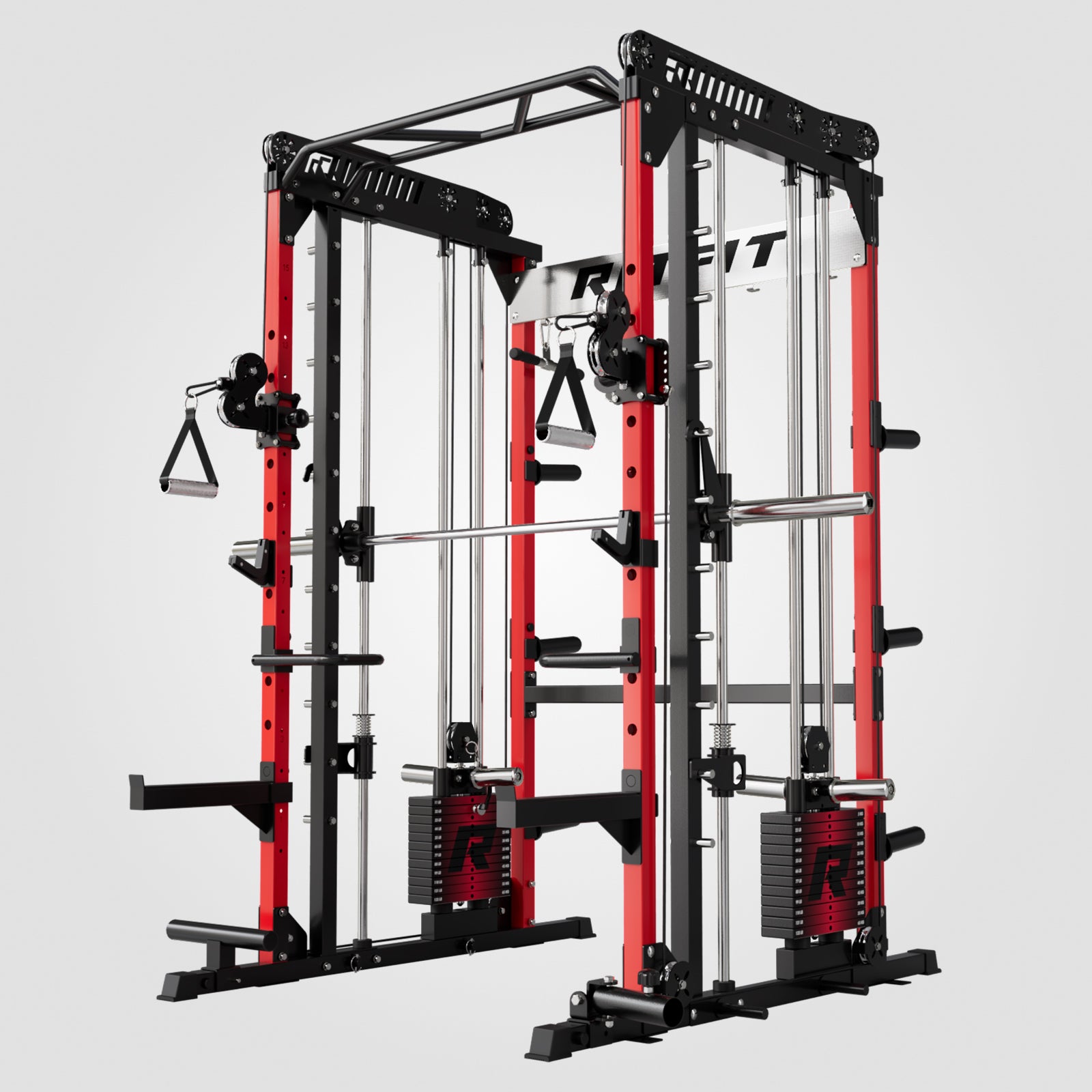
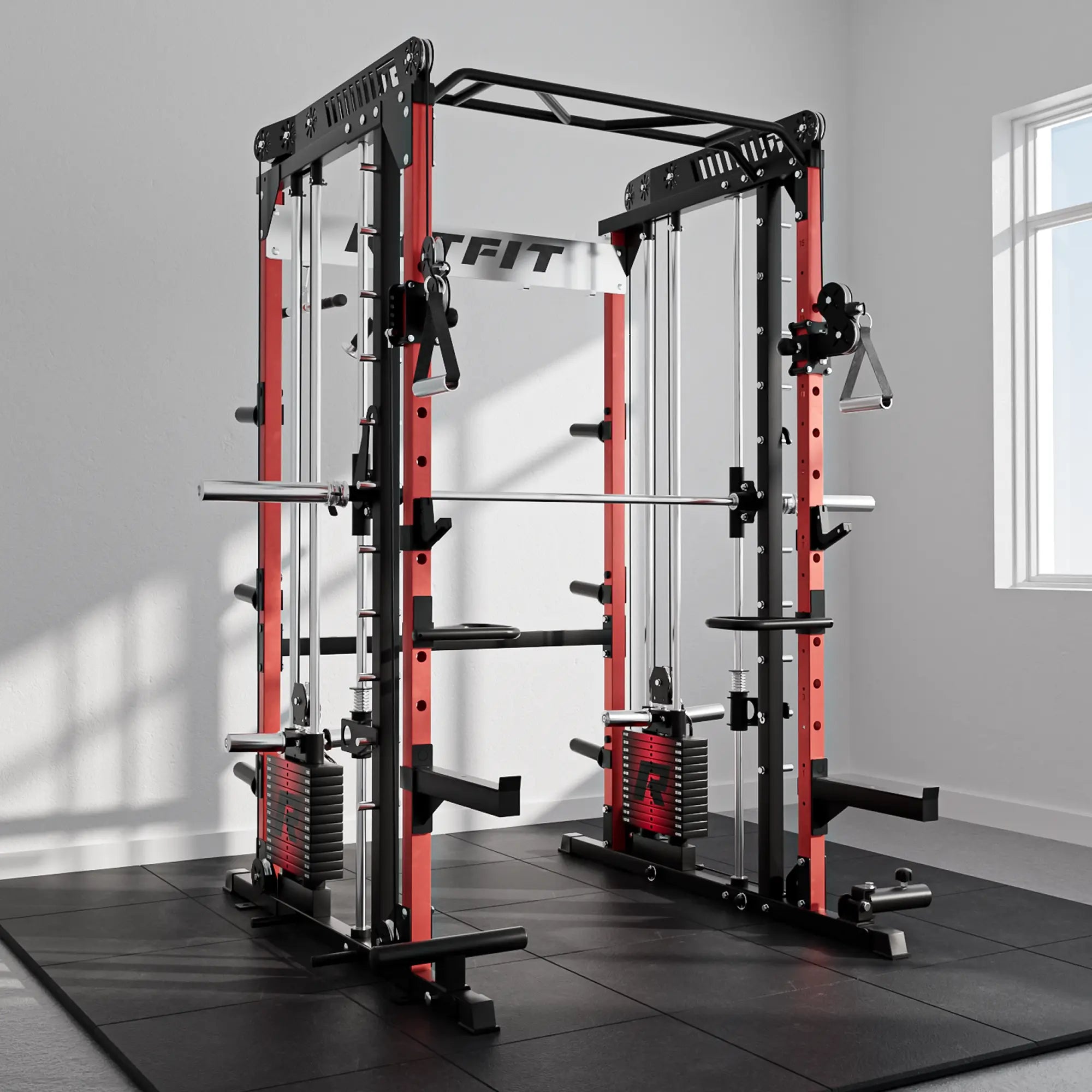
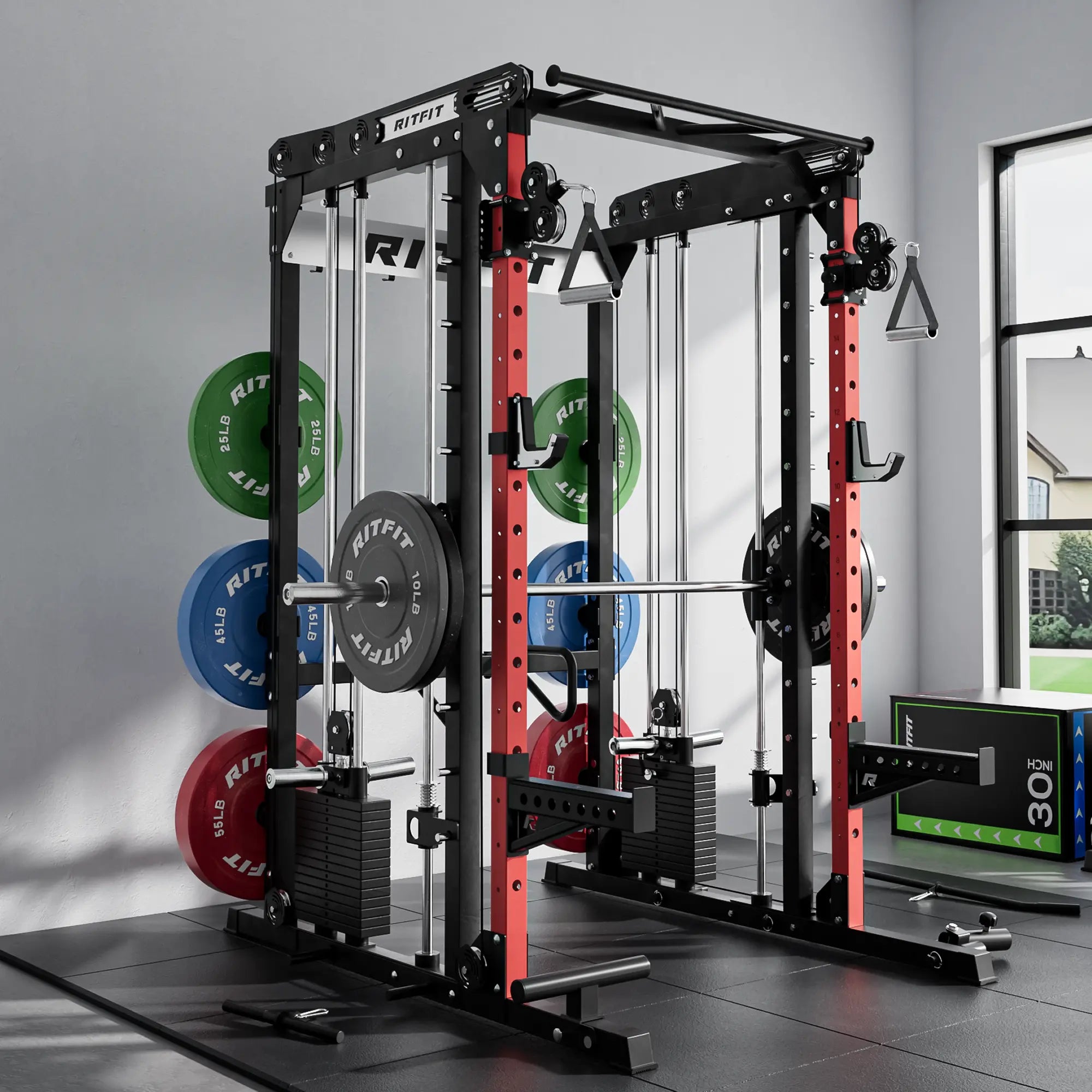

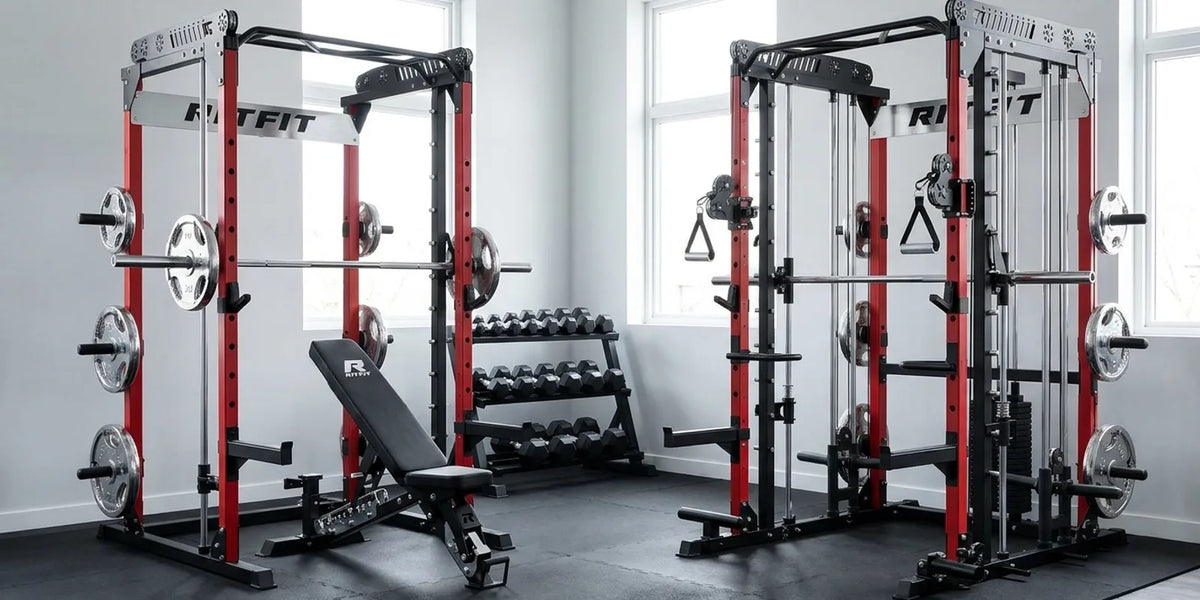
The M1 Pro no stack vs weight stack decision is not a choice between two machines, because both configurations share the same RitFit M1 Pro frame, smith carriage, and cable crossover system. The real question is whether a $1,000 premium for a factory-installed 264 lb weight stack fits the way you train.
This guide compares list prices, carriage specifications, day-to-day training flow, and upgrade costs for both versions. By the end, you will know which M1 Pro configuration matches your plates, your space, and your budget.
Quick Answer: For most people building a home gym from the ground up, choose the $2,299.99 M1 Pro Weight Stack Set. The extra $1,000 buys fast pin-selected resistance and a ready-to-train setup without a separate cable-work plate collection, while the $1,299.99 No Stack version is better only if you already own Olympic plates or specifically prefer plate loading.
Key Takeaways
- Same frame, two configurations: Both versions share the M1 Pro frame, smith carriage, and cable crossover system, and the stack configuration adds a 264 lb integrated stack.
- The gap is $1,000: The No Stack configuration lists at $1,299.99 and the Weight Stack Set at $2,299.99 at the time of writing.
- Same core frame: Both configurations use 2 x 2, 14-gauge steel, a 1,600 lb frame capacity, a 20.9 sq ft footprint, 15 cable positions, and 11 Smith positions.
- Best value for a new setup: The Weight Stack Set puts the main training options in place from day one, while the $999.99 WSM1 add-on shows that the bundled $1,000 step-up is a practical way to avoid a second purchase later.
- Training science is neutral here: A 2023 meta-analysis found no direct-comparison differences in strength or hypertrophy between free-weight and machine-based training.
What Is the Difference Between the M1 Pro No Stack and Weight Stack Versions?
The two versions use the same M1 Pro platform, but the loading system changes the daily training experience. The No Stack version uses plates, while the With Stack version adds a 264 lb built-in stack, and the current comparison price is $1,299.99 versus $2,299.99.
| Feature | M1 Pro, No Stack | M1 Pro, With Stack |
|---|---|---|
| Product | M1 Pro, No Stack | M1 Pro, With Stack |
| Price | $1,299.99 | $2,299.99 |
| Smith machine type | Basic Smith | Basic Smith |
| Built-in weight stack | None | 264 lb |
| Rack material | 2 x 2, 14-gauge steel | 2 x 2, 14-gauge steel |
| Frame capacity | 1,600 lb | 1,600 lb |
| Rack height | 85.3 inches | 85.3 inches |
| Footprint | 20.9 sq ft | 20.9 sq ft |
| Cable adjustment positions | 15 | 15 |
| Smith adjustment positions | 11 | 11 |
| Pull-up bar capacity | 465 lb | 465 lb |
| Safety arm capacity | 575 lb | 575 lb |
| J-hook capacity | 287 lb | 287 lb |
| Plate storage bars | 6 | 6 |
| Suggested user height | Up to approximately 6 feet 6 inches | Up to approximately 6 feet 6 inches |
Specifications and list prices from the RitFit M1 Pro product listing, checked October 2026. Treat the listing as the final word on current pricing and color availability.
The listing shows a customer rating of 4.7 out of 5 from 480 reviews on the product page as of October 2026, so both configurations draw on the same owner feedback base. Everything else about the machine, from the smith bar path to the attachment ecosystem, carries over unchanged between the two.
"An truly awesome piece of home gym equipment, I love that I can do almost any exercise and several different variations of most lifts. The quality is good, the price point is outstanding, and adding things like the weight stack make this piece even better."
Kyle K. Verified Buyer, RitFit M1 PRO Multi-Functional Smith Machine with Cable Crossover System and Squat Rack for Home Gym
Training With Plates on the No Stack Version
Plate loading turns every resistance change into a short walk to the carriage, and some lifters prefer that direct control. The No Stack configuration keeps the same 1,600 lb frame capacity, 465 lb pull-up bar capacity, and 575 lb safety arm capacity listed for the With Stack configuration.
- Loading rhythm: Changing resistance means sliding a collar and adding or removing plates, which slows fast drop sets but gives you exact control over every jump.
- Capacity profile: The parameter table lists a 287 lb J-hook capacity, 6 plate storage bars, and a suggested user height up to approximately 6 feet 6 inches for both M1 Pro configurations.
- Storage on frame: Six plate holders and slots for 3 Olympic bars keep loose plates off your garage floor.
- What you already own matters: Lifters with a plate collection skip the biggest hidden cost of the plate route, which is buying plates in the first place.
If you worry that plates versus a pin-selected stack changes your results, the evidence says otherwise. A 2023 meta-analysis found no differences between free-weight and machine-based training in direct comparisons of strength, jump performance, and hypertrophy, and concluded that strength changes are specific to the training modality you use.[1]
Training With the Built-In 264 lb Weight Stack
The stack configuration trades plate handling for speed, because changing resistance means moving a pin instead of loading steel. It adds a 264 lb built-in stack while keeping the same rack material, frame capacity, footprint, and adjustment positions shown for the No Stack version.
- Set-to-set speed: Moving a pin takes seconds, which keeps supersets, drop sets, and paired exercises moving without plate math between sets.
- Shared-machine flow: Several lifters can rotate through a workout with no loose plates to corral, which is why stack machines dominate commercial gym floors.
- Cable feel: The 2:1 pulley ratio on the high and low pulleys pairs with 15 adjustable positions for smooth, controlled cable travel.
For anyone concerned that a machine stack limits progress, a 10-week randomized trial in 36 novice trainees found similar gains in strength, muscularity, and functional ability regardless of whether participants trained on machines or free weights.[2] Consistency, not the loading method, drove the results in that study.
"Few pieces of equipment in the home exercise industry are as comprehensive and versatile as this all-in-one gym system. The robust system provides a natural, centered bar path for compound lifts like squats, presses, and rows, and incorporates a dual cable crossover station with a full rack of precision-engineered attachments."
Tom Eskey, CF-L1, CPT, Home Gym Equipment Reviewer at Garage Gym Revisited, RitFit M1 Multi-functional Smith Machine Review
M1 Pro Cost Comparison: Is the Weight Stack Worth the Extra $1,000?
The $1,000 gap is easier to justify when the Weight Stack Set is your starting setup because the same 264 lb stack lists at $999.99 as a WSM1 add-on. For a new home gym, buying the stack with the machine is a strong value move because it puts the most convenient daily training path in place without planning a second upgrade.
- Bundled now: Choosing the Weight Stack Set configuration adds $1,000 to the $1,299.99 base price, and the stack arrives installed with the machine.
- Added later: The WSM1 264 lb weight stack set lists at $999.99 as a standalone add-on, so the upgrade-later path lands within a dollar of the bundled price.
- Plate route: Starting the No Stack version without plates means budgeting for a set of Olympic plates on top of the $1,299.99, an amount that varies with how much iron you want on hand.
- Check the live listing: Promotional pricing appears on this listing from time to time, so treat the product page as the final word on what you will actually pay.
The bundle also makes the daily experience more straightforward, because the stack arrives as part of the main configuration instead of requiring a later upgrade decision and delivery. If you already own a useful Olympic plate collection, the No Stack version remains the smarter budget choice, but starting from zero usually makes the Weight Stack Set the better overall value.
"The M1 Pro fits my needs and fits my extra bedroom. It was also priced right. Evrything is working smoothly right now."
Bruce G. Verified Buyer, RitFit M1 PRO Multi-Functional Smith Machine with Cable Crossover System and Squat Rack for Home Gym
Which M1 Pro Configuration Should You Buy?
For most new home gym buyers, buy the Weight Stack Set because it makes the M1 Pro ready for efficient daily training from day one. Choose No Stack when you already own Olympic plates, need the lowest upfront price, or prefer plate loading over pin-selected convenience.
| Your situation | Better fit | Why |
|---|---|---|
| You already own a full plate set and prefer plate loading | No Stack | You avoid buying duplicate resistance equipment and keep the lower entry price |
| You want a faster daily training flow | Weight Stack Set | Pin selection makes supersets, drop sets, and exercise changes easier to manage |
| Several lifters share the machine | Weight Stack Set | No loose plates to move or store between users, and resistance changes stay simple |
| You want the lowest entry price today | No Stack | $1,299.99 leaves room in the budget, but you still need plates for plate-loaded work |
| You plan the full ecosystem from day one | Consider a package | The weight stack home gym package and the strength system package bundle the popular upgrades |
Recommendations based on the listed specifications and prices for the two M1 Pro configurations, checked October 2026.
ACSM guidance frames the free-weight versus machine choice as a matter of training status, movement familiarity, and your primary training objective, and that is exactly how this purchase should be made.[3] If you want to compare this machine against the wider RitFit lineup, browse the smith machine collection.
"Easy to install. All parts came in great condition. I love this machine"
Johnathan M. Verified Buyer, RitFit M1 PRO Smith Machine Weight Stack Home Gym Package
Upgrade Paths and Attachment Costs for Each Version
Both configurations feed the same M1 Pro attachment ecosystem, so your upgrade path stays open either way. The only fork is stack timing, since the WSM1 264 lb set can join your garage later for $999.99.
- Cable expansion: The LDM1 lat pulldown attachment and LHM1 leg holder attachment are built for the M1 Pro and work on either configuration.
- Stack timing: Buying the WSM1 add-on later lets the stack arrive in its own delivery window, which helps when the machine budget is already stretched.
- Package upgrades: The M1 Pro weight stack home gym package and the M1 Pro strength system package with the BLP01 leg press bundle the popular upgrades into one order.
For a deeper look at the stack configuration, our smith machine with weight stack guide covers that setup in detail. Attachment compatibility never changes between the two versions, so no upgrade decision is locked in today.
Warranty Coverage for Each Configuration
Both configurations carry the same M1 Pro warranty terms, and the add-ons follow the RitFit strength equipment schedule. Coverage starts from the order date and applies to orders within the lower 48 states.
| Model | Category | Coverage term | What it covers |
|---|---|---|---|
| M1 Pro Smith Machine, both configurations | Smith machine | 3-year basic warranty | Frame and welding, plus 1 year on bolts and pulleys |
| M1 Pro attachments such as the LDM1 and LHM1 | Strength equipment | 3 years frame and welding, 1 year bushings and bearings, 6 months parts and pads | Per the strength equipment warranty schedule |
| WSM1 weight stack set | Strength equipment | 3 years frame and welding, 1 year bushings and bearings, 6 months parts and pads | Per the strength equipment warranty schedule |
Terms from the RitFit warranty policy page and the M1 Pro product listing, checked October 2026.
The fine print applies uniformly, with coverage running from the order date, staying non-transferable, and excluding products that leave the lower 48 states.
FAQs About the M1 Pro No Stack and Weight Stack Versions
Can I add a weight stack to the M1 Pro No Stack version later?
Yes. RitFit sells the WSM1 264 lb weight stack set as a separate M1 Pro add-on, listed at $999.99 at the time of writing. Adding it later costs about the same as choosing the Weight Stack Set configuration up front, so the main difference is delivery, assembly, and timing rather than total price.
How much weight can the M1 Pro carriage hold in each configuration?
The parameter table lists both configurations with a 1,600 lb frame capacity, 465 lb pull-up bar capacity, 575 lb safety arm capacity, and 287 lb J-hook capacity. The configurations differ mainly in loading method and built-in stack equipment for everyday home training.
What plates does the plate-loaded M1 Pro use?
The parameter table lists 6 plate storage bars for both configurations, along with the same 2 x 2, 14-gauge rack material, 85.3 inch rack height, 20.9 sq ft footprint, and suggested user height up to approximately 6 feet 6 inches.
Does the 264 lb stack limit my top-end cable weight?
It can, depending on the exercise. The 264 lb stack is shared between the high and low pulleys, so the resistance ceiling arrives sooner on stack-fed movements than on plate loading. Lifters who pull or press very heavy on cable work should compare their working loads against the stack before choosing this configuration.
Which M1 Pro version works better for a shared family gym?
The weight stack version usually wins for shared use. Moving a pin takes seconds, there are no loose plates to corral between users, and the setup stays tidy. The plate-loaded version suits a household that already owns plates and wants the plate-loaded setup for heavier plate work.
Do both M1 Pro configurations include the same frame and attachments?
Yes. Both configurations share the same M1 Pro frame, smith carriage, cable crossover system, and standard attachment set, with 15 adjustable positions and the same accessory ecosystem. The main spec difference in this comparison is the built-in 264 lb stack, while the supplied parameter table shows the same core frame and adjustment specifications for both configurations.
Conclusion
For most buyers, the M1 Pro Weight Stack Set is the better value because it makes daily training easier from the first session and avoids a separate stack purchase later. Choose the No Stack version when you already own Olympic plates or prefer plate loading for your routine.
Before you order, check the current listing price and any active promotions, and read our RitFit discount guide to stack savings on top. Whichever configuration you choose, buy once and build around it.
Disclaimer
Prices, specifications, and warranty terms in this article reflect RitFit listings and policy pages checked in October 2026 and can change without notice. Confirm current details on the official product pages before purchasing, and consult a qualified professional before starting a new strength training program.
References
1. Haugen ME, Vårvik FT, Larsen S, Haugen AS, van den Tillaar R, Bjørnsen T. Effect of free-weight vs. machine-based strength training on maximal strength, hypertrophy and jump performance - a systematic review and meta-analysis. BMC Sports Sci Med Rehabil. 2023;15(1):103. doi:10.1186/s13102-023-00713-4. PMCID: PMC10426227
2. Aerenhouts D, D'Hondt E. Using Machines or Free Weights for Resistance Training in Novice Males? A Randomized Parallel Trial. Int J Environ Res Public Health. 2020;17(21). doi:10.3390/ijerph17217848. PMCID: PMC7662789
3. Currier BS, D'Souza AC, Singh MAF, et al. American College of Sports Medicine Position Stand. Resistance Training Prescription for Muscle Function, Hypertrophy, and Physical Performance in Healthy Adults: An Overview of Reviews. Med Sci Sports Exerc. 2026;58(4):851-872. doi:10.1249/MSS.0000000000003897. PMCID: PMC12965823