








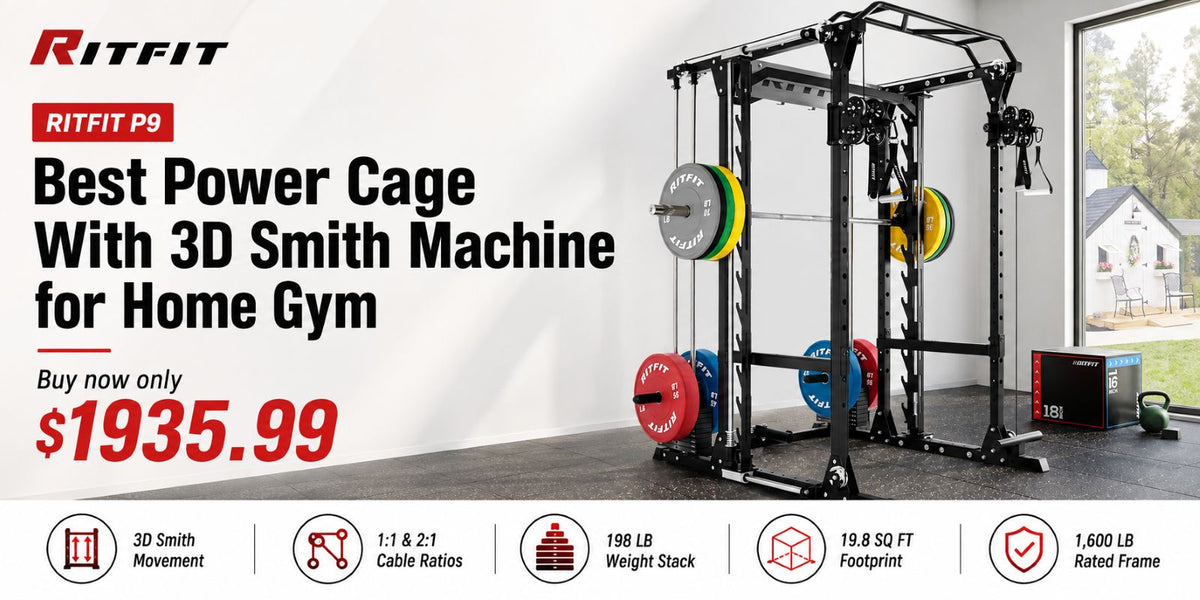
The RitFit P9 is the best power cage with 3D Smith machine for a home gym in 2026, pairing multi-directional bar movement with a dual cable system and a weight stack in one compact footprint. This guide covers how the 3D Smith bar works, why the 1:1 and 2:1 cable ratios matter, and how much room the P9 needs.
Below you will find the P9 specs, the best ways to train on a multi-directional Smith bar, and a decision matrix for your home gym. Always measure your floor space and ceiling height before ordering.
Quick Answer: The best power cage with 3D Smith machine for a home gym in 2026 is the RitFit P9, a flagship all-in-one rack with a multi-directional Smith bar, a dual cable system in 1:1 and 2:1 ratios, and a 198 lb weight stack in a 19.8 square foot footprint.
Key Takeaways
- 3D Smith movement: The P9 Smith bar travels both vertically and horizontally with about 20.6 inches of horizontal travel, giving you a freer bar path than a fixed-path Smith.
- Dual cable system: You can switch between 1:1 and 2:1 cable ratios, so the same pulley supports heavy row work and light isolation moves.
- Integrated weight stack: The 198 lb steel stack is built in, with 99 lb per side and no need to load plates for cable exercises.
- Compact footprint: The P9 fits a 19.8 square foot footprint with a 1,600 lb rated frame, which suits a garage or spare room home gym.
- Modular design: Six Smith bar locking positions let you switch between fixed and free modes for different lifts and skill levels.
What Makes a Power Cage with 3D Smith Machine Different?
A power cage with a 3D Smith machine lets the bar move along a fixed vertical track at first, then unlock to glide freely in several directions once you switch modes. Unlike a standard single-plane Smith, a 3D Smith bar offers roughly 20.6 inches of horizontal travel so you can press and squat along a natural, slightly curved path.
- Fixed mode first: Beginners keep the bar locked to a straight vertical track for steady rack pulls and presses.
- Free 3D mode: More experienced lifters unlock the bar to add side-to-side or front-to-back micro-movement that feels closer to a free barbell.
This flex makes the P9 appealing whether you are new to guided pressing or you want a crossover between a pure cable machine setup and a free rack. The bar path stays controlled during heavy work, which is the core reason shoppers pair a Smith with a power cage in a compact home footprint.
"You only need a power rack, barbell, bench and (ideally) some dumbbells to run this program. You could replace the bench work in this program with dips, dumbbell press, smith-machine press or machine chest press."
Jeff Nippard, Science-Based Natural Bodybuilder and Powerlifter, JeffNippard.com
RitFit P9 at a Glance: Key Specs
The P9 is a modular all-in-one cage with a 1,600 lb rated frame and a 19.8 square foot footprint, so you get full rack and cable capability without a multi-station footprint. It stands 85.2 inches tall with a 63.4 inch length and a 78.6 inch width.
| Spec | RitFit P9 |
|---|---|
| Frame rating | 1,600 lb |
| Smith bar static rating | 530 lb |
| Footprint | 19.8 sq ft |
| Height | 85.2 in |
| Smith horizontal travel | 20.6 in |
| Weight stack | 198 lb total, 99 lb per side |
| Cable ratio | 1:1 and 2:1 |
Spec ratings come from the RitFit brand product page. Treat frame and Smith ratings as manufacturer engineering limits, not independent third-party certifications.
All the key numbers line up for a serious single-user home gym. The 530 lb static Smith rating and 660 lb safety arms give you a wide working window, and the 19.8 square foot footprint means you rarely need to clear out a full garage bay. Browse the full range of power racks and cages to see how the P9 sits alongside the rest of the line.
How Does the 3D Smith Bar Change Your Workouts?
A 3D Smith bar changes your training because it adds a horizontal component to the vertical track, so the bar can move slightly forward and backward instead of being pinned to one plane. The P9 delivers about 20.6 inches of horizontal travel with a lowest bar position of 9.0 inches, and six locking positions let you flip between fixed and free modes.
Exercises that benefit most from 3D movement
Rows, presses, and squats benefit most because they each involve a slight forward-back arc that a fixed-path Smith cannot reproduce.
- Squat: The guided bar adds stability under load if you train alone without a spotter, and the free mode lets your hips drive the bar in a natural shelf position.
- Bench press: Locking the bar in fixed mode keeps the path steady for high-rep volume, then free mode adds a touch of shoulder-friendly drift.
- Bent-over row: The horizontal travel lets the bar clear your knees and travel back toward your hips in a straighter pull.
One peer-reviewed study of trained women reported higher one-repetition-maximal Smith-machine squat strength than free-weight squat [1]. A separate peer-reviewed study found submaximal-velocity methods predicted Smith machine bench press 1-RM to within about 1 kg in trained men [2], which reinforces how useful a guided press is when you train without a partner. In elite sprinters, loaded squat jump height was similar whether the squat was performed on a Smith machine or with a free barbell [3].
How Do the 1:1 and 2:1 Cable Ratios Work?
The 1:1 and 2:1 cable ratios change how much resistance you feel per loaded weight, and the P9 lets you switch between them to match the move and the load. In 1:1 ratio the pulldown weight matches the stack directly, which suits heavy lat pulldowns and cable rows, while 2:1 ratio halves the felt resistance for lighter accessory and isolation work.
- 1:1 ratio: Use it for heavier pressing and pulling moves where you want the full stack to feel heavy and direct.
- 2:1 ratio: Use it for cable flyes, face pulls, and warm-up sets where a lighter, smoother feel gives you better control.
The single-side pulley is rated for 550 lb static and 330 lb dynamic, and the system runs on 20 commercial-grade aluminum pulleys for a smooth, quiet pull. Think of the ratio switch as a quick way to widen the working load range without touching a plate.
How Does the 198 lb Weight Stack Fit In?
The P9 integrates a steel weight stack with 9 plates per side that delivers 198 lb total, or 99 lb per side, so your cable cable, row, and fly moves stay smooth and quick to set up. Each individual plate weighs 11 lb (5 kg), and the stack is built into the frame rather than bolted on as an afterthought.
- Quick load changes: You just move the selector pin instead of sliding plates onto a sleeve between sets.
- Balanced resistance: Equal plates on both sides keep the dual cables feeling even through a full range of motion.
For most home lifters 198 lb is plenty for upper-body cable work and warm-up sets. If you want to go heavier, you can run the stack in the 1:1 ratio and pair the P9 with loose plates on a barbell for squats and presses.
Does the P9 Fit Your Room and Ceiling?
The P9 needs a floor footprint of 19.8 square feet plus clearance around it, and it stands 85.2 inches tall, so ceiling height is often the bigger constraint than floor space. The rack is 63.4 inches long and 78.6 inches wide, and it suits users roughly 4 ft 9 in to 6 ft 5 in tall based on the 145 to 195 cm suggested range.
- Ceiling clearance: Leave at least 12 inches above your head when overhead pressing, so a 8 foot ceiling usually clears a 6 foot lifter pressing a Smith bar.
- Side clearance: Keep a few feet on each side to load plates and swing a pull-up bar without hitting a wall.
- Floor type: A hard rubber mat or gym flooring under the 623 lb rack protects your floor and keeps the frame level.
Measure the ceiling first because the fixed 85.2 inch height does not change. If your ceiling is lower than about 7 feet 6 inches, the P9 may still fit, but your pressing stroke will be cramped. For a space guide across the whole family, compare the P9 with our range of all-in-one Smith machines.
How Hard Is the P9 Assembly?
The P9 ships in multiple boxes with a total rack weight of 623 lb, so plan for a two-person build that takes around 3 to 5 hours depending on your tool setup and experience level. The frame is modular, so the main steps are mounting the uprights, attaching the Smith bar guides, and connecting the cable pulley system.
- Tools needed: A standard socket set, a torque wrench, and a rubber mallet for aligning the guide rods.
- Floor prep: Put down a gym mat or rubber tiles before you assemble so the rack sits flat and your floor stays protected.
- Cable tension: Follow the included manual step by step for the dual cable tension, because the 20 pulleys need even routing to run smoothly.
If you have never assembled a cable crossover rack before, watch RitFit assembly videos on the product page to see the pulley routing before you start.
Who Should Buy the RitFit P9?
The P9 is for the garage gym builder who wants a single station that handles Smith squats, bench presses, pull-ups, cable flies, and pulldowns without switching between machines. It works best for the Marcus-style shopper who values spec-per-dollar and wants a rack that anchors a serious home gym.
- Single spotter-free trainer: The 3D Smith bar and safety arms let you push to failure alone on squats and bench presses.
- Space-conscious buyer: The 19.8 square foot footprint replaces a rack, a Smith machine, and a cable crossover, all in one corner.
- Progressive lifter: The 1:1 and 2:1 cable ratios cover you from heavy rows to light flyes, and the 1,600 lb frame gives you room to grow into heavier loads.
If you already own a barbell and plates and want the most capability per square foot, the P9 is worth the flagship price within the RitFit line. Compare it to the RitFit M3 and the Buffalo Smith machine to see which power profile fits your routine.
Who Should Skip the P9?
The P9 is not the right fit if you are a beginner on a tight budget, if you have a ceiling shorter than 7 feet 6 inches in your gym space, or if you prefer buying a rack and a separate Smith machine later. The 198 lb weight stack is enough for most cable moves, but it may feel light for a strong lifter who wants heavy lat pulldowns.
- Budget-first buyer: The RitFit M1 starts lower and still gives you a Smith plus cable crossover.
- Short ceiling rooms: Basements with 7 foot ceilings leave no room for overhead pressing, so a shorter rack or a freestanding Smith may fit better.
- Plate-loaded preference: A lifter who already owns a full plate set may prefer a plate-loaded cable system over a fixed weight stack.
If any of these match your situation, look at the M3 Power Rack or the P3 power cage for a different feature balance.
RitFit P9 vs Other RitFit Models: Which One Fits Your Training?
The P9 sits at the top of the RitFit line as the only model with a full 3D Smith bar, dual cable system, and integrated weight stack in a single frame. Below is how it compares to the other RitFit all-in-one models so you can pick the right one for your space and goals.
| Model | Price | Footprint | Smith Type | Cable | Weight Stack |
|---|---|---|---|---|---|
| RitFit P9 | $2,099.99 | 19.8 sq ft | 3D Smith 20.6 in travel | Dual cable 1:1-2:1 | 198 lb |
| RitFit M2 3D | ~$2,199.99 | 23 sq ft | 3D Smith ~6 in travel | Dual cable | Plate-loaded or stack |
| RitFit M1 | $1,069-1,299 | Compact | Standard Smith | Cable crossover | No built-in stack |
| Buffalo Smith | ~$3,199 | All-in-one | Standard Smith | Smith + lat pulldown + cable crossover | Weight stack |
Prices and specs are sourced from the RitFit product pages. Budget options and larger combos are available across the line.
The P9 offers the most Smith travel and the smallest footprint among the two 3D models.
If you want the full 3D bar travel and a weight stack, the P9 hits the value sweet spot.
If you want a bigger weight stack or a larger frame, the Buffalo or M3 may suit you better.
FAQs About the RitFit P9 Power Cage
What is a 3D Smith machine on the RitFit P9?
A 3D Smith machine lets the bar move in multiple directions instead of a fixed vertical path. The P9 Smith bar offers about 20.6 inches of horizontal travel. This means you can press, row, and squat with a freer bar path. Six locking positions let you switch between fixed and free modes for different exercises.
How much space does the RitFit P9 need?
The P9 footprint is 19.8 square feet. It measures 63.4 inches long, 78.6 inches wide, and 85.2 inches tall. Plan for extra clearance around the rack for loading plates and moving the bar. Ceiling height matters more than floor space, so measure both before you buy.
What does the 198 lb weight stack on the P9 do?
The P9 has an integrated steel weight stack with 9 plates per side. That delivers 198 lb total, or 99 lb per side, with each plate weighing 11 lb. This powers the cable system for lat pulldowns, cable flies, and rows without loading plates.
What are the 1:1 and 2:1 cable ratios on the P9?
In 1:1 mode each cable carries the full stack weight, which suits heavy row and press work. In 2:1 mode the resistance is halved, which suits isolation and high-rep exercises. You switch between ratios to match the exercise and the load you need.
How much weight can the RitFit P9 hold?
The P9 frame is rated up to 1,600 lb. The Smith bar carries 530 lb static, and the pull-up bar and safety arms are rated 660 lb static. These are engineering ratings from the spec sheet, so load your bar within them for safe training.
What is the suggested user height for the P9?
The P9 suits users roughly 4 ft 9 in to 6 ft 5 in tall, based on the manufacturer spec of 145 to 195 cm. The rack stands 85.2 inches tall. Check your ceiling height and your reach before you commit to the setup.
Is the P9 worth the price compared to other RitFit models?
The P9 is the flagship all-in-one in the RitFit line, so it sits above the M1 and M2 3D on price. You pay for the 3D Smith bar, dual cable system with weight stack, and the 1,600 lb frame. If you want all of these in one footprint, it is the value pick for a serious garage gym.
Conclusion
The RitFit P9 is the best power cage with 3D Smith machine for a home gym in 2026, packing a multi-directional Smith bar, a dual cable system with 1:1 and 2:1 ratios, and a 198 lb weight stack into a 19.8 square foot footprint. It suits the experienced garage gym builder who wants one station for squats, presses, rows, and cable work.
Start by measuring your ceiling height and floor space, then compare the P9 to the M2 3D and Buffalo models. Use the RitFit discount guide before checkout for the best price.
Disclaimer
This article is for informational purposes only and does not constitute medical, training, or safety advice. Always consult a qualified fitness professional before starting a new training program or purchasing equipment for your home gym.
References
1. Hsieh S, et al. Effects of Transducer Placement on Load-Velocity Profile in Smith Machine and Free Weight Squats. J Funct Morphol Kinesiol. 2025;10(1). doi:10.3390/jfmk10010084. PMCID: PMC12101428
2. Tessaro G, et al. Accuracy of Predicting One-Repetition Maximum from Submaximal Velocities in the Smith Machine Bench Press. J Strength Cond Res. 2022;36(8):2213-2219. doi:10.1519/JSC.0000000000003820. PMCID: PMC9465738
3. Loturco I, Mcguigan MR, Freitas TT, et al. Squat and countermovement jump performance across a range of loads: a comparison between Smith machine and free weight execution modes in elite sprinters. Biol Sport. 2022;39(4):1043-1048. doi:10.5114/biolsport.2022.112085. PMCID: PMC9536377





