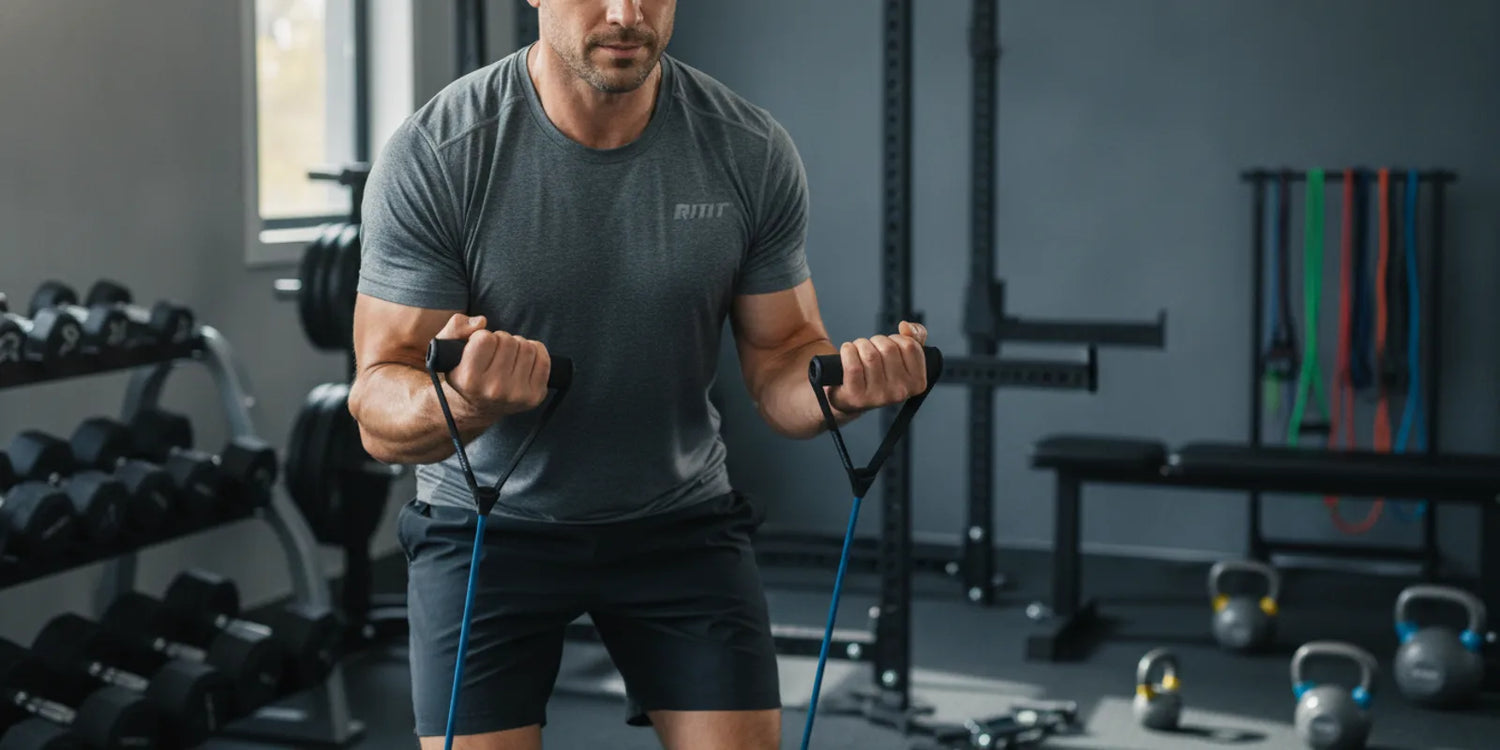
The RitFit single resistance exercise band with comfortable handles is a natural latex tube band designed for full-body strength training, physical therapy, and portable workouts at home or on the road.
This guide covers the band's key features, evidence-based benefits of elastic resistance training, a complete 10-exercise workout, and practical tips on choosing the right resistance level and progressing safely over time.
Quick Answer: The RitFit single resistance exercise band with comfortable handles is a 4-foot natural latex tube band that supports over 30 full-body exercises for strength training, muscle toning, and physical therapy. A meta-analysis found that elastic resistance bands produce strength gains comparable to conventional weights, making this band an effective and portable training tool for all fitness levels. [1]
Key Takeaways
- Comparable Gains: A meta-analysis found that elastic resistance training produces similar strength gains to conventional weight training across multiple muscle groups.
- Full-Body Versatility: The RitFit band supports over 30 exercises covering chest, back, shoulders, arms, legs, and core using a single 4-foot natural latex tube.
- Comfort-First Design: Cushioned foam handles with anti-slip grip and a 3-inch foam door anchor significantly expand the range of exercises you can perform.
- Smart Progression: Move up one resistance level once you can complete 2 sets of 15 reps with good form and minimal fatigue on consecutive sessions.
- Broad Applicability: The band is effective for beginners, seniors, travelers, and physical therapy patients due to its portability, low joint stress, and adjustable load.
What Is the RitFit Single Resistance Exercise Band with Comfortable Handles?
The RitFit single resistance exercise band with comfortable handles is a natural latex tube band measuring 4 feet in length, designed for stackable resistance, physical therapy, and versatile strength training at any location. According to product specifications, the band is made from natural latex that is non-irritant and odor-free, paired with cushioned foam anti-slip handles and a 3-inch foam door anchor.
Key Features: Natural Latex, Foam Handles, and Door Anchor
The band's natural latex construction delivers smooth, linear variable resistance that increases as you stretch the band through its range of motion. The foam handles provide a secure, comfortable grip that reduces hand fatigue during higher-rep sets.
- Natural latex tube: Stackable design allows combining multiple bands to increase resistance; odor-free and non-irritant for sensitive skin.
- Cushioned foam handles: Anti-slip grip material keeps the handles stable during pulling and pushing movements at any angle.
- 3-inch foam door anchor: Dense foam padding secures the band at the top, mid, or bottom of a door, enabling cable-style pulling exercises without a gym machine.
- 4-foot length: Suitable for most upper and lower body exercises in a standing or seated position without excess slack.
- Portability: The complete set fits in a travel bag, making it practical for hotel rooms, offices, and outdoor workouts.
For users who also train on a cable machine, the RitFit Exercise Handles for Cable Machine offer a compatible handle upgrade for machine-based cable work.
Available Resistance Levels and How to Choose Yours
The RitFit band is available in color-coded resistance levels, starting with Yellow at 1-5 lb for beginners and progressing through higher resistance options for intermediate and advanced trainees. Choosing the correct resistance level from the start protects joint health and promotes proper movement patterns.
- Yellow (1-5 lb): Best for beginners, seniors, and physical therapy; ideal for learning movement patterns and shoulder rehabilitation exercises.
- Mid-range levels: Suitable for upper body pulling and pressing exercises once foundational form is established.
- Higher resistance levels: Appropriate for lower body exercises such as squats, deadlifts, and hip abduction, which engage larger muscle groups.
Browse the full resistance bands collection to find the level that matches your current fitness, including options for beginners and advanced trainees.
What Does the Evidence Say About Resistance Band Training?
Elastic resistance band training produces strength gains comparable to conventional weight training, according to a systematic review and meta-analysis published in SAGE Open Medicine. [1] This finding holds across different population profiles and diverse training protocols, which supports the use of resistance bands as a primary training tool rather than just a warm-up accessory.
Elastic Bands vs. Conventional Weights for Strength Gains
In a randomized controlled trial, untrained females followed a four-week heavy-resistance program using either elastic bands or isotonic weights; the results showed no significant difference in concentric or eccentric force gains between the two groups, with percent changes in force ranging from 7 to 30 percent for both groups. [2] Practitioners can prescribe elastic band training and expect comparable strength outcomes to traditional weight training.
- Linear variable resistance: Elastic bands increase tension as the band stretches, which challenges muscles through a greater portion of the range of motion than a constant-weight dumbbell.
- Eccentric loading: Bands provide controlled resistance on the return phase of each movement, supporting eccentric muscle development that is often undertrained with free weights alone.
- Fat loss potential: According to Cleveland Clinic, a review of 18 trials involving 669 participants found that resistance band training reduced body fat in overweight individuals more effectively than free weights and bodyweight exercise alone.
- Joint-friendly loading: The progressive tension profile of elastic bands reduces peak joint stress at the most vulnerable portion of each movement, making them suitable for users with joint sensitivity.
"Resistance bands might not look like much, but they can strengthen your muscles as effectively as more traditional weights. In many ways, bands put more tension on your muscles and work them longer during movements."
Christopher Travers, MS, Exercise Physiologist, Cleveland Clinic, Using Resistance Bands for Strength Training ↗
Full-Body Workout: 10 Exercises With Your RitFit Resistance Band
A single resistance band with handles supports a complete full-body workout targeting every major muscle group, from the chest and back to the legs and core. The exercises below are organized by muscle group and can be combined into a single session or split across training days.
Upper Body Exercises: Chest, Back, Shoulders, and Arms
Anchor the band at mid-height using the door anchor for horizontal pressing and rowing movements, or hold it underfoot for overhead and curl exercises.
- Chest press: Anchor at mid-back height, hold both handles, and press forward until elbows are fully extended. Perform 2-3 sets of 10-15 reps.
- Bent-over row: Stand on the band's center, hinge at the hips to 45 degrees, and pull both handles to your ribcage. Focus on squeezing the shoulder blades at the top.
- Overhead press: Stand on the band, hold handles at shoulder height with palms forward, and press overhead until arms are fully extended.
- Bicep curl: Stand on the band, keep elbows at your sides, and curl both handles to shoulder level. Control the descent over 2-3 seconds.
- Tricep pushdown: Anchor the band at a high door position, grip handles with palms facing down, and push both handles toward the floor while keeping upper arms stationary.
For more exercise ideas, see 9 resistance band exercises you can do at home and resistance band exercises you can do anywhere.
Lower Body Exercises: Squats, Lunges, and Hip Abduction
Stand on the band or anchor it low to add resistance to lower body movements that engage the quads, glutes, and hamstrings.
- Squat: Stand on the band with feet shoulder-width apart, hold handles at shoulder height, and squat to parallel before driving back up through the heels.
- Reverse lunge: Stand on the band's midpoint with one foot, hold both handles at your sides, and step one foot back into a lunge. Alternate legs for 10-12 reps per side.
- Hip abduction: Anchor the band low, loop it around one ankle, and stand sideways to the door. Lift the banded leg out to the side for 15 reps, then switch sides.
Core Exercises: Pallof Press and Standing Oblique Crunch
Anchor the band at mid-chest height to load the core against rotational and anti-rotational forces, which builds stability rather than just flexion strength.
- Pallof press: Stand perpendicular to the anchor point, hold both handles at chest level, and press straight out. Hold for 2 seconds before returning. This exercise resists rotation and builds deep core stability.
- Standing oblique crunch: Anchor the band overhead, hold both handles above one shoulder, and crunch diagonally toward the opposite hip for 12-15 reps per side.
For a complete breakdown of exercises organized by muscle group, visit resistance band workouts for all body parts.
How Do You Choose the Right Resistance Level?
The correct resistance level allows you to complete 2 sets of 15 repetitions with good form while reaching near-muscular fatigue by the final 2-3 reps of each set. Choosing too light a band eliminates the training stimulus, while choosing too heavy compromises form and increases injury risk.
- Beginners and physical therapy: Start with the lightest available resistance to learn movement patterns and protect joints.
- Upper body pulling and pressing: Most intermediate trainees need a mid-range resistance for rows, curls, and chest presses.
- Lower body exercises: Squats, deadlifts, and hip abduction involve larger muscle groups and typically require a higher resistance level than upper body movements.
- Form over resistance: According to Cleveland Clinic exercise physiologist Christopher Travers, maintaining proper form and posture is more important than using the highest possible resistance level.
If you are unsure about your starting level, check the exercise handle general info page for guidance on matching resistance to exercise type.
How Do You Progress With a Resistance Band Over Time?
Progressive overload with a resistance band works the same way as with free weights: you must consistently increase the training demand to continue building strength and muscle. The three primary methods for progressively overloading a resistance band are increasing reps, decreasing rest time, or moving up to a higher resistance level.
When to Increase Resistance
Move up one resistance level when you can complete 2 sets of 15 reps with proper form and minimal fatigue across two consecutive training sessions. Trying to increase resistance before that point leads to form breakdown and increased injury risk.
How to Make Any Exercise Harder Without Buying More Bands
You can increase training demand without switching bands by modifying tempo, stance, or band position.
- Slow the eccentric phase: Extend the lowering portion of each rep to 3-4 seconds to increase time under tension without adding resistance.
- Shorten your stance: Standing closer to the anchor point or stepping further from the band's center increases baseline tension before you even begin the movement.
- Add a pause: Hold the peak contraction for 2 seconds on each rep to increase muscular activation at the most challenging point of the movement.
- Increase training frequency: Performing 2-3 sessions per week consistently produces greater long-term strength improvements than sporadic high-intensity sessions.
- Stack bands: The RitFit natural latex band's stackable design allows combining multiple bands through the same handle for incremental resistance increases.
For guidance on avoiding common progression errors, see resistance band mistakes to avoid.
How Do You Use the Door Anchor Safely?
The RitFit door anchor allows you to replicate cable machine exercises at home by securing the band at multiple heights using any standard interior door. Proper setup is essential to prevent anchor slippage during high-tension movements.
- Choose the correct door: Use a solid interior door; avoid hollow-core, glass, or bi-fold doors that may not withstand repeated tension loads.
- Position and lock: Thread the anchor's loop through the band handle, close it firmly on the hinge side of the door, and ensure the door latches completely before loading tension.
- Pre-load test: Pull the band firmly before starting any set to confirm the anchor is fully secure and will not slip during exercise.
- Set the correct height: Position the anchor low (floor level) for rows and deadlifts, mid-height for chest presses and Pallof presses, and high (top of door) for lat pulldowns and tricep pushdowns.
- Face away from the door hinge: Stand facing away from the hinged side to ensure the door is pulled shut, not pulled open, by band tension.
The exercise handles technical specification page provides additional setup information for handle-based band exercises.
Who Benefits Most From the RitFit Single Resistance Band?
The RitFit single resistance exercise band is effective for a broad range of users, from complete beginners to older adults and physical therapy patients who need a low-impact, adjustable training tool. A systematic review and meta-analysis of 25 randomized controlled trials found that elastic band resistance training significantly improves lower limb strength and balance function in older adults across multiple health conditions. [3]
- Home exercisers: The band replaces multiple pieces of equipment and requires no dedicated space, making it practical for apartment and small-space workouts.
- Travelers: The band fits in a carry-on bag and allows full-body training in hotel rooms, maintaining training consistency between gym sessions.
- Beginners: The low entry resistance level and joint-friendly loading curve make the band ideal for building foundational movement patterns without the coordination demands of free weights.
- Older adults and seniors: Elastic resistance training improves lower limb strength and balance in older populations, supporting fall prevention and functional independence.
- Physical therapy patients: The progressive tension profile of elastic bands reduces peak joint stress compared to isotonic weights, making them a standard tool in rehabilitation settings. Always follow a therapist's prescribed resistance level and range of motion guidance during rehabilitation.
See what resistance bands help with and can you build muscle with resistance bands for additional context on use cases and outcomes.
Users who want to complement band training with added load can explore the exercise weights collection for compatible free weight options.
What Are the Most Common Mistakes When Using a Resistance Band?
Most resistance band training errors fall into two categories: using incorrect resistance for the exercise, and skipping safety checks on the band and anchor before each session. Both errors reduce training effectiveness and increase injury risk.
- Overstretching the band: Stretching the band beyond its designed range can cause it to snap, resulting in potential injury. Never overstretch to add resistance; move up to the next resistance level instead.
- Skipping the pre-session inspection: Inspect the band before each session for cracks, thinning, discoloration, or nicks, especially near the handle attachment points. Discard bands showing visible wear.
- Starting with too much resistance: Using a resistance level that prevents smooth range of motion leads to compensatory movement patterns that reinforce poor form. Start lighter and progress systematically.
- Neglecting the eccentric phase: Allowing the band to snap back uncontrolled eliminates the eccentric loading benefit and can cause joint strain. Control each rep through the full range of motion in both directions.
- Training without footwear: Always wear shoes when standing on the band to prevent slipping, particularly on smooth floor surfaces.
- Stop if you feel sharp joint pain: Muscle fatigue and a burning sensation are normal during resistance band training. Sharp, acute joint pain is not, and is a signal to stop the exercise and assess your form or resistance level before continuing.
For a deeper review of what to avoid during band training, see resistance band mistakes to avoid.
FAQs About the RitFit Single Resistance Exercise Band
What resistance level should I start with for the RitFit resistance band?
Beginners should start with the lightest Yellow band (1-5 lb) to learn proper form without straining joints. Once you can complete 2 sets of 15 reps with good technique and little fatigue, move up one level. Match resistance to the exercise, lighter for shoulders and triceps, heavier for squats and rows.
Can I build muscle with a single resistance band?
A meta-analysis published in SAGE Open Medicine found that elastic resistance training produces similar strength gains to conventional weight training across multiple muscle groups. Consistent progressive overload, increasing resistance or reps over time, is the key factor, not the equipment type. Two to three sessions per week is sufficient for measurable gains.
How do I use the door anchor safely?
Thread the door anchor through the band loop and close it firmly on the hinge side of a solid interior door. Pull the band sharply before starting to confirm the anchor is secure. Position it at the correct height for each exercise, low for rows, mid for chest press, and high for lat pulldowns.
How many exercises can I do with one resistance band and handles?
A single tube band with handles supports over 30 exercises targeting every major muscle group. Upper body options include chest press, bicep curls, overhead press, and bent-over rows. Lower body options include squats, lunges, and hip abduction. Core exercises such as the Pallof press and standing oblique crunch are also effective with this setup.
How long does a natural latex resistance band last?
With proper care, a natural latex resistance band typically lasts one to two years of regular use. Inspect the band before each session for cracks, discoloration, or thinning. Avoid prolonged exposure to direct sunlight or extreme cold, which accelerates latex degradation. Store it loosely coiled in a cool, dry place.
Are resistance bands good for physical therapy and rehabilitation?
Resistance bands are widely used in physical therapy for joint rehabilitation and post-surgery recovery because they provide linear variable resistance, increasing load gradually through the range of motion. This reduces peak joint stress compared to free weights. Always follow a therapist's prescribed resistance level and range of motion guidance during rehabilitation.
Conclusion
The RitFit single resistance exercise band with comfortable handles is an evidence-backed, portable training tool that supports full-body strength training, muscle toning, and physical therapy for a wide range of users. A systematic review confirmed that elastic resistance training produces strength gains comparable to conventional weights, making this band a legitimate alternative to gym machines for home and travel use.
Start with the lightest resistance level, focus on form, and progress systematically. Complement your band training with the resistance bands collection to find the right resistance for every exercise in your routine.
Disclaimer
The information in this article is intended for general fitness and educational purposes only and does not constitute medical advice, diagnosis, or treatment. Consult a qualified healthcare provider or physical therapist before beginning any new exercise program, especially if you have an existing injury, medical condition, or are recovering from surgery.
Save on your next RitFit order
Tap the button to copy your code, then paste it at checkout.
References
1. Lopes JSS, Machado AF, Micheletti JK, et al. Effects of training with elastic resistance versus conventional resistance on muscular strength: A systematic review and meta-analysis. SAGE Open Med. 2019;7:2050312119831116. https://pmc.ncbi.nlm.nih.gov/articles/PMC6383082/
2. Picha KJ, Almaddah M, Barker J, et al. Concentric and Eccentric Force Changes with Elastic Band and Isotonic Heavy Resistance Training: A Randomized Controlled Trial. J Strength Cond Res. 2021. https://pmc.ncbi.nlm.nih.gov/articles/PMC8169017/
3. Meng Y, Hu Y, Yang W, Xue Y, Yang S. Effects of elastic band resistance training on lower limb strength and balance function in older adults: a systematic review and meta-analysis. Front Sports Act Living. 2025;7:1649305. doi:10.3389/fspor.2025.1649305. https://pmc.ncbi.nlm.nih.gov/articles/PMC12630110/