








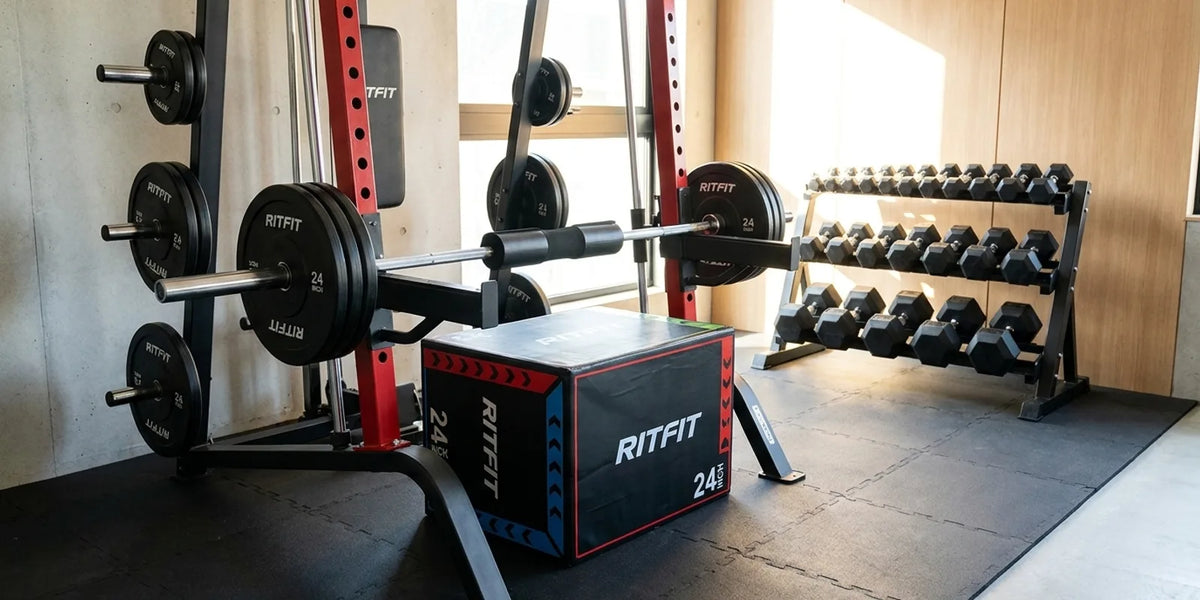
Yes, seated calf raises on a Smith machine work as a direct substitute for a seated calf raise machine, and the setup takes one minute. Sit on a low bench inside the rack, rest the padded bar across your lower thighs just above the knees, and raise and lower your heels through a full range of motion.
This guide covers bench height, bar and pad placement, platform height, and the knee angle that shifts the work to your soleus. You will also get loading, reps, common mistakes, and clear pain rules.
Quick Answer: Yes, seated calf raises on a Smith machine work because the bar sits across your lower thighs exactly like the pad of a dedicated seated calf raise machine. Sit on a bench that keeps your knees bent at about 90 degrees, keep the balls of your feet on a raised platform, and move your heels through a full range of motion.
Key Takeaways
- Setup: Sit on a low bench inside the Smith machine, pad the bar, and rest it across your lower thighs just above the knees.
- Muscle focus: Bent knees shift most of the effort to the soleus, the deeper calf muscle that builds lower leg thickness.
- Evidence: A 2024 EMG study of 30 healthy young men recorded 35% lower medial gastrocnemius activity when the knee stayed bent during plantarflexion.
- Programming: Start light for 3 sets of 10 to 15 slow reps and add weight only when every rep reaches a full stretch and squeeze.
- Safety: Sharp Achilles tendon or knee pain ends the set, and thigh bruising means the bar needs a thicker pad or a new position.
Can You Do Seated Calf Raises on a Smith Machine?
Yes, seated calf raises on a Smith machine replace a dedicated seated calf raise machine in any home gym. The guided bar sits across your lower thighs just like the machine pad, so the setup takes one bench, one bar pad, and a raised platform.
The fixed vertical path of the Smith bar removes the balance problem that makes free standing calf raises awkward. You can load the movement like a machine exercise and chase progressive overload without wobbling through the rep.
- Machine-like loading: Add plates in small jumps and keep every set honest.
- Real stretch and squeeze: A raised platform lets the heels drop below the toes for full dorsiflexion at the bottom and full plantarflexion at the top.
- Two minutes to set up: A bench, a bar pad, and a step or weight plates replace a dedicated seated calf raise machine.
- Safe solo training: Turn the hooks back to rack the bar at any point, so you never need a spotter.
The whole setup sits inside the rack you already own, which is why the movement belongs in any home gym calf routine.
What Muscles Do Seated Calf Raises Work?
Smith machine seated calf raises train the soleus as the main mover because the bent knee shortens the gastrocnemius and cuts its force output at the ankle. The gastrocnemius still helps, but the deep soleus does most of the work.
The calf has two main muscles under one tendon. The gastrocnemius crosses both the knee joint and the ankle joint, while the soleus crosses only the ankle joint.
When the knee bends to about 90 degrees, the gastrocnemius is pulled short at the knee and loses leverage at the ankle. The soleus keeps its full working length, so it takes over as the primary driver of plantarflexion.
In one 2024 study of 30 healthy young men, medial gastrocnemius EMG activity was 35% lower with the knee bent at 90 degrees than with the knee straight. Soleus activity in the first half of slower repetitions ran 15% and 28% higher, and total plantarflexion torque was 31% lower with the bent knee[1].
- Soleus: The deep muscle that gives the lower leg its thickness from the side view.
- Gastrocnemius: The two-headed surface muscle that shapes the upper calf and works harder with a straight knee.
- Triceps surae: The shared name for both calf muscles plus the plantaris, all pulling on the Achilles tendon.
"The gastrocnemius crosses both the knee joint and the ankle joint and can serve as a knee flexor and a plantar flexor. For most actions of the soleus, the origin of the soleus is on the fibular head and lateral plateau of the tibia, with the insertion being at the calcaneal tuberosity via the Achilles tendon. To put this simply: The soleus only crosses the ankle joint. This is a very important distinction to make."
Dr. Bryan Mann, Assistant Professor of Kinesiology and Sport Science, University of Miami. Why You Must Include the Seated Calf Raise Exercise. SimpliFaster
Set Up the Smith Machine for Seated Calf Raises
Set the bench inside the Smith machine so your knees bend at about 90 degrees, then rest the padded bar across your lower thighs just above your knees. A good setup locks in the soleus focus before you add any weight.
- Bench and seat height: Pick a flat bench or a sturdy plyo box that leaves your knees bent at about 90 degrees with your thighs close to parallel to the floor. A seat height of roughly 16 to 18 inches works for most lifters.
- Bar height: Set the Smith bar so it lands on your lower thighs just above the knees while you sit. Unrack it by turning the hooks forward and keep your hands on the bar for control.
- Bar pad: Wrap the bar with a bar pad or a folded towel. Bare steel presses into the thighs fast as the weight climbs.
- Foot platform: Place a firm step or a pair of weight plates about 2 to 4 inches high under the balls of your feet. The heels must drop below the platform for a full stretch.
- Getting in and out: Sit on the bench first, slide your thighs under the bar, set the pad just above the knees, and place the balls of your feet on the platform edge. Turn the hooks back into the uprights before you slide out at the end of the set.
Foot angle is forgiving. A 2011 study of 20 resistance-trained adults compared heel raises with the forefeet elevated about 0.05 m in neutral, toes-in, and toes-out positions and found no significant difference in ankle range of motion between positions[2].
Keep the knee angle near 90 degrees through the whole set. A straighter knee turns the movement into a standing calf raise, and a deeply bent knee can cramp the calves for some lifters.
How to Do Smith Machine Seated Calf Raises Step by Step
Unrack the padded bar, drop your heels into a full calf stretch, then press through the balls of your feet to raise your heels as high as possible. Control every inch of the rep instead of bouncing off the bottom.
- Step 1: Sit and place the bar. Sit tall on the bench, slide the thighs under the padded bar, and line the bar up just above both knees.
- Step 2: Set your feet. Rest the balls of both feet on the platform edge with the heels free to drop, and keep the feet about hip width apart.
- Step 3: Unrack and stretch. Turn the hooks forward, then lower the heels slowly for 2 to 3 seconds until you feel a deep calf stretch.
- Step 4: Squeeze to the top. Drive through the big toes and the balls of the feet to raise the heels as high as possible, and hold the top for a beat.
- Step 5: Rack it safely. After the last rep, turn the hooks back into the uprights before you slide your legs out.
Breathe in as the heels drop and breathe out as you press to the top. A controlled tempo beats a fast bounce that steals work from the calves.
How Much Weight and How Many Reps for Seated Calf Raises?
Start with the empty Smith bar and perform 3 sets of 10 to 15 slow full range repetitions, then train calves 2 to 3 times per week. The calves respond to range of motion and tension more than raw weight.
- Starting load: The empty Smith bar is enough for the first sessions, because the stretch matters more than the plate count.
- When to add weight: Add the smallest plate you own once every set finishes at the top of the rep range with a full stretch and a full squeeze on every rep.
- Rep tempo: Lower for 2 to 3 seconds, pause briefly at the bottom, and press up without bouncing off the stretch.
- Frequency: Train calves 2 to 3 times per week with at least one recovery day between sessions.
- Stalling point: If the heels stop reaching a full stretch, drop the weight and rebuild the range of motion first.
For full set and rep planning across the week, follow our guide to how many calf raises to do for stronger and more defined calves.
Common Mistakes and When to Stop for Pain
The most common mistakes are bouncing at the bottom, shortening the range of motion, and resting the bar on the kneecaps, which reduces calf stimulus and adds joint stress. All three are easy to fix once you know what to watch for.
- Bouncing reps: Momentum lifts the weight instead of the calves, and the Achilles tendon absorbs the shock.
- Half range: Stopping the heels at platform level removes the stretch where the soleus works hardest.
- Bar on the kneecaps: Slide the pad down to the lower thighs to protect the knee joints.
- Too much weight: If the heels never reach full dorsiflexion or the knees bend to cheat the rep, the load is too heavy.
- Rushing the set: Fast reps with no pause train the joints more than the calves.
A dull muscular burn in the calves is normal, but sharp pain in the Achilles tendon, the back of the ankle, or the knee joint ends the set immediately. Numbness or tingling in the thighs under the bar means the pad is too thin or the bar sits too low.
Adjust the position before the next set, and see a qualified clinician if tendon pain lingers after the session. Training through sharp pain turns a small irritation into a long layoff.
Seated vs Standing vs Donkey Calf Raises on a Smith Machine
Seated calf raises emphasize the soleus because the bent knee limits the gastrocnemius, while standing and donkey calf raises keep the knee straight and shift work to the gastrocnemius. Each position earns a place in a complete calf program.
| Position | Knee angle | Main emphasis | Best used for |
|---|---|---|---|
| Seated, bar on thighs | About 90 degrees bent | Soleus | Lower leg thickness |
| Standing, bar on shoulders | Straight | Gastrocnemius | Upper calf shape |
| Donkey, hips hinged | Straight | Gastrocnemius with a deep stretch | Stretch-focused calf work |
Positions compared for muscle emphasis on the same Smith machine.
A 2020 study of 10 people recovering from an Achilles tendon rupture found similar soleus activity in seated and standing heel rises, and the authors noted the seated position can strengthen all three triceps surae muscles[3].
Donkey calf raises keep the knees straight but hinge the hips forward under the bar, which changes the stretch through the upper calf. Rotate the three positions across the week, and use our standing Smith machine calf raises guide for the knee-straight variation.
Should You Choose the RitFit PSR05 Smith Machine for Seated Calf Raises?
The RitFit PSR05 2.0 Multifunctional Smith Machine suits seated calf raises in any garage gym. The guided bar holds a steady path through every rep, so the machine doubles as a full calf station without a second purchase.
- Steady bar path: The guided bar stays on its uprights while you press through the ankles, which suits lifters training alone.
- Flexible hook heights: Multiple hook positions let short and tall lifters land the bar just above the knees from the same bench.
- More than a calf station: The same machine covers squats, presses, and rows, so seated calf raises never need their own footprint.
If you are still choosing the one machine for your space, the Smith machine collection lists the frame sizes and cable options that fit a home gym.
"If you're short on space, this compact Smith machine delivers everything you need for a complete strength-training experience. The machine is well designed with a small footprint, making it ideal for my home gym. Very happy with this purchase."
Maria del Carmen S. Verified Buyer, RitFit PSR05 2.0 Smith Machine Home Gym Package
What If You Do Not Have a Smith Machine?
A dedicated calf raise machine, a leg press, or a dumbbell balanced across one knee can all replace the Smith machine seated calf raise. The bent-knee principle stays the same, so the soleus still does the work.
- Dedicated calf raise machine: The RitFit BLP01 3-in-1 leg press and hack squat machine adds a calf raise station with a seat and knee pad, so the position is built in.
- Leg press: The leg press platform trains the same plantarflexion pattern with heavy loads and no bar on the thighs. Our leg press calf raise guide covers foot placement and sets.
- Single leg raises: Single leg calf raises build each side evenly and need only a step and a wall for balance.
- Training away from the rack: The full menu of calf exercises at home covers the days you train without machines.
FAQs About Smith Machine Seated Calf Raises
Can you do seated calf raises on a Smith machine?
Yes. A Smith machine can replace a seated calf raise machine when you sit on a low bench, rest the padded bar across your lower thighs just above the knees, and keep the balls of your feet on a raised platform. The guided bar keeps the load stable so you can focus on a full stretch and a strong squeeze.
Where should the bar sit for Smith machine seated calf raises?
The bar should rest across your lower thighs just above the knees and never on the kneecaps themselves. Set the bar height so your knees stay bent at about 90 degrees while you sit, and wrap the bar with a pad or a folded towel to protect your thighs during heavy sets.
What muscles do seated calf raises on a Smith machine work?
Seated calf raises on a Smith machine train the soleus as the main mover and the gastrocnemius as a helper because the bent knee reduces the ability of the gastrocnemius to produce force at the ankle. The soleus sits under the gastrocnemius and gives the lower leg its dense look when viewed from the side.
How much weight should you use for seated calf raises on a Smith machine?
Start with the empty Smith bar and add the smallest plates available once you can finish every set with a full range of motion. Calves respond well to moderate weight and slow controlled repetitions, so the goal is a deep stretch and a hard squeeze on every rep rather than a heavy bounce.
How often should you do seated calf raises?
Train seated calf raises two to three times per week with two to four sets of ten to fifteen repetitions per session. Leave at least one recovery day between sessions, and increase the weight only when every repetition reaches a full stretch and a full squeeze without bouncing.
Are seated calf raises better than standing calf raises?
Neither version is better because they emphasize different calf muscles. Seated calf raises focus on the soleus since the bent knee limits the gastrocnemius, while standing calf raises keep the knee straight and pull more work into the gastrocnemius. Most lifters get the best calf development by training both positions across the week.
When should you stop doing seated calf raises because of pain?
Stop the set immediately if you feel sharp pain in the Achilles tendon, the back of the ankle, or the knee joint. A dull muscular burn in the calves is normal, but joint or tendon pain means the bar position, pad, or load needs to change before you train again.
Conclusion
Seated calf raises on a Smith machine are one of the simplest ways to build stronger calves at home. Pad the bar across your lower thighs, keep the balls of your feet on a raised platform, and control every inch of the rep.
Start light, train calves two to three times per week, and add weight only when the reps stay clean. Check the current RitFit discount guide before you build out the rest of your setup.
Disclaimer
This article is general fitness information and not medical advice. Stop any exercise that causes sharp pain, and consult a qualified healthcare professional before starting a new training program if you have an injury or medical condition.
References
1. Kovács B, Csala D, Yang S, Tihanyi J, Gu Y, Hortobágyi T. Knee position affects medial gastrocnemius and soleus activation during dynamic plantarflexion: no evidence for an inter-muscle compensation in healthy young adults. Biol Open. 2024;13(12). doi:10.1242/bio.061810. PMCID: PMC11708772
2. Arnsdorff K, Limbaugh K, Riemann BL. Analysis of Heel Raise Exercise with Three Foot Positions. Int J Exerc Sci. 2011;4(1):13-21. doi:10.70252/YPIC8188. PMCID: PMC4738962
3. Zellers JA, Brorsson A, Silbernagel KG. Impact of seated and standing positions on triceps surae muscle activation in unilateral Achilles tendon rupture. Transl Sports Med. 2020;3(1):3-8. doi:10.1002/tsm2.117. PMCID: PMC7236791





