








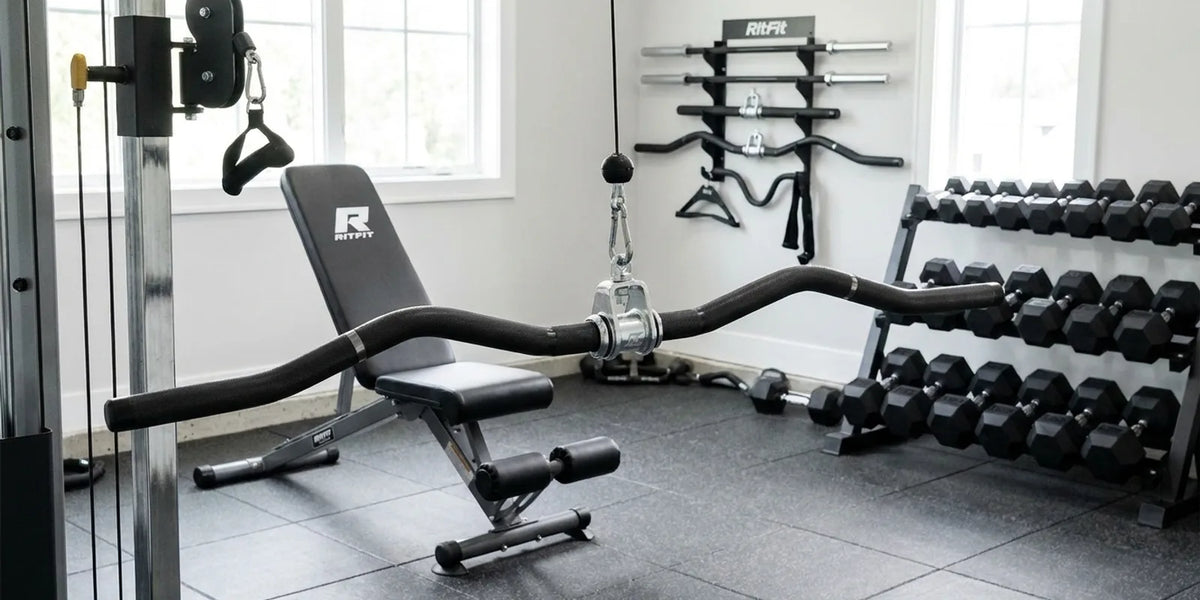
A shoulder lateral raise attachment is a clip on handle, bar, or lever arm that turns the cable machine, functional trainer, or rack you already own into a dedicated side delt station. This guide covers what these attachments are, how cables compare with dumbbells for side delt growth, and how to pick one that fits your exact setup.
Inside you get fit checks for carabiners and rack uprights, a step by step form walkthrough, and programming that keeps tension on the delt instead of the traps. Every performance claim links to its source.
Quick Answer: A shoulder lateral raise attachment is a handle, rope, or lever arm that connects your cable machine, functional trainer, or power rack to your hand for lateral raises. Cables and dumbbells grow the side delt at similar rates in direct comparison, so pick your attachment for fit, steady tension, and small weight jumps rather than promised extra growth.
Key Takeaways
- Definition: A shoulder lateral raise attachment is any clip on handle, rope, or rack mounted lever arm that lets you train lateral raises on equipment you already own.
- Evidence: In one 8-week trial, lateral deltoid thickness grew 3.3% to 4.6%, with similar results between cable and dumbbell raises.
- Fit: Clip on handles hinge on carabiner opening size and pulley height range, while rack mounted arms must match your upright size and hole spacing exactly.
- Form: Set the pulley just below hip height, keep a soft 10-15 degree elbow bend, lead with the elbow, and stop at shoulder height.
- Programming: Roughly ten or more weekly sets for the side delt, trained twice weekly in strict 10-15 rep sets, is a productive starting point.
What Is a Shoulder Lateral Raise Attachment?
A shoulder lateral raise attachment is any handle, rope, or lever arm that connects your hand to a cable pulley or a rack mounted pivot so you can perform lateral raises with steady resistance. The lateral raise lifts your arm out to the side, a movement the side delt drives, and that muscle is what creates the look of shoulder width.
- Clip on handles: single handles, dual handles, and ropes that attach to a cable machine or functional trainer with a carabiner.
- Rack mounted arms: lever arms that bolt to power rack uprights and give you a fixed pivot with no weight stack required.
- Why it matters: the right small accessory adds a dedicated side delt station to the machine you already train on, with no new footprint.
Think of the attachment as a small piece of gear with a big job on shoulder day. If you already own a functional trainer or a rack with a pulley, a handle is all that stands between you and cable lateral raises.
Do Cables or Dumbbells Build the Side Delt Better?
Cables and dumbbells build the side delt at similar rates, so a shoulder lateral raise attachment is not a shortcut to extra growth but a better training experience. In one 8-week trial, 24 resistance-trained men and women did five sets of lateral raises to failure twice weekly, and lateral deltoid thickness increased 3.3% to 4.6% whether they used cables or dumbbells[1].
The real difference is the resistance curve. A dumbbell pulls straight down, so its leverage against your side delt shrinks as your arm hangs at your side, while a cable pulls toward the pulley and keeps tension on the delt through the bottom of the range.
Dedicated raise work deserves equipment either way. In one study, 13 strength-trained men performed four upper body exercises, and the lateral raise activated the medial deltoid at 30.3% MVIC versus 5.0% for the bench press[2], which is why pressing alone leaves the side delt undertrained.
- Constant tension: the cable keeps pulling through the bottom of the rep, where a dumbbell barely loads the delt, so the muscle works from stretch to top.
- Fine progression: a weight stack lets you tune resistance in jumps smaller than most dumbbell pairs, which matters on a small isolation lift.
- Consistent path: the pull direction stays the same rep to rep, and many lifters who deal with cranky shoulders find the cable raise easier to keep clean than a heavy dumbbell swing.
None of this makes the cable the superior muscle builder, and any listing that promises extra growth is overselling. What an attachment buys you is fit, tension quality, and progression precision on the machine you already own.
"A functional trainer ranks high for its versatility, allowing you to recreate nearly any movement pattern you want, from curls and tricep pushdowns to face pulls and side lateral raises."
Jeff Cavaliere, MSPT, CSCS, Physical Therapist and Strength Coach and founder of ATHLEAN-X, Gym Machines Ranked, Men's Fitness
What Types of Lateral Raise Attachments Fit Your Setup?
The three main types of lateral raise attachment are single handles, dual handles and ropes that clip to a cable pulley, and rack mounted lever arms that bolt to power rack uprights. Fit comes down to three measurements, your carabiner opening, your pulley height range, and your rack upright size.
Single-handle cable attachments
A single handle clipped to a low pulley is the classic tool for the one arm cable lateral raise, because you can stand with the cable crossing slightly in front of your body and feel tension from stretch to top. Most single handles, like the options in the RitFit lat pulldown and cable attachments family, hang from a carabiner that suits common functional trainers and rack pulleys.
- Fit check: compare the carabiner opening to your pulley anchor before ordering, because a clip that is too small will not seat and a sloppy fit rattles under load.
- Best use: one arm at a time lets you feel whether your traps are stealing the rep, and the low pulley stretches the side delt at the bottom.
- Rotation: a handle that swivels lets the cable path stay smooth through the arc instead of twisting your wrist.
Dual-handle and rope options
Ropes and dual handles change your grip rather than your machine. A rope lets your hands trace a wider arc with a neutral grip, and dual handles on a two pulley functional trainer let you raise both arms at once for balanced, time efficient sets.
- Rope raises: the flexible angle lets you keep a neutral grip and a soft elbow bend, which keeps the focus on the side delt rather than the forearm.
- Dual handle raises: standing between two pulleys trains both sides evenly, and any left to right imbalance shows up immediately.
- Same clip: ropes and dual handles use the same carabiner check as single handles, so one measurement covers your whole attachment drawer.
Rack-mounted lever arm attachments
A rack mounted lever arm bolts to your power rack uprights and gives you a fixed pivot for lateral raises with plates, with no cable stack required. Fit is exact rather than general, so the arm must match your rack upright size and hole spacing, like the RitFit lever arm attachment built for the M2 rack.
- Who it fits: lifters who own a power rack but no cable stack, since the arm turns the rack into a raise station with standard plates.
- What to measure: upright size and hole spacing come first, and arm length decides how the resistance feels through the arc.
- Where to browse: compare options across RitFit rack attachments to see which arms match your rack model.
| Attachment type | How it mounts | What to check before buying | Best fit for |
|---|---|---|---|
| Single handle | Carabiner to one low pulley | Clip opening, pulley height range, handle rotation | Functional trainers and rack pulleys for one arm raises |
| Rope | Carabiner to one low pulley | Clip opening, rope length, grip comfort | Neutral grip raises and face pulls |
| Dual handles | Carabiners to two pulleys | Pulley spacing, cable path, handle rotation | Two arm raises on functional trainers |
| Rack mounted lever arm | Bolts to rack uprights | Upright size, hole spacing, arm length | Power racks without a cable stack |
Fit checks are general guidance for the attachment category, so confirm the exact specs of your machine and the attachment before ordering.
How Do You Choose One for Your Home Gym?
The right lateral raise attachment is the one that matches the equipment you already own, filtered by handle rotation, grip, capacity, and how finely you can progress the load. The order matters, because a beautifully knurled handle that does not fit your pulley is a paperweight.
- Start with your machine: a functional trainer or cable column points you to clip on handles, while a bare power rack points you to lever arms or a RitFit rack pulley set that adds a pulley for cable raises.
- Check handle rotation: a swiveling handle keeps the cable path smooth through the whole arc, which matters most near the top of the raise where a rigid bar starts to twist your wrist.
- Judge the grip: knurling or texture keeps a sweaty hold at the end of a set, and a diameter you can close fully beats a fat bar you fight on every rep.
- Verify capacity: the working load of the attachment should cover your stack or your heaviest plate, and honest specs state it plainly.
- Count your jumps: small weight increments let you progress a strict 10-15 rep isolation lift, where big dumbbell jumps can force sloppy reps.
Think ecosystem before checkout. The clip on family that carries your raise handle also covers pulldowns and face pulls, like the RitFit cable machine attachments and the RitFit high row pulldown attachment, so one fit check unlocks your whole cable station.
Round out shoulder day with press work beside your raise station. Pair your raises with the RitFit 2-in-1 chest and shoulder press machine when you want a fixed path for heavy pressing at home.
How to Do the Cable Lateral Raise: Setup and Form
The correct setup puts the pulley just below hip height, the single handle clipped to the carabiner, and your body side on to the stack with the cable crossing slightly in front of your body, raising to shoulder height with a soft elbow bend. Many coaches recommend this exact chain, pulley low and elbow leading, because it keeps tension on the side delt from the first inch of the rep.
- Step 1, pulley height: set the pulley just below hip height so the cable pulls from below and the side delt stretches at the bottom of the rep.
- Step 2, clip check: seat the carabiner fully onto the pulley anchor and confirm the handle swivels without binding before you add load.
- Step 3, stance: stand about an arm's length from the stack, cable crossing slightly in front of your body, with feet under your hips and core braced.
- Step 4, grip: hold the handle in a neutral grip with a soft 10-15 degree bend in the elbow, since a study of competitive bodybuilders found the neutral grip emphasized the medial deltoid more than rotated variations[3].
- Step 5, the raise: lead with the elbow and raise until your upper arm reaches shoulder height, no higher, then pause briefly at the top.
- Step 6, the lower: take three or four seconds to return to the stretch, keeping the cable under tension the whole way down.
Record a side view set on your phone if you train alone. The camera catches shrugging and swinging that you cannot feel mid set, and one look is usually enough to fix the rep.
For the dumbbell side of the comparison, our lateral raises: muscles worked, form, and best weight guide walks through the same lift with free weights.
Sets, Reps, and Progression
A productive starting point is roughly ten or more weekly sets for the side delt, trained twice weekly in strict 10-15 rep sets, with load added only when form holds. Volume guidelines from hypertrophy researchers frame that number as a floor rather than a ceiling, so build up as your recovery allows.
- Session structure: one guide suggests 3-4 sets of 10-15 reps at the end of a shoulder or upper body session, when the delt is warm but not yet tired.
- Split your tools: run some weekly sets on the cable and some on dumbbells, since both grew the side delt at similar rates in direct comparison[1].
- Progress load first: move the pin one small increment when you hit the top of the rep range on every set with clean form.
- Then progress reps: if the next increment breaks your form, drop back and add reps instead, which keeps progression honest on a small muscle.
- Watch the clock: a three or four second lowering phase turns an easy swing into real work and costs you nothing but discipline.
Progression on an isolation lift is a staircase, not a sprint. Small jumps, strict reps, and patient weekly volume will outgrow any ego loading within a training block.
The raise slot fits neatly inside a normal upper body day. This routine shows where raise work sits inside a full session on RitFit equipment.
Common Mistakes and Safety Checks
The most common mistakes in the cable lateral raise are shrugging the traps into the rep, swinging the torso for momentum, raising past shoulder height, and jumping in weight before form is solid. Each one steals tension from the side delt, which is the only muscle the exercise exists to train.
- Trap dominance: if your traps burn first, you are shrugging, so lead with the elbow and think about pushing the handle away from your body rather than lifting it.
- Momentum: a three or four second lowering phase kills the swing, and if the rep still breaks down, cut the weight by a third.
- Range: stopping at shoulder height keeps the work on the delt, while reaching overhead hands the rep to the traps.
- Load jumps: add the smallest increment the stack allows, and only when every rep of every set stays clean.
- Hardware check: inspect the carabiner and handle before each session, seat the clip fully, and retire any attachment that shows wear, cracking, or a bent gate.
Stop the set if you feel sharp shoulder pain or your form collapses, reduce the load, and only restart when the rep moves smoothly again. Persistent pain deserves a professional look before you train through it, not a heavier pin.
FAQs About Shoulder Lateral Raise Attachments
Do I really need a lateral raise attachment?
No, dumbbell lateral raises build the side delt just as well in trials, but an attachment makes training smoother in a small gym. A single handle clipped to your cable lets you work one arm at a time with constant tension, and you can fine tune the resistance far below the smallest dumbbell jump.
What height should the pulley be for cable lateral raises?
Set the pulley just below hip height, then stand sideways to the stack with the cable crossing slightly in front of your body. This low position stretches the side delt at the bottom, keeps tension through the whole rep, and stops your traps from taking over the movement early.
Why do my traps feel cable lateral raises more than my shoulders?
Usually you are shrugging, lifting too heavy, or swinging your torso. Lead with your elbow, keep a soft ten to fifteen degree bend in the arm, raise only to shoulder height, and slow the lowering phase to three or four seconds. If form still breaks down, cut the weight by a third.
Are rack mounted lateral raise arms better than cable attachments?
They solve different problems. Rack mounted lever arms give you a fixed pivot on a power rack with no cable stack needed, while cable attachments need a pulley but offer smoother, adjustable resistance through the full range. Choose the one that matches the equipment you already own.
Will a lateral raise attachment fit any cable machine?
Most clip on attachments use a standard carabiner that fits nearly every functional trainer and rack pulley, but check two things before you order, the clip opening size and your pulley handle anchor. Rack mounted arms are different, since they must match your rack upright size and hole spacing exactly.
How many sets of lateral raises should I do each week?
Volume guidelines from hypertrophy researchers suggest roughly ten or more weekly sets per muscle as a productive starting point, and many coaches train the side delt twice weekly. Keep reps strict in the ten to fifteen range, split your sets between cable and dumbbell raises, and add load only when form holds.
Conclusion
A shoulder lateral raise attachment earns its shelf space through fit and feel, not hype. Cables and dumbbells grow the side delt at similar rates, so match the clip to your pulley, set the pulley just below hip height, lead with your elbow, and give the side delt roughly ten weekly sets of strict work.
Measure your machine today, then pick the handle that fits it. For gear that stretches your budget further, check the RitFit discount guide before you order.
Disclaimer
This article shares general fitness information and is not medical, health, or professional advice. Consult a qualified professional before starting any new training program, especially if you have an existing shoulder issue or ongoing pain.
References
1. Larsen S, Wolf M, Schoenfeld BJ, et al. Dumbbell versus cable lateral raises for lateral deltoid hypertrophy: an experimental study. Frontiers in Physiology. 2025. PMCID: PMC12277279
2. Campos YAC, Vianna JM, Guimarães MP, et al. Different shoulder exercises affect the activation of deltoid portions in resistance-trained individuals. Journal of Human Kinetics. 2020. PMCID: PMC7706677
3. Coratella G, Tornatore G, Longo S, et al. An electromyographic analysis of lateral raise variations and frontal raise in competitive bodybuilders. International Journal of Environmental Research and Public Health. 2020;17(17):6015. PMCID: PMC7503819





