








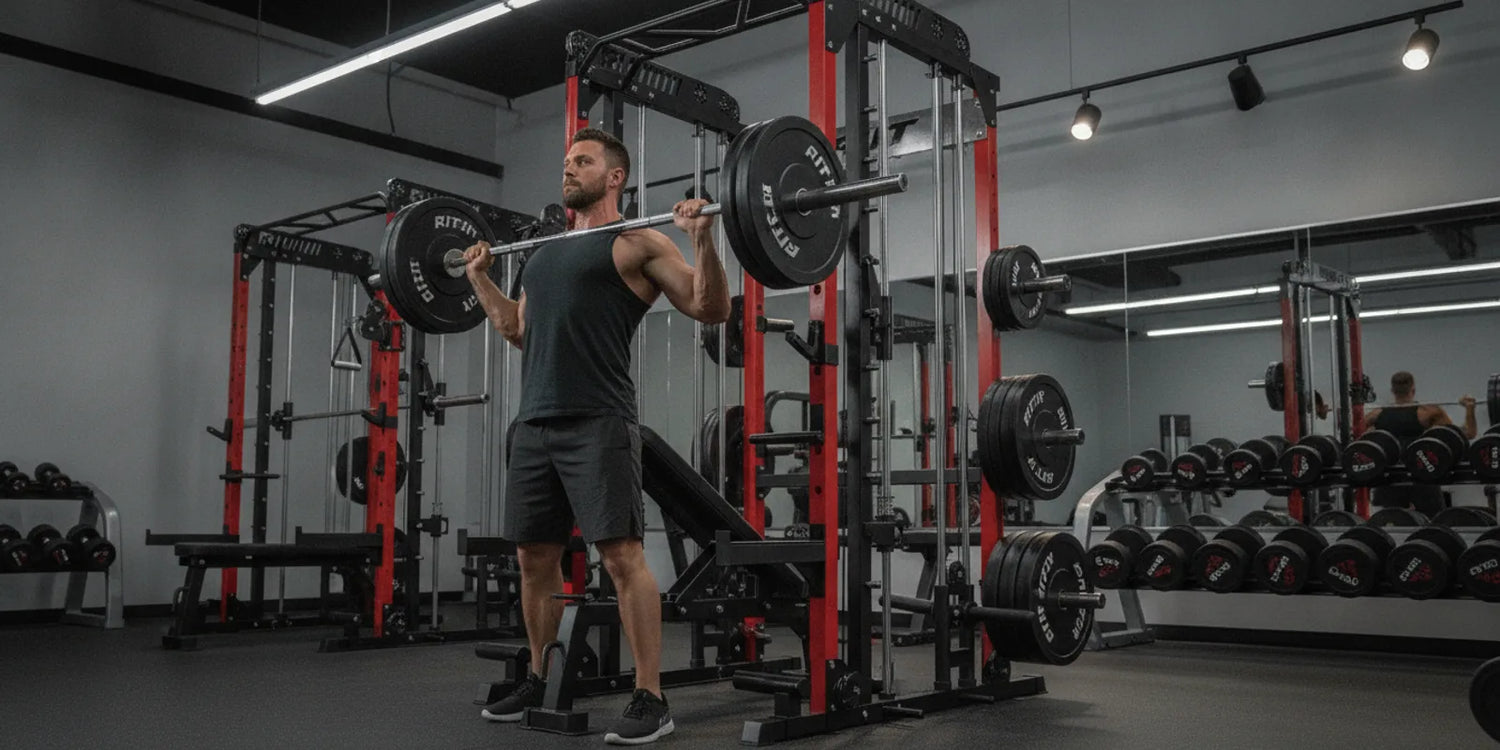
The smith machine chest workout for men gives you a structured, spotter-free way to build a thicker, stronger chest through every angle. Whether you train in a commercial gym or a home gym, the fixed bar path lets you push closer to failure on every set and track your progress with precision.
This guide covers the five best smith machine chest exercises, a 4-week progressive overload program with clear load rules, setup tips for each angle, and the most common mistakes that stall chest growth. You'll leave with a ready-to-use training plan, not just a list of exercises.
Quick Answer
A smith machine chest workout for men builds pectoral size through flat, incline, and decline press variations on a fixed bar path. Train chest twice per week, start with 3-4 sets of 8-12 reps, and add 2.5-5 lb every one to two weeks for consistent hypertrophy without a spotter.
Key Takeaways
- Machine hypertrophy is comparable to free weights: A 2023 meta-analysis found that machine-based training and free-weight training produce similar muscle growth outcomes, making the smith machine a fully valid primary tool for chest development.
- Train chest twice per week: Two sessions per week with at least 48 hours of recovery between them is the most widely supported approach for consistent hypertrophy, with 10-20 total working sets spread across flat, incline, and decline variations.
- Cover all three angles: Flat press targets the mid-chest, incline press at 30 degrees targets the upper clavicular head, and decline press shifts emphasis to the lower pecs, together giving complete development.
- Progressive overload is the key driver: Add 2.5-5 lb every one to two weeks on your main press, or add a rep before adding weight, to keep adaptation running past the first month.
- Setup is everything on the smith machine: Position the bar so it descends to your mid-chest at the nipple line, keep elbows at 45-75 degrees from your torso, and never let the bar drift toward your neck or stomach.
Why the Smith Machine Works for Chest Development
The smith machine works for chest development because its fixed bar path removes the balance demand of free-weight pressing, letting you direct nearly all effort toward contracting the pectorals rather than stabilizing the bar. A 2023 systematic review and meta-analysis found that machine-based and free-weight training produce similar hypertrophy outcomes, with no statistically significant difference in muscle growth between the two modalities.[1]
In one 10-week study, resistance-trained men who performed smith machine chest press twice per week showed strength gains that transferred to the barbell bench press, confirming that smith machine pressing builds real pressing strength, not just machine-specific coordination.[3]
- Safer near-failure sets: The built-in safety catches mean you can push to the edge of failure on every work set without a spotter, and near-failure training is one of the strongest stimuli for muscle growth.
- Consistent bar path: Every rep follows the same vertical track, making it easier to notice when fatigue changes your mechanics and to correct it immediately.
- Trackable progression: According to one evidence-based coaching resource, smith machine progression is more trackable than free-weight pressing because the constrained path reduces rep-to-rep variability, so changes in performance more reliably reflect real adaptation.
- Adjustable for all three chest angles: You can target the upper, mid, and lower chest simply by changing bench angle within the same machine, no separate stations needed.
- Home gym friendly: The RitFit Multifunctional Smith Machine gives home gym lifters full smith machine pressing capability with cable attachments, all within a compact footprint.
Which Muscles Do Smith Machine Chest Exercises Target?
Smith machine chest exercises primarily target the pectoralis major, the large fan-shaped muscle covering the front of the ribcage, along with secondary activation of the anterior deltoid and triceps brachii. A 2022 EMG study found that the fixed bar path of the smith machine alters stabilizer co-activation patterns compared to free-weight pressing, producing distinct biceps brachii activity that reflects how the body manages the constrained movement path.[2]
- Pectoralis major (sternal head): The flat and decline press angles load the lower-to-mid fibers of the pec most directly, contributing to chest width and thickness across the mid-section.
- Pectoralis major (clavicular head): The incline press at 30 degrees places the greatest mechanical demand on the upper chest fibers that run from the collarbone, building the shelf-like fullness at the top of the chest.
- Anterior deltoid: The front shoulder assists on every horizontal press variation and takes on more load as incline angle increases above 30-45 degrees, which is why staying at 30 degrees preserves chest emphasis.
- Triceps brachii: The triceps drive the lockout of every press, and the close-grip variation places extra demand here by narrowing the elbow angle through the range of motion.
- Serratus anterior: This muscle protracts the scapula at the top of the press, keeping the shoulder blade in contact with the ribcage and contributing to a stable pressing base.
The 5 Best Smith Machine Chest Exercises for Men
The five best smith machine chest exercises for men cover all regions of the pectoralis major through flat, incline, decline, and grip-variation pressing, giving complete chest development from a single piece of equipment.
1. Flat Smith Machine Bench Press
The flat smith machine bench press is the foundation of any chest program, loading the mid and sternal pec fibers with the most weight you can move. Set the bench flat, position it so the bar descends to your nipple line, and drive through your full chest at the top without shrugging.
- Grip width: Slightly wider than shoulder width, wrists stacked directly over elbows.
- Eccentric tempo: Lower the bar for 2-3 seconds under full control, pause lightly at the chest, then press explosively.
- Program slot: Always first in the session while your strength is highest.
2. Incline Smith Machine Press (30 Degrees)
The incline smith machine press at 30 degrees is the most effective angle for loading the clavicular head of the pectoralis major while keeping front-deltoid involvement manageable. Angles above 45 degrees shift the load increasingly onto the shoulder, reducing chest stimulus.
- Bench angle: Set the adjustable bench to exactly 30 degrees, not higher.
- Bar descent point: The bar should track down to your upper chest, just below the collarbone, not to the neck.
- Common error: Starting the rep from the top lockout position misaligns the bar at the bottom where it matters most. Always align the bar at the bottom of the range first, then press from there.
3. Decline Smith Machine Press
The decline smith machine press targets the lower pectoralis fibers and lets most men move more weight than the flat variation because the pressing angle shortens the range of motion slightly. Use a decline bench set at 15-20 degrees.
- Foot position: Hook your feet securely under the pad to prevent sliding as fatigue builds.
- Range of motion: Lower the bar to the lower chest, just above the sternum, and press up and very slightly back.
- Program slot: Best placed after flat and incline work as a volume finisher.
4. Close-Grip Smith Machine Press
The close-grip smith machine press shifts emphasis to the inner pectoral fibers and triceps by narrowing the hand spacing to just inside shoulder width, increasing elbow flexion through the press. It serves as an effective finishing exercise at higher rep ranges.
- Hand spacing: Place hands about 8-10 inches apart, closer than your normal bench press grip.
- Elbow path: Keep elbows pointed slightly out, not fully tucked, to share load between the chest and triceps.
- Rep range: Best performed at 12-15 reps as a burnout exercise at the end of the session.
5. Smith Machine Reverse-Grip Press
The smith machine reverse-grip press uses a supinated grip to shift activation toward the upper inner chest fibers and reduce shoulder stress for lifters who feel discomfort with a standard overhand pressing grip. It is an advanced variation best added after mastering the standard flat press.
- Grip orientation: Turn both palms toward your face, thumbs pointing outward.
- Controlled eccentric: Use a 3-second lowering phase to maintain control of the unfamiliar bar orientation.
- Best for: Intermediate lifters who want upper chest variety without adding more incline volume.
How Do You Set Up the Smith Machine for Each Chest Press?
Setting up the smith machine correctly for each chest press variation means positioning the bench so the bar tracks over the target part of your chest, not your neck or stomach, before you unrack a single plate. Correct setup prevents joint stress and maximizes pec loading on every rep.
Watch the tutorial above to see correct bench positioning and bar path before loading any weight.
- Flat press setup: Slide the bench so that when you lie down, the bar sits directly above your mid-chest at the nipple line. Your shoulder blades should be pinched together and your feet flat on the floor.
- Incline press setup: Set the bench to 30 degrees, then lie down and find the bar with your arms extended. Adjust forward or back until the bar, at the bottom of its path, touches your upper chest below the collarbone. Lock that position before loading weight.
- Decline press setup: Hook your feet under the pad, then slide the bench so the bar descends to just above the lower sternum. The bar should never travel toward your neck during a decline press.
- Unlocking the bar: Always rotate the bar to disengage the hooks before pressing. Failing to unlock fully causes the bar to catch mid-set, which can destabilize your shoulder at a loaded position.
- Safety hook height: Set the safety catches 2-3 inches below your chest-touch point before every working set, so if you reach failure the bar stops safely without crushing your chest.
- Bar height at start: The bar should sit at a height you can reach with slightly bent elbows while lying down, not so high that you have to press your arms fully straight to unrack.
If you are building a home gym setup, the RitFit guide to choosing the best smith machine for men walks through what specs matter most for pressing-focused training.
What Does a 4-Week Smith Machine Chest Progressive Overload Program Look Like?
A 4-week smith machine chest program for men organizes flat, incline, and decline pressing into two sessions per week, starting with a hypertrophy base in weeks 1-2 and shifting to strength accumulation in weeks 3-4. For a full multi-station home gym approach, the best full-body smith machine workout for home gym shows how to extend this programming across all muscle groups.
Week 1-2: Hypertrophy Base (3 Sets of 10-12 Reps)
The hypertrophy base phase focuses on building consistent volume at moderate intensity, training the movement pattern, and establishing a baseline load for each exercise. For each session, rest 60-90 seconds between sets to keep metabolic stress and blood flow elevated in the working muscle.
- Session A (Monday or Tuesday): Flat Smith Press 3x10-12, Incline Smith Press (30 degrees) 3x10-12, Close-Grip Smith Press 3x12-15.
- Session B (Thursday or Friday): Incline Smith Press 3x10-12, Decline Smith Press 3x10-12, Smith Machine Reverse-Grip Press 3x10-12.
- Progression trigger: When you complete all sets at the top of the rep range with 2 reps in reserve on the last set, add 2.5-5 lb at the next session.
- Mind-muscle focus: Use a 2-3 second eccentric on every rep and pause for one second at the chest. The goal in this phase is muscle tension, not load.
Week 3-4: Strength Accumulation (4 Sets of 6-8 Reps)
The strength accumulation phase increases volume by adding a set and reduces the rep range to drive heavier load adaptations. Rest 3-5 minutes between sets on the primary movement to allow adequate ATP recovery for near-maximal efforts.
- Session A: Flat Smith Press 4x6-8 at heavier load, Incline Smith Press 3x8-10, Close-Grip Smith Press 3x12.
- Session B: Incline Smith Press 4x6-8, Decline Smith Press 3x8-10, Smith Machine Reverse-Grip Press 3x10.
- Progression trigger: When you complete all 4 sets at the top of the rep range, add 5 lb to the bar at the next session.
- Deload week (Week 5): Drop to 2 sets per exercise at 60% of your week 4 load, then restart the cycle with higher starting loads at week 1.
| Exercise | Weeks 1-2 (Sets x Reps) | Weeks 3-4 (Sets x Reps) | Rest |
|---|---|---|---|
| Flat Smith Press | 3x10-12 | 4x6-8 | 60-90s / 3-5 min |
| Incline Smith Press (30 deg) | 3x10-12 | 4x6-8 | 60-90s / 3-5 min |
| Decline Smith Press | 3x10-12 | 3x8-10 | 60-90s |
| Close-Grip Smith Press | 3x12-15 | 3x12 | 60s |
| Reverse-Grip Smith Press | 3x10-12 | 3x10 | 60-90s |
Sets, reps, and rest intervals are practical training guidelines, not clinical recommendations. Adjust based on your recovery and available training time.
How Much Weight Should You Start With on the Smith Machine Chest Press?
Start with a load that lets you complete 12 clean reps on the flat press while maintaining a controlled 3-second eccentric, which for most intermediate men is around 50-60% of their estimated barbell 1RM. The smith machine bar itself typically weighs around 15-25 lb depending on the model, so account for that when loading plates.
- Beginner guideline: If you have less than 6 months of pressing experience, start with just the bar plus small plates at 25 lb per side. Mastering the setup and tempo matters more than load in the first two weeks.
- Intermediate guideline: If you regularly bench press a barbell, subtract 10-15% from your working barbell load as a starting point for the smith machine flat press, then adjust up or down after your first session.
- When to add weight: Add 2.5-5 lb when you can complete all prescribed sets at the top of the rep range with good form and at least 2 reps still in reserve on your last set.
- When to hold the load: If your form breaks down, you lose the controlled eccentric, or your elbows flare past 90 degrees, stay at the same load for another session before adding weight.
- Incline and decline starting load: Most men can use about 80-85% of their flat press load for the incline variation and equal to or slightly more than flat press for the decline, given the shorter effective range of motion.
If you want to expand beyond pressing and add cable accessory work, the smith machine with cable system complete workout guide covers how to pair cable exercises with your chest sessions for a complete upper-body program.
What Are the Most Common Smith Machine Chest Press Mistakes?
The most common smith machine chest press mistakes involve setup errors that misdirect bar path away from the pecs, grip or elbow positioning that dumps load onto the shoulder joint, and a lack of controlled eccentric that reduces time under tension. Correcting these mistakes immediately improves both safety and muscle stimulus on every rep.
- Bar tracking too high toward the neck: This is the most frequent setup error. If the bar descends toward your throat rather than your mid-chest, slide the bench further under the bar before your next set. Bar path toward the neck increases anterior capsule stress on the shoulder joint.
- Elbows flaring past 90 degrees: Wide elbow flare places peak torque on the front of the shoulder rather than the pec. Keep your elbows at 45-75 degrees from your torso, which keeps the load in the pectoral muscle.
- Bouncing the bar off the chest: Using the chest as a springboard removes tension from the pec at the bottom, which is exactly where chest-specific stretch stimulus occurs. Lower under control and stop just at the surface of the chest.
- Locking out fully on every rep: Full elbow lockout at the top transfers tension to the triceps and takes the chest momentarily off load. Stopping just short of lockout keeps the pec under continuous tension through the full set.
- Skipping the incline variation: Many men default entirely to flat press and wonder why their upper chest stays flat. The clavicular head only responds well to pressing done at an incline angle, so including incline work in every session is non-negotiable for complete chest development.
- When to stop due to pain: Shoulder pain that is sharp, located in the front of the joint, or persists after your warm-up should stop the session. Pain during the lockout phase specifically often signals impingement from excessive bar height. Adjust setup or stop and consult a qualified professional.
"Both machines and free weight movements have a place in a hypertrophy-oriented routine as they complement each other in terms of their strengths and weaknesses. Machines allow a lifter greater ability to target specific muscles, there is greater stress on the target muscle when training on a machine, potentially allowing for greater muscular development of that muscle."
Brad Schoenfeld, PhD, Exercise Science Researcher specializing in Muscle Hypertrophy, CUNY Lehman College
What Can You Use Instead of Smith Machine Chest Exercises?
Free-weight barbell and dumbbell bench press, machine chest presses, and cable flyes can all replace or supplement smith machine chest exercises, with each offering tradeoffs in stability, range of motion, and load ceiling. The best replacement depends on your gym access, training goals, and how your joints respond to each variation.
- Barbell bench press: Provides greater stabilizer demand and slightly different motor pattern compared to the smith machine. Use this when you want to train the full pressing skill including balance control, or when testing a true 1RM.
- Dumbbell bench press: Allows independent arm movement and a deeper stretch at the bottom of the range, which is useful for targeting the outer pec fibers. The load ceiling is lower than smith or barbell pressing for most men.
- Machine chest press: The RitFit Gorilla 2-in-1 Chest and Shoulder Press Machine provides a guided pressing path with an arc-based movement pattern, which some lifters find more comfortable on the shoulder joint than vertical smith machine pressing.
- Cable chest press or cable crossover: Cables maintain constant tension through the full range of motion, especially at the shortened position where free weights and smith machine pressing lose tension near lockout. Best used as an accessory exercise after main pressing work.
- When to prefer the smith machine over free weights: Train alone without a spotter, want consistent load tracking for progressive overload, or are returning to pressing after an extended break and want a controlled environment to rebuild confidence and technique.
For a broader look at what you can train on the smith machine beyond chest, see the guides on smith machine back workouts and smith machine leg workouts to build a complete full-body training plan.
FAQs About Smith Machine Chest Workout for Men
Is the smith machine good for chest development in men?
Yes. A 2023 meta-analysis found that machine-based training produces similar hypertrophy outcomes to free weights. The fixed bar path lets you train close to failure safely without a spotter, which is one of the strongest drivers of muscle growth, making it a fully valid primary tool for chest development.
How much weight should I start with on the smith machine chest press?
Start with a load you can press for 12 clean reps while maintaining a 3-second eccentric, typically around 50-60% of your estimated barbell 1RM. The smith machine bar weighs around 15-25 lb depending on the model, so factor that in when loading plates and adjust after your first session.
What angle should I set the bench for upper chest on the smith machine?
A 30-degree incline is the most effective angle for targeting the upper pectoralis major while minimizing front-deltoid takeover. Angles above 45 degrees shift the load increasingly onto the anterior deltoid and away from the upper chest fibers, reducing the chest stimulus you get from the exercise.
How often should men train chest on the smith machine per week?
Training chest 2 times per week with at least 48 hours of recovery between sessions is the most widely supported approach for hypertrophy. Each session should include 10-20 total working sets across flat, incline, and decline variations to cover the full pec muscle and drive consistent adaptation.
Can I build a bigger chest using only the smith machine without free weights?
Yes. You can build significant chest size training exclusively on the smith machine. The fixed path allows precise load tracking and safe near-failure sets. Adding angle variety across flat, incline, and decline, and progressing load over weeks, replicates the muscle-building stimulus of free-weight pressing effectively.
Why does my shoulder hurt during smith machine chest press and how do I fix it?
Shoulder discomfort usually signals a setup issue where the bar is tracking too high toward the neck or your elbows are flaring past 90 degrees. Slide the bench back slightly until the bar descends to mid-chest, and keep elbows at a 45-75 degree angle from your torso to reduce anterior capsule stress on the shoulder joint.
Conclusion
A structured smith machine chest workout for men covering flat, incline, and decline pressing with a 4-week progressive overload plan delivers consistent hypertrophy without a spotter. The fixed bar path makes load tracking precise and near-failure training safe.
Start with the flat press, add the 30-degree incline for upper chest, and apply the progression rules from weeks 1-4. Explore the full range of RitFit Smith machines to find the right setup for your space, and check the guide to what a smith machine is if you are just getting started.
Disclaimer
The information in this article is provided for general fitness education purposes only and does not constitute medical advice, diagnosis, or treatment. Always consult a qualified healthcare or fitness professional before beginning any new exercise program, especially if you have a history of injury, joint pain, or other health conditions.
Save on your next RitFit order
Tap the button to copy your code, then paste it at checkout.
References
1. Vårvik FT, Haugen AS, van den Tillaar R, et al. Effect of free-weight vs. machine-based strength training on maximal strength, hypertrophy and jump performance - a systematic review and meta-analysis. BMC Sports Sci Med Rehabil. 2023;15:103. https://pmc.ncbi.nlm.nih.gov/articles/PMC10426227/
2. Wang L. A comparison of muscle activation and concomitant intermuscular coupling of antagonist muscles among bench presses with different instability degrees in untrained men. Front Physiol. 2022;13:940719. https://pmc.ncbi.nlm.nih.gov/articles/PMC9486837/
3. Saeterbakken AH, Andersen V, van den Tillaar R, et al. The effects of ten weeks resistance training on sticking region in chest-press exercises. PLoS One. 2020;15(7):e0235555. https://pmc.ncbi.nlm.nih.gov/articles/PMC7347144/





