








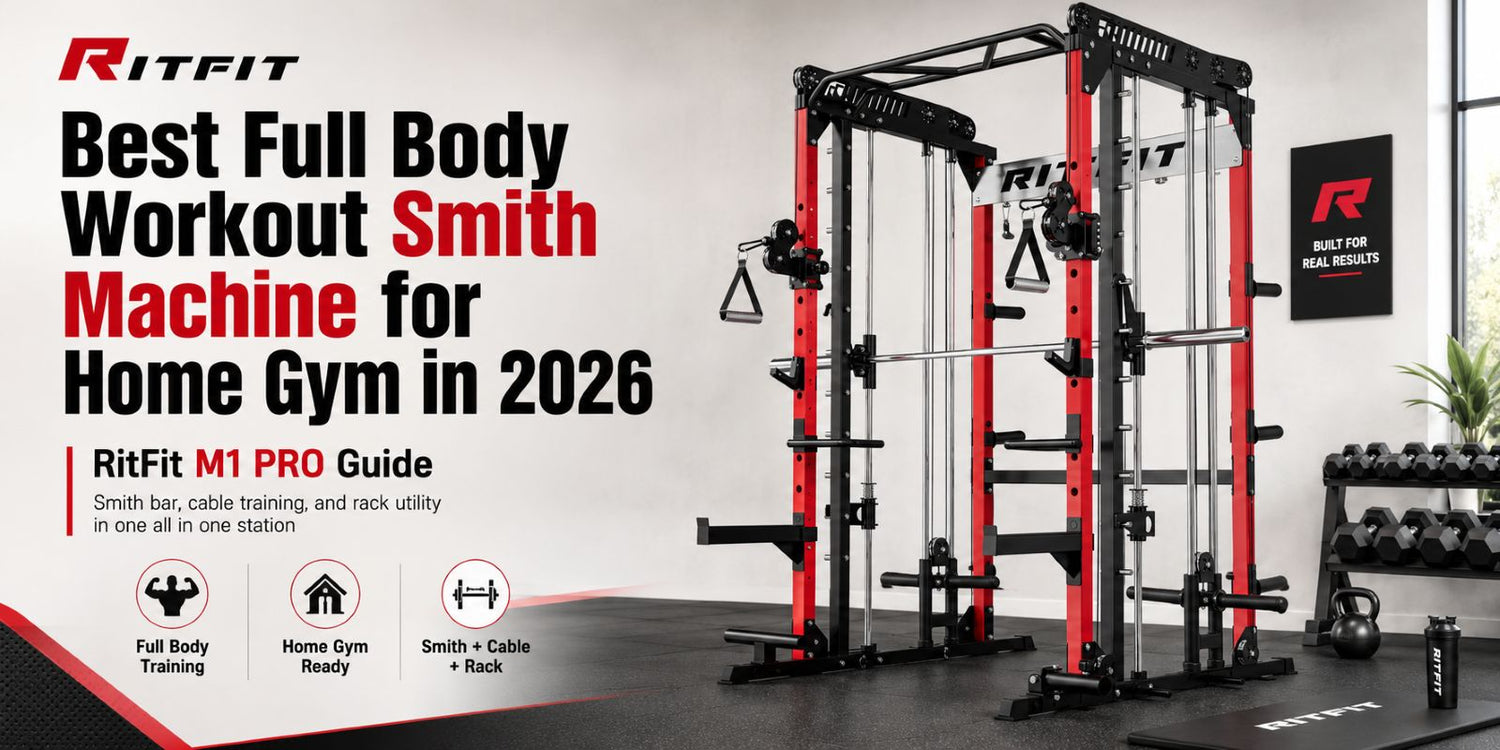
The RitFit M1 PRO is a strong full body home gym option if you want guided bar training, cable work, and rack functions in one station. It fits solo lifters, space conscious buyers, and home gym users who want more exercise variety than a basic rack alone.
A full body workout Smith machine makes sense at home because it lets you train more muscle groups with fewer setup changes and less equipment sprawl. The RitFit M1 PRO is worth a close look if you want guided bar work, cable variety, and rack utility in one training station.
Key Takeaways
- One station, many movement patterns: The M1 PRO can cover squats, presses, rows, pulldowns, split squats, hinges, arms, and core work in one home setup.
- Better for mixed goal training: It makes sense for buyers who want strength work, hypertrophy volume, and cable accessories without building a room around separate machines.
- Solo lifting is the main advantage: A guided bar path can make setup, reracking, and controlled hard sets easier for home users training alone.
- Space checks matter more than marketing claims: Bench path, side loading room, ceiling clearance, and storage flow matter as much as the machine footprint.
- The right add ons complete the setup: An adjustable bench, plates, and a few core attachments turn the M1 PRO from a good machine into a practical full body home gym.
Overview of the RitFit M1 PRO
What the M1 PRO is
The RitFit M1 PRO is an all in one home gym built around a guided Smith bar, cable crossover functions, pull up work, and rack style lifting. That combination is why it works better as a full body centerpiece than a basic Smith only frame.
- Main product page: Buyers who want the core machine can start with the RitFit M1 PRO Smith Machine Home Gym Package.
- Bench pairing: Full body training works better when you pair it with an adjustable weight bench for flat, incline, seated, and support work.
- Loading essentials: Most buyers will also need barbells and weight plates to make the setup fully usable from day one.
Why this format works for home gyms
An all in one machine reduces walking, setup friction, and equipment clutter, which matters when your home gym is also a garage, basement, or shared room. It also makes it easier to move from compound lifts to accessory work without rebuilding your whole station.
Why it is relevant in 2026
Home gym buyers are still prioritizing versatility, safety, and footprint efficiency over single purpose equipment, especially when they train alone or need one machine to cover most sessions. Public community discussions keep returning to the same fit checks, solo safety, ceiling height, pulley feel, and whether the machine replaces enough separate stations to justify the cost.
Why the RitFit M1 PRO Works for Full Body Training
Full body training is a valid home gym strategy
Full body training is not a compromise plan, because research shows full body and split routines can both improve strength and hypertrophy when the weekly work is set up well.[2] That makes a versatile all in one station a practical choice for home lifters who want fewer moving parts in their program.
Machine based training can still build muscle well
Machine based and free weight training can both support strength and muscle gain, even though results show some specificity to the testing method and exercise style used.[1] For a home buyer, that means a Smith centered setup is still a serious training tool, not just a beginner shortcut.
It covers the main movement categories
The M1 PRO makes the most sense when you use it to cover squat, hinge, push, pull, single leg, arm, and core patterns from one station. That is what turns it from a product page topic into a true full body home gym topic.
- Lower body compounds: Squats, split squats, RDL patterns, calf raises, and controlled lunge work give the machine real lower body value.
- Upper body pressing: Flat presses, incline presses, seated shoulder presses, and close grip presses are simple to set up and repeat.
- Upper body pulling: Cable rows, pulldowns, face pulls, and pull up variations fill the back training gap that a basic rack often leaves open.
- Accessory work: Curls, pushdowns, lateral raises, cable crunches, and anti rotation work are easy to add at the end of a session.
It suits solo lifters well
The biggest home gym advantage is not novelty, it is confidence, because many buyers want a setup that feels easier to manage without a training partner. That is where guided bar work and simpler reracking can make the machine feel more usable from week to week.
- Read first: Buyers new to the category can start with what is a Smith machine for a basic category overview.
- Solo use case: The article on safe solo workouts at home is especially relevant for buyers who train without a spotter.
Feature Deep Dive
Guided Smith bar
The Smith bar is the feature that changes the buying decision, because it adds guided pressing and lower body work to a rack and cable frame. It is most useful for buyers who want stable hard sets, cleaner repeatability, and less setup hesitation at home.
Cable system
The cable system is what makes the machine feel like a full body station instead of a squat frame with extras. It opens the door to pulldowns, rows, fly patterns, arm work, shoulder work, and core training in the same footprint.
- Related guide: For a broader category explanation, see Smith machine with cable system complete workout guide.
- Home gym logic: For buyers comparing categories, functional trainer with Smith machine explains why this format works so well as a main station.
Rack utility
The rack style area matters because it gives the machine more than one training identity. It helps the M1 PRO feel closer to a real home gym hub rather than a fixed path machine with limited training personality.
Upgrade path
The M1 PRO is stronger as a buying guide topic because RitFit offers multiple package paths, including bundle and weight stack style configurations on official product paths. That flexibility gives buyers a cleaner upgrade story than buying three separate machines in random order.
Full Body Programming on the RitFit M1 PRO
What makes a full body plan work
Broad loading ranges can support hypertrophy when effort and total work are appropriate, so you do not need one narrow rep scheme to make a full body home plan effective.[3] The best plan is usually the one you can repeat, load progressively, and recover from inside your real weekly schedule.
Why time efficient programming matters
Time efficient resistance training works best when you prioritize compound lifts, control exercise count, and repeat high value movement patterns across the week.[4] That is one reason an all in one machine can be a better practical choice than a room full of disconnected equipment.
Beginner fit
Beginner home lifters often do well with mixed setups, because machine based and free weight based training have both shown useful benefits in novice users when applied consistently.[5] The M1 PRO fits that logic well if the buyer wants guidance and variety instead of a barbell only learning curve.
- Beginner template: Start with one squat pattern, one press, one pull, one hinge or split squat pattern, one arm pairing, and one core finish.
- Weekly rhythm: Two or three full body sessions per week are enough for many home lifters, especially when work sets are hard and exercise quality stays high.
- Progression rule: Add load, reps, or total work only after bar path, setup, and repeatability are stable.
Sample beginner full body routine
This type of routine works because it keeps the session simple, balanced, and easy to repeat. It also uses the machine the way most home buyers actually train, one main lower body lift, one push, one pull, then focused accessories.
- Smith squat: 3 sets of 6 to 10 reps.
- Smith flat or incline press: 3 sets of 8 to 12 reps.
- Cable pulldown or row: 3 sets of 8 to 12 reps.
- Split squat or RDL variation: 2 to 3 sets of 8 to 12 reps.
- Curl and pushdown pairing: 2 to 3 sets of 10 to 15 reps.
- Core finisher: 2 to 3 sets of cable crunches or chops.
Sample intermediate full body routine
An intermediate plan works better when each day has one strength priority and one volume priority. That keeps the machine from becoming a random exercise menu and turns it into a real progression tool.
- Day A: Smith squat, incline Smith press, cable row, Bulgarian split squat, lateral raise, core.
- Day B: Smith RDL, flat Smith press, pulldown, walking lunge, curl and pushdown pairing, core.
- Day C: Front squat pattern, seated shoulder press, chest supported row setup, hip thrust pattern, face pulls, calf raises.
Movement specific resources
The best internal links are the ones that solve the next real training question, not generic click here links. That is why movement guides are especially valuable inside a buyer guide like this.
- Hinge pattern: Use how to do Smith machine Romanian deadlift if you want a cleaner posterior chain setup.
- Glute pattern: Use how to do Smith machine hip thrust if your full body plan needs a more focused glute movement.
- Exercise ideas: The article on must do Smith machine exercises for full body gains fits naturally with this page.
How the M1 PRO Compares With Other Home Options
Versus a basic Smith machine
A basic Smith machine can handle presses and squats, but it usually gives you less pulling variety and less all around training density. The M1 PRO makes the stronger case for buyers who want one station to carry most of the week.
Versus a power rack
A power rack is still the cleaner choice for buyers who care most about barbell specificity and classic rack progression. The M1 PRO is the better fit when guided bar work, cable convenience, and accessory efficiency matter more than barbell purity.
- Direct comparison: The page on Smith machine vs power rack is the most natural support article for this decision.
Versus separate stations
Separate stations can give you more room to superset and more specialization, but they also cost more space, more money, and more setup complexity. Most home buyers do not need the perfect room, they need the machine they will actually use.
Buying Guide: Who Should Choose the RitFit M1 PRO
Best fit buyers
The M1 PRO is the best fit for solo lifters, mixed goal trainees, and buyers building one main home gym station instead of collecting separate machines over time. It also suits people who want guided bar work without giving up cable training.
- Good fit: Beginners who want structure, intermediates who want more weekly variety, and home users who need one station to do most of the work.
- Less ideal fit: Pure powerlifters, buyers with very tight ceiling limits, and users who want two lifters working at once with minimal adjustment.
- Room check: Measure front working space, side loading room, and vertical clearance before you buy.
What to check before ordering
The machine can be a good fit on paper and still be wrong for your room if you only measure the base footprint. Bench travel, plate loading access, and delivery path are what usually decide whether the machine feels smooth or frustrating in real life.
- Ceiling and clearance: Low ceiling buyers should also review the best Smith machine for low ceilings before finalizing the purchase.
- Floor and support: Rubber flooring, a stable bench, and enough plate storage make the whole setup safer and easier to use.
- Package logic: Choose the package path that matches your actual training, not the one with the longest feature list.
Pros and Cons
Pros
The M1 PRO is easy to understand as a buyer proposition because it solves the main home gym problem, too many needs and not enough room. It brings guided bar work, cable versatility, and rack style utility into one station.
- Versatility: Better full body coverage than a basic Smith only frame.
- Solo training: Easier setup confidence for users who lift alone.
- Efficiency: Faster transitions from compound lifts to accessory work.
- Upgrade path: More practical long term than random piecemeal buying for many users.
Cons
The M1 PRO is still a real piece of equipment, not a magic space saver, so buyers should not underestimate assembly, footprint, or room flow. It also will not replace the feel of a dedicated commercial setup for every lifter.
Setup and Practical Tips
Assembly mindset
Assembly goes better when you treat it like a project, not a quick errand, because alignment, hardware order, and room positioning affect the final feel. Two people, basic tools, and a clear floor make the process much easier.
Placement basics
The best placement leaves enough room to move a bench, load plates, and step in and out of exercises without clipping walls or storage. A machine that technically fits but blocks real movement usually becomes underused.
- Front clearance: Leave enough room for flat and incline bench setups, step back positions, and floor work.
- Side clearance: Make sure plate changes and cable arm access feel natural.
- Overhead clearance: Check pull up comfort, top range movements, and basement lighting.
Safety notes
Guided bar work can improve confidence, but it does not remove the need for judgment. Warm up properly, set safeties before hard sets, and learn the machine path before chasing heavy numbers.
FAQs
What makes a full body workout Smith machine better for home training?
Yes. The best full body workout Smith machine makes home training simpler because it combines guided bar work, cable training, and rack functions in one station. That helps you train legs, chest, back, shoulders, arms, and core without needing multiple large machines or long setup changes.
Can the RitFit M1 PRO replace several home gym machines?
Yes. The RitFit M1 PRO can replace several common home gym stations because it combines a Smith bar, cable crossover functions, pull up work, and rack based lifting in one frame. It still works best when paired with an adjustable bench, plates, and enough training space.
Is a Smith machine good for full body workouts if you train alone?
Yes. A Smith machine is a strong full body option for solo lifters because the guided bar path and built in lock points can make setup and stopping points easier to manage. You still need to set safeties correctly, control your reps, and avoid chasing loads you cannot handle.
How much space do you need for a full body workout Smith machine at home?
You need more than the machine footprint alone because full body training also requires bench movement, plate loading room, and overhead clearance. Before buying, measure front clearance, side clearance, ceiling height, and the path for accessories so your setup feels usable, not just technically possible.
Which exercises make the RitFit M1 PRO a true full body machine?
The RitFit M1 PRO becomes a true full body machine when you use it for squats, presses, rows, pulldowns, split squats, hinges, curls, pushdowns, and core work. That mix covers the main movement patterns most home gym lifters need for strength, hypertrophy, and general fitness.
Should beginners choose the RitFit M1 PRO or a basic power rack first?
It depends. Beginners who value guided bar practice, cable variety, and solo training convenience may prefer the RitFit M1 PRO, while pure barbell focused lifters may prefer a basic power rack first. The better choice depends on your room, budget, confidence level, and preferred training style.
Will a full body workout Smith machine help with muscle growth?
Yes. A full body workout Smith machine can support muscle growth when your program includes enough weekly volume, progressive overload, and exercise variety. The machine does not build muscle by itself, but it can make consistent squats, presses, rows, lunges, and accessory work easier to perform at home.
Conclusion
The RitFit M1 PRO is one of the more practical full body home gym choices for buyers who want guided Smith work, cable variety, and rack utility in one station. It is strongest for solo lifters, mixed goal training, and space conscious setups, while pure barbell specialists may still prefer a more dedicated rack first.
Disclaimer: This guide is for educational and product comparison purposes only, and it does not replace medical advice, coaching, or a safety assessment of your room and equipment. Check current package details, assembly requirements, and clearance measurements on the official RitFit product page before you buy or train.
References
- Haugen ME, Vårvik FT, Larsen S, Haugen AS, van den Tillaar R, Bjørnsen T. Effect of free-weight vs. machine-based strength training on maximal strength, hypertrophy and jump performance: a systematic review and meta-analysis. BMC Sports Sci Med Rehabil. 2023;15(1):103. doi:10.1186/s13102-023-00713-4
- Evangelista AL, Braz TV, Teixeira CVLS, Rica RL, Alonso AC, Barbosa WA, et al. Split or full-body workout routine: which is best to increase muscle strength and hypertrophy? Einstein (Sao Paulo). 2021;19:eAO5781. doi:10.31744/einstein_journal/2021AO5781
- Schoenfeld BJ, Grgic J, Van Every DW, Plotkin DL. Loading recommendations for muscle strength, hypertrophy, and local endurance: a re-examination of the repetition continuum. Sports. 2021;9(2):32. doi:10.3390/sports9020032
- Iversen VM, Norum M, Schoenfeld BJ, Fimland MS. No time to lift? Designing time-efficient training programs for strength and hypertrophy: a narrative review. Sports Med. 2021;51(10):2079-2095. doi:10.1007/s40279-021-01490-1
- Aerenhouts D, D'Hondt E. Using machines or free weights for resistance training in novice males? A randomized parallel trial. Int J Environ Res Public Health. 2020;17(21):7848. doi:10.3390/ijerph17217848





