








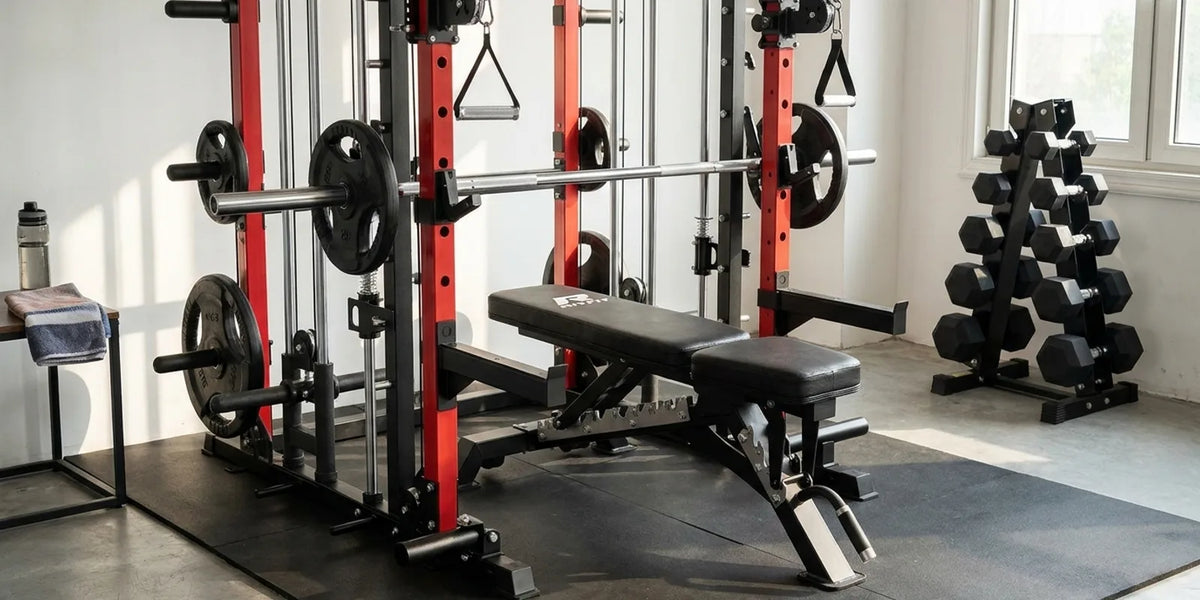
The smith machine reverse lunge turns one of the best single-leg exercises into a guided, home-friendly movement.
The fixed bar path does the balancing for you, so your quads and glutes do the work.
This guide covers setup, step-by-step form, the curtsy lunge variation, and a simple programming plan you can start this week.
It is written for home gym lifters who are new to single-leg training, or who want a safer way to load it. Everything here is general fitness guidance, not medical advice.
Quick Answer: A smith machine reverse lunge is a single-leg exercise where you set the bar at shoulder height, step both feet forward from the machine, and step one foot back into a lunge while the bar moves on a fixed vertical path. It trains the quads and glutes with far less balance demand than a free barbell.
Key Takeaways
- Guided bar path: The fixed vertical path lets you load lunges without a balancing act, which suits beginners and solo home trainers.
- Quad and glute emphasis: EMG research on lunge exercises found the highest activation in the vastus lateralis and vastus medialis, followed by the gluteus medius and gluteus maximus.
- Higher peak force: One 2020 study found trained men produced more peak force in unilateral squats inside a smith machine, thanks to the stable setup.
- Start light: An empty bar for 3 sets of 8 to 12 reps per leg is enough for most beginners.
- The curtsy variation: Stepping back and across the midline shifts more work to the gluteus medius and outer hip.
Why the Smith Machine Reverse Lunge Deserves a Spot in Your Leg Day
The smith machine reverse lunge builds single-leg strength without a balancing act, which makes it ideal for home training. Your hands only guide the bar, so your legs handle the load and your depth stays consistent from rep to rep.
- Balance is handled: The bar cannot drift forward or sideways, so you can concentrate on the lunge pattern itself.
- Safe solo training: Most smith machines include adjustable safety stops, and the bar rests on the rails whenever you need to set it down.
- Easy progressive overload: Small weight jumps feel manageable because the bar is stabilized the entire time.
- It pairs with squats: Use it as a second leg pattern after squats, or as the main lift on lighter days.
If you are still choosing a machine for your space, the RitFit smith machine collection covers every footprint, from the compact multifunctional smith machine to full cable crossover rigs. Pick the one that fits your room, and the lunge work stays the same.
If maximum quad growth is the goal, do squats and also do exercises such as front squats, leg press, lunges, and leg extensions.
Bret Contreras, PhD, sports scientist, Do More than Just Squat
What Muscles Does the Smith Machine Reverse Lunge Work?
The smith machine reverse lunge works the quads and glutes hardest, with help from the hamstrings, gluteus medius, and core. In a 2020 EMG study of 20 active adults, lunge-type unilateral exercises produced the highest activation in the vastus lateralis and vastus medialis, followed by the gluteus medius and gluteus maximus, and the concentric phase out-activated the eccentric phase in every muscle measured.[1]
- Quadriceps: The vastus lateralis and vastus medialis carried the highest EMG activity of all muscles measured in that study.
- Gluteus maximus: The back-step pattern loads the glutes hard on the front leg, especially at the bottom position.
- Gluteus medius: This outer-hip stabilizer keeps your pelvis level, and single-leg work challenges it more than squats do.
- Hamstrings and core: They assist through the descent and brace your torso the whole time.
Keep in mind that this research tested lunge variations at submaximal loads, so treat the muscle map as a guide rather than an exact prediction for every barbell load. Your own stance width and depth shift the emphasis a little too.
How Do You Do a Reverse Lunge on a Smith Machine?
Set the bar at shoulder height, step your feet forward, then step one foot straight back and lower with control. Keep the front shin close to vertical and drive through the whole front foot to stand back up.
Set the bar and your stance
Rest the bar on your upper back just below the neck, and grip it slightly wider than your shoulders. Step both feet forward until the bar travels freely, then place your front foot flat and your back foot on the ball of the foot about 2 to 3 feet behind.
Step-by-step execution
- Step 1: Brace your core, keep your chest tall, and look straight ahead.
- Step 2: Step one foot straight back and lower until the front thigh is parallel to the floor.
- Step 3: Let the back knee travel toward the floor without slamming it down.
- Step 4: Push through the whole front foot and squeeze the front glute to stand back up.
- Step 5: Finish all reps on one side, then switch legs.
Breathing and tempo
Inhale as you lower and exhale as you drive up. A 2 second descent and a controlled drive keeps every rep honest.
Short on space? The M1 multi-functional home gym smith machine gives you the same guided bar path in a footprint made for garages and spare rooms.
Is the Smith Machine Reverse Lunge Better Than a Barbell Reverse Lunge?
Neither version is better for everyone, because the smith machine trades balance demand for stability while the barbell builds it. One 2020 study of 12 trained men found peak force was higher in unilateral squats performed in a smith machine, which the researchers attributed to the added stability of the fixed bar path.[2]
The same study reported that free-weight instability increased gluteus and vastus medialis activation, so the barbell still challenges stabilizers in a way the machine does not. A 2022 study of 10 elite sprinters adds useful context, because loaded jump performance was similar between smith machine and free barbell execution across loads from 40 to 120 percent of body mass.[3]
| Factor | Smith machine reverse lunge | Barbell reverse lunge |
|---|---|---|
| Balance demand | Low, the bar moves on rails | High, you stabilize the bar |
| Peak force under load | Higher in trained lifters in one study | Lower under the same load |
| Stabilizer challenge | Lower | Higher, especially for the gluteus medius |
| Best for | Beginners, solo home training, focused quad and glute work | Lifters with a rack who want balance carryover |
Comparison is qualitative, based on the two cited studies and standard equipment design, not a single head-to-head lunge trial.
Choose the smith machine when you train alone at home or want to load the legs with confidence. Choose the free barbell when balance skill and stabilizer demand are the priority.
If you want more capacity for heavy leg days, the M3 power rack cable crossover smith machine adds cable work to the same guided bar path.
Want a middle ground between rails and free weight? The RitFit M2 is built as a 3D smith machine, and the independent review below walks through what that design means in practice.
How Do You Do a Curtsy Lunge on a Smith Machine?
Set the bar like a reverse lunge, then step one foot back and across your midline, lowering with control. The crossing step rotates the front hip and shifts more work to the gluteus medius and outer glutes.
- Step 1: Unrack the bar and stand tall with your core braced.
- Step 2: Step your right foot back and to the left, crossing behind the standing leg.
- Step 3: Lower until the front thigh is parallel while keeping your hips square to the front.
- Step 4: Drive through the front heel to return to the start, then repeat on the other side.
Keep the range of motion comfortable, because the curtsy path asks more of your hip rotation than a straight-back step. Start with the empty bar until the movement feels natural, and stop at any depth that pinches the front hip.
The curtsy lunge does not replace the reverse lunge. It complements it, and many lifters rotate the two across the week.
How Should You Program Smith Machine Reverse Lunges?
Run 3 sets of 8 to 12 reps per leg on the empty bar, then add weight as form holds. Most lifters do well with one to two lunge-focused sessions per week inside an existing leg split.
Sets, reps and starting weight
Beginners should own the pattern before the plate math, so run the empty bar for the first week or two. Intermediates can start with light plates in the 8 to 12 rep range and hold 1 to 2 reps in reserve.
Progression and when to add weight
Add 5 to 10 pounds once you complete every set with clean form and no stalling. If your depth shortens or your heel lifts, hold the load and add reps instead.
Sample home leg day
- Smith machine squat: 4 sets of 6 to 8 reps as the main lift.
- Smith machine reverse lunge: 3 sets of 8 to 12 reps per leg.
- Romanian deadlift: 3 sets of 8 to 10 reps for the posterior chain.
- Calf raise or core finisher: 2 to 3 sets to round out the session.
New to buying plates? A complete setup like the RitFit home gym package with the M1 smith machine bundles the machine with the plates you need.
Not sure how the pieces fit together in a real session? The official RitFit demo below runs a full workout on a Buffalo smith machine, and the Buffalo smith machine home gym package pairs the same machine with a weight stack.
Common Mistakes and Fixes for the Smith Machine Reverse Lunge
Most smith machine reverse lunge mistakes come from a short stance, a lifting front heel, or caving knees. Every one of them has a simple cue that fixes it within a session or two.
- Stance too short: The front knee shoots past the toes, so step the back foot farther back until the front shin stays close to vertical.
- Front heel lifting: Shift your weight into the whole front foot and slow the descent down.
- Knees caving inward: Think about spreading the floor with your front foot, and drive the knee over the middle of the foot.
- Chasing depth too early: Lower only as far as you can keep your form, then add range week by week.
- Bar resting on the neck: Place the bar on the upper back and pull the elbows down to build a stable shelf.
Film one set from the side every few weeks. A short stance looks fine from the front, and the camera catches what your body forgets.
Alternatives and Safety: When to Swap or Stop
Swap in split squats, step-ups, or dumbbell reverse lunges, and stop any set that causes sharp joint pain. Muscle burn is normal, sharp knee or hip pain is a stop sign, not something to push through.
- Smith machine split squat: Same setup with no step back, great for focused quad work.
- Step-ups: Train one leg at a time with a shorter range of motion.
- Dumbbell reverse lunges: Same pattern with more balance demand once the machine version feels easy.
- Bodyweight reverse lunge: The regression that teaches the pattern with zero load.
Rack the bar and end the session if you feel dizziness or your form breaks down. If knee comfort is a priority, a machine with smooth rails and adjustable safety stops helps, and options like the BPC06 all-in-one smith machine with 260 lb weight stacks or the M1 Pro smith machine weight stack package make plate jumps precise.
FAQs About the Smith Machine Reverse Lunge
Is the smith machine reverse lunge effective for building glutes?
Yes. The reverse lunge pattern works the gluteus maximus hard on the front leg, and EMG research on lunge variations shows clear gluteus medius and gluteus maximus activation alongside strong quad work. Because the smith machine stabilizes the bar, you can focus on pushing through the front heel and squeezing the glutes on every rep without fighting balance.
What is the difference between a curtsy lunge and a reverse lunge on a smith machine?
In a reverse lunge you step straight back, which keeps the work focused on the quads and glutes. In a curtsy lunge you step back and across the midline, which rotates the front hip and increases demand on the gluteus medius and outer hip. Both work on a smith machine with the same bar and stance setup.
How much weight should a beginner use for smith machine reverse lunges?
Start with an empty bar or a very light load, roughly 10 to 25 pounds total, and master foot placement first. Most beginners can build strength for several weeks in the 8 to 12 rep range before adding plates. Because the bar moves on a fixed path, small jumps of 5 to 10 pounds feel manageable and safe.
Can you do lunges on a smith machine?
Yes. Reverse lunges, split squats, and curtsy lunges all work well on a smith machine because the bar travels on a fixed vertical path, so your hands only guide the bar instead of balancing it. Set the bar at shoulder height, step your feet forward from the bar, and lunge with a controlled tempo.
Why does my knee hurt during reverse lunges?
Sharp knee pain during reverse lunges usually comes from stepping too far back, letting the front heel lift, or caving the front knee inward. Shorten your step, keep the front shin close to vertical, and push through the whole foot. If pain persists, stop the exercise and consult a qualified professional before continuing leg training.
Are smith machine reverse lunges better than barbell reverse lunges?
Neither is universally better. Research on trained lifters shows the smith machine allows higher peak force in unilateral squats because stability is higher, while free-weight versions challenge balance and stabilizers more. Choose the smith machine when you want to load the legs confidently at home, and the free barbell when balance skill is the goal.
Conclusion
The smith machine reverse lunge gives you guided, repeatable single-leg training, and the curtsy lunge variation adds an outer-hip stimulus the straight-back version misses.
Start with the empty bar, own your depth, and progress in small jumps.
That is the whole game.
Setting up your first home smith machine? Check our RitFit discount guide before you order, then run the sample leg day above for the next four weeks.
Disclaimer
This article is general fitness information for healthy adults and is not medical advice. Stop any exercise that causes sharp pain and consult a qualified healthcare professional before starting a new program, especially if you have a history of knee, hip, or back injury.
References
1. Muyor JM, Martín-Fuentes I, Rodríguez-Ridao D, Antequera-Vique JA. Electromyographic activity in the gluteus medius, gluteus maximus, biceps femoris, vastus lateralis, vastus medialis and rectus femoris during the Monopodal Squat, Forward Lunge and Lateral Step-Up exercises. PLoS One. 2020;15(4):e0230841. doi:10.1371/journal.pone.0230841. PMCID: PMC7112217
2. van den Tillaar R, Larsen S. Kinematic and EMG Comparison Between Variations of Unilateral Squats Under Different Stabilities. Sports Med Int Open. 2020;4(2):E59-E66. doi:10.1055/a-1195-1039. PMCID: PMC7365712
3. Loturco I, Mcguigan MR, Freitas TT, et al. Squat and countermovement jump performance across a range of loads: a comparison between Smith machine and free weight execution modes in elite sprinters. Biol Sport. 2022;39(4):1043-1048. doi:10.5114/biolsport.2022.112085. PMCID: PMC9536377





