








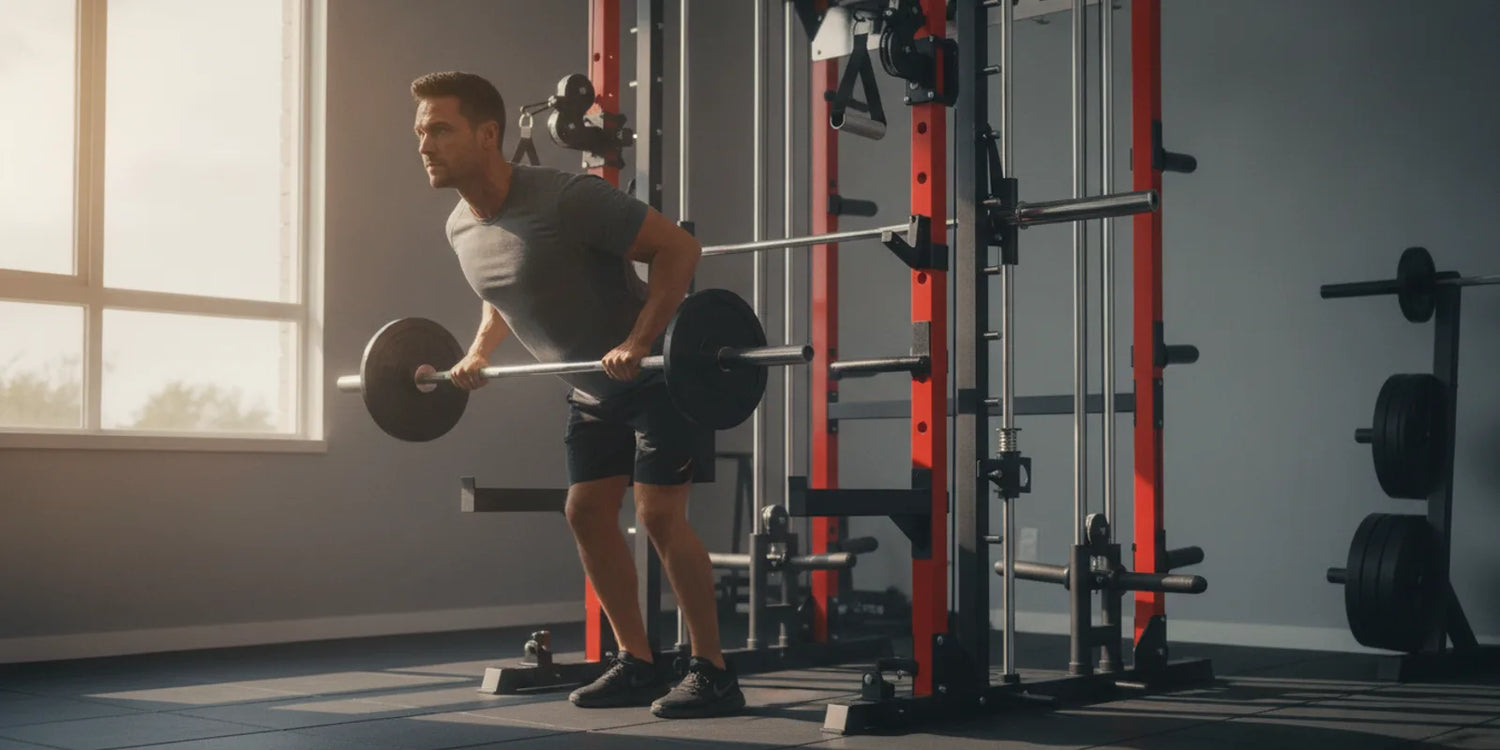
A smith machine spine busters workout routine is a sequenced back day built on the guided bar path of a Smith machine, loading your lats, traps, and spinal erectors with controlled rows, rack pulls, good mornings, and shrugs. It is designed for a stronger, more resilient posterior chain.
This guide gives you the exact order, sets, reps, load selection, progression rules, swaps, and clear stop signals so you can train back day without guessing or risking your lower back.
Quick Answer
The smith machine spine busters workout routine is a structured back session that pairs Smith machine rows, rack pulls, good mornings, shrugs, and inverted rows to build the lats, traps, rhomboids, and erector spinae. The fixed bar path lets you focus on pulling hard while keeping a neutral, protected spine.
Key Takeaways
- Full posterior chain focus: The routine trains lats, traps, rhomboids, and erector spinae in one guided Smith machine session.
- Spine protection first: The fixed bar path helps you hold a neutral spine and pull with intent instead of fighting balance.
- Programmed, not random: A set order with rep ranges and rest beats picking exercises on the fly.
- Progress with control: Add weight only after every set hits clean form with reps in reserve.
- Know your stop signals: Sharp lower back pain or lost neutral spine means end the set, not push through.
| Detail | Summary |
|---|---|
| Key Exercises | Bent-over row, rack pull, good morning, shrug, inverted row |
| Typical Volume | 3-4 sets of 8-15 reps per movement, 1-2 times per week |
| Best For | Intermediate home and gym lifters building back strength |
| Not Ideal For | Anyone with an active lower back injury or no hinge experience |
What Is the Smith Machine Spine Busters Routine?
The smith machine spine busters routine is a back focused training session performed entirely on a Smith machine, sequencing pulls and hinges that load the entire posterior chain. It blends rows, rack pulls, good mornings, shrugs, and inverted rows into one programmed workout.
Because the bar travels on fixed rails, you can lock in your stance and pull hard without balancing a free barbell. In a high density EMG study of 14 resistance trained men, fixing or freeing the shoulder blades during rows produced comparable overall muscle excitation, so a guided bar path remains an effective rowing tool.[1]
- The goal: Build strength and size across the back while keeping the spine in a safe, neutral position.
- The format: A fixed order of five movements with set rep ranges, not a random pick of machines.
This structured approach pairs well with a full split, so you can read our Smith machine leg workouts to plan the rest of your week.
Which Muscles Does the Routine Work?
The routine targets every major back muscle plus the spinal stabilizers, including the latissimus dorsi, trapezius, rhomboids, and the erector spinae. Rows drive the lats and mid back, shrugs hit the upper traps, and rack pulls and good mornings load the spinal erectors.
- Latissimus dorsi: The large fan shaped muscle that creates back width, worked hard in every rowing movement.
- Trapezius and rhomboids: Upper and mid back muscles that retract the shoulder blades during rows and shrugs.
- Erector spinae: The deep spinal extensors that hold a neutral spine and drive hip hinge lifts.
A systematic review of EMG studies on the deadlift and its variants found that the erector spinae and quadriceps showed greater activation than the gluteus maximus and biceps femoris, confirming the spinal erectors as primary movers in hinge pulls.[2] For more variations, see our guide on the best Smith machine back workouts.
Why Train Your Back on a Smith Machine?
Training your back on a Smith machine gives you a stable, guided bar path that lets you focus on pulling and squeezing your shoulder blades instead of balancing a free weight. This control suits rows, rack pulls, and shrugs, though it does reduce stabilizer demand.
What are the benefits of the fixed bar path?
The fixed bar path keeps the load moving in one plane, which helps beginners groove proper pulling mechanics and lets advanced lifters chase tension safely near failure.
- Easier setup: Rack the bar at the right height and start without picking weight off the floor.
- Built in safety: Rotate the hooks to rerack instantly if a rep stalls.
- Tension focus: Less balancing means more attention on squeezing the target muscles.
What are the honest limitations?
The fixed path trains fewer stabilizer muscles than free weights, so the Smith machine works best as one tool rather than your only back option.
To round out your training, the Smith machine with cable system guide shows how cable rows add free moving variety. A versatile unit like the RitFit Multifunctional Smith Machine lets you run every move in this routine, and you can browse the full Smith machine collection to compare setups.
What Is the Full Spine Busters Routine?
The full spine busters routine runs five Smith machine movements in a fixed order, moving from heavier compound pulls to lighter finishers. Perform each exercise for the listed sets and reps, resting 90 to 120 seconds between heavy sets and 60 seconds on the finisher.
The video above demonstrates how the same machine handles multiple back angles, which is the core idea behind sequencing this routine.
1. Smith Machine Bent-Over Row
Set the bar at mid thigh, hinge to a roughly 45 degree torso angle, and row to your belly button while squeezing the shoulder blades. Do 4 sets of 8 to 10 reps.
2. Smith Machine Rack Pull
Set the bar just below the knees and drive your hips through to lockout, keeping a flat back the whole way. Do 3 sets of 6 to 8 reps.
3. Smith Machine Good Morning
Rest the bar on your upper traps, soften the knees, and hinge forward until you feel a hamstring stretch, then stand tall. Do 3 sets of 10 to 12 reps.
4. Smith Machine Shrug
Hold the bar at arms length, then shrug straight up and pause hard at the top before lowering slowly. Do 3 sets of 12 to 15 reps.
5. Smith Machine Inverted Row (Finisher)
Set the bar at hip height, hang underneath with a straight body, and pull your chest to the bar for 3 sets to near failure. This finisher pairs well with our Smith machine hip thrust on glute day.
How Do You Choose Weight and Progress Safely?
Choose a weight you can lift for the target reps while keeping a flat back and full shoulder blade squeeze. Leave one or two reps in reserve, and add small increments only after every set hits clean form.
- Start conservative: Pick a load that feels controlled, not maximal, on your first session so you can learn the bar path.
- Progress by reps first: Add reps within the range before adding weight, then reset reps once you add load.
- Train it 1 to 2 times weekly: Leave at least 48 hours before a heavy deadlift or squat day so the erectors recover.
- Add weight when ready: Increase only after the top of the rep range feels clean and controlled across all sets.
New to the machine itself? Our explainer on what a Smith machine is covers the basics before you load up.
What Are the Most Common Mistakes?
The most common mistake is letting the lower back round under load, which shifts stress off the working muscles and onto the spine. Setup and grip choices matter just as much as the weight you select.
An experimental study of latissimus dorsi weight training exercises showed that grip and exercise variation change how much the back muscles activate, so your grip is worth dialing in.[3]
"The safest way to perform Barbell Rows is starting with the bar placed on a low rack so that you aren't picking it up from the floor. Lean into a flexed-forward position bending at the hips into a 45-degree angle (not a horizontal torso) with knees slightly bent."
Jeff Cavaliere, MSPT, CSCS, Physical Therapist and Strength Coach, Athlean-X
- Rounding the back: Brace your core and keep the chest proud to hold a neutral spine on every rep.
- Using momentum: Control the lowering phase rather than yanking and dropping the bar.
- Standing too close: Set your feet so the bar path stays over your midfoot, not into your shins.
What Can You Swap or Regress?
You can swap or regress any movement to match your mobility and experience while keeping the same muscle targets. Beginners should lighten the load and shorten the range first.
- Good morning swap: Replace with a partial range hip hinge or a back extension if hamstring mobility is limited.
- Rack pull regression: Raise the pins higher to shorten the range until your hinge feels solid.
- Row alternative: Use an inverted row or a chest supported row to reduce lower back demand.
- Add cable variety: Layer in cable rows for a free moving pull that complements the fixed bar path.
If you also train pushing muscles, our Smith machine chest workouts guide rounds out a full upper body split.
When Should You Stop a Set?
You should stop a set immediately if you feel sharp lower back pain or you can no longer hold a neutral spine. Muscle fatigue is normal, but spinal pain and form breakdown are clear signals to rack the bar.
- Sharp or pinching pain: End the set and the hinge work for the day rather than pushing through.
- Lost neutral spine: If your back rounds or hyperextends, the weight is too heavy or you are too fatigued.
- Numbness or tingling: Stop the session and consult a professional before training again.
FAQs About the Smith Machine Spine Busters Routine
Is the Smith machine good for back workouts?
Yes. The Smith machine works well for back training because its fixed bar path lets you focus on pulling and squeezing your shoulder blades without balancing a free barbell. It suits rows, rack pulls, shrugs, and inverted rows. The trade off is less core and stabilizer demand, so include some free weight or cable work over time for complete development.
How often should I do the spine busters routine?
For most intermediate lifters, training this back routine once or twice per week is plenty, with at least 48 hours of recovery between sessions. Beginners should start with one session weekly. Because rack pulls and good mornings load the lower back, avoid stacking them the day before a heavy deadlift or squat day so your erector spinae can recover fully.
What muscles does the spine busters routine train?
The routine targets the major back muscles, including the latissimus dorsi, trapezius, and rhomboids, plus the erector spinae running along your spine. Rows and inverted rows drive the lats and mid back, shrugs hit the upper traps, and rack pulls and good mornings load the spinal erectors and posterior chain. Together they build a stronger, more resilient back.
Can beginners do this Smith machine back routine?
Beginners can start this routine using light loads and regressions like inverted rows and partial range rack pulls, focusing on a neutral spine and controlled tempo before adding weight. If you are new to good mornings, master the hinge with an empty bar first and stop any set that causes sharp lower back pain.
How heavy should I lift on Smith machine rows?
Choose a weight you can row for the target reps while keeping a flat back and full shoulder blade squeeze, usually a load that leaves one or two reps in reserve. If your torso bounces or you cannot pause at the top, the weight is too heavy. Add small increments only after clean, controlled reps.
Conclusion
The smith machine spine busters workout routine gives you a safe, programmed way to build a stronger back and posterior chain. Follow the fixed order, choose controlled loads, and respect your stop signals to train hard while protecting your spine.
Start with light weights to learn the bar path, then progress gradually as your form locks in. Stay consistent with one or two back sessions per week, and your posterior chain strength will follow.
Disclaimer
This article is for general education and is not medical or rehabilitation advice for any existing injury or condition. Consult a qualified healthcare or fitness professional before starting a new training program.
Save on your next RitFit order
Tap the button to copy your code, then paste it at checkout.
References
1. Padovan R, Cè E, Longo S, Tornatore G, Esposito F, Coratella G. High-Density Surface Electromyography Excitation of Prime Movers Across Scapular Positions in the Seated Row. J Funct Morphol Kinesiol. 2025;11(1). doi:10.3390/jfmk11010006 https://pmc.ncbi.nlm.nih.gov/articles/PMC12821611/
2. Martín-Fuentes I, Oliva-Lozano JM, Muyor JM. Electromyographic activity in deadlift exercise and its variants. A systematic review. PLoS One. 2020;15(2):e0229507. doi:10.1371/journal.pone.0229507 https://pmc.ncbi.nlm.nih.gov/articles/PMC7046193/
3. Lehman GJ, Buchan DD, Lundy A, Myers N, Nalborczyk A. Variations in muscle activation levels during traditional latissimus dorsi weight training exercises: An experimental study. Dyn Med. 2004;3(1):4. doi:10.1186/1476-5918-3-4 https://pmc.ncbi.nlm.nih.gov/articles/PMC449729/





