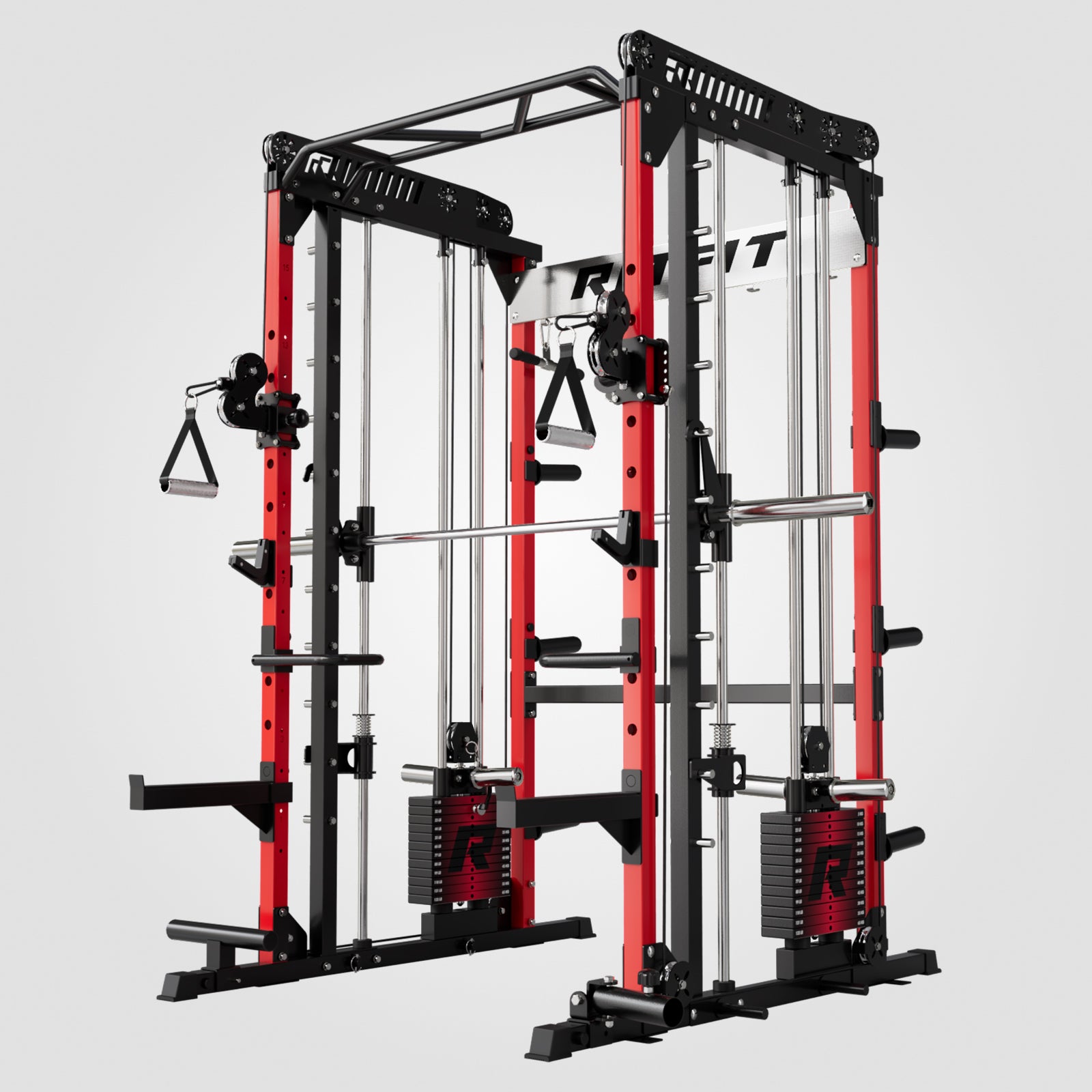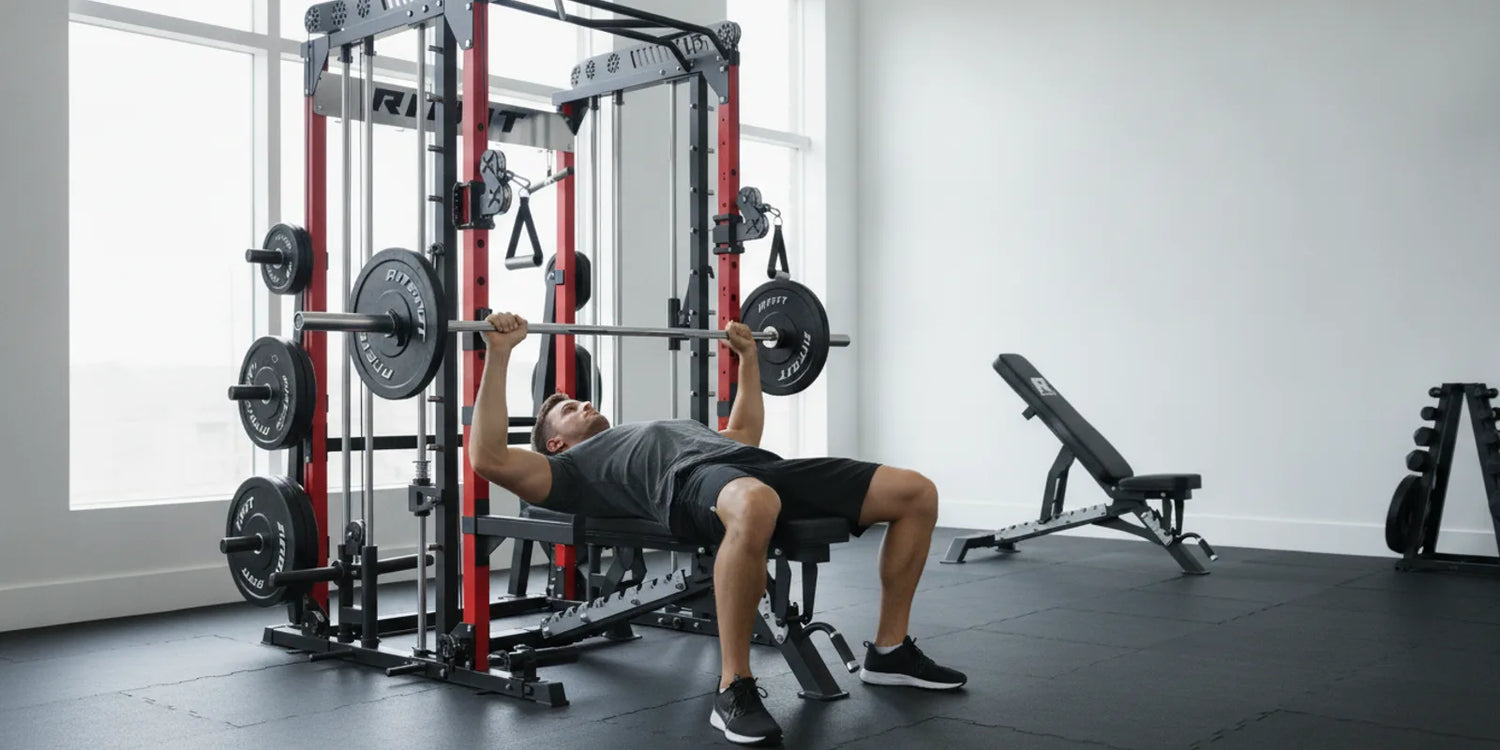
The Smith machine bench press is generally safer than a free barbell bench press when you train without a spotter, because its fixed bar path lets you twist the hooks and rack the bar at almost any point if a rep fails. The catch is that this safety only holds when the stops are set correctly.
This guide focuses on the solo lifter with no spotter. It explains why benching alone is risky, how to set up each option safely, and what you trade away in muscle and skill when you pick the machine.
Quick Answer
For most solo lifters, the Smith machine bench press is safer than a free barbell without a spotter, since the guided bar locks onto hooks at almost any height if you fail a rep. A free barbell is only as safe as the power rack safety pins set behind it, so both demand correct setup.
Key Takeaways
- Safer by default, not automatically: The Smith machine protects a solo lifter only when its catches sit just below chest level.
- The free barbell needs a rack: A barbell is only safe alone inside a power rack with safety pins set correctly.
- One real machine risk: A Smith bar can stall between catch slots, so know how to twist the hooks before going heavy.
- You trade stabilizer work: The fixed path reduces balance demand and changes shoulder activation versus a free bar.
- Use both for best results: Smith machine for safe solo volume, free barbell for strength and skill carryover.
The Real Question Behind Solo Bench Safety
The question is not which press builds more muscle, but which one will not pin you when a rep fails alone. The Smith machine and the free barbell answer that very differently because one guides the bar and one does not.
- Smith machine: The bar rides fixed rails, so you twist your wrists to catch the hooks at almost any point.
- Free barbell: The bar moves freely, so your only backstop is a power rack with safety pins behind it.
If you train chest alone, your setup is your spotter. Learning how to do a Smith machine bench press with correct catches is the first step toward safe solo pressing.
Why Is the Bench Press the Most Dangerous Lift to Do Alone?
The bench press is the most dangerous lift to do alone because a loaded bar travels directly over your throat and chest. A failed rep with no backstop can trap you under the weight with no quick way out.
- No escape route: Unlike a squat, you cannot simply step away from a bar resting on your chest.
- Grip and fatigue failures: Wrists can give out or the bar can drift, especially on later reps near failure.
This is exactly why a spotter is recommended, and why solo lifters need a mechanical equivalent. Both the Smith machine and a power rack exist to fill that role when no person is there to help.
How Does the Smith Machine Protect a Solo Lifter?
The Smith machine protects a solo lifter by fixing the bar on vertical rails lined with hooks, so a small wrist twist racks the bar at nearly any height. If a rep fails, you rotate the bar into the nearest hook instead of being pinned.
- Self racking: The hooks let you bail without help, which is the core solo safety feature.
- Lower balance demand: The guided path removes the side to side wobble that ends free weight reps early.
The video below shows a RitFit multifunctional Smith machine in a home setup, useful context for how the rails and catches work.
Setting Smith Machine Safety Catches Correctly
Set the bottom safety catches just below the height your chest reaches at the bottom of a rep, so a failed bar lands on them and not on you.
- Test empty first: Lie down with the empty bar and confirm the catches sit a hooks notch below your chest.
- Practice the twist: Rehearse rotating the bar into the hooks before adding heavy plates.
Common Mistakes to Avoid With the Catches
The one real machine failure mode is the bar stalling between two catch slots, where it locks into neither hook nor your control. Because the bar is fixed in the rails, you also cannot tip it sideways to slide plates off.
- Avoid it: Always set the bottom catches so the bar reaches a hook before it reaches your chest.
- Stay within reach: Keep loads where you can still rotate the wrists under fatigue, not maximal singles.
A machine with reliable, easy to reach catches matters here. Browse the Smith machine options built for confident solo pressing, and explore guided variations like the incline Smith machine press.
How Do You Bench a Free Barbell Safely Without a Spotter?
You bench a free barbell safely without a spotter by working inside a power rack with safety pins set just below chest level. The pins, not the spotter, are what stop a failed bar from crushing your throat or chest.
"If you don't have a spotter, first off, you need to set up a bit further back on the bench. The pins should be set low enough that you don't have to reach up to unrack the bar, which can make you lose your arch and scapular positioning."
Greg Nuckols, MA, Strength Researcher and Coach, Stronger By Science
Setting Power Rack Safety Pins Correctly
Set the pins just below your chest at full arch, lower than your raised chest but high enough to guard your face and throat. If you miss, exhale, drop your chest, and rest the bar on the pins, then slide out.
- Set back position: Lie a bit further back so you can press the bar off the pins without losing your arch.
- Test the bail: Practice lowering an empty bar to the pins so the escape feels automatic under load.
The No-Collars Roll-Off Backup
If no rack is available, benching alone without collars lets you tilt the bar and slide the plates off one side in an emergency. This is a last resort backup, not a substitute for proper safety pins.
- Trade noise for safety: The plates crash loudly, but that beats being pinned under the bar.
- Stop condition: If you cannot move the bar off your chest, tilt and unload one side before it settles on you.
What Do You Give Up on the Smith Machine?
You give up stabilizer demand and some free weight skill on the Smith machine, because the fixed path does the balancing for you. That safety benefit comes with a real trade in how your shoulder and supporting muscles work.
- Changed activation: Switching from a free barbell to a Smith machine alters muscle activity around the shoulder, since the fixed one dimensional path produces more stereotyped patterns than the joint adjustments a free bar allows.[1]
- Skill carryover: The machine trains pressing force but not the balance a free bar requires for sport or powerlifting.
Research context helps set expectations. In untrained men, the lower instability Smith machine press was suggested as suitable for people who have not yet developed the neuromuscular control to stabilize the elbow under a free bar.[2]
Strength still transfers, though. A 10 week study had resistance trained men train the chest press on a Smith machine, with dumbbells, or with a barbell on a Swiss ball, and strength gains transferred toward the untrained free barbell bench regardless of which variation was trained.[3]
For triceps focused work on the same frame, the JM press on a Smith machine is a useful add on, and the Smith machine shoulder press rounds out guided upper body pressing.
Which Should the Solo Lifter Choose?
The solo lifter should choose the Smith machine for safe high volume chest work and the free barbell for strength and skill, ideally using both. Your goal and your equipment decide the balance.
- Choose the Smith machine if: You train alone often, want secure self racking, or focus on controlled hypertrophy volume.
- Choose the free barbell if: You have a power rack with pins and want free weight strength and balance.
- Use both if: You want safe solo volume plus the carryover only a free bar builds.
Solo lifters comparing other guided options may also find the leg press vs Smith machine breakdown helpful, alongside dedicated leg press machines for lower body days.
FAQs About Smith Machine and Barbell Bench Press Safety
Is the Smith machine bench press safer than a barbell without a spotter?
For most solo lifters yes, because the Smith machine fixes the bar on rails so you can twist your wrists and rack it at almost any point if a rep fails. A free barbell offers no such backstop unless you set power rack safety pins, and the machine is only safer when its catches sit below chest level.
What is the main danger of benching a Smith machine alone?
The bar can stall between two catch slots if you fail mid rep and cannot rotate it into a hook, and because it is locked in vertical rails you cannot tip it sideways to slide the plates off either. Always set the bottom safety catches just below chest level so a failed bar lands on them, not on you.
How do I set safety pins to bench a barbell alone safely?
Place the pins just below the height your chest reaches at the bottom of a rep, lower than your raised chest but high enough to catch your face and throat. If you miss, exhale, drop your chest, and lower the bar onto the pins, then slide out, since the pins protect your throat and abdomen rather than your chest.
Does the Smith machine build less muscle than a barbell?
The fixed path reduces stabilizer demand and changes activation around the shoulder, so it trains balance and free weight control less than a free bar does. One 10 week study found strength still transferred toward the barbell bench regardless of the variation trained, so use the Smith machine for safe volume rather than as your only chest press.
Should beginners use the Smith machine bench press?
Yes, it can be a reasonable starting point, since research on untrained men suggested it suits people who have not yet developed the neuromuscular control to stabilize the elbow under a free bar. It lets beginners groove the press safely, but they should still progress toward free weight benching to build real stabilization over time.
Conclusion
For the solo lifter, the Smith machine bench press is usually the safer choice without a spotter, but only when its catches sit just below chest level. A free barbell can be just as safe inside a power rack with correctly set pins.
Before you load any plates, check your setup. Set the catches or pins just below chest level first, then train with a real backstop in place using a multifunctional Smith machine built for confident solo pressing.
Disclaimer
This article is for general educational purposes and does not replace professional coaching or medical advice. Consult a qualified trainer or healthcare provider before starting heavy pressing, especially if you train alone or have a prior injury.
Save on your next RitFit order
Tap the button to copy your code, then paste it at checkout.
References
1. Gołaś A, Maszczyk A, Pietraszewski P, et al. Muscular activity patterns of female and male athletes during the flat bench press. Biol Sport. 2018;35(2):175-179. doi:10.5114/biolsport.2018.74193 https://pmc.ncbi.nlm.nih.gov/articles/PMC6234306/
2. Wang L, Qiao M, Tao H, et al. A comparison of muscle activation and concomitant intermuscular coupling of antagonist muscles among bench presses with different instability degrees in untrained men. Front Physiol. 2022;13:940719. doi:10.3389/fphys.2022.940719 https://pmc.ncbi.nlm.nih.gov/articles/PMC9486837/
3. Saeterbakken AH, Andersen V, van den Tillaar R, et al. The effects of ten weeks resistance training on sticking region in chest-press exercises. PLoS One. 2020;15(7):e0235555. doi:10.1371/journal.pone.0235555 https://pmc.ncbi.nlm.nih.gov/articles/PMC7347144/