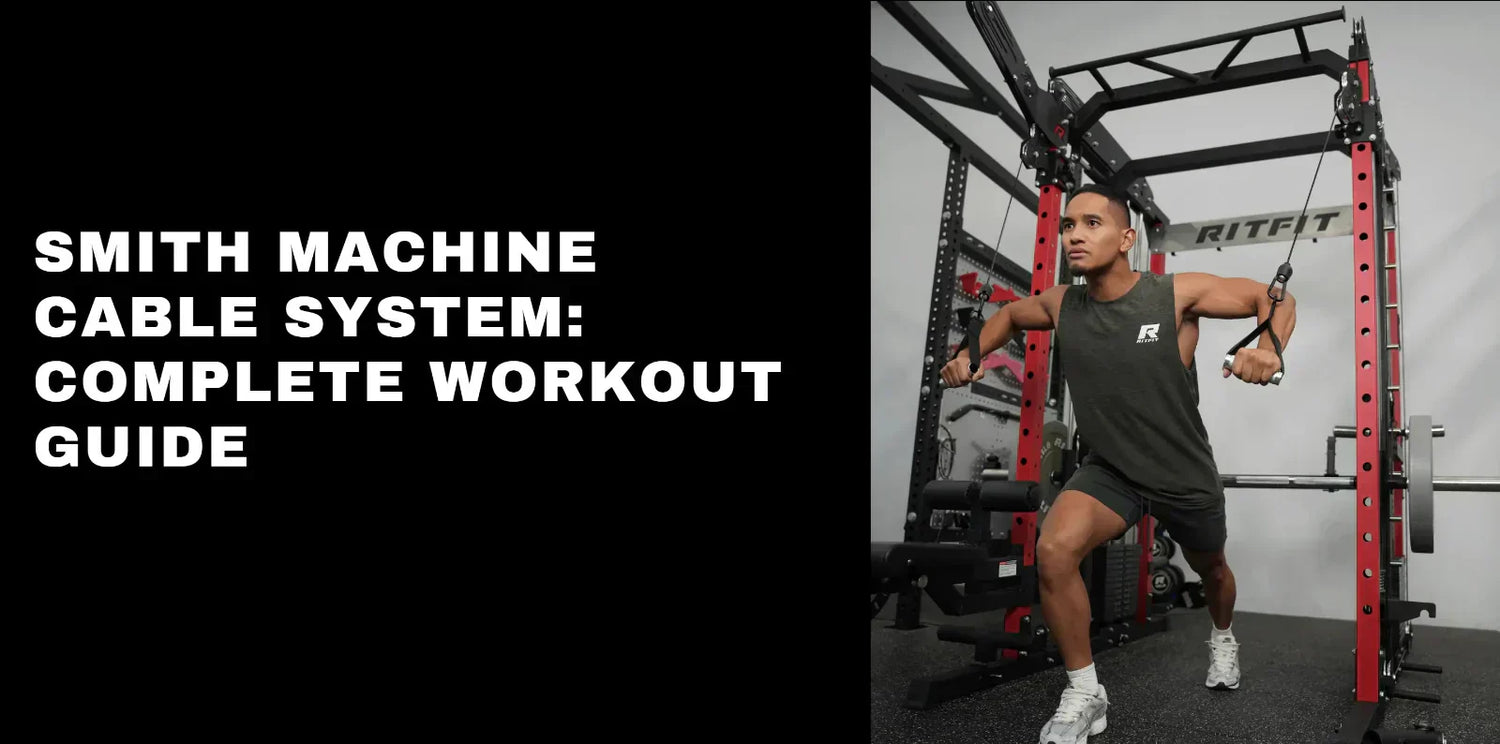
A Smith machine with a cable system is one of the most efficient ways to build a full body home gym in one compact training station. It combines guided bar training, adjustable cable resistance, pull movements, pressing work, leg training, and core exercises without requiring several separate machines.
This guide shows how to set up, train, progress, and choose a Smith cable combo safely. It uses RitFit home gym systems as examples while keeping the training principles useful for any similar setup.
Key Takeaways
- All in one training: A Smith machine with a cable system supports squats, presses, rows, pulldowns, flies, curls, glute work, and core training.
- Better solo setup: The guided bar and safety catches can help home gym users train with more confidence, especially when no spotter is available.
- Smart cable use: High, mid, and low pulley positions let you match resistance to the natural path of each exercise.
- Simple programming works: Most users can make progress with a 3 day full body plan or a 4 day upper lower split.
- Buying fit matters: The best model depends on space, cable needs, upgrade path, training partners, and ceiling height.
Table of Contents
- What Is a Smith Machine with a Cable System?
- Why a Smith with Cable Combo Is Perfect for Home and Garage Gyms
- Getting Set Up: Safety, Adjustments and Basics
- Movement Library: Best Smith Machine and Cable Exercises
- Complete Workout Templates with Only Smith and Cables
- How to Progress Safely
- Common Mistakes to Avoid
- Choosing or Upgrading Your Smith Machine with Cable System
What Is a Smith Machine with a Cable System?
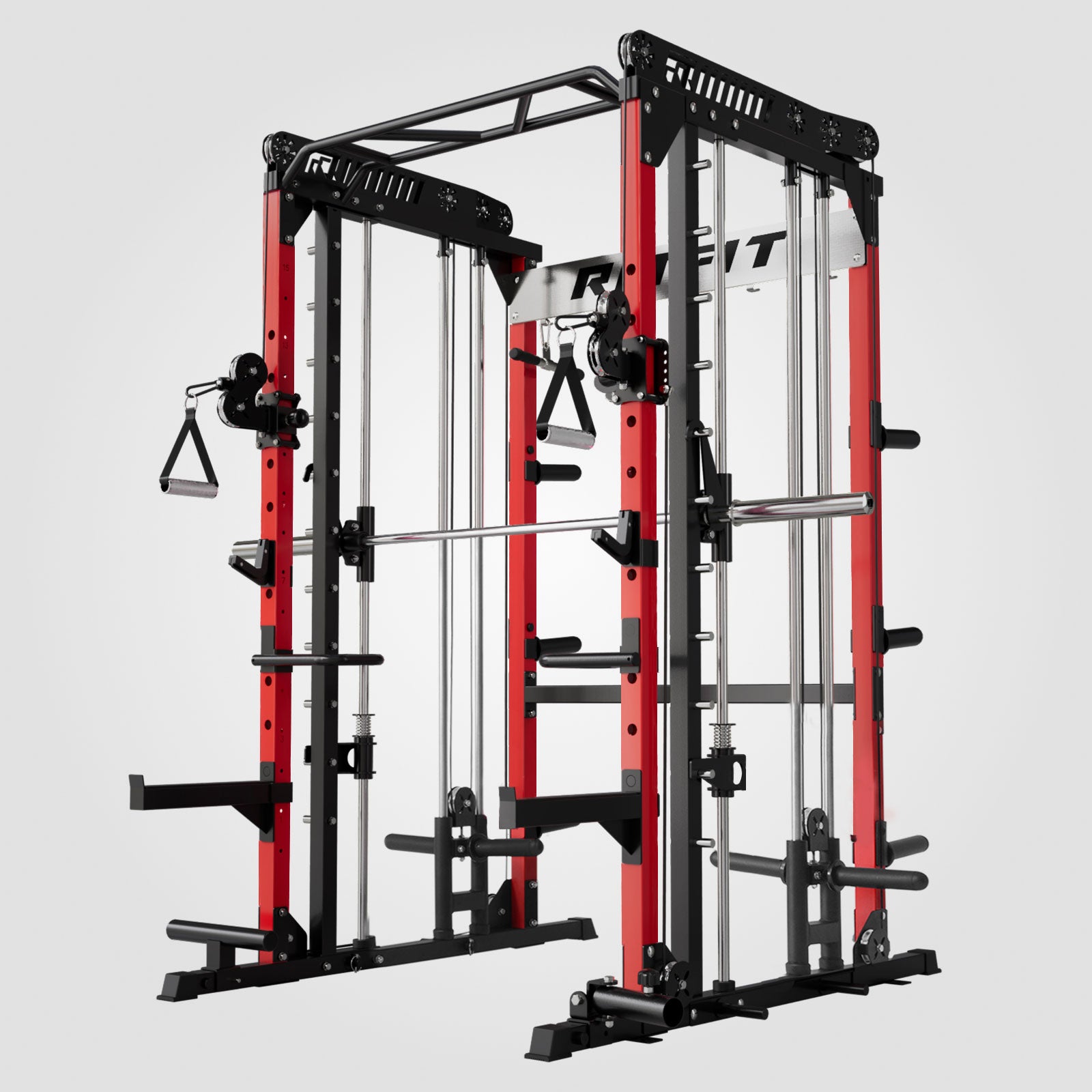
A Smith machine with a cable system combines guided barbell training, adjustable pulleys, rack style safety features, and cable accessory work in one frame. It is designed for home gym users who want strength training and cable versatility without filling the room with separate machines.
- Smith bar on rails: The guided bar moves on a fixed track and catches on multiple height settings. This supports squats, presses, hip thrusts, rows, and controlled bar path training.
- Adjustable cable pulleys: The pulleys can be placed high, mid, or low for rows, pulldowns, curls, pressdowns, flies, pull throughs, and core work.
- Rack style features: Many systems include J hooks, safety arms, plate storage, and a pull up bar. This makes the unit useful for both Smith bar exercises and rack based strength work.
- Lat pulldown and cable crossover: A dual cable setup can support back training, chest isolation, shoulders, arms, and rotational core work. For technique support, see this RitFit guide on how to do a lat pulldown on a Smith machine.
Compared with a standalone Smith machine, a cable combo adds more pulling, isolation, and core options. Compared with a basic rack, it gives you cable resistance without buying a separate functional trainer.
For RitFit shoppers, the RitFit Smith machine collection includes compact and multifunctional options for different home gym goals. Popular examples include the RitFit M1 PRO Smith Machine, the RitFit M2 Modular Home Gym Package, and the RitFit BUFFALO Smith Machine Home Gym Package.
Why a Smith with Cable Combo Is Perfect for Home and Garage Gyms
A Smith cable combo is ideal for home gyms because it solves three common problems at once, limited space, solo training, and exercise variety. It lets you train heavy compound lifts and cable accessories without needing a commercial gym layout.
Built for Training Alone with Less Worry
The guided Smith bar and safety catches can help solo lifters train presses, squats, and hip thrusts with more control. They do not replace good form, proper setup, or smart loading.
- Safety catches: Set the bottom position before squats, bench presses, and hip thrusts. This gives the bar a safe stopping point if a rep slows down.
- Guided bar path: The fixed track reduces balance demand compared with free weight lifting. This can help beginners focus on range of motion, bracing, and tempo.
- Controlled loading: Start with a weight you can move smoothly. Add load only when your form stays consistent across all working sets.
Full Body Training on One Machine
A Smith cable system can train the lower body, upper body push muscles, upper body pull muscles, arms, and core. This makes it practical for busy users who want one main training station.
- Lower body: Smith squats, Romanian deadlifts, split squats, hip thrusts, and cable pull throughs cover quads, glutes, and hamstrings.
- Upper push: Smith bench press, incline press, shoulder press, cable chest fly, lateral raise, and pressdowns cover chest, shoulders, and triceps.
- Upper pull: Lat pulldowns, cable rows, face pulls, Smith rows, and cable curls cover lats, upper back, rear delts, and biceps.
- Core: Cable Pallof presses, woodchops, cable crunches, and anti rotation holds build trunk control.
Space and Budget Efficient
One integrated frame can reduce the need for a separate Smith machine, power rack, lat pulldown, and cable crossover. This is especially useful for garage gyms, basements, and spare rooms.
Before buying, measure ceiling height, available wall width, front clearance, and walking space around the frame. A compact home gym should still allow safe plate loading, bench movement, cable setup, and exercise transitions.
Joint Friendly When Set Up Correctly
A Smith cable combo can be joint friendly when the bar path, pulley height, stance, and range of motion match your body. Squat mechanics can change meaningfully when stance width, trunk angle, tibia position, foot rotation, and depth change.[1]
Use the machine to find pain free positions rather than forcing every exercise into a single setup. If a movement causes sharp or persistent pain, reduce load, shorten range, change the angle, or stop the exercise.
Getting Set Up: Safety, Adjustments and Basics
Proper setup makes every Smith machine and cable exercise safer, smoother, and easier to repeat. Set the bar, safeties, bench, pulley height, and load before the first working set.
Set the Smith Bar and Safeties First
The bar should start at a height that lets you unrack without shrugging, tiptoeing, or losing posture. The safety catches should sit just below your controlled bottom position.
- Squats: Set the bar slightly below shoulder height. Place safeties at or just below your lowest controlled squat depth, then test the empty bar first.
- Bench press: Place the bench so your eyes are under the bar. Set safeties slightly above chest level so the bar cannot pin your torso.
- Hip thrusts: Start with the bar near hip height when seated. Set safeties below the lowest point of your thrust path.
Dial in the Cable System
The cable should pull in the same general direction as the movement you want to train. A mismatched pulley height can shift tension away from the target muscle or stress the joint angle.
- High pulley: Use this for triceps pressdowns, face pulls, pulldowns, high to low woodchops, and overhead cable work.
- Mid pulley: Use this for rows, chest flies, rear delt flies, lateral raises, and standing presses.
- Low pulley: Use this for curls, upright rows, pull throughs, low rows, and low to high cable raises.
Warm Up Before Loading Heavy
A short warm up helps prepare joints, muscles, and confidence before heavier resistance training. Research on warm ups suggests they can increase blood flow and readiness, although stretching choices should match the workout goal.[2]
- General warm up: Do 2 to 3 minutes of light cardio, marching, cycling, rowing, or jump rope. Keep the intensity easy enough to breathe normally.
- Joint preparation: Use controlled leg swings, arm circles, bodyweight squats, and band pull aparts. Choose movements that match your first exercises.
- Specific ramp sets: Do 1 to 3 lighter sets of your first lift. Increase weight gradually before starting your main working sets.
Movement Library: Best Smith Machine and Cable Exercises
The best Smith cable exercises are the ones you can perform with stable posture, full control, and repeatable technique. Use this section as a menu, not a requirement to do every movement in one workout.
Lower Body Exercises
Smith bar lower body exercises are useful for quads, glutes, hamstrings, and controlled progressive loading. Cable lower body work adds constant tension and helps fill gaps in glute and posterior chain training.
- Smith machine squat: Stand with feet slightly in front of the bar line if that improves comfort and control. Keep your torso braced, knees tracking with toes, and weight balanced through mid foot.
- Smith machine Romanian deadlift: Hinge your hips back with soft knees and keep the bar close to your legs. Stop when you feel a strong hamstring stretch without losing a neutral spine.
- Smith machine Bulgarian split squat: Elevate the rear foot and position the front foot under a stable bar path. Lower under control and keep the front knee aligned with the foot.
- Smith machine hip thrust: Place your upper back on a bench and keep feet flat. Drive through your heels and finish with a controlled glute squeeze.
- Cable pull through: Attach a rope to a low pulley behind you. Hinge forward, keep the spine neutral, and drive the hips through without turning it into a squat.
Upper Body Push Exercises
Smith presses and cable push movements train the chest, shoulders, and triceps with stable resistance. For shoulder comfort, keep the elbows slightly tucked rather than flared straight out.
- Smith flat bench press: Set the bench so the bar tracks toward the lower chest or upper rib area. Keep feet planted, shoulder blades set, and wrists stacked over elbows.
- Smith incline bench press: Use a moderate incline to bias the upper chest and front delts. Lower with control and avoid turning the movement into a steep shoulder press.
- Smith shoulder press: Press from around chin or upper chest height if your shoulders tolerate it. Brace your core and avoid excessive lower back arching.
- Cable chest fly: Set pulleys around chest height and keep a soft bend in the elbows. Bring the handles together with control and avoid overstretching at the bottom.
- Cable lateral raise: Set the pulley low or slightly below hand level. Raise the handle out to the side with a controlled tempo and minimal body swing.
Upper Body Pull Exercises
Cable pull exercises are a major advantage of a Smith machine with a cable system. They help train the lats, upper back, rear delts, biceps, and posture muscles through adjustable angles.
- Cable lat pulldown: Sit tall and pull toward the upper chest. Avoid pulling behind the neck, since that position may feel uncomfortable for many shoulders.
- Cable row: Set the pulley around mid or low height and row toward the lower ribs. Keep the spine neutral and pause briefly when the shoulder blades come back.
- Smith bent over row: Hinge at the hips and row the bar toward the mid torso. Keep the movement strict and avoid turning every rep into a body swing.
- Cable face pull: Set the rope around upper chest or face height. Pull toward the forehead with elbows high and finish with a controlled rear delt squeeze.
- Cable biceps curl: Use a low pulley and keep elbows close to your sides. Curl without leaning back or letting the shoulders take over.
Core Exercises
Cable core exercises are effective because they challenge the trunk against constant resistance. Focus on resisting motion as much as creating motion.
- Cable Pallof press: Stand sideways to the pulley and press the handle away from your chest. Keep your ribs down and resist rotation through the torso.
- Cable woodchop: Use high to low or low to high cable angles. Rotate through the upper body and hips without yanking the handle.
- Cable crunch: Kneel with a rope attachment and curl the rib cage toward the pelvis. Use abdominal control rather than pulling only with the arms.
Complete Workout Templates with Only Smith and Cables
You do not need a complicated program to make progress with a Smith cable combo. Pick one routine, train consistently for 6 to 8 weeks, and track reps, weight, and form quality.
Option 1: 3 Day Full Body Routine
This plan is best for beginners, busy parents, and home gym users who want simple weekly consistency. Train on nonconsecutive days such as Monday, Wednesday, and Friday.
Day A: Squat and Push Focus
- Smith squat: 3 sets of 8 to 10 reps.
- Smith flat bench press: 3 sets of 8 to 10 reps.
- Cable row: 3 sets of 10 to 12 reps.
- Cable lateral raise: 3 sets of 12 to 15 reps.
- Cable Pallof press: 3 sets of 12 to 15 reps per side.
Day B: Hinge and Pull Focus
- Smith Romanian deadlift: 3 sets of 8 to 10 reps.
- Cable lat pulldown: 3 sets of 8 to 10 reps.
- Smith shoulder press: 3 sets of 8 to 10 reps.
- Cable biceps curl: 3 sets of 10 to 12 reps.
- Cable triceps pressdown: 3 sets of 10 to 12 reps.
Day C: Glutes and Accessories
- Smith Bulgarian split squat: 3 sets of 8 to 10 reps per leg.
- Smith hip thrust: 3 sets of 10 to 12 reps.
- Cable chest fly: 3 sets of 10 to 12 reps.
- Cable face pull: 3 sets of 12 to 15 reps.
- Cable woodchop: 3 sets of 12 to 15 reps per side.
Option 2: 4 Day Upper Lower Split
This plan is best for users who want more weekly volume without training every day. Rest 60 to 120 seconds between most sets, and rest longer for heavier compound lifts.
Day 1: Lower Body Squat Focus
- Smith squat: 4 sets of 6 to 8 reps.
- Smith Romanian deadlift: 3 sets of 8 to 10 reps.
- Cable pull through: 3 sets of 10 to 12 reps.
- Cable calf raise: 3 sets of 12 to 15 reps.
Day 2: Upper Body Push Focus
- Smith flat bench press: 4 sets of 6 to 8 reps.
- Smith incline bench press: 3 sets of 8 to 10 reps.
- Cable chest fly: 3 sets of 10 to 12 reps.
- Cable lateral raise: 3 sets of 12 to 15 reps.
- Cable triceps pressdown: 3 sets of 10 to 12 reps.
Day 3: Lower Body Glute Focus
- Smith Bulgarian split squat: 3 sets of 8 to 10 reps per leg.
- Smith hip thrust: 4 sets of 8 to 10 reps.
- Cable pull through: 3 sets of 10 to 12 reps.
- Cable Pallof press: 3 sets of 12 to 15 reps per side.
Day 4: Upper Body Pull Focus
- Cable lat pulldown: 4 sets of 8 to 10 reps.
- Smith bent over row: 3 sets of 8 to 10 reps.
- Cable row: 3 sets of 10 to 12 reps.
- Cable face pull: 3 sets of 12 to 15 reps.
- Cable biceps curl: 3 sets of 10 to 12 reps.
Option 3: Push Pull Legs
This plan is best for experienced users who enjoy training 5 to 6 days per week and recover well. Beginners should start with the 3 day full body routine before moving to higher frequency training.
- Push day: Smith bench press, Smith incline press, Smith shoulder press, cable fly, lateral raise, and triceps pressdown.
- Pull day: Cable lat pulldown, Smith row, cable row, face pull, rear delt fly, and cable curl.
- Leg day: Smith squat, Smith Romanian deadlift, Bulgarian split squat, hip thrust, pull through, and calf raise.
How to Progress Safely
Progress comes from repeating good training, not from maxing out every session. Research suggests that both load progression and repetition progression can support muscular adaptations when training is organized well.[3]
Use a Simple Progression Rule
When you hit the top of the rep range for every set with good form, increase the load next time by the smallest practical amount. If the jump is too large, keep the same weight and add reps first.
- For strength: Use heavier loads, fewer reps, longer rests, and strict technique.
- For muscle growth: Use moderate loads, controlled reps, enough weekly sets, and sets that finish near but not always at failure.
- For confidence: Keep 1 to 2 reps in reserve on most working sets. This supports progress while reducing sloppy reps.
Run a 6 to 8 Week Training Block
A short training block makes progress measurable and prevents random exercise hopping. Hypertrophy oriented resistance training should create enough mechanical tension and training stimulus while still allowing recovery.[4]
- Weeks 1 and 2: Learn the movements and choose conservative loads. Focus on setup, tempo, and range of motion.
- Weeks 3 to 5: Add reps or small load increases when form stays clean. Keep most sets challenging but controlled.
- Weeks 6 and 7: Maintain effort and progress where possible. Do not force increases if joints or technique feel worse.
- Week 8: Reduce load or total sets for a deload. Use the week to recover, review your log, and plan the next block.
Common Mistakes to Avoid
Most problems with a Smith machine and cable system come from poor setup, rushed loading, or using one pulley position for every exercise. Fix the setup before blaming the machine.
- Ignoring the safeties: Always set safeties for squats, presses, and hip thrusts. A failed rep should have a clear stopping point.
- Standing in the wrong bar path: Many lower body movements feel better with feet slightly forward. Test the empty bar before loading plates.
- Using random cable heights: Match the pulley to the movement path. Chest flies, face pulls, rows, curls, and pull throughs all need different cable angles.
- Adding weight too fast: The guided bar can make heavy loads feel easier at first. Use controlled eccentrics, full bracing, and consistent rep speed.
- Skipping warm up sets: Do not jump from an empty bar to a heavy working set. Use ramp sets to prepare the joints and nervous system.
- Forgetting space clearance: Leave enough room for plates, attachments, bench movement, and cable exercises. A tight setup can make training awkward and unsafe.
Choosing or Upgrading Your Smith Machine with Cable System
The best Smith cable system is the one that matches your space, training style, upgrade needs, and budget. Machine based and free weight based strength training can both improve strength and muscle outcomes, so the right choice depends on how you will actually train at home.[5]
- Stable frame: Choose a system that feels secure under your expected loads. Stability matters for squats, presses, rows, and cable work.
- Smooth guided bar: A smooth Smith track helps each rep feel predictable. This is especially useful for solo training and controlled tempo work.
- Adjustable pulleys: Multiple cable positions improve exercise variety. Look for enough height options for pulldowns, rows, flies, curls, pressdowns, and core work.
- Rack features: Pull up bars, J hooks, safety arms, and plate storage increase long term value. These features reduce the need for extra equipment.
- Upgrade path: Attachments, weight stacks, handles, and lat pulldown accessories can make a compact system more versatile over time.
| Model | Key Design Feature | Core Components and Stations | Best For |
|---|---|---|---|
| RitFit M1 PRO Multifunctional Smith Machine | Compact all in one design | Smith bar, squat rack, cable crossover system, and pull up bar | Home gym users who want a space efficient full body training station. |
| RitFit BUFFALO Multifunctional Smith Machine | Dual sided training layout | Smith bar, lat pulldown, cable crossover, and multi station training access | Families, couples, or training partners who want more exercise flow. |
| RitFit M2 Multi Functional Modular Smith Machine | Modular and expandable setup | Customizable attachments and training stations | Lifters who want a system that can grow with changing goals. |
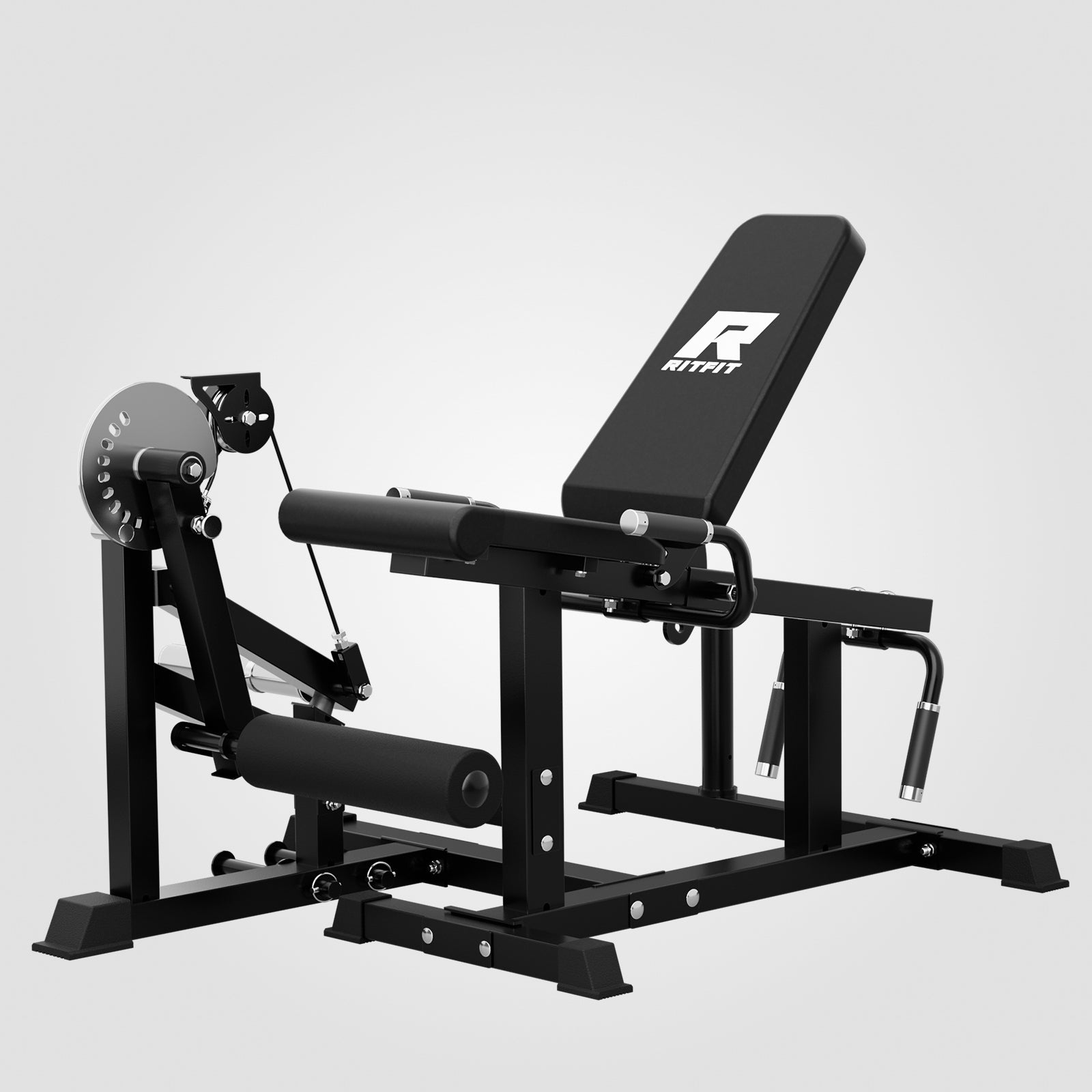
If you want to expand cable training, browse RitFit lat pulldown attachments and cable machine attachments. If you need a stronger pressing and hip thrust setup, pair your station with the RitFit GATOR adjustable weight bench.
FAQs About Smith Machine Cable Workouts
Can I build muscle with only a Smith machine with cable system?
Yes. A Smith machine with cable system can build muscle when you train close to failure, use enough weekly volume, and progress reps or load over time. The Smith bar covers heavy compound lifts, while cables add constant tension for rows, flies, curls, pressdowns, glutes, and core.
Is a Smith machine with cable system safe for solo home gym training?
Yes. It can be safer for solo training when the safeties are set correctly and the weight matches your ability. The guided bar helps reduce balance demands, but it does not remove the need for bracing, controlled reps, warm ups, and pain free movement.
What exercises can I do on a Smith machine cable combo?
You can train squats, bench presses, shoulder presses, Romanian deadlifts, rows, pulldowns, chest flies, lateral raises, curls, pressdowns, hip thrusts, pull throughs, and cable core work. The best setup uses the Smith bar for heavier lifts and cables for angles, isolation, and accessories.
How many days per week should I train with a Smith cable machine?
Most home gym users should train 3 to 4 days per week with a Smith cable machine. A 3 day full body plan works well for beginners and busy schedules, while a 4 day upper lower split gives more weekly volume for strength and muscle growth.
Do I need dumbbells if I own a Smith machine with cables?
No. Dumbbells are useful, but they are not required for a complete home gym program. A Smith machine with cables already covers the main movement patterns, including squat, hinge, push, pull, glute training, arm work, and core resistance, while dumbbells mainly add variety.
Which RitFit Smith machine is best for a home gym?
The best RitFit Smith machine depends on space, training style, and upgrade goals. The M1 PRO suits compact all in one training, the BUFFALO suits shared multi station workouts, and the M2 suits lifters who want a more modular setup that can adapt over time.
How much space do I need for a Smith machine with cable system?
You need enough space for the frame, bench travel, plate loading, cable movement, and safe walking clearance. Before buying, measure ceiling height, wall width, front clearance, and side clearance, then compare those numbers with the product dimensions and the exercises you plan to perform.
Final Thoughts: Turn Your Combo into a Home Training Studio
A Smith machine with a cable system can become the main training hub of a serious home gym. With smart setup, consistent programming, safe progression, and the right accessories, one compact station can support full body strength, muscle growth, and long term training consistency.
Choose the model that fits your room, goals, and upgrade path, then start with one simple routine. The machine only works when your setup, form, and weekly habits work together.
Disclaimer: This article is for general educational purposes only and is not medical advice. If you have pain, a recent injury, a medical condition, or limited exercise experience, consult a qualified healthcare professional or certified fitness professional before starting a new resistance training program.
References
- Straub RK, Powers CM. A biomechanical review of the squat exercise: implications for clinical practice. Int J Sports Phys Ther. 2024;19(4):490-501. doi:10.26603/001c.94600
- Park HK, Jung MK, Park E, et al. The effect of warm-ups with stretching on the isokinetic moments of collegiate men. J Exerc Rehabil. 2018;14(1):78-82. doi:10.12965/jer.1835210.605
- Plotkin D, Coleman M, Van Every D, et al. Progressive overload without progressing load? The effects of load or repetition progression on muscular adaptations. PeerJ. 2022;10:e14142. doi:10.7717/peerj.14142
- Krzysztofik M, Wilk M, Wojdała G, Gołaś A. Maximizing muscle hypertrophy: a systematic review of advanced resistance training techniques and methods. Int J Environ Res Public Health. 2019;16(24):4897. doi:10.3390/ijerph16244897
- Haugen ME, Vårvik FT, Larsen S, Haugen AS, van den Tillaar R, Bjørnsen T. Effect of free-weight vs machine-based strength training on maximal strength, hypertrophy and jump performance: a systematic review and meta-analysis. BMC Sports Sci Med Rehabil. 2023;15(1):103. doi:10.1186/s13102-023-00713-4