








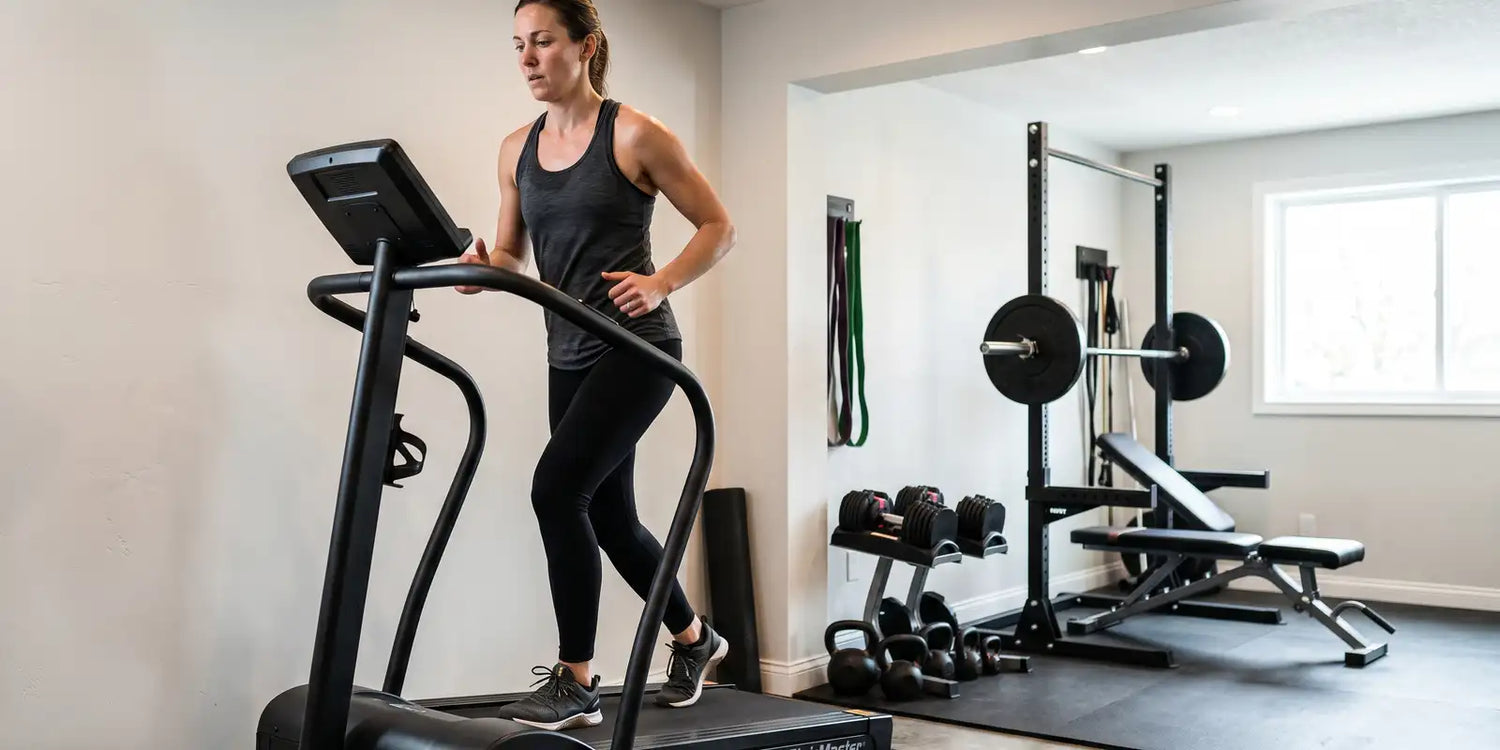
A StairMaster for home delivers commercial-grade stair climbing cardio directly into your personal workout space. Choosing the right machine requires evaluating ceiling clearance, floor dimensions, and resistance mechanisms to match your fitness goals.
This comprehensive guide details vertical measurement calculations, equipment categories, and biomechanical training rules for residential spaces. Reviewing these setup guidelines ensures you maximize conditioning benefits while avoiding common installation errors.
Quick Answer: A StairMaster for home provides efficient lower-body conditioning and low-impact cardiovascular training in a compact footprint. Fitting a stair climber indoors requires calculating ceiling clearance by adding user height plus eighteen inches to the machine stepping height, selecting between compact steppers and revolving stepmills based on available room dimensions.
Key Takeaways
- Ceiling Calculation: Add your maximum user height plus eighteen inches to the top step height to guarantee safe overhead clearance.
- Footprint Efficiency: Compact home stair steppers require roughly thirty by fifty inches of floor area plus two feet of clearance on all sides.
- Low-Impact Mechanics: Independent pedal stepping maintains continuous foot contact, reducing joint impact compared to road running.
- Full Extension: Driving through complete hip extension engages glute and hamstring musculature far more effectively than short choppy strides.
- Complementary Setup: Pairing stair climbing conditioning with dedicated strength equipment creates a balanced home fitness routine.
What Is a StairMaster for Home?
A StairMaster for home is a stationary cardiovascular fitness machine designed to simulate continuous vertical stair climbing in a residential environment. It delivers intense aerobic conditioning while strengthening the lower body without requiring commercial ceiling heights.
- Commercial StepMills: Large revolving staircases engineered for commercial fitness centers that require significant overhead clearance and dedicated floor area.
- Home Stair Steppers: Compact dual-pedal or folding upright machines engineered specifically for standard ceiling heights and apartment spaces.
For most lifters building out a training area, consulting a comprehensive Home Gym Guide helps determine how cardio machines integrate with strength racks.
How Much Space and Ceiling Clearance Do You Need?
Installing a home stair climber requires at least eight to nine feet of vertical ceiling height depending on the specific machine step elevation. You must also allocate a floor footprint of approximately thirty by fifty inches with surrounding safety margins.
| Machine Style | Average Footprint (L x W) | Minimum Ceiling Height | Recommended Room Type |
|---|---|---|---|
| Mini Stepper | 16" x 12" | 7.5 Feet | Apartment / Bedroom |
| Upright Stepper | 36" x 24" | 8.0 Feet | Spare Room / Basement |
| Revolving StepMill | 50" x 30" | 9.0+ Feet | Garage / High-Ceiling Gym |
Dimensions represent average equipment specifications across popular residential and light-commercial models.
Examining layout strategies in curated Home Gym Ideas helps optimize square footage before purchasing large equipment.
Which Type of Home Stair Climber Suits You?
The best stair climber depends on your ceiling clearance, training intensity demands, and total equipment budget. Three primary machine styles serve different residential fitness setups.
- Mini Steppers: Ultra-portable hydraulic units suitable for light aerobic movement and under-desk workouts.
- Upright Vertical Climbers: Full-body climbing machines featuring interactive moving handrails and independent foot pedals.
- Revolving Stair Units: Premium motorized revolving stairs that replicate actual architectural stairwells for advanced conditioning.
If you want to build strong leg drive alongside climbing cardio, adding a RitFit Cougar Home Leg Adduction Abduction Machine or exploring our versatile Functional Training Equipment targets hip stabilizers effectively.
What Should You Look For When Choosing One?
Selecting a durable stair climber involves evaluating frame weight capacity, step height stroke, drive mechanism noise levels, and resistance control options. Premium machines utilize magnetic resistance or heavy-duty eddy current braking for whisper-quiet home operation.
- Step Range and Height: Look for a comfortable six to eight inch step height that mimics natural stair climbing mechanics.
- Weight Capacity: Ensure the steel chassis is rated for at least three hundred pounds to maintain structural stability during sprints.
- Console Metrics: Digital monitors tracking step rate, vertical floors climbed, heart rate, and caloric expenditure provide progressive feedback.
To strengthen the lower back and posterior chain for injury prevention on the stairs, consider integrating the RitFit BE01 Adjustable Back Extension Machine into your weekly routine.
Is a Stair Climber Worth It for a Home Gym?
A stair climber is an exceptionally worthwhile investment for home gyms because it combines vigorous aerobic training with posterior chain muscular endurance. Research shows that structured stair climbing protocols significantly boost VO2max, cardiorespiratory capacity, and metabolic markers.[1][2]
To develop complete lower body power that enhances climbing stamina, lifters often cross-train using the RitFit Gazelle 3 In 1 Leg Press Hack Squat Machine for heavy quad and glute development.
How Do You Train Safely and Avoid Common Mistakes?
Training safely on a stair climber requires maintaining an upright spinal posture, avoiding excessive handrail leaning, and stepping through complete hip extension. Low-volume progressive stepping routines effectively improve functional fitness while protecting knee joints from overuse fatigue.[3]
- Avoid Slouching Forward: Leaning heavily onto console handles removes loading from leg muscles and strains the lower back.
- Maintain Full Foot Contact: Press through the midfoot and heel rather than bouncing exclusively on toes to recruit glutes.
- Control Step Cadence: Regulate pace to maintain smooth rhythmic motion rather than erratic bursts that compromise balance.
"A lot of us take the option of taking short choppy steps on a Stairmaster, step mill, we don't drive the step all the way down through full hip extension. What that means is less work being done. And for you, less work equals less calories, and less calories equals less weight loss."
Jeff Cavaliere, MSPT, CSCS, former Head Physical Therapist for the NY Mets, Athlean-X
Stair Climber vs Treadmill, Which Fits Your Home?
Choosing between a stair climber and a treadmill comes down to available vertical space versus horizontal floor dimensions and your specific training goals. Stair climbers prioritize concentrated glute activation in a compact footprint, whereas treadmills accommodate varied running and walking workouts.
Explore detailed comparisons in our Best Treadmill for Home analysis. For an all-around training foundation, pair your conditioning tools with the M1 Multi Functional Home Gym Smith Machine or the heavy-duty RitFit P3 Power Cage 1200lbs Home Gym Package.
FAQs About StairMaster for Home
Can a StairMaster fit in a home with standard 8-foot ceilings?
A StairMaster can fit under standard eight-foot ceilings if you select a compact stepper or low-profile climber. Commercial stepmills with large steps often demand nine feet or more. To calculate exact clearance, add your height plus eighteen inches to the maximum pedal stepping height.
How much floor space does a home stair climber need?
A home stair climber typically requires a floor footprint of roughly thirty by fifty inches for compact revolving units. Mini steppers need even less space. Always leave at least two feet of clear surrounding buffer on all sides for safe entry, exit, and balanced stepping.
Is a stair climber better than a treadmill for a home gym?
A stair climber offers higher muscular engagement for the glutes and lower body while maintaining lower joint impact than a treadmill. Treadmills provide greater versatility for flat running and incline walking. Your choice depends on personal fitness goals, joint comfort, and available ceiling height.
Are stair climbers low impact and safe for knee joints?
Stair climbers provide low-impact cardiovascular exercise because your feet stay planted on independent pedals during the movement stroke. This continuous contact eliminates the high pounding forces typical of running. Maintaining an upright torso and driving through full extension helps protect knees from unnecessary joint stress.
How often should you use a stair climber for noticeable results?
You should use a stair climber three to five times per week in sessions lasting twenty to thirty minutes for optimal results. Consistent training improves cardiorespiratory endurance and builds lower-body stamina within four to six weeks. Pair your climbing sessions with resistance training for balanced progress.
Conclusion
A StairMaster for home provides an efficient cardiovascular and lower-body workout while fitting into compact floor layouts. Measuring vertical ceiling height and choosing an appropriate machine style ensures smooth and safe training sessions.
Upgrade your training setup by exploring current promotional offers in our RitFit Discount Guide today.
Disclaimer
This article is for informational purposes only and does not constitute medical or professional fitness advice. Consult a physician before beginning any new conditioning regimen or operating unfamiliar training equipment.
References
1. Boreham CA, Kennedy RA, Murphy MH, Tully M, Wallace WF, Young I. Training effects of short bouts of stair climbing on cardiorespiratory fitness, blood lipids, and homocysteine in sedentary young women. Br J Sports Med. 2005;39(9):590-3. doi:10.1136/bjsm.2002.001131. PMCID: PMC1725304
2. Ghosal AM, Chandrasekaran B. Stair-climbing interventions on cardio-metabolic outcomes in adults: A scoping review. J Taibah Univ Med Sci. 2024;19(1):136-150. doi:10.1016/j.jtumed.2023.10.003. PMCID: PMC10656261
3. Kennedy RA, Boreham CA, Murphy MH, Young IS, Mutrie N. Evaluating the effects of a low volume stairclimbing program on measures of health-related fitness in sedentary office workers. J Sports Sci Med. 2007;6(4):448-54. PMCID: PMC3794484





