








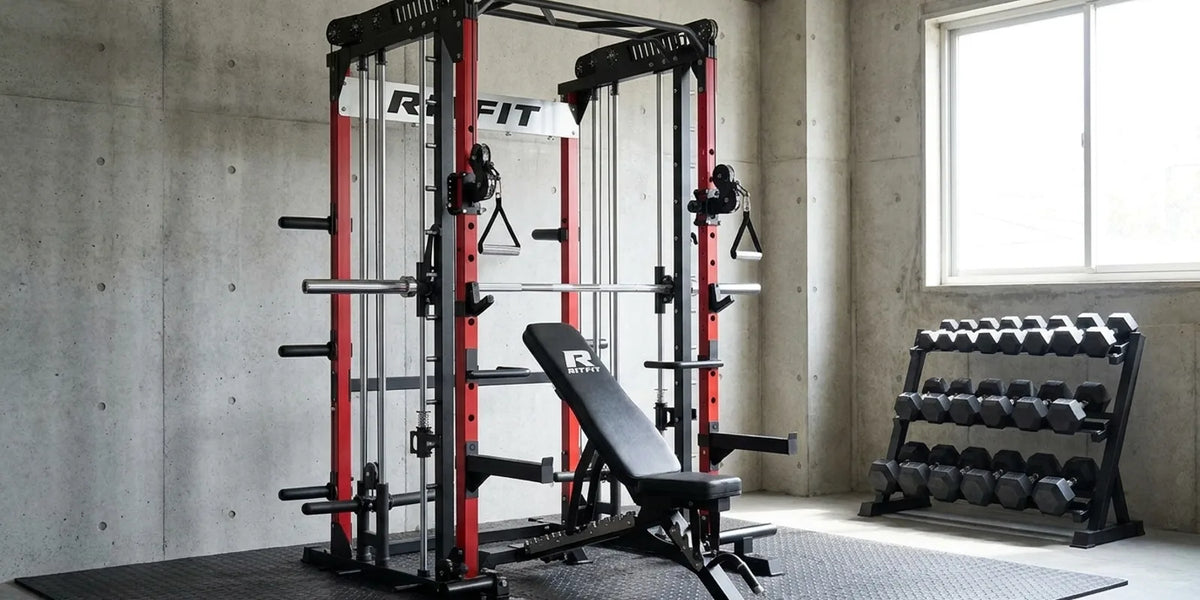
The sumo squat with a smith machine pairs a wide, toes-out stance with a guided bar path, letting you push the hips, glutes, and inner thighs hard without balancing a free bar. Getting it right comes down to stance width, foot angle, and bar height.
This guide shows how to set up the machine, find your stance, and run each rep on the fixed track, then covers common sumo squat form mistakes, loading, and the pain signals that mean stop.
Quick Answer: A sumo squat with a smith machine is done by setting the bar at mid-chest height, standing with heels outside shoulder width and toes turned out, and hinging at the hips until the thighs reach parallel while the bar travels on its fixed path. Wider stances shift more of the work toward the hips and posterior chain.
Key Takeaways
- Setup first: Set the bar around mid-chest height, lock the safety stops below your depth, and measure the stance against the guide rod clearance before any plates go on.
- Stance width: Heels just outside shoulder width with the toes turned out keeps the knees tracking over the toes on the way down.
- Muscle focus: The wide stance squat shifts mechanical demand toward the hip extensors and posterior chain, which is where the inner thigh and glute focus comes from.
- Form standard: Clean sumo squat form means planted heels, a neutral spine, and every rep looking the same through a full range of motion.
- Progression: Add weight only after every rep looks the same, and stop for sharp groin, hip, or knee pain.
Set Up the Smith Machine for a Wide Stance
Good setup starts before the first rep: bar height, safety stops, and foot clearance decide whether a wide stance fits the machine at all. Set the hooks at about the middle of your chest and set the stops one or two holes below your lowest planned rep.
- Bar height: Unrack with the hooks at mid-chest so you can stand tall without pressing the bar up first.
- Safety stops: Set the stops just below the deepest rep so a failed set lands on steel instead of on you.
- Stance check: Take your widest comfortable stance and confirm the whole foot stays on the platform with room around the guide rods.
Take the stance test before any weight goes on, because a wide stance that clips the guide rods will not get better under load. If you are still choosing a machine, the Smith machine lineup is the right place to compare frames, and machines like the Multifunctional Smith Machine and the M3 power rack cable crossover Smith machine are worth measuring the same way before you buy.
Choose the RitFit M1 PRO If You Squat Wide
Your heels and the outside edges of the feet must stay clear of the guide rods and uprights at the bottom of every rep, and different frames put that open space in different places. If one machine has to serve the whole household's training, an all-in-one frame like the RitFit M1 Multi-Functional Home Gym Smith Machine covers sumo squats, presses, and pulls in one footprint, so measure before you lock in a stance width.
- Measure, do not guess: A worked example is a heel-to-heel stance of around 24 inches against around 26 inches of inside clearance, and your machine's numbers will differ.
- Widen gradually: Move the heels out an inch at a time and keep the outside edge of each foot on the platform.
"Packages arrived within 4 days of ordering, very well packaged and boxes to protect during shipping. Instructions were very clear and well laid out. Putting the set together was very easy and quality control was very good as haven't had any defects."
Stephen R. Verified Buyer, RitFit Pro Strength System
Find Your Sumo Squat Stance Width
A sumo squat stance width starts just outside shoulder width and widens until the knees can track over the toes while the heels stay heavy on the platform. Foot angle and stance width work together, so adjust them as a pair instead of chasing one fixed number.
Foot angle matters as much as width: a 3D motion analysis of 21 novice and 21 experienced squatters found that stance width and foot placement angles of 0, 21, and 42 degrees all changed the hip and knee joint moments, and it flagged the extreme pairing of a wide stance with feet pointed straight ahead as one to handle with special care.[1]
A multi-experiment study of 70 and 20 lifters squatting at 70% of 1RM found that wide stances up to about 1.5 times greater trochanter width significantly enhanced posterior-chain muscle forces, while narrow stances raised quadriceps forces and peak power.[2] Scale the sumo squat stance width to your own hip structure, and the same setup carries over to the Smith machine squat form guide for the base pattern.
- Heel width: Start with the heels just outside shoulder width and widen an inch at a time until the hips feel loaded and the knees stay in line.
- Toe angle: Turn the toes out with the stance, and never run a wide stance with the feet pointed straight ahead.
- Foot pressure: Keep the whole foot planted, because lifting the heels turns the movement into a different exercise.
| Stance width | Foot angle | What the load favors | What to watch |
|---|---|---|---|
| Narrow | Toes forward or slightly out | Quadriceps force and peak power | Knees travel further forward |
| Hip width | Toes slightly out | Balanced hip and knee demand | General squat mechanics |
| Wide, sumo | Toes noticeably out | Hip extensors and posterior chain | Feet must clear the guide rods |
Foot angle and stance width effects summarized from the stance width experiments cited above, and the table is a decision aid rather than a ranking of squat variations.
Unrack, Hip Hinge, and Control Your Depth on the Fixed Bar Path
A smith machine sumo squat runs on a fixed vertical path, so the frame does the balancing while you own the hip hinge and the depth. Unrack with the hooks turned clear, sit the hips back and down, and stop the descent when the thighs reach parallel or the form starts to change.
- Step 1: Set your feet, brace your ribs over your pelvis, and stand tall with the bar across your upper back.
- Step 2: Turn the hooks clear of the uprights and let the bar settle before the first descent.
- Step 3: Hinge at the hips and bend the knees together, tracking the knees over the toes as the hips sit back.
- Step 4: Descend until the thighs reach parallel or the heels start to lighten, then drive the floor away and exhale at the top.
The guided path removes the forward and backward drift of a free bar, so every rep stays in the same groove and you can work a full range of motion without a spotter.
Next, I do Smith machine squats for the quads and glutes. Here I get as deep as I can and explode out of the hole. Doing these on the Smith allows me to push my last set to failure without worrying about dumping the bar.
Jeff Nippard, Science-Based Natural Bodybuilder and Powerlifter, JeffNippard.com, Jeff Nippard's Science-Backed Leg Workout for Massive Quads (Men's Health UK)
Target the Inner Thighs and Glutes
The wide stance and toes-out position create the inner thigh and glute focus of this lift, because the hips carry a larger share of the total moment. Adductors and gluteus maximus drive the hips back to standing while the quadriceps finish the lockout.
In an EMG study of 18 lifters, nine men and nine women squatting heavy for three reps, a wide stance shifted total moment contribution toward the hip extensors, while a narrow stance showed higher vastus lateralis and lower gluteus maximus activity.[3]
That mechanic is what lifters mean by the wide stance squat emphasis, and it is why the sumo stance earns its place in a lower-body session built around hip work.
- Gluteus maximus and hip extensors: The hips take a larger share of the load as the stance widens.
- Adductors: The inner thigh muscles hold the knees out over the toes in the bottom position.
- Quadriceps: The front of the thigh still finishes every rep, with a smaller share than a narrow stance.
Avoid These Common Mistakes in Sumo Squat Form
Most sumo squat form problems come from the stance and the foot pressure, not from the machine. The fixes below keep the knees, hips, and guide rods working together instead of against each other.
- Feet straight ahead: A wide stance with the toes pointed straight ahead puts the knees and hips in extreme positions, so turn the toes out with the stance.
- Knees collapsing inward: Drive the knees out over the toes through the whole range of motion.
- Heels lifting: Keep the weight through the mid-foot and heels, and narrow the stance if the heels float.
- Feet crowding the guide rods: Reset the stance width instead of fighting the frame at the bottom of every rep.
- Bouncing off the stops: The safety stops are a safety net, not part of the rep.
Choose Weight, Sets, and Reps
Start with an empty bar or a light load and keep most working sets in the six to twelve rep range. The fixed path rewards clean reps more than heavy ones, so choose a weight you can move for every planned rep with the same depth and tempo.
Loading the lift is simple: two to four sets of six to twelve reps, two or three minutes of rest, and weight that leaves one or two clean reps in reserve.
When to Add Weight
Add a small jump, around five pounds, only after every set in the session looks the same as the first. If the last reps slow down or the depth shortens, keep the weight and rebuild the reps.
Progress, Swap, or Stop
Run the smith machine sumo squat once or twice a week inside a lower-body session and judge progress by rep quality before load. Swap the movement when the hips need a break, and stop the set the moment sharp pain shows up.
Progress the Lift Over Time
The pattern adapts fastest when the stance, foot angle, and bar height stay fixed while only the load moves. Track the working sets week to week and add a rep before adding a plate.
Swap the Movement When You Need To
When the hips or groin feel beat up, trade the bar pattern for a machine that keeps the load off the lower back, like a leg press or a hack squat.
- Leg press and hack squat: The 3-in-1 leg press and hack squat machine keeps the quads and glutes working with the spine supported.
- Heavier variations: The Gazelle Pro leg press and hack squat machine covers the same swap for lifters who want another option.
- Free-weight option: A dumbbell goblet sumo squat keeps the wide stance while removing the fixed path.
When to Stop for Pain
Stop the set immediately for sharp pain in the groin, hip, or knee, or for any pinched feeling that does not fade with rest. Muscle soreness is normal, but joint pain is a boundary, and a qualified professional should clear the movement before you load it again.
FAQs About Sumo Squats on a Smith Machine
How wide should your stance be for a smith machine sumo squat?
Start with your heels just outside shoulder width and your toes turned out, then adjust until your knees track over your toes at the bottom. Your feet should stay clear of the guide rods, and the sumo squat stance width should match your hip structure rather than a fixed number.
What foot position should you use for a sumo squat with a smith machine?
Turn your toes out comfortably, usually somewhere between slightly and noticeably outward, and keep your whole foot planted through the rep. A wide stance with the feet pointed straight ahead creates large knee and hip joint moments, so pair the wide stance with a toe angle that keeps your knees aligned over your toes.
Does a smith machine sumo squat train the inner thighs and glutes?
Yes. The wide stance and toes-out position bring the inner thigh and glute focus that lifters look for, and wider-stance squatting shifts more of the mechanical demand toward the hip extensors and posterior chain. Narrower stances load the quadriceps harder, so keep the stance wide when the goal is hip and inner thigh work.
How deep should you go on a wide stance squat on a smith machine?
Descend until your thighs reach at least parallel to the floor, or to the depth where you can hold a neutral spine and keep your heels down. The fixed bar path lets you sit back into the hip hinge safely, so stop the descent when your form breaks instead of chasing depth you cannot control.
What weight should you start with for a sumo squat on a smith machine?
Start with an empty bar or a light load and run two sets of eight to twelve controlled reps while the stance and bar path feel new. Add a small amount of weight only after every rep looks the same, and keep most working sets in the six to twelve rep range.
When should you stop a sumo squat because of pain?
Stop the set immediately if you feel sharp pain in the groin, hip, or knee, or if the joints feel pinched rather than worked. Sore muscles during and after training are normal, but sharp or lingering joint pain is a signal to rest and talk with a qualified professional before loading the pattern again.
Conclusion
The sumo squat with a smith machine rewards setup over effort: measure the stance against the guide rods, turn the toes out, and own the depth before the load. Clean reps and small jumps do the rest.
Start with the empty bar, film the first sessions, and when the stance feels solid, use the RitFit discount guide to plan the rest of a home gym around the M1 Smith machine home gym package or the PSR05 Smith machine package.
Disclaimer
This content is general training information and is not medical advice or a rehabilitation program. Stop exercising and consult a qualified healthcare professional before training again if you have an injury, joint pain, or a medical condition.
References
1. Lorenzetti S, Ostermann M, Zeidler F, et al. How to squat? Effects of various stance widths, foot placement angles and level of experience on knee, hip and trunk motion and loading. BMC Sports Sci Med Rehabil. 2018;10:14. doi:10.1186/s13102-018-0103-7. PMCID: PMC6050697
2. Sinclair J, Taylor PJ, Jones B, Butters B, Bentley I, Edmundson CJ. A Multi-Experiment Investigation of the Effects Stance Width on the Biomechanics of the Barbell Squat. Sports (Basel). 2022;10(9). doi:10.3390/sports10090136. PMCID: PMC9503729
3. Larsen S, Kristiansen E, Helms E, van den Tillaar R. Effects of Stance Width and Barbell Placement on Kinematics, Kinetics, and Myoelectric Activity in Back Squats. Front Sports Act Living. 2021;3:719013. doi:10.3389/fspor.2021.719013. PMCID: PMC8440835





