








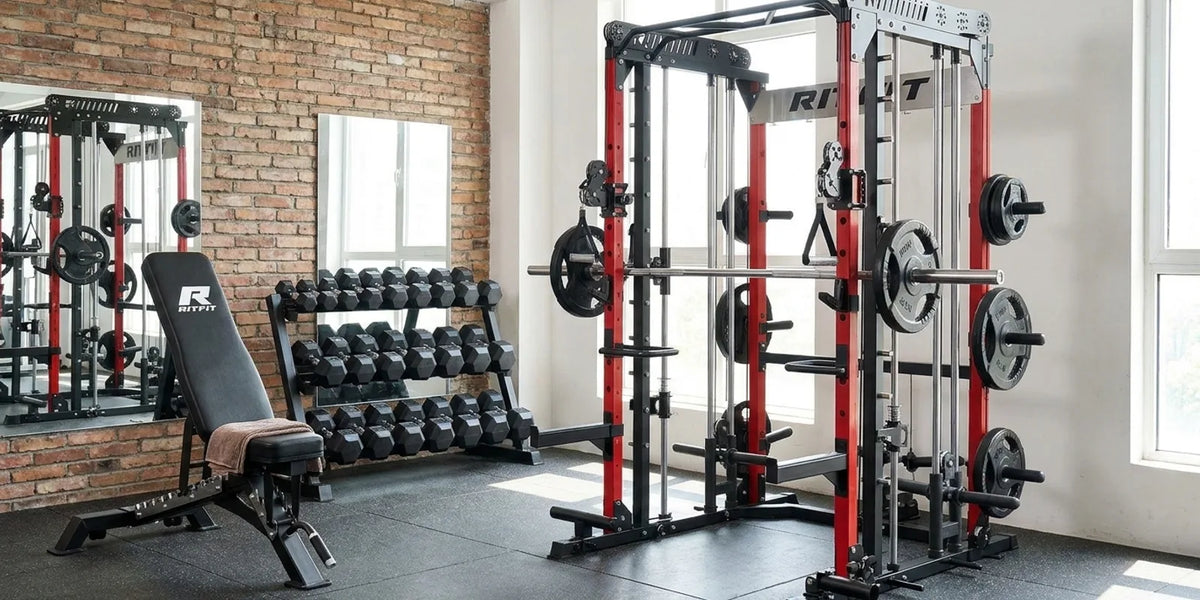
Tempo squats on a Smith machine are slow, deliberately timed squats where you control the descent, the bottom, and the stand instead of just moving the bar. The fixed rail removes the balance problem, so the drill is easier to repeat on a machine than most lifters assume.
This guide covers the tempo notation, the exact setup, how much load to take off, and how tempo squatting differs from pause squatting.
Quick Answer: Tempo squats on a Smith machine work by timing each phase of the lift, usually written as a three digit count like 3-1-1 or 4-2-1. The fixed bar path makes a slow, steady descent easier to repeat, so the main adjustment is dropping the load and counting every rep out loud.
Key Takeaways
- Tempo is a timing rule, not a machine: a tempo squat can be performed on a Smith machine because the count defines the drill, not the equipment.
- The count reads eccentric first: 3-1-1 means a three second descent, a one second bottom pause, and a one second stand.
- The rail is an advantage: a fixed bar path removes the balance demand, so a slow descent stays vertical and repeatable.
- Take load off the bar: slower tempos require a lighter external load, and most lifters start near 60 to 70 percent of their normal squat weight.
- Tempo and pause squat are different drills: tempo times the whole repetition, while a pause squat keeps normal speed and adds a dead stop at the bottom.
What Is a Tempo Squat and How Is the Tempo Written?
A tempo squat is a back squat where you time the eccentric, the pause, and the concentric phase of every repetition instead of moving at whatever speed feels natural. Coaches write that timing as a three or four digit sequence such as 3-1-1, where each number is a count in seconds. A review of movement tempo research concluded that pairing a slower eccentric with a faster concentric is the most favorable combination for muscle growth[1].
- First digit, the eccentric: the seconds you spend lowering the bar to the bottom position.
- Second digit, the bottom pause: a short isometric pause with no bounce off the calves.
- Third digit, the concentric: the seconds you spend standing the bar back up to full hip extension.
- Fourth digit, when it appears: the pause at the top, which most squat tempos leave at zero.
The three tempos worth memorizing are 3-1-1 for general strength work, 4-2-1 when you want a harder bottom position, and 2-0-1 as an entry point if you have never counted a rep before. Longer is not automatically better, and extremely slow repetitions are generally no more effective for growth, and can be less effective, than moderate ones.
Use the count as the training target and the rep number as a consequence, because a set that starts at a three second descent and finishes at a one second descent has already stopped being a tempo squat.
Can You Do Tempo Squats on a Smith Machine?
Yes, a tempo squat can be performed on a Smith machine because tempo is a timing rule, not a piece of equipment requirement. The fixed rail holds the bar on a vertical path, which removes the balance and bar drift problems that make a slow descent hard to control with free weights. That makes the machine a practical place to learn tempo rather than a compromise.
- The bar path is locked: the sleeve travels on linear bearings inside the rail, so the bar only moves up and down.
- Balance stops competing with timing: you can spend your attention on the count instead of on keeping the bar over midfoot.
- The safeties catch a failed rep: if the tempo collapses on the last rep, you can set the bar on the catches instead of dumping it.
- Setup is repeatable: the same hook height and stance width every session makes one tempo rep directly comparable to the next.
The tradeoff is that the machine removes some stabilizer demand, so a Smith machine tempo squat complements a free-weight squat rather than replacing it. If you have the ceiling height and the rack for both, train both and let the Smith machine carry the slow, high time under tension work.
The machine also removes the excuse that a slow rep is too unstable to hold, which is why lifters who struggle to keep a barbell tempo find the rack-based version easier to learn. Browse the Smith machine lineup if you are starting a garage setup from nothing.
"Next, I do Smith machine squats for the quads and glutes. Here I get as deep as I can and explode out of the hole. Doing these on the Smith allows me to push my last set to failure without worrying about dumping the bar."
Jeff Nippard, Science-Based Natural Bodybuilder and Powerlifter, JeffNippard.com, Jeff Nippard's Science-Backed Leg Workout for Massive Quads
How to Do Tempo Squats on a Smith Machine Step by Step
Learning a tempo squat on a Smith machine takes five setup steps, and the count is the last one. Set the bar height, set your stance, brace, unrack, then descend on the count you picked rather than on feel.
Step 1: Set the Bar Height and the Safety Catches
Set the hooks so the bar sits at roughly mid-chest height when you are standing under it, and set the safety catches one notch below your lowest controlled bottom position.
Step 2: Set Your Stance and Foot Position
Stand with your feet shoulder width apart and walk them forward so your midfoot sits just behind the bar, which keeps the rail path lined up with your center of mass.
Step 3: Brace and Unrack
Take a full breath into your belly, brace against it, and rotate the bar off the hooks with your feet already in place so you are not searching for your stance mid-rep.
Step 4: Count the Tempo
Count the descend, pause, and stand out loud or against a metronome, and keep the number of seconds identical on the first rep and the last rep of the set.
Step 5: Rack the Bar When the Count Breaks
Re-rack as soon as you cannot hold the count with control, because a rep that finishes faster than it started trains a different habit than the one you are trying to build.
If you have never squatted on a rail before, spend one session on Smith machine squat technique before you add the count, and use a multifunctional Smith machine so the same uprights cover your squat and your accessory work.
Tempo Squat vs Pause Squat: What Is the Difference?
A tempo squat controls speed across the whole repetition, while a pause squat controls only the stop at the bottom. In a tempo squat every phase is timed from the first inch of the descent to the last inch of the stand. In a pause squat you descend at normal speed, sit still for a set number of seconds, then stand.
- Variable being controlled: a tempo squat manipulates speed and time under tension, while a pause squat manipulates the stretch reflex.
- Where the tension sits: tempo spreads tension across the full range of motion, and a pause concentrates it in the bottom position.
- How the count reads: tempo is written as a full sequence like 3-1-1, and a pause squat is written like 2-3-1 with the middle digit doing the work.
- Which one to pick: choose tempo when you want eccentric control and time under tension, and choose a pause when you want to own the bottom position.
Both drills reduce the load you can handle, and both suit a Smith machine for the same reason, which is that the rail keeps the bar stable while you think about the clock. If you run both in one block, put them on different days so the recovery demand does not stack.
How Heavy Should You Go for Tempo Squats?
Take load off when you add a tempo, because a slow eccentric phase is a much harder stimulus than the fast rep you are used to. In a 7 week squat study, 18 participants trained at 60 to 70 percent of 1RM with either a 4 second or a 1 second eccentric, and the slow eccentric group gained more 1RM strength and greater vastus lateralis size[2]. A practical starting point is 60 to 70 percent of the weight you would use for the same rep range without a tempo.
- The effect size was measurable: the slow eccentric group posted a hypertrophy effect size of 1.74 for the vastus lateralis against 1.37 for the fast tempo group.
- Intensity stayed constant: both groups trained at the same relative load, so tempo was the variable that changed and not weight.
- Rest stayed constant: 3 to 4 sets with 120 seconds of rest held for both groups across the whole block.
- The window is wide: anything from 4 to 8 seconds of descent counts as a real tempo, and the extreme end is not where the extra benefit lives.
Start with the rep range you already use and cut the weight until you can hold the count on every rep, because a load you cannot slow down is a load you are not ready to tempo. If the final rep is faster than the first, the weight is still too heavy.
Which Tempo Squat Variations and Substitutions Work Best?
Tempo squat variations change one digit or one setup detail at a time, and substitutions swap the machine while keeping the same count. Keep the tempo fixed and change the stance, the depth, or the equipment, but never all three in one block.
- Front-rack tempo squat: a 3-1-1 count with the bar on the front delts shifts the demand toward the quadriceps and forces a more upright torso.
- Wide-stance tempo squat: the same count with the feet turned out and set wider, which changes where the bottom position loads.
- Tempo box squat: a 4-2-1 count down to a box teaches an honest squat depth before you take the box away.
- Machine substitutions: keep a 3-1-1 count on the 3 in 1 leg press and hack squat machine, or use a slower cadence on the Gazelle Pro 3 in 1 leg press and hack squat machine when your lower back needs a break from axial loading.
Change one variable per training block so you can tell which change produced the result, because swapping stance and count at once leaves you guessing.
How Often Should You Train Tempo Squats and When Should You Add Weight?
Train tempo squats once or twice a week and add weight only when you hold the count on every rep of every set. A study of 10 trained men found volitional tempo produced a longer time under tension, 0.84 seconds against 0.67 seconds at maximal tempo, with lower peak bar velocity[3]. That extra time is the reason a tempo set costs more than a normal set at the same load.
- Once a week is enough for most lifters: use it as the main squat variation, or as a lighter back-off after a heavy free-weight squat.
- Rep range: 4 to 6 reps per set at a 3-1-1 tempo, or 3 to 5 reps at a 4-2-1 tempo, which keeps time under tension high without turning the set into a grind.
- Progression rule: add load only after every rep of every set holds the count, then add the smallest increment your plates allow.
- Progressive overload still applies: tempo is a tool inside a normal program, not a replacement for adding weight over time.
- Deload signal: if the cadence speeds up without you deciding to speed it up, cut the load rather than the tempo.
Use a M1 Smith machine home gym package if you want the squat rail and the accessory stations arriving together, since a tempo block still needs rows and pulldowns to balance the session.
Does the RitFit M1 PRO Smith Machine Work for Tempo Squats?
Yes, the M1 PRO Smith machine works for tempo squats because its rail keeps the bar on a fixed vertical path, which is what a counted descent needs. The RitFit M1 multi functional home gym Smith machine pairs that rail with a squat rack and a cable crossover, so a tempo block and the accessory work after it share one footprint.
- Guided bar path: the sleeve rides a linear bearing inside the rail, so a 4 second descent stays vertical during the last set of a garage session when the quadriceps are already tired.
- Adjustable safety catches: set them one notch under your bottom position and a stalled tempo rep in a low-ceiling basement ends on the catches rather than on the floor.
- Rack and cable crossover in one frame: the uprights double as a squat rack and the crossover covers pulldowns and rows, so a single-car garage gets the squat station and the accessory station without a second machine.
- Room to move inside the line: the M3 power rack cable crossover Smith machine adds a heavier frame for lifters chasing maximal loads, the Pink M1 Smith machine 2.0 offers the same platform in the Pink line, and the BPC06 all in one Smith machine package trades open floor space for an enclosed station.
For a tempo block the M1 PRO sits in the middle of the lineup, with enough rail travel for a full-depth counted rep and enough rack and cable capacity that the rest of the session does not need another machine.
"Few pieces of equipment in the home exercise industry are as comprehensive and versatile as this all-in-one gym system. The robust system provides a natural, centered bar path for compound lifts like squats, presses, and rows, and incorporates a dual cable crossover station with a full rack of precision-engineered attachments."
Tom Eskey, CF-L1, CPT, Home Gym Equipment Reviewer, Garage Gym Revisited, RitFit M1 Multi-functional Smith Machine Review
"I bought the bundle with the M1 Pro and the leg press machine. I am so glad to have a home gym in my basement where I can go and workout and not have to worry about going all the way to a gym"
Russell M. Verified Buyer, RitFit Pro Strength System
What Are the Most Common Mistakes With Tempo Squats?
The most common tempo squat mistakes are counting too fast, bouncing out of the bottom, and letting the concentric phase turn into a grind. Each one removes the timing that makes the drill worth doing in the first place.
- Rushing the count: a three second descent that actually takes one second is a normal squat with extra steps.
- Bouncing at the bottom: a loaded bounce replaces the isometric control you came for and hides a squat depth you have not actually reached.
- Chasing the rep number: holding a rep target after the count breaks trains fatigue tolerance, not control.
- Adding weight too early: if the load goes up before the count holds, you are squatting heavier and slower rather than running a tempo.
Stop the set when two consecutive reps break the count, and end the session if you feel sharp knee or lower back pain rather than muscular fatigue. A broken tempo is a programming signal, not a test of character.
FAQs About Tempo Squats on a Smith Machine
How do you count tempo on a squat?
You read the tempo as three numbers that match the eccentric, pause, and concentric phases. A 3-1-1 tempo means a three second descent, a one second pause, and a one second stand. Count out loud or use a metronome so the rhythm stays honest.
Can you do tempo squats on a Smith machine?
Yes. Tempo squats work on a Smith machine because the fixed bar path removes the balance demand, letting you slow the descent without the bar drifting. Set the safeties, pick a load lighter than your normal squat, and count the tempo out loud. The rails guide the bar while your quads control the speed.
What is the difference between a tempo squat and a pause squat?
A tempo squat slows the whole repetition, so every inch of the descent and ascent is timed. A pause squat keeps normal speed but adds a dead stop at the bottom. Tempo builds control through the full range, while pausing removes the stretch reflex and makes the bottom position harder.
How heavy should tempo squats be?
Start around 60 to 70 percent of your normal squat working weight and expect to drop the load compared with regular squats. Slower reps mean more time under tension, so the same weight feels heavier. Increase only when you hold the tempo for every rep of every set.
How many tempo squats should you do per set?
Most lifters use three to four sets of four to six reps with a three to one to one tempo. Slower reps take longer, so the rep count drops while time under tension rises. Stop the set when the tempo collapses rather than chasing the rep target.
Are tempo squats safe for beginners?
Yes, when the load stays light and the machine has working safeties. Beginners should learn the tempo with an empty bar or a fraction of their working weight first. Slow reps expose control problems early, so a coach or a mirror can help confirm depth and knee tracking.
Do tempo squats build muscle with less weight?
Yes, a slower eccentric raises time under tension, so a lighter load can still create a strong growth stimulus. A seven week squat training study reported that a four second descent produced larger strength and vastus lateralis gains than a one second descent at the same intensity.
Conclusion
Tempo squats on a Smith machine are a timing drill that the machine makes easier to learn, because the fixed rail removes the balance problem while you concentrate on the count. Pick a tempo such as 3-1-1, drop the load until every rep holds the same rhythm, and treat the count as the target for the set.
Start with one tempo session a week, keep reps at four to six, and add weight only when the count survives the last rep. New to RitFit? The RitFit discount guide covers current offers and the best entry point for a first machine.
Disclaimer
This article provides general fitness information and is not medical advice. Consult a qualified healthcare professional before starting a new training program, particularly if you have a history of knee, hip, or lower back injury.
References
1. Wilk M, Zajac A, Tufano JJ. The influence of movement tempo during resistance training on muscular strength and hypertrophy responses: a review. Sports Med. 2021;51(8):1629-1650. doi:10.1007/s40279-021-01465-2. PMCID: PMC8310485
2. Kojic F, Mandic D, Duric S. The effects of eccentric phase tempo in squats on hypertrophy, strength, and contractile properties of the quadriceps femoris muscle. Front Physiol. 2024;15:1531926. doi:10.3389/fphys.2024.1531926. PMCID: PMC11754408
3. Trybulski R, Gepfert M, Gawel D, et al. Impact of movement tempo on bar velocity and time under tension in resistance exercises with different external loads. Biol Sport. 2022;39(3):547-554. doi:10.5114/biolsport.2022.106160. PMCID: PMC9331330





