Best quad exercises for strength and muscle growth build all four quadriceps heads through a mix of heavy knee dominant lifts and controlled targeted work. This guide covers the top compound and isolation moves, how to program sets and reps, and the equipment you need to train at home.
You will learn which exercises bias the inner quad and VMO, how often to train, and how to avoid common technique mistakes. The information is general fitness guidance, not medical advice, so adjust any movement that causes sharp knee pain.
Quick Answer: The best quad exercises for strength and muscle growth combine heavy knee dominant compounds like the front squat, leg press, and Bulgarian split squat with targeted moves such as leg extensions and terminal knee extensions. Train quads two to three times per week with controlled depth, stable knee tracking, and progressive overload.
Key Takeaways
- Compound lifts come first: Front squats, leg presses, heel elevated squats, and split squats should form the base of any quad building program.
- Targeted work finishes the session: Terminal knee extensions, leg extensions, and controlled wall sits reinforce end range quad control.
- You cannot fully isolate the VMO: Exercise setup can bias the inner quad, but the quadriceps always work together during knee extension.
- Controlled depth and load win: Deep, pain free knee flexion with progressive load builds more strength and size than heavy partial reps.
- Pain is not the goal: Quad training should feel like muscular effort, not sharp kneecap pain, swelling, locking, or instability.
What Are the Best Quad Exercises for Strength and Muscle Growth?
The best quad exercises for strength and muscle growth pair heavy knee dominant compounds with targeted isolation moves so all four quadriceps heads are trained. Front squats, leg presses, Bulgarian split squats, and leg extensions cover the loading and range of motion that drive quad strength and size.
The quadriceps include the rectus femoris, vastus lateralis, vastus intermedius, and vastus medialis. These muscles share the job of knee extension and work together during squats, lunges, leg presses, and step based movements.
Why the Inner Quad Matters
A stronger inner quad area may support better knee control during loaded lower body exercises. Patellofemoral pain is commonly managed with conservative care, activity modification, and physical therapy based strengthening when appropriate.[1]
Common Signs of Poor Quad Control
Poor quad control often appears as shaky knees, uneven leg drive, limited squat depth, or discomfort during stairs and lunges. These signs can come from many causes, so they should not be blamed on the VMO alone.
For a complete lower body plan, pair quad work with these leg exercises for size and strength.
Can You Really Target the Inner Quad and VMO?
You cannot fully isolate the VMO, but the right exercise setup can bias more effort toward the inner quad area. Controlled range of motion, stable knee tracking, and progressive strength work matter more than chasing one muscle feeling.
The VMO can be emphasized in some exercise setups, but it does not work alone. Research on sling based exercises in people with patellofemoral pain found differences in VMO and vastus lateralis activation across exercise types, which supports exercise selection rather than absolute isolation.[2]
Biasing means choosing exercises that make the quads work hard while keeping the knee moving smoothly. This often includes deep controlled squats, narrow stance leg presses, terminal knee extensions, and split squat variations.
Foot Position and Toe Angle
A slight toe out position may help some lifters feel smoother knee tracking during closed chain exercises. External rotation may affect the VMO to vastus lateralis activity ratio, but it is not a guaranteed isolation method.[3]
What Are the Best Compound Quad Exercises for Strength?
The best compound quad exercises for strength are the front squat, high bar back squat, heel elevated squat, leg press, and Bulgarian split squat. These lifts allow heavier loading and functional knee control that builds the whole quadriceps.
1. Front Squat
The front squat is one of the best quad focused barbell exercises because the upright torso encourages more knee flexion. Use a controlled depth and keep your elbows high to avoid turning the lift into a hip dominant squat.
- Best for: Building heavy quad strength with a vertical torso.
- How to do it: Hold the bar across the front shoulders, brace the core, and squat down with the knees tracking over the toes.
- Form tip: Use a depth that keeps your heels grounded and your knees stable.
- Suggested sets: Perform 3 to 4 sets of 6 to 10 reps.
2. High Bar Back Squat
The high bar back squat shifts more emphasis toward the quads than a low bar squat for many lifters. A slightly narrower stance and controlled forward knee travel can make it more useful for quad focused training.
- Best for: Building total leg strength with strong quad involvement.
- How to do it: Place the bar high on the upper traps, brace, and squat with the torso as upright as your anatomy allows.
- Form tip: Keep pressure through the whole foot instead of letting the heels lift.
- Suggested sets: Perform 3 to 5 sets of 5 to 8 reps.
3. Heel Elevated Squat
The heel elevated squat increases knee travel and can make the quads work harder through a deep range. It is useful for lifters who want quad focus with dumbbells, a barbell, or a Smith machine.
- Best for: Quad focused depth and controlled knee flexion.
- How to do it: Elevate your heels on a wedge or stable plates, keep your torso tall, and squat down under control.
- Form tip: Do not bounce at the bottom or force range that causes kneecap pain.
- Suggested sets: Perform 3 to 4 sets of 8 to 15 reps.
4. Leg Press
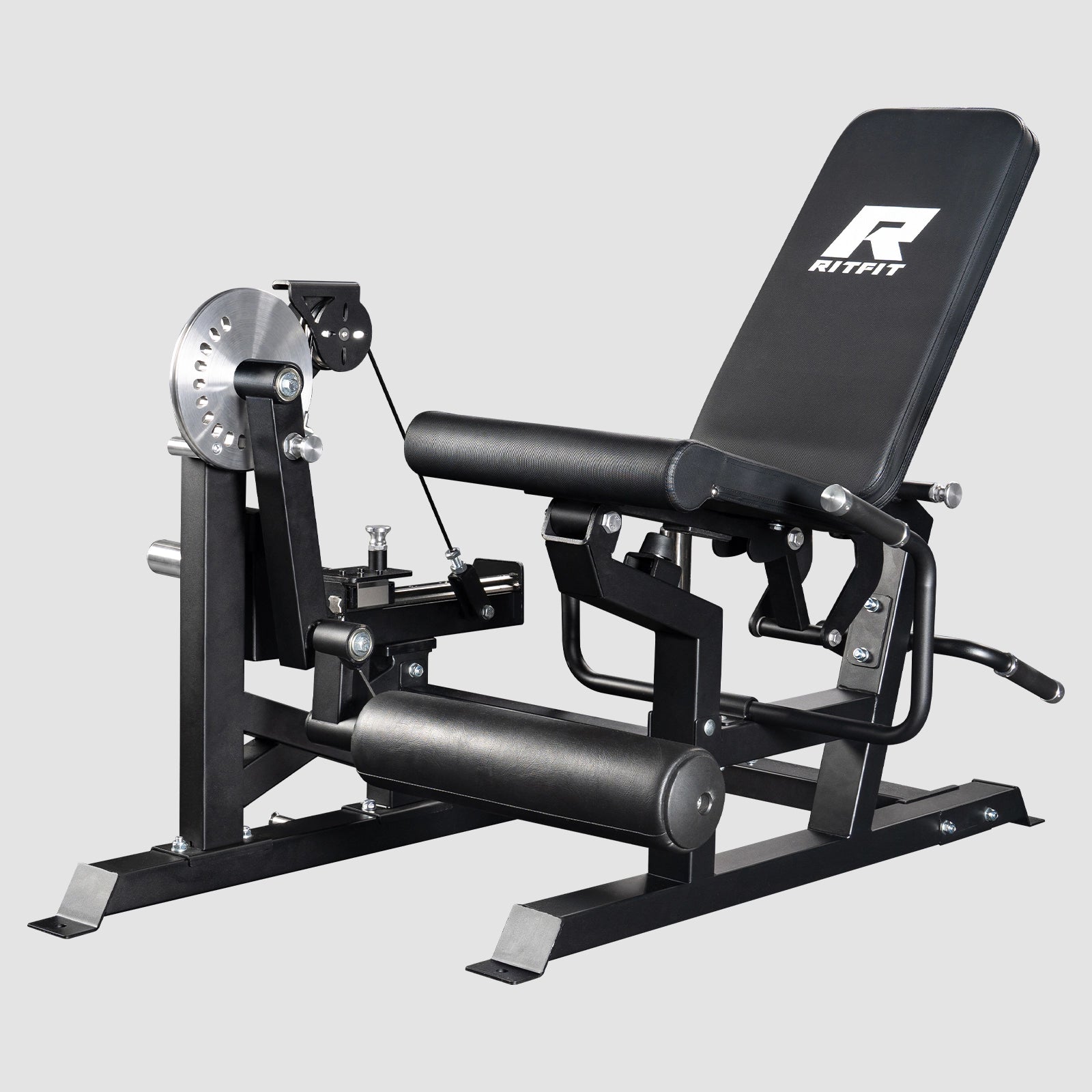
The leg press is useful for loading the quads with more external support than a free weight squat. A machine such as the RitFit GAZELLE PRO leg press and hack squat machine lets home gym users train quad focused presses and hack squat patterns in one setup.
- Best for: Quad overload with back support.
- How to do it: Place your feet slightly lower on the platform, keep the knees tracking with the toes, and press smoothly.
- Form tip: Avoid locking hard at the top or rounding the lower back at the bottom.
- Suggested sets: Perform 3 to 4 sets of 10 to 15 reps.
5. Bulgarian Split Squat
The Bulgarian split squat helps correct left to right strength differences while loading the front leg heavily. Keep the torso upright and allow the front knee to travel forward only as far as you can control.
- Best for: Single leg quad strength and knee control.
- How to do it: Place the rear foot on a bench, lower slowly, and drive through the front foot to stand.
- Form tip: Use a shorter stride if you want more quad emphasis.
- Suggested sets: Perform 3 sets of 8 to 12 reps per leg.
| Exercise | Best For | Suggested Reps | Equipment | Difficulty |
|---|---|---|---|---|
| Heel Elevated Goblet Squat | Beginner quad focus | 10-15 | Dumbbell and wedge | Beginner |
| Front Squat | Heavy quad strength | 6-10 | Barbell | Intermediate |
| Leg Press | Quad overload with support | 10-15 | Leg press machine | Beginner to intermediate |
| Bulgarian Split Squat | Single leg control | 8-12 per leg | Bench and dumbbells | Intermediate |
Choose one heavy compound lift first, then add one or two targeted accessories based on your training level and available equipment.
"There's no better machine for the quads. The tilted foot plate promotes normal biomechanics at the knee and hip."
Jeff Cavaliere, MSPT, CSCS, Physical Therapist and Strength Coach, former Head Physical Therapist for the NY Mets, Athlean-X
What Are the Best Targeted Quad Exercises for Muscle Growth?
The best targeted quad exercises are terminal knee extensions, leg extensions, sissy squats, and wall sits. These moves reinforce smooth knee extension and build muscular endurance after heavier compound work.
1. Terminal Knee Extension
Terminal knee extensions help train the final portion of knee extension with a strong quad squeeze. Attach a band behind the knee, step back for tension, then straighten the knee slowly.
- Best for: End range quad control and warm up activation.
- How to do it: Anchor a band behind the knee, bend slightly, then extend the knee while squeezing the quad.
- Form tip: Keep the movement small and controlled instead of snapping the knee back.
- Suggested sets: Perform 2 to 4 sets of 15 to 25 reps per leg.
2. Leg Extension
The leg extension trains knee extension directly and works well with light to moderate control. A slight toe out position may feel natural for some lifters, but pain free movement matters more than foot angle.
- Best for: Direct quad tension and controlled peak contraction.
- How to do it: Extend the knees smoothly, pause at the top, and lower slowly.
- Form tip: Avoid kicking the pad or using momentum.
- Suggested sets: Perform 3 sets of 12 to 20 reps.
3. Sissy Squat
The sissy squat is a demanding quad exercise that creates high knee flexion and strong anterior thigh tension. Use assistance first and avoid this movement if it causes sharp knee pain.
- Best for: Advanced quad focused bodyweight training.
- How to do it: Hold support, keep the hips extended, bend the knees forward, and return under control.
- Form tip: Start with a short range before attempting deeper reps.
- Suggested sets: Perform 2 to 3 sets of 8 to 15 reps.
4. Wall Sit With Adduction Squeeze
The wall sit builds quad endurance and can improve awareness of knee position. Place a light ball or pad between the knees and squeeze gently without forcing the knees inward.
- Best for: Finisher work and beginner friendly quad endurance.
- How to do it: Sit against a wall with knees bent, feet flat, and gentle inward pressure on the ball.
- Form tip: Keep pressure even through both feet and stop before form breaks.
- Suggested sets: Perform 2 to 3 holds of 30 to 60 seconds.
5. Squat Surface and Stability
Stable surfaces are usually better for strength work because they allow cleaner loading and more repeatable technique. A study on squats across different surfaces measured vastus lateralis and VMO activity, but strength training should still prioritize safe and stable setup before instability challenges.[4]
For knee friendly support at home, these standing exercises that restore knee strength are a useful complement.
How Should You Program Sets, Reps, and Frequency for Quads?
Program quads two to three times per week with a mix of heavy compound sets and controlled targeted work. Use lower reps for strength, higher reps for muscle growth, and progress one variable at a time.
Progressive overload can come from more reps, more load, or better control. Research on progression strategies suggests that both load progression and repetition progression can support muscular adaptations over a training cycle.[5]
Weekly Volume
Start with 6 to 10 hard quad sets per week if you are new to focused leg training. More advanced lifters can add volume only when recovery, performance, and knee comfort stay stable.
Rest Periods
Use 2 to 3 minutes of rest for heavy squats and leg presses. Use 45 to 90 seconds for terminal knee extensions, leg extensions, and wall sits.
Warm Up
A good warm up should raise body temperature and prepare the ankles, hips, and knees for knee dominant movement. Use light cycling, bodyweight squats, band terminal knee extensions, and easy split squats before heavy work.
| Week | Main Goal | Progression Target | Knee Comfort Rule |
|---|---|---|---|
| Week 1 | Learn technique | Use light to moderate loads | No sharp pain |
| Week 2 | Add reps | Add 1 to 2 reps per set | Keep smooth tracking |
| Week 3 | Add load | Add a small weight increase | Keep the same depth |
| Week 4 | Improve control | Use slower lowering tempo | Stop before irritation builds |
Progress one variable at a time and reduce load, depth, or tempo if sharp knee pain appears.
What Does the Best Quad Workout Routine Look Like?
The best quad workout routine starts with one heavy compound lift, adds a single leg pattern, and finishes with one or two targeted exercises. Pick a beginner, intermediate, or home minimal equipment plan below based on your training age and gear.
Beginner Quad Workout
This beginner routine builds quad control with simple movements and moderate reps. Use it twice per week before moving into heavier barbell or machine work.
- Heel Elevated Goblet Squat: 3 sets of 10 to 12 reps.
- Supported Split Squat: 3 sets of 8 to 10 reps per leg.
- Band Terminal Knee Extension: 3 sets of 15 to 20 reps per leg.
- Wall Sit: 2 holds of 30 to 45 seconds.
Intermediate Quad Workout
This intermediate routine combines heavy quad work with single leg control and targeted finishers. Use it once or twice per week depending on your total leg training volume.
- Front Squat: 4 sets of 6 to 8 reps.
- Bulgarian Split Squat: 3 sets of 8 to 10 reps per leg.
- Leg Press: 3 sets of 10 to 15 reps.
- Leg Extension: 3 sets of 12 to 20 reps.
- Terminal Knee Extension: 2 sets of 20 reps per leg.
Home Minimal Equipment Workout
This home routine works well with dumbbells, a bench, and bands. RitFit hex rubber dumbbells and the RitFit GATOR adjustable weight bench can support goblet squats, split squats, step ups, and accessory leg work.
- Heel Elevated Dumbbell Squat: 4 sets of 12 to 15 reps.
- Short Step Reverse Lunge: 3 sets of 10 to 12 reps per leg.
- Step Up: 3 sets of 8 to 12 reps per leg.
- Band Terminal Knee Extension: 3 sets of 20 reps per leg.
What Technique Mistakes Limit Quad Growth?
The biggest quad training mistakes are forcing knee collapse, cutting reps short, bouncing at the bottom, and ignoring pain. Good reps look controlled, repeatable, and free from sharp kneecap discomfort.
- Do not force knee collapse: The knees should track in line with the toes. Letting them cave inward under load makes the movement less stable.
- Do not cut every rep short: Short partial reps may limit useful quad tension. Use as much range as you can control comfortably.
- Do not bounce at the bottom: Bouncing reduces control and may irritate sensitive knees. Lower slowly and pause briefly when needed.
- Do not use pain as proof: Sharp pain is not a sign of muscle activation. Change the exercise or reduce intensity.
- Do not neglect hips and hamstrings: Balanced leg training improves the way your lower body absorbs force. Add hip hinges, curls, and glute work across the week.
What Equipment Do You Need for Quad Training at Home?
You can train quads at home with dumbbells, resistance bands, a bench, and a stable barbell setup. A leg press or hack squat machine adds machine based loading when you want heavier quad work with more support.
Browse RitFit strength machines, the RitFit BLP01 leg press and hack squat machine, or the RitFit Smith machine collection for machine based quad loading.
Recommended Equipment Setup
A complete lower body setup should let you squat, split squat, press, hinge, and progressively load your legs. A RitFit 7FT Olympic barbell and RitFit high grade color bumper plates support barbell squats, front squats, and progressive strength work.
| Training Goal | Best Equipment | Example Exercise |
|---|---|---|
| Beginner quad control | Dumbbells and bands | Goblet squat and terminal knee extension |
| Heavy quad loading | Leg press machine | Narrow stance leg press |
| Barbell strength | Barbell and plates | Front squat |
| Single leg balance | Bench and dumbbells | Bulgarian split squat |
Match the equipment table to your training goal and available space before buying home gear.
Who Benefits Most From Quad Strengthening?
Quad strengthening benefits lifters, runners, cyclists, and anyone who wants stronger squats, better leg definition, and smoother knee control. Program it safely around your sport and training history.
- Home gym lifters: Quad work makes dumbbell squats, split squats, and machine based leg training more complete.
- Runners and cyclists: Controlled quad work supports repetitive knee extension demands, but it should not replace sport specific conditioning.
- Aesthetic lifters: The quad area contributes to the teardrop look near the knee. Growth still requires full quad training, not one isolated exercise.
- Strength athletes: Better quad strength supports squat depth, leg drive, and positional control.
FAQs About Quad Exercises for Strength and Muscle Growth
Can you really isolate the inner quad?
No. You cannot fully isolate the inner quad because the quadriceps work together during knee extension. You can bias the area with deep controlled squats, leg presses, split squats, terminal knee extensions, and smooth knee tracking that keeps the kneecap moving comfortably.
What is the best inner quad workout for beginners?
The best beginner inner quad workout starts with heel elevated goblet squats, supported split squats, and band terminal knee extensions. These exercises teach knee control, quad tension, and stable foot pressure before heavier barbell squats or machine based leg press work.
How often should you train inner quads?
Most lifters should train inner quads two to three times per week. Leave at least forty eight hours between hard quad sessions, use moderate volume at first, and progress only when your knees feel stable during squats, lunges, and extensions.
Are leg presses good for inner quad growth?
Yes. Leg presses can support inner quad growth when you use a controlled range of motion and a quad focused foot position. Keep the feet slightly lower on the platform, avoid bouncing at the bottom, and stop if the setup causes sharp kneecap discomfort.
Should your toes point out during inner quad exercises?
Not always. A slight toe out position can feel more natural for some lifters, but it is not required for every inner quad exercise. The better rule is to keep your knees tracking in the same direction as your toes through each rep.
Is knee over toe training safe for inner quad work?
Yes. Knee over toe training can be safe when the load, depth, and tempo match your ability. Start with controlled bodyweight or light resistance, keep the heel stable, and reduce the range if the movement creates sharp pain around the kneecap.
What should you do if inner quad exercises cause knee pain?
Stop the exercise and adjust the load, depth, stance, or tempo first. Inner quad training should create muscular effort, not sharp joint pain, swelling, locking, or instability. If symptoms continue, get guidance from a qualified healthcare professional.
Which equipment is best for an inner quad workout at home?
The best home equipment includes dumbbells, a stable bench, resistance bands, and a leg press or hack squat machine if space allows. Start with simple tools first, then add machines when you want heavier quad loading with more support.
Conclusion
The best quad exercises for strength and muscle growth combine heavy knee dominant compounds with targeted control work across two to three sessions per week. Train the full quadriceps, bias the inner quad with smart setup, and progress load only when your knees feel stable.
Start with the beginner routine and add volume gradually. For home training, check the RitFit sales page for deals on the barbells, plates, and machines that support quad work.
Disclaimer
This article is for general educational purposes only and is not medical advice. Consult a qualified healthcare professional before starting a new leg training program if you have knee pain, swelling, locking, instability, a recent injury, or symptoms that worsen during exercise.
References
1. McCarthy MM, Strickland SM. Patellofemoral pain: an update on diagnostic and treatment options. Curr Rev Musculoskelet Med. 2013;6(2):188-94. doi:10.1007/s12178-013-9159-x. PMCID: PMC3702777
2. Chang WD, Huang WS, Lai PT. Muscle Activation of Vastus Medialis Oblique and Vastus Lateralis in Sling-Based Exercises in Patients with Patellofemoral Pain Syndrome: A Cross-Over Study. Evid Based Complement Alternat Med. 2015;2015:740315. doi:10.1155/2015/740315. PMCID: PMC4609425
3. Miller JP, Sedory D, Croce RV. Leg rotation and vastus medialis oblique/vastus lateralis electromyogram activity ratio during closed chain kinetic exercises prescribed for patellofemoral pain. J Athl Train. 1997;32(3):216-20. PMCID: PMC1320240
4. Hyong IH, Kang JH. Activities of the Vastus Lateralis and Vastus Medialis Oblique Muscles during Squats on Different Surfaces. J Phys Ther Sci. 2013;25(8):915-7. doi:10.1589/jpts.25.915. PMCID: PMC3820212
5. Bernárdez-Vázquez R, Raya-González J, Castillo D, Beato M. Resistance Training Variables for Optimization of Muscle Hypertrophy: An Umbrella Review. Front Sports Act Living. 2022;4:949021. doi:10.3389/fspor.2022.949021. PMCID: PMC9302196