A premium home gym is built around one core strength machine, not three separate stations.
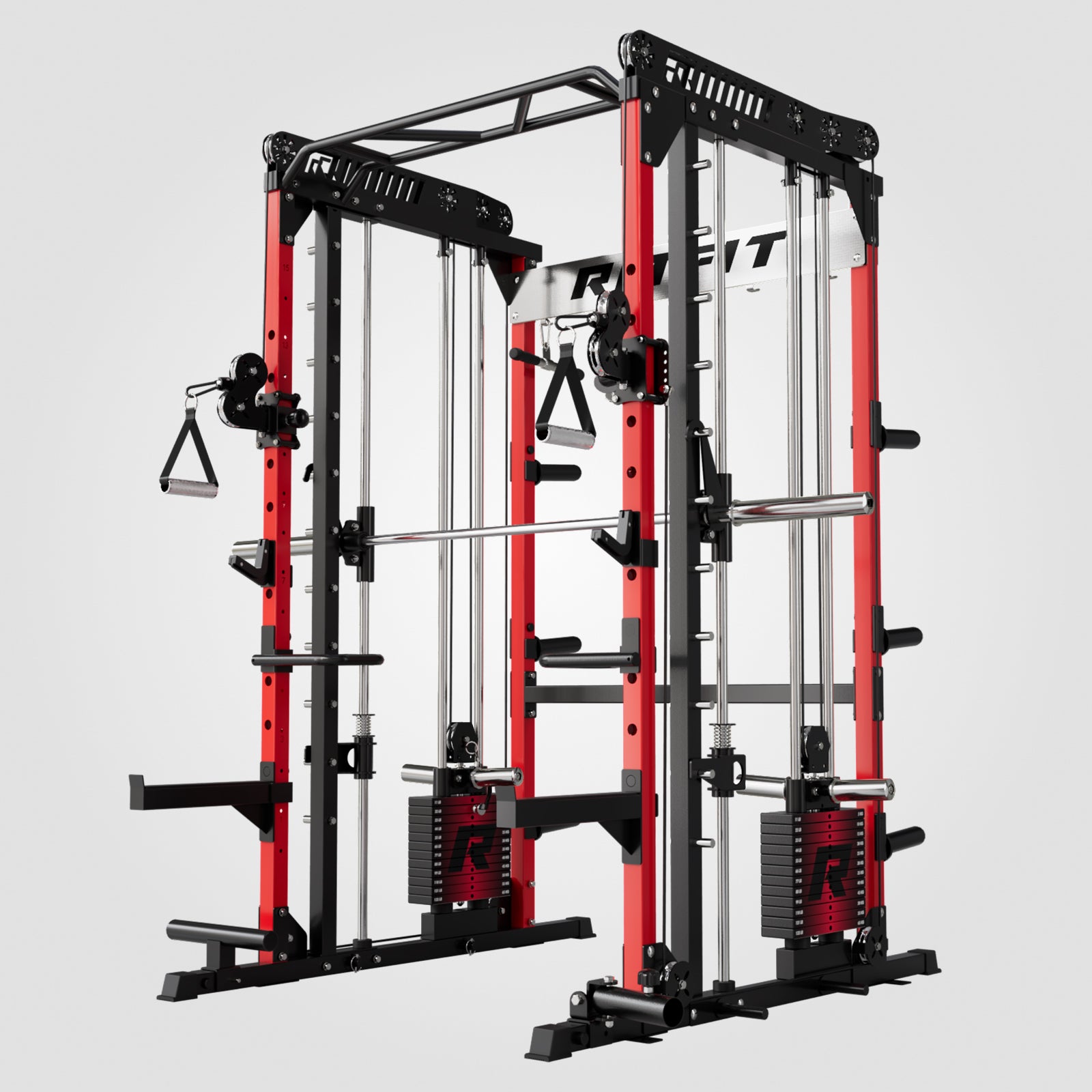
Here is how the RitFit M3 combines a power rack, cable crossover, and Smith machine to fill that role.
Quick Answer: The best smith machine for a premium home gym is the RitFit M3, a three-in-one unit that puts a power rack, cable crossover, and Smith machine on one 3x3 inch 11-gauge steel frame with 2,500 pound capacity and 180 pound built-in stacks per side. It replaces three separate stations in a 21.5 square foot footprint.
Key Takeaways
- Three in one: The M3 packs a power rack, cable crossover, and Smith machine into a single 21.5 sqft frame.
- Uniform build: Every upright uses 3x3 inch 11-gauge steel front to back on a 2,500 lb rated frame.
- Built-in stacks: 180 lb per side of weight stacks run through 16 aluminum pulleys at a 2:1 ratio.
- Solo-safe Smith: A full 2.2 m Olympic bar with 10 catches and 650 lb static safety arms.
- Premium pick: For a premium build, the M3 clears the M2 and M1 on frame gauge and capacity.
Why does a premium home gym start with a three-in-one strength station?
A premium home gym is defined by training coverage, not by how many machines you own. One three-in-one station puts a power rack, cable crossover, and Smith machine on a single frame, so you cover heavy compound lifts, cable isolation, and guided pressing without flooring three separate pieces.
The case for a dedicated home centerpiece holds up under real training data. In one 4-week home-based training study, leg power improved by 16.9% in older adults with no specialist equipment, which shows that a serious home setup drives measurable gains.[1]
In the RitFit lineup, that centerpiece role falls to the M3 Home Gym Smith Machine. Its full 3x3 frame and native cable stacks mean you never bolt a crossover or Smith module onto a base rack later.
How much weight can the M3 handle, and does its frame stay planted?
The M3 frame is rated for 2,500 lb total, and it stays planted because the front, middle, and rear posts all use the same 3x3 inch 11-gauge steel rather than stepping down to lighter tubing on the rear.
Uniform 3x3 11-gauge steel, front to back
Where many multi-functional racks use 2x3 or 2x2 tubing on the middle and rear posts, the M3 keeps a uniform 3x3 inch, 11-gauge profile across all three posts. That uniform spec, plus 1,093.5 lb of total steel mass and a reinforced twin-base support, is what keeps the frame from shifting when you rack a heavy bar hard.
2,500 lb frame capacity and what it means for your squat and bench
A 2,500 lb frame capacity gives you headroom well beyond what most home lifters load, so the rack is never the limiting factor on your squat or bench. On the squat, a 2023 study found that trunk angle and shank angle each shape the hip-to-knee moment ratio,[2] and a 2024 biomechanical review notes that trunk and tibia inclination have opposite effects on knee flexion moments.[3]
A third study found quadriceps activation peaks around 90 degrees of knee flexion during squatting,[4] which is why training through full depth matters. The M3's 650 lb static safety arms and 352 lb dynamic Smith bar back up every one of those deep reps.
Why does a built-in cable crossover beat a bolt-on upgrade?
A built-in cable crossover is native to the frame, so it ships complete and costs less than buying a rack and bolting a crossover module on later. The M3 integrates it with 180 lb stacks per side, so there is nothing extra to order or retrofit.
180 lb per side stacks and 16 aluminum pulleys at a 2:1 ratio
The M3 ships with 180 lb of built-in weight per side, eighteen 4.5 kg plates running through sixteen aluminum pulleys at a 2:1 ratio. A 2:1 ratio gives you smooth cable travel and a longer throw for flyes, rows, curls, and pressdowns, and the 29 adjustment positions let you set pulley height with one hand.
This is the difference between a single-purpose rack and a complete gym. Where many all-in-one trainers sell the crossover as a paid upgrade module, the M3 includes it, so you pay once instead of adding modules over time. If you are comparing cable-equipped frames, the M1 Smith Machine with Cable Crossover and the Buffalo Smith Machine with Lat Pulldown and Cable Crossover put a cable system in smaller frames.
Is the M3 Smith machine safe to train on alone?
The M3 is safe to train on alone thanks to a fixed bar path, 22 inch safety arms rated for 650 lb static, and ten quick rack catch positions. You can push hard on bench and squat and fail safely without a spotter.
The true 2.2 m Olympic Smith bar and 10-position catches
The M3 uses a full 2.2 m, 30 mm Olympic Smith bar rather than a shortened replica, with a knurled grip and a ten position quick rack plate system. The bar carries a 352 lb dynamic and 572 lb static rating, and the catches let you set a hard stop at any of ten heights.
650 lb static safety arms for solo benching
The 22 inch safety arms are each rated for 650 lb static, giving you a second fail-safe under the bar on top of the Smith catches. That layered protection is what makes the M3 a sensible pick for anyone who trains alone and still wants to lift heavy.
Which RitFit machine fits your premium build: M1, M2, or M3?
For a premium build, the M3 is the pick because it is the only RitFit machine with a uniform 3x3 inch 11-gauge frame, a 2,500 lb capacity, and 180 lb built-in stacks per side. The M1 Multi Functional Home Gym Smith Machine is the value entry, and the M2 targets a 3D bar path.
| Model | Frame | Built-in stacks | Price | Best for |
|---|---|---|---|---|
| M3 | 3x3 in 11-gauge | 180 lb/side | $3,199.99 | Premium centerpiece |
| M2 (Pro 3D) | 13-gauge | ~143 lb/side | from $2,199.99 | 3D bar path |
| M1 | 14-gauge | lighter | under $2,000 | Value entry |
M3 specifications are from the RitFit product page. M1 and M2 gauge and price figures reflect third-party reviews of the RitFit line.
The decision comes down to what your premium build is missing. Choose the M3 when you want the strongest frame and native cable stacks, the M2 when the 3D bar path is the feature you are after, and the M1 when you want to start small and upgrade later.
Compare the whole lineup in the RitFit Smith Machine collection, including the M1 Pro Smith Machine with Weight Stack, the Buffalo Smith Machine with Weight Stack, and the BPC06 All-in-One Smith Machine.
How much space does the M3 actually need?
The M3 needs a 21.5 square foot footprint and 84 inches of ceiling height with the pull-up bar, about the space of a parked SUV. It clears most low-ceiling garages and basements, and its 78 inch highest upright hole leaves room for overhead pressing.
21.5 sqft footprint and 84-inch height, measured
The frame measures 86.5 inches long, 60.4 inches wide, and 84 inches tall, which fits a one-car garage corner or a finished basement. Suggested user height runs from 4 feet 9 inches to 6 feet 5 inches, so the rack adjusts across a wide range of lifters.
When floor space is tight for the supporting pieces around a centerpiece, keep the accessories compact. Jeff Cavaliere puts that tradeoff plainly in his home gym guidance.
"If your space is limited, a good set of adjustable dumbbells might be your better option. They will allow you to progress to heavier weight as you get stronger."
Jeff Cavaliere, MSPT, CSCS, Physical Therapist and Strength Coach, Athlean-X
FAQs About the RitFit M3 Smith Machine
Is the RitFit M3 worth the price for a premium home gym?
The M3 earns its place by combining a power rack, cable crossover, and Smith machine into one 21.5 sqft frame with a 3 by 3 inch 11-gauge steel build and 2,500 pound capacity. For a serious home gym, this replaces three separate stations, which costs more and needs more floor space when bought individually.
How much floor space does the M3 need?
5 square foot footprint, about the size of a parked SUV, and stands 84 inches tall with the pull-up bar.
It clears most low-ceiling garages and basements, and the 78-inch highest upright hole leaves room for overhead pressing.
Measure your ceiling and add a few inches of clearance before ordering.
Can I lift heavy alone on the M3 Smith machine?
Yes.
The M3 is built for solo training with a fixed-bar Smith path, 22-inch safety arms rated for 650 pounds static, and a 352-pound dynamic Smith capacity.
You can set the 10-position quick rack catches, push past normal rep ranges on bench and squat, and fail safely without a spotter.
What is the M3's total weight capacity?
The M3 frame is rated for 2,500 pounds total capacity, with a 650-pound static rating per safety arm and J-hook, a 352-pound dynamic Smith bar rating, and 300-pound dynamic pull-up capacity. The built-in weight stacks hold 180 pounds per side at a 2:1 cable ratio.
How does the M3 compare to the M1 and M2?
The M3 is the premium pick with a uniform 3 by 3 inch 11-gauge frame and 2,500 pound capacity.
The M2 is a half rack with an optional 3D Smith bar path, while the M1 is the value entry with lighter gauge steel.
For a premium build, the M3's built-in stacks and full Olympic Smith bar make it the centerpiece.
Does the M3 come with weight stacks or is it plate loaded?
The M3 ships with built-in weight stacks of 180 pounds per side, eighteen plates of 4.5 kilograms each, running through sixteen aluminum pulleys at a 2:1 cable ratio. You still add Olympic plates to the Smith bar and power rack, but the cable station needs no plate loading between sets.
Conclusion
The M3 earns its place as the core of a premium home gym because it combines a power rack, cable crossover, and Smith machine on one uniform 3x3 inch 11-gauge frame.
If you want one machine that covers heavy compound lifts, cable isolation, and guided pressing, it is the strongest pick in the RitFit lineup.
Build around the M3 and add plates, a bench, and dumbbells as your program grows.
See the full specs and current price on the RitFit M3 Home Gym Smith Machine with Cable Crossover.
Disclaimer
This article is for general fitness information and is not medical advice. Consult a qualified professional before starting a new training program, and always use safety catches when lifting alone.
References
1. Maden-Wilkinson TM, et al. A 4-week, lifestyle-integrated, home-based exercise training program elicits improvements in physical function and lean mass in older men and women: a pilot study. Physiological Reports. 2017. PMCID: PMC5680536
2. Graber KA, Halverstadt AL, Gill SV, Kulkarni VS, Lewis CL. The effect of trunk and shank position on the hip-to-knee moment ratio in a bilateral squat. Phys Ther Sport. 2023;61:102-107. PMCID: PMC10518215
3. Straub RK, Powers CM. A Biomechanical Review of the Squat Exercise: Implications for Clinical Practice. Int J Sports Phys Ther. 2024;19(4):490-501. PMCID: PMC10987311
4. Marchetti PH, Jarbas da Silva J, Jon Schoenfeld B, et al. Muscle Activation Differs between Three Different Knee Joint-Angle Positions during a Maximal Isometric Back Squat Exercise. J Sports Med (Hindawi Publ Corp). 2016;2016:3846123. PMCID: PMC4967668