








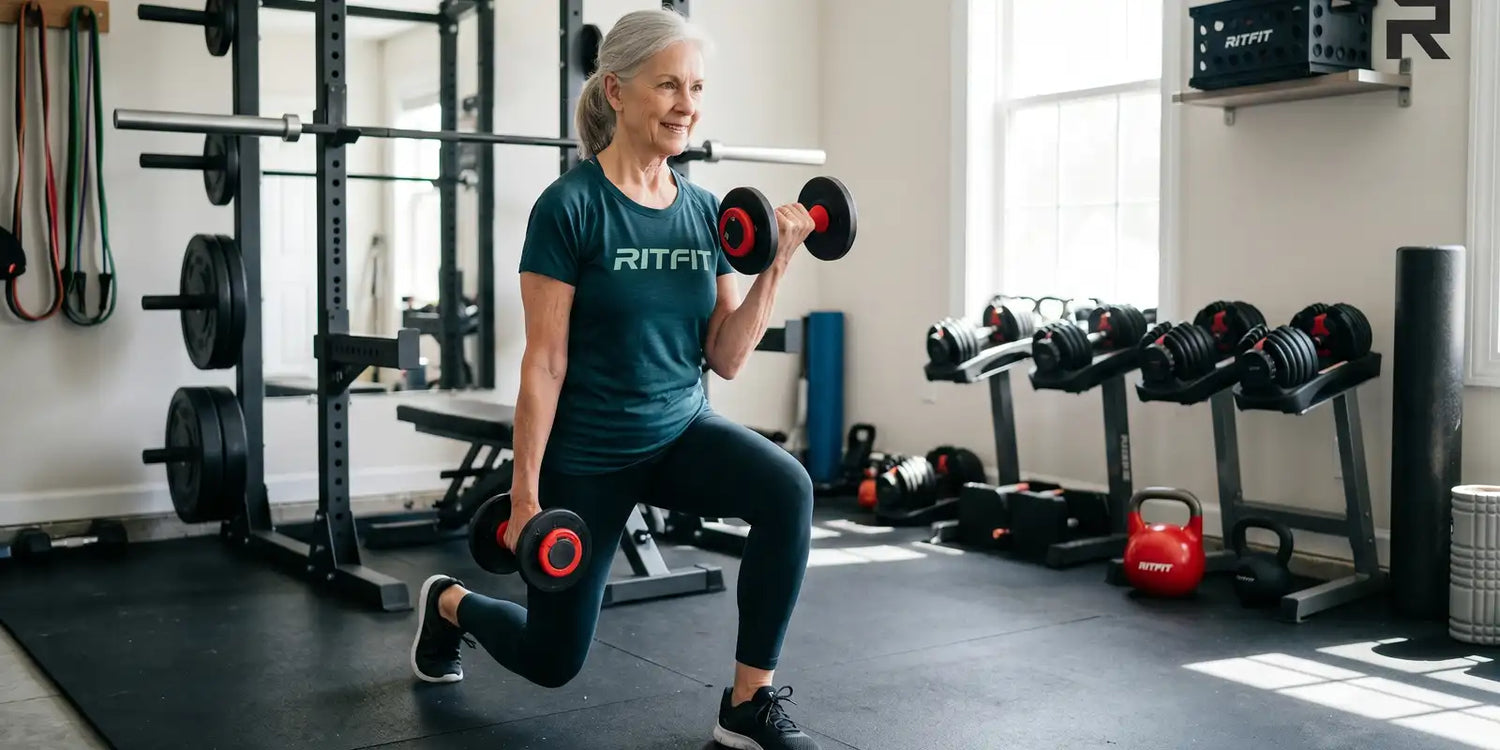
Weight-bearing exercises are movements you do on your feet that make your bones and muscles work against gravity or added load. For older adults, this kind of loading is one of the most practical ways to support bone density and everyday strength.
This guide explains what counts as weight-bearing, why loading matters more after 60, and gives a home-friendly move list with a sensible progression. It is general guidance for healthy older adults, not medical advice.
Disclaimer
This article is general educational information for healthy older adults and is not medical advice, diagnosis, or treatment for osteoporosis or any condition. Talk with your doctor or a physical therapist before starting a new exercise program, especially if you have health concerns.
Table of Contents
Key Takeaways
- Weight-bearing means upright loading: Movement done on your feet against gravity or added weight, not swimming or cycling.
- Bone responds to load: Loading the skeleton and muscles helps support bone density and functional strength as you age.
- Start at home, no gym needed: Sit-to-stands, step-ups, wall push-ups, and light dumbbells cover the basics.
- Progress slowly: Add load or reps only after your form stays solid across two sessions.
- Get cleared first: Talk with a doctor or physical therapist before starting, especially if you have any health limits.
What Weight-Bearing Exercise Actually Means (and Why It Differs From Walking Alone)
Weight-bearing exercise is any activity you do on your feet that forces your bones and muscles to support your body weight or added resistance. Walking counts, but loaded and varied movement does more for bone.
- Weight-bearing examples: Brisk walking, stair climbing, dancing, sit-to-stands, step-ups, and standing moves with light dumbbells.
- Non-weight-bearing examples: Swimming and cycling are excellent for the heart and joints but do not load bone the same way.
- Why variety helps: According to NIAMS, weight-bearing activities produce a force on bones that makes them work harder, which is the signal bone needs.
So walking is a fine base, but adding stepping, squatting, and light resistance gives your bones and muscles more to respond to.
Why Loading Your Bones Matters More After 60
After 60, bone and muscle both tend to decline, which raises fall and fracture risk. Loading them gives the body a reason to maintain and adapt.
Bone Responds to Mechanical Load
A Cochrane systematic review of 43 trials with 4320 participants found exercise produced a small but statistically significant benefit for bone mineral density in postmenopausal women, with combination programmes most effective for the spine and lower-limb resistance training most effective for the neck of the femur.[1]
Muscle Loss (Sarcopenia) and Fall Risk
Age-related muscle loss, called sarcopenia, reduces strength and balance, which makes everyday tasks harder and falls more likely. Weight-bearing strength work targets exactly these systems.
- Strength supports independence: Stronger legs make standing, climbing stairs, and carrying groceries easier.
- Balance lowers fall risk: Standing and stepping moves train the stability that protects against falls.
- Bone and muscle train together: The same loaded movements that build muscle also signal bone to adapt.
For deeper lower-body work, our guide to leg strengthening exercises for seniors pairs well with this bone-loading focus.
“I want people doing progressive resistance training two to three times per week with weights, machines or bands, because strong muscles create strong bones.”
— Susan Bukata, MD, Chair, Department of Orthopedic Surgery, UC San Diego, 《The Stair Habit Doctors Say Could Help Prevent Bone Loss》
A Home-Friendly Weight-Bearing Exercise List for Seniors
You can load bone and build strength at home with simple equipment. Start with bodyweight, then add light resistance as you get stronger.
Lower-Body Loading (Sit-to-Stand, Step-Ups, Squats to Chair)
These moves load the hips and thighs, the sites that matter most for daily function and femoral-neck bone.
- Sit-to-stand: Rise from a sturdy chair without using your hands, then sit back slowly with control.
- Step-ups: Step onto a low, stable step or bottom stair, alternating legs, holding a rail if needed.
- Squat to chair: Lower toward a chair as if to sit, tap lightly, and stand back up.
Upper-Body and Spine-Supporting Loading (Wall Push-Ups, Light Dumbbell Presses, Rows)
Upper-body loading supports posture and the bones of the arms and upper back.
- Wall push-ups: Hands on a wall, lean in and press back out, keeping your body in a straight line.
- Light overhead or chest press: Use light dumbbells or water bottles for controlled presses.
- Standing rows: Hinge slightly and pull light weights toward your ribs to support the upper back.
Gentle Impact and Standing Balance Add-Ons
Small amounts of gentle impact and balance practice round out a bone-friendly routine.
The video below demonstrates home-based moves a physical therapist uses for bone-loading, which complements the list above.
How Much Load, How Often: Sets, Reps, and Intensity
Aim for consistency over intensity at first. A few short sessions a week, built up gradually, beats occasional hard efforts.
- Frequency: A meta-analysis of progressive resistance training in older adults recommends about three sessions per week, including a weight-bearing or impact component such as stepping.[2]
- Sets and load: That same review points to roughly one to two sets per exercise at a load around 75 to 80 percent of your one-repetition maximum for combined muscle and bone gains.[2]
- Federal guidance: According to NIAMS, federal guidance recommends at least 150 minutes per week of moderate activity plus muscle-strengthening work at least twice a week.
If higher-intensity loading feels advanced, start lighter and progress under guidance. Heavy training percentages are targets to build toward, not starting points.
A Simple 8-Week Progressive Plan
This sample structure shows how to layer load gradually. Treat the loads as illustration-only starting suggestions, not prescriptions.
| Weeks | Focus | Example Approach |
|---|---|---|
| 1-2 | Bodyweight base | Sit-to-stands, wall push-ups, step-ups, 1 set of 8 to 12 reps |
| 3-4 | Add light load | Add light dumbbells (about 2 to 5 lb) on presses and rows |
| 5-6 | Build volume | Move toward 2 sets, add gentle balance and stepping work |
| 7-8 | Progress load | Increase weight slightly once form stays solid across two sessions |
In one randomized trial of 63 women aged 60 and older, 16 weeks combining resistance and treadmill walking improved bone mineral density z-scores at sites including the hip and lumbar spine, suggesting about two sessions per week may be sufficient.[3]
Once you are comfortable with supported pressing, our guide to weight bench exercises at home is a natural next read.
Safety, Precautions, and When to Check With a Professional
Most healthy older adults can begin gentle weight-bearing movement, but a quick check first protects you. Form and progression matter more than pushing hard.
- Get cleared: According to NIAMS, people with low bone density, osteoporosis, or physical limitations should talk to a health care provider before starting an exercise program.
- Use support: Keep a sturdy chair or rail nearby for balance moves and wear supportive footwear.
- Mind the spine: Avoid heavy loaded forward bending or twisting unless a professional has cleared it for you.
- Watch for red flags: Stop and seek advice if you feel sharp pain, dizziness, or chest discomfort.
For a broader routine that blends strength and stability, see our guide to exercises for seniors to improve strength and balance safely.
Equipment That Helps at Home
You do not need a full gym to load your bones. A few simple, adjustable tools cover most home routines.
- Light dumbbells: A starter set of light exercise weights lets you add load to presses, rows, and curls.
- Adjustable options: A general weights collection makes it easy to progress as you get stronger.
- Supported pressing: When you advance, an adjustable weight bench supports seated and lying presses with stability.
Start with what loads you comfortably, then add small increments over time.
FAQs About Weight-Bearing Exercises for Seniors
What counts as a weight-bearing exercise for seniors?
A weight-bearing exercise is any movement done on your feet that makes your bones and muscles work against gravity or added resistance. For seniors this includes brisk walking, stair climbing, sit-to-stands, step-ups, squats to a chair, and standing moves with light dumbbells. Swimming and cycling are healthy but are not weight-bearing for your bones.
How often should older adults do weight-bearing exercises?
Most evidence-informed guidance suggests strength and bone-loading work about two to three days per week, plus regular walking on other days. Federal activity guidance referenced by NIAMS recommends at least 150 minutes of moderate activity weekly and muscle-strengthening work at least twice a week. Start lighter and add days gradually as you build confidence.
Are weight-bearing exercises safe if I have weak bones?
Gentle weight-bearing movement is often beneficial, but if you have low bone density, osteoporosis, or other health limits you should talk with a doctor or physical therapist before starting. They can rule out high-risk moves such as heavy spinal twisting or forward bending and tailor a plan to your situation. This article is general guidance, not medical advice.
Do I need equipment to do weight-bearing exercises at home?
No, you can start with bodyweight moves like sit-to-stands, wall push-ups, and step-ups using a sturdy chair or stair. As you get stronger, light dumbbells, ankle weights, or water bottles add helpful load. A stable chair for support and good footwear matter more than fancy gear when you begin.
How heavy should the weights be for senior bone health?
Begin with a load you can lift with good form for about eight to twelve repetitions, feeling worked but not strained. Research on older adults points to progressively heavier resistance over time for bone benefit, but progress should be slow and supervised if possible. Increase weight only after your form stays solid across two sessions.
Conclusion
Weight-bearing exercise gives your bones and muscles a reason to stay strong as you age. A few sessions a week of sit-to-stands, step-ups, wall push-ups, and light loaded moves cover the essentials at home.
Start with bodyweight, progress slowly, and get cleared by a professional first. Consistency over months matters more than any single hard workout.
References
1. Howe TE, Shea B, Dawson LJ, et al. Exercise for preventing and treating osteoporosis in postmenopausal women. Cochrane Database of Systematic Reviews. 2011;2011(7):CD000333. https://pmc.ncbi.nlm.nih.gov/articles/PMC12744941/
2. O'Bryan SJ, Giuliano C, Woessner MN, et al. Progressive Resistance Training for Concomitant Increases in Muscle Strength and Bone Mineral Density in Older Adults: A Systematic Review and Meta-Analysis. Sports Medicine. 2022;52(8):1939-1960. https://pmc.ncbi.nlm.nih.gov/articles/PMC9325860/
3. Ellis A, Crowe-White K, Hunter G. Effects of Different 16-Week Exercise Interventions on Bone Mineral Density of Sedentary Older Women. Innovation in Aging. 2021;5(Suppl 1):895. https://pmc.ncbi.nlm.nih.gov/articles/PMC8681684/





