








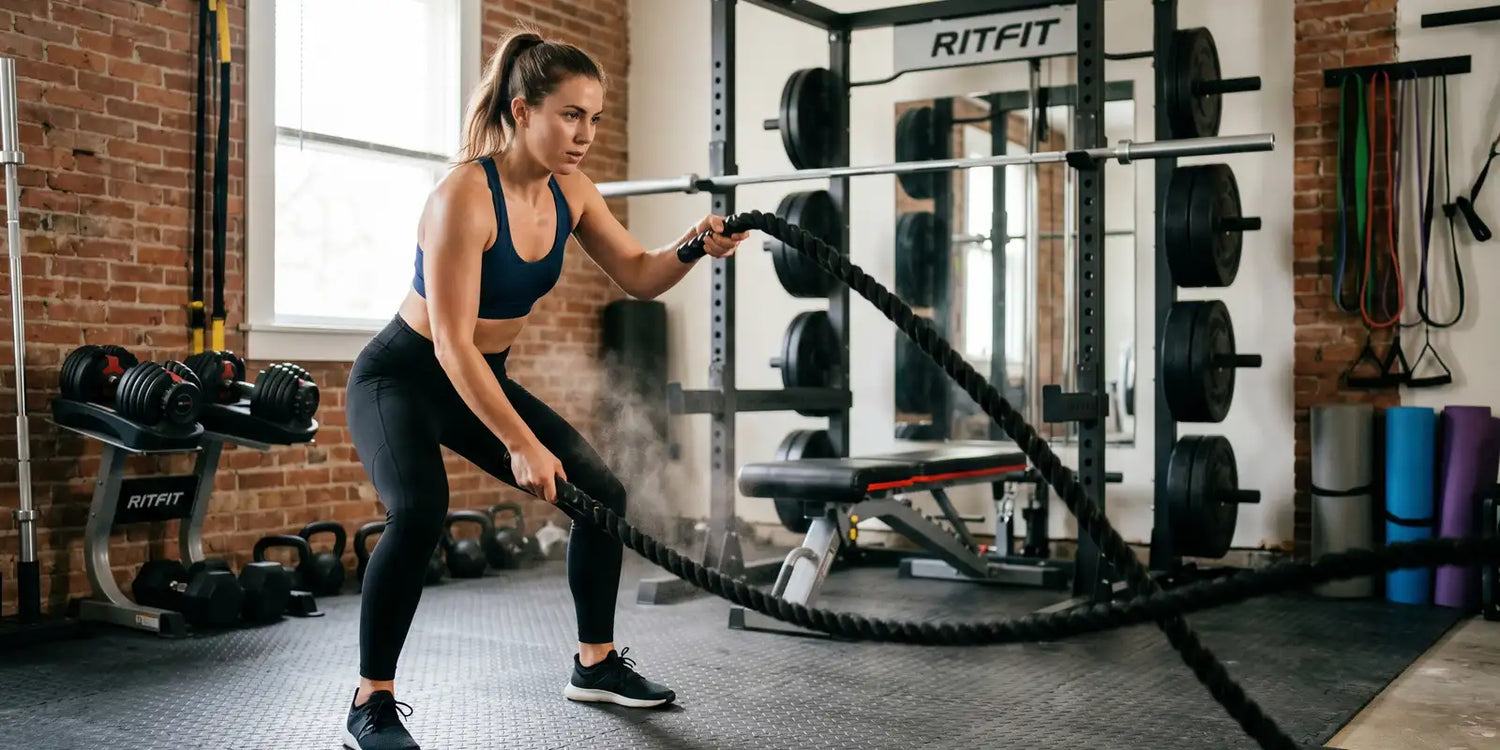
Battle ropes are one of the most efficient tools for full-body conditioning, yet many home gym users aren't sure if they're worth the floor space. The short answer: they work your upper body, core, and cardiovascular system simultaneously in ways that most other equipment cannot.
This guide explains what battle ropes are good for, which muscles they target, the key fitness benefits backed by research, and practical beginner exercises to get you started at home.
Table of Contents
Key Takeaways
- Battle ropes deliver simultaneous cardiovascular and muscular endurance training in a single tool.
- Double arm undulation produces greater quad and core activation, while alternating arm motion increases glute engagement.
- A battle rope HIIT protocol can push average heart rate to approximately 86% of age-predicted maximum, classifying it as vigorous exercise.
- Battle ropes are low impact and can be modified for seated use, making them accessible for a wide range of fitness levels.
- Beginners should start with 2 to 3 sets of 30-second intervals and progress toward 60 to 90 seconds as conditioning improves.
What Are Battle Ropes and How Do They Work?
Battle ropes are heavy, thick ropes anchored at one end that you manipulate with wave, slam, or rotation movements to generate resistance. One guide notes that battle ropes typically range from 30 to 50 feet in length and 1.5 to 2.5 inches in diameter, with thicker ropes providing more resistance for strength-focused work and thinner ropes allowing faster movement for cardio emphasis.
The resistance comes from the rope's own weight and the momentum you create, meaning effort level scales directly with how hard you move, not a fixed load setting.
Rope Diameter and Training Focus
Thicker ropes demand greater grip and upper-body strength to sustain wave patterns, while thinner ropes allow faster oscillations that raise heart rate more quickly.
What Muscles Do Battle Ropes Work?
Battle ropes train the shoulders, arms, back, core, and lower body in a single movement, with muscle emphasis shifting based on the motion pattern you use. A study found that double arm battle rope undulation produced greater activity in quad and core muscles, including vastus medialis, rectus abdominis, and multifidus, while alternating arm motion produced greater glute activation.[1]
This means you can shift your training emphasis by simply changing your arm pattern, making battle ropes one of the most versatile tools available for functional training equipment in a home gym setup.
Upper Body
Shoulders, biceps, triceps, and upper back are the primary movers in all wave-based exercises, handling the continuous load of generating rope oscillations.
Core and Lower Body
Maintaining a stable hip hinge position throughout a battle rope set activates the deep core stabilizers and posterior chain continuously, adding a functional strength component to every rep.
| Movement Pattern | Primary Muscles Activated |
|---|---|
| Double Arm Waves | Quads, rectus abdominis, multifidus, shoulders |
| Alternating Arm Waves | Glutes, obliques, shoulders, biceps |
| Power Slams | Lats, triceps, core, hip flexors |
| Lateral Waves | Rear delts, rotator cuff, obliques |
Key Benefits of Battle Rope Training
Battle ropes combine cardio, muscular endurance, and core training into one continuous effort, making them an efficient choice for home gym users with limited time.
Cardiovascular Fitness and Endurance
A study found that a battle rope HIIT protocol using 10 rounds of undulation at a 15-second work, 45-second rest ratio produced an average heart rate at approximately 86% of age-predicted maximum, consistent with vigorous exercise classification.[2]
A separate study also found that high-intensity battle rope exercise significantly elevated heart rate during and after exercise, confirming its effectiveness as a cardiovascular training stimulus.
Full-Body Muscle Endurance
Unlike isolated exercises, battle rope waves require continuous coordinated effort from the upper body, core, and lower body simultaneously, building muscular endurance across multiple movement patterns in a single set.
This full-chain engagement means you build work capacity alongside strength endurance, a combination that translates well to real-world physical demands and pairs naturally with metcon workouts.
Low-Impact High-Intensity Training
Battle rope exercises are low impact and can be modified for seated performance, making them suitable for people with lower body limitations.
This combination of high intensity and low joint stress is rare among conditioning tools, allowing you to push cardiovascular output without the repetitive impact of running or jumping, which is ideal for safer home gym strength workouts.
Core Stability and Functional Strength
A study found that battle rope exercises elicit significant trunk muscle activity across both able-bodied individuals and other populations, confirming their role as a core training tool, not just a cardio tool.[3]
The anti-rotation demand of alternating wave patterns forces the deep core stabilizers to resist lateral force on every repetition, building the kind of functional stability that carries over to compound lifts and daily movement.
Best Battle Rope Exercises for Beginners
The three foundational movements for beginners are alternating waves, double waves, and power slams, each targeting slightly different muscle groups and energy systems.
Trainers recommend beginners start with 2 to 3 sets of 30-second intervals for these exercises, progressing toward 60 to 90-second intervals as fitness improves, which aligns well with a circuit training approach.
Alternating Waves
Stand in a hip-width athletic stance, hold one rope end in each hand, and move arms alternately up and down to send continuous waves toward the anchor point.
Double Arm Waves
Use both arms simultaneously to generate larger, slower waves that increase quad and core engagement compared to the alternating pattern.
Power Slams
Raise both ropes overhead and slam them down forcefully to the floor, engaging the lats, triceps, and core in a high-power explosive movement.
This tutorial from Mind Pump TV covers proper battle rope technique to maximize results and avoid common form mistakes.
How to Add Battle Ropes to Your Home Gym Workout
Battle ropes work best as a finisher after strength training or as standalone HIIT cardio on active recovery days, rather than as a primary strength tool.
Pairing them with compound movements from your full body circuit training workouts for beginners creates a well-rounded session that covers both strength and conditioning in under an hour.
Sample Weekly Structure
Use battle ropes two to three days per week for 10 to 20 minutes per session, treating them as a metabolic conditioning block rather than a standalone workout tool.
Progression Strategy
Progress by extending interval duration (30 to 60 to 90 seconds), shortening rest periods, or adding complexity through lateral movements and squat-to-wave combinations to keep adaptation continuous, consistent with the 10 best battle rope workouts for beginners.
FAQs About Battle Ropes
Are battle ropes good for losing weight?
Yes. Battle rope HIIT sessions can reach vigorous exercise intensity, with research showing average heart rate at approximately 86% of age-predicted maximum in a structured protocol. High-intensity intervals burn significant calories during and after exercise, supporting a calorie deficit when combined with proper nutrition.
How long should a beginner use battle ropes per session?
Beginners should target 10 to 15 minutes of total battle rope work per session. Trainers recommend starting with 2 to 3 sets of 30-second intervals with full rest between sets, then gradually building duration over several weeks as cardiovascular endurance improves.
Do battle ropes build muscle?
Yes, though primarily for muscular endurance rather than hypertrophy. Battle ropes activate multiple muscle groups simultaneously, including shoulders, arms, core, and glutes. For maximum muscle growth, combine battle rope conditioning with progressive resistance training using barbells or dumbbells.
Can I use battle ropes every day?
No. Daily battle rope training does not allow adequate muscle recovery and can lead to overtraining fatigue. Two to three sessions per week with at least one rest day between each is the standard recommendation, allowing muscles and the cardiovascular system to adapt between bouts.
Are battle ropes safe for beginners with no upper body strength?
Yes. Battle ropes are scalable to any strength level by adjusting wave speed, interval duration, and rope diameter. Starting with shorter intervals and lighter movements allows beginners to build grip strength and shoulder stability progressively without overloading joints from the first session.
What is the best battle rope length for a home gym?
A 30 to 40 foot rope is practical for most home gym spaces. One guide notes that ropes typically range from 30 to 50 feet, with shorter ropes requiring less anchor distance while still providing effective resistance for waves and slams. Measure your available floor space before purchasing.
Can battle ropes replace cardio machines?
Yes, for high-intensity intervals. Battle ropes deliver vigorous cardiovascular intensity comparable to sprint-based cardio while also engaging upper body muscles. They work well as a treadmill or rower alternative on days when you want conditioning without lower body impact, using your functional and strength training equipment space efficiently.
Conclusion
Battle ropes are good for cardiovascular conditioning, full-body muscular endurance, core stability, and low-impact high-intensity training, making them one of the most versatile tools available for a home gym.
Start with alternating waves and double waves at 30-second intervals, progress gradually, and pair them with your existing strength work for the best results.
Disclaimer: This article is for general fitness education purposes only and does not constitute medical advice. Consult a qualified healthcare professional before beginning any new exercise program, particularly if you have existing injuries, cardiovascular conditions, or other health concerns.
References
- Calatayud J, Borreani S, Colado JC, et al. The addition of synchronous whole-body vibration to battling rope exercise increases skeletal muscle activity. J Hum Kinet. 2017;58:55-63. https://pmc.ncbi.nlm.nih.gov/articles/PMC5601236/
- Lage VKS, Lacerda LT, Rodrigues FF, et al. Vascular responses to high-intensity battling rope exercise in resistance-trained men and women. J Strength Cond Res. 2021. https://pmc.ncbi.nlm.nih.gov/articles/PMC8219269/
- Goodman R, Noonan A, Gauthier C, et al. Trunk muscle activity and kinematics during boxing and battle rope exercises in people with and without spinal cord injury. J Spinal Cord Med. 2023. https://pmc.ncbi.nlm.nih.gov/articles/PMC10795558/




