








Burpees are the classic full-body bodyweight move in fitness that chains a squat, a plank, a push-up, and an explosive jump into one continuous rep. They build strength, power, and cardio with no equipment at all.
This guide explains the muscles burpees train, their practical benefits, step-by-step form, the mistakes that strain wrists and lower backs, and variations that fit every level. It is written for healthy adults who want a scalable conditioning tool that works in a garage, a basement, or a hotel room.
Quick Answer: A burpee is a full-body bodyweight exercise that links a squat, a plank, a push-up, and an explosive jump into one rep. Burpees train the legs, glutes, chest, shoulders, triceps, and core while spiking heart rate, and they scale from a step-back version to weighted and pull-up variations.
Key Takeaways
- Full-body move: A burpee chains a squat, a plank, a push-up, and a jump into one fluid bodyweight rep.
- Trains everything: It works the legs, glutes, chest, shoulders, triceps, and core in a single set.
- Time efficient: A short burpee interval protocol can be completed in roughly two minutes.
- Form first: Brace your core, keep hips level, and land softly to protect your wrists and back.
- Scalable: Remove the push-up and jump as a beginner, then add volume and speed as conditioning improves.
What Is a Burpee?
A burpee is a full-body, multi-joint calisthenics exercise that links a squat, a plank, a push-up, and an explosive jump into one continuous motion. It uses only your body weight for resistance, so it needs no gear and very little floor space.
- Bodyweight and equipment-free: One guide describes the burpee as a movement you can do anywhere with no gear and minimal space.
- Strength plus cardio: The chained movements train muscular endurance and cardiovascular fitness in a single rep.
- A conditioning staple: Burpees show up in HIIT classes, bootcamps, and CrossFit because they pack so much work into little time.
If you are learning fitness terminology alongside this move, our explainer on the 5 components of fitness shows how burpees touch several of them at once.
What Muscles Do Burpees Work?
Burpees are a true full-body exercise that recruits the lower body, upper body, and core in every rep. According to Cleveland Clinic, the movement uses your full musculature from top to bottom.
Lower-Body Movers
The quadriceps, gluteus maximus, hamstrings, and calves drive the squat descent and power the explosive jump back to standing.
Upper-Body and Core
The pectorals, deltoids, and triceps hold and press through the plank and push-up, while the core works isometrically to keep your spine stable during fast transitions.
Because burpees train so many areas together, they complement the kind of full-body work covered in our guide to interactive fitness.
What Are the Benefits of Burpees?
Burpees deliver cardiovascular, muscular, and time-efficiency benefits in one move. Their appeal is doing a large amount of work in a very short window.
Cardiovascular and Metabolic Conditioning
Burpees spike your heart rate fast and tap all three energy systems depending on how long you sustain the work interval. One coaching resource notes that 10 to 20 second bursts draw on the phosphocreatine system, while 30 to 60 second efforts shift into glycolysis.
- Quick, potent intervals: A randomized controlled trial found that two 20 second all-out burpee-jump intervals separated by 10 seconds of rest, completed in roughly two minutes, improved physical and mental health in inactive males.[1]
- Comparable to running intervals: In one trial of 15 participants, functional high-intensity interval training and running high-intensity interval training improved VO2max similarly, about 11 percent versus about 13 percent over four weeks, and the functional group improved its burpee performance.[2]
To gauge how hard you are pushing during these intervals, it helps to understand what RIR means in fitness and how cardiac fitness responds to repeated bursts.
How Do You Do a Burpee With Proper Form?
A clean burpee flows through five phases without rushing or losing tension. Move with control so each transition stays safe and repeatable.
- Stand tall: Begin with feet about hip-width apart, arms at your sides, and core braced.
- Drop into a squat: Bend your knees, hinge your hips back, and place both hands flat on the floor just inside your feet.
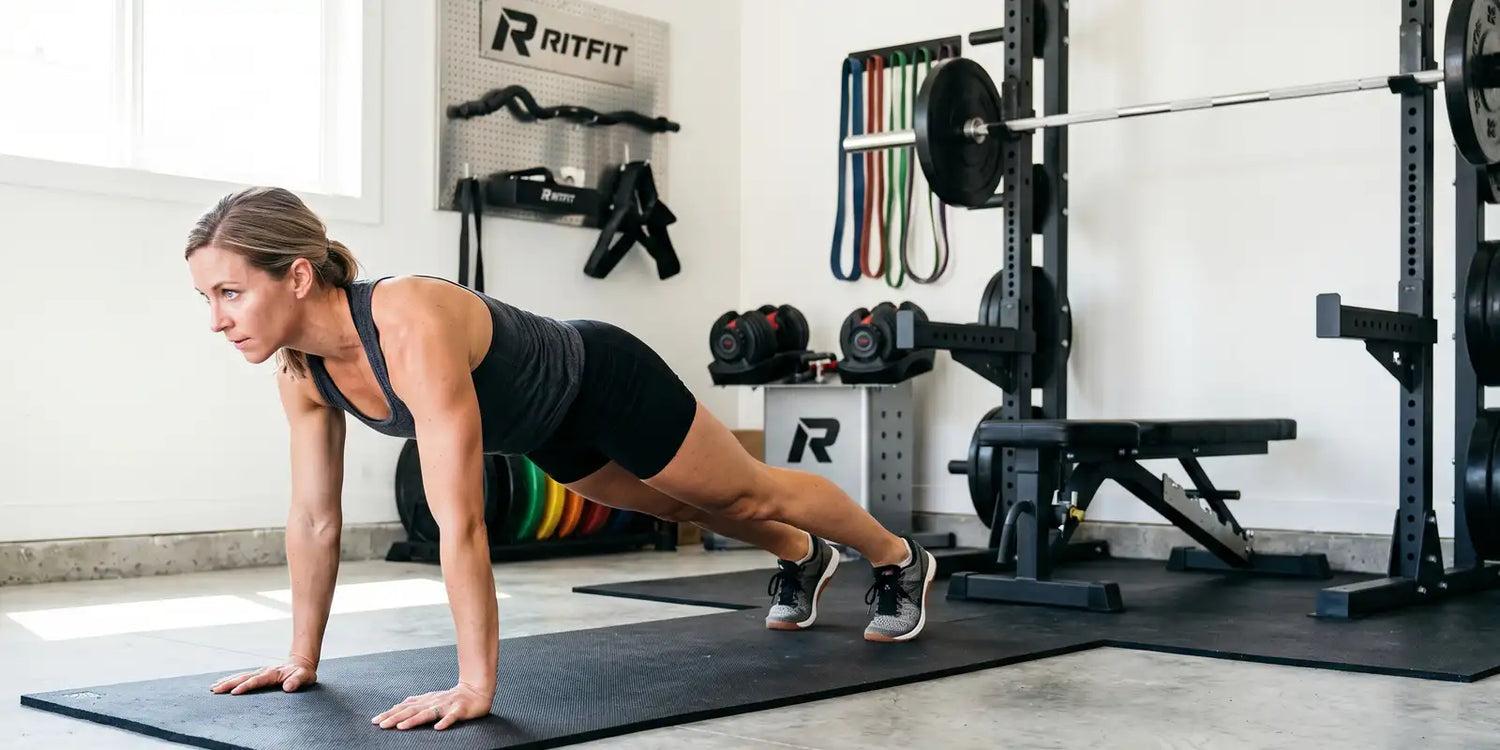
- Jump to plank: Kick your feet back so your body forms a straight line from head to heels, keeping hips level.
- Push-up: Lower your chest toward the floor with elbows tracking back, then press back to plank.
- Hop and jump: Jump your feet forward to your hands, stand, and finish with an explosive jump, landing softly.
The walkthrough below demonstrates the same phases and the most common form errors to watch for.
"The knee joint itself is a consequential joint. That means it is simply a hinge joint that is at the mercy of what is going on at the ankle below and the hip above."
Jeff Cavaliere, MSPT, CSCS, Physical Therapist and Strength Coach, Athlean-X, How to Fix Knee Valgus
What Are the Most Common Burpee Mistakes?
Most burpee problems come from fatigue breaking down technique rather than from the movement itself. Trainers recommend slowing down before form falls apart.
- Sagging hips: Letting the lower back drop in the plank strains the spine, so keep the core braced and hips level.
- Collapsing on landing: Land softly with knees tracking over your toes rather than slamming down on straight legs.
- Wrist overload: Stack your wrists, elbows, and shoulders in the plank to spread the load through your skeleton.
- Chasing speed too early: Fast, sloppy reps cost more than they return, so own the five phases first.
Burpees are an advanced movement, and one guide cautions that a sloppy rep can strain the wrists or lower back, so scale before you struggle.
Which Burpee Variations Suit Beginners Through Advanced?
Burpees scale in both directions, which is why they suit nearly every level. Pick the version that matches your current conditioning rather than the version you see online.
| Level | Variation | What Changes |
|---|---|---|
| Beginner | Walk-out burpee | Step back to plank, skip the push-up and jump, stand to finish. |
| Intermediate | Standard burpee | Full squat, plank, push-up, and explosive jump in sequence. |
| Advanced | Burpee pull-up or weighted vest | Add a pull-up or external load to raise the strength and power demand. |
Scaling options by training level and the movement component each one adds or removes.
Beginners who want lower-impact options can also explore gentler tools in our roundup of low-impact fitness accessories.
How Should You Program Burpees Safely?
Program burpees by intervals rather than chasing a single max set. Short, focused work keeps form sharp and lowers injury risk.
- Start small: Begin with 5 to 8 scaled reps, prioritizing clean transitions over speed.
- Use timed intervals: Try 20 seconds of work with brief rest, then build rounds as conditioning improves.
- Track effort, not just reps: Knowing what RM means in fitness helps you balance bodyweight and loaded training.
A circuit approach works well too. A randomized controlled study found that 9 weeks of functional high-intensity circuit training that included burpees improved body composition, peak oxygen uptake, and functional strength in overweight women, an approach echoed in our guide to fitness for women.[3]
FAQs About Burpees
What exactly is a burpee in fitness?
A burpee is a full-body bodyweight exercise that links four movements into one fluid rep, a squat, a plank, a push-up, and an explosive jump. It uses no equipment, relies on your own body weight for resistance, and trains strength, power, and cardiovascular endurance at the same time, which is why it is a staple in HIIT workouts.
What muscles do burpees work?
Burpees are a true full-body move. The quadriceps, glutes, hamstrings, and calves power the squat and jump, while the chest, shoulders, and triceps drive the push-up portion. Throughout every rep your core works isometrically to keep your spine stable, so burpees combine lower-body, upper-body, and core training in a single continuous exercise.
Are burpees good for weight loss?
Burpees can support weight loss because they are a high-intensity, full-body movement that burns calories quickly and elevates your heart rate. Research on burpee-inclusive high-intensity interval training has shown improvements in body composition and fitness. That said, lasting weight loss depends on your overall activity, total calorie balance, and nutrition, not on any single exercise.
How many burpees should a beginner do?
Beginners can start with small, manageable sets, such as 5 to 8 reps using a scaled version that removes the push-up and jump. Focus on clean form and soft landings before adding volume or speed. As your conditioning improves, progress toward short timed intervals, like 20 seconds of work followed by a brief rest.
Are burpees bad for your knees or back?
Burpees are safe for most healthy adults when performed with good technique, but sloppy form can strain the wrists or lower back. Keep your core braced, avoid letting your hips sag in the plank, and land softly with knees tracking over your toes. If you have a current injury, choose a low-impact step-back variation first.
Can you do burpees every day?
Yes. Burpees can be trained daily if your volume stays modest and your joints recover between sessions. Many people do better with three or four burpee sessions a week alongside other training. Watch for wrist, knee, or lower back soreness that lingers, and reduce volume or add a rest day when it appears.
Conclusion
Burpees are one of the most efficient bodyweight tools you can use, training strength, power, and cardio in a single move with no equipment. The deciding factor is clean technique and honest scaling.
Start with a scaled version, prioritize soft landings and a braced core, then add reps, speed, or intervals as your conditioning grows. For current offers on home training gear, check the RitFit discount guide.
Disclaimer
This article is for general educational purposes only and is not medical advice. Consult a qualified healthcare or fitness professional before starting any new exercise program, especially if you have an injury or health condition.
References
1. Hu M, Chen X, Nie J, Shi Q, Kong Z. Real-world efficacy of equipment-free reduced-exertion high-intensity interval training in improving physical and mental health in inactive males: A randomized controlled trial. J Exerc Sci Fit. 2025;23(4):273-283. PMCID: PMC12273568
2. Menz V, Marterer N, Amin SB, Faulhaber M, Hansen AB, Lawley JS. Functional vs running low-volume high-intensity interval training: Effects on VO2max and muscular endurance. J Sports Sci Med. 2019;18(3):497-504. PMCID: PMC6683610
3. Sperlich B, Wallmann-Sperlich B, Zinner C, Von Stauffenberg V, Losert H, Holmberg HC. Functional high-intensity circuit training improves body composition, peak oxygen uptake, strength, and alters certain dimensions of quality of life in overweight women. Front Physiol. 2017;8:172. PMCID: PMC5376588





