








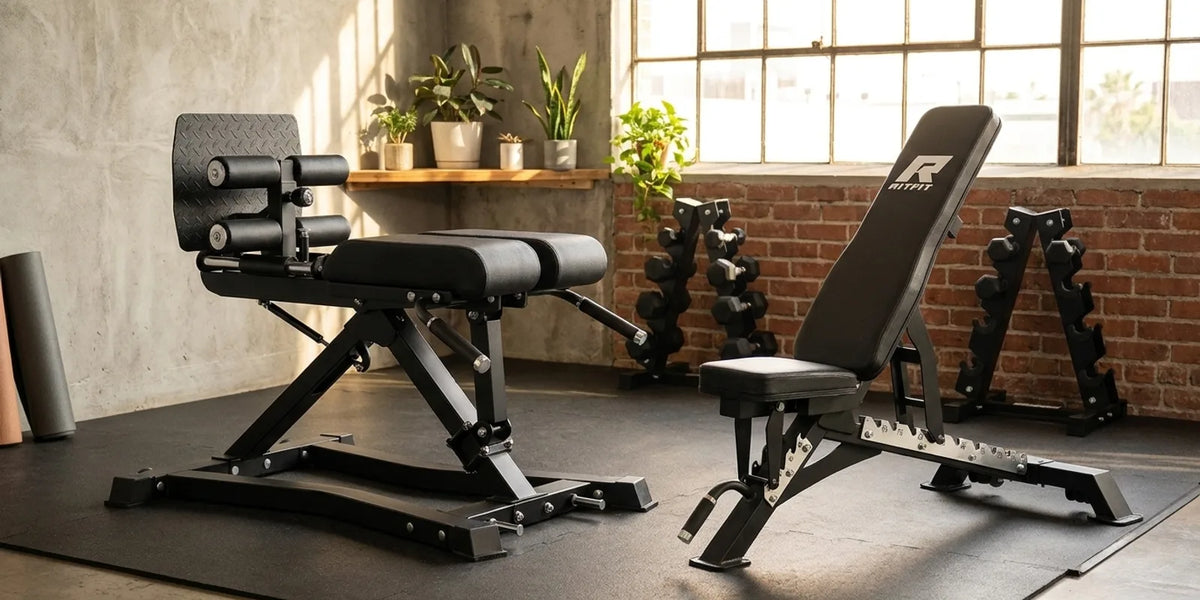
A back extension machine is strength equipment that holds your legs and hips in place so you can hinge forward and drive your torso back up, training the lower back and posterior chain. It is one of the most direct tools for building strength in the erector spinae, glutes, and hamstrings at home.
This guide covers what a back extension machine is, the muscles it works, how to use it with correct form, and what to look for when you buy one. Start with bodyweight and build up slowly as your form stays clean.
Quick Answer: A back extension machine (also called a hyperextension bench or Roman chair) lets you do back extensions, a hip-hinge exercise that trains the erector spinae, glutes, and hamstrings together. It is a dependable way to strengthen the lower back and posterior chain at home using bodyweight or added load.
Key Takeaways
- Targets: The back extension machine works the erector spinae, glutes, and hamstrings in one posterior chain movement.
- Types: Roman chair, horizontal, and seated pin-loaded versions all use the same hip and spine extension pattern.
- Form: Hinge at the hips and keep the lumbar spine neutral so the back extensors are strengthened instead of stressed.
- Progression: Start with bodyweight and add load only when you can hold clean form for your planned reps.
- Buying: Look for adjustable pad height, a stable base, and a footprint that fits your home space.
What is a back extension machine?
A back extension machine is strength equipment that anchors your legs and hips while your torso hinges forward and back, training the erector spinae, glutes, and hamstrings. It turns the hip hinge into a guided, repeatable movement you can load safely at home.
- Purpose: Strengthen the lower back and posterior chain without placing load directly on the spine.
- Setup: Your thighs rest on a padded hip support and your ankles lock under rollers so only the torso moves.
- Resistance: Start with bodyweight and add a weight plate held at your chest as you progress.
What types of back extension machines are there?
Back extension machines come in three main forms: the 45 degree Roman chair, a horizontal bench, and a seated pin-loaded unit. They all train the same hip and spine extension pattern, so your choice comes down to space and preference.
- Roman chair (45 degree): The most common version, with your hips on an angled pad and your torso hanging free.
- Horizontal bench: Your body stays parallel to the floor, which makes the top of the movement hardest.
- Seated machine: A pin-loaded stack where you push backward against a roller pad with a controlled path.
A 45 degree Roman chair is the easiest format to learn and works well in a compact home setup.
What muscles does a back extension machine work?
A back extension machine works the erector spinae, gluteus maximus, and hamstrings together, with the core stabilizing each rep. The erectors hold your spine neutral while your glutes and hamstrings drive the movement.[1]
- Erector spinae: The columns along your spine that keep you upright and extend the trunk.
- Gluteus maximus: The main hip extensor that powers the upward drive.
- Hamstrings: The back of the thigh, which assist hip extension and feel the stretch in the lowered position.
- Core and obliques: Stabilize the trunk so the load stays on the hips and back.
Why train the lower back and posterior chain?
Training the posterior chain builds the muscles behind your body, which support posture and stronger squats, deadlifts, and rows. A study found greater activation of the quadriceps and posterior-chain muscles during free-weight squat variations than in machine isolation substitutes.[2]
- Posture: A strong posterior chain helps you hold a neutral spine under load and in daily life.
- Performance: Strong hips and hamstrings carry over to squats, deadlifts, and jumps.
- Balance: The posterior chain balances the front-loaded work of quads and abs.
How do you use a back extension machine with correct form?
To use a back extension machine correctly, set the pad so your hips can fold freely, keep the spine neutral, and hinge at the hips rather than bending at the lower back. Move slowly through a controlled range and drive back up by squeezing your glutes.
- 1. Set the pad: Position the hip pad so your thighs rest tight against it and your hip crease clears the top edge.
- 2. Lock your feet: Anchor your ankles under the rollers with your feet flat on the platform.
- 3. Hinge down: Fold at the hips slowly until you feel a stretch in your hamstrings, keeping your back flat.
- 4. Drive up: Squeeze your glutes and press your hips into the pad until your body forms one straight line.
- 5. Stop at neutral: Do not arch past a straight line at the top, and control the descent for two to three seconds.
How do you target your glutes instead of your lower back?
To target your glutes, lower the hip pad and keep a gentle round in your upper back while you drive up by squeezing the glutes, which shifts the work away from the lower back. One study found that an abdominal bracing cue during hip extension increased gluteus maximus activity and reduced lumbar erector activity.[3]
- Lower the pad: Set it at the lower edge of your hip bones so the hip joint can fold completely.
- Round the upper back: Tuck your ribcage slightly and keep a gentle curve for the whole set to lock the lumbar segment out.
- Turn toes out: Point your feet about 45 degrees and drive up by squeezing the glutes hard.
What back extension mistakes should you avoid?
Avoid bending at the lower back instead of the hips, arching too far at the top, and bouncing with momentum. Treating the hip hinge as a spine bend places shear stress on the discs, which is why some people feel sore the next day.
- Pad set too high: The hips cannot fold, so the spine bends instead. Fix the setup before anything else.
- Hyperextending at the top: Rising past straight and arching adds pure lumbar compression.
- Momentum reps: Fast bouncing loads the spine at the bottom where it is most flexed and least protected.
- Stop for pain: Sharp pain in the lower back means stop and reset your form, not push through.
How often should you do back extensions?
Do back extensions two to three times per week with at least one rest day between sessions to let the lower back recover. Start with two to three sets of 10 to 15 controlled reps at bodyweight.
- Weight selection: Add a plate only when the last few bodyweight reps feel easy and your form stays clean.
- Progression: Add reps first, then add load, then slow the tempo for a harder eccentric.
- When to add weight: Increase resistance when you can finish all planned sets and reps without cheating.
- Recovery: The lower back is a small muscle group, so it responds best with adequate rest between sessions.
Back extension machine vs alternatives
A back extension machine is a focused way to train the posterior chain compared with alternatives like Romanian deadlifts, good mornings, and hip thrusts. Because it anchors your hips and removes balance demands, it is easy to load safely and matches well with lower body machines like a RitFit PLC01 Leg Extension Curl Machine or a Mustang Pro Leg Extension Curl Machine.
- Romanian deadlift: A free-weight hinge that loads the posterior chain but demands hamstring flexibility.
- Good morning: A barbell hinge that stresses the same chain with balance and bar control needed.
- Hip thrust: A glute-focused movement that is easier to adjust toward the glutes than the lower back.
- Machine circuit: Combine the machine with other leg machines and leg press machines for full lower body coverage.
How do you choose a back extension machine for your home gym?
Choose a back extension machine with adjustable pad height, a stable wide base, and a footprint that fits your room, because form depends on the hip pad being right and the frame staying planted. Look for welded steel and a comfort pad that will hold up to regular use.
- Pad adjustability: A pull-pin pad height range lets you match the setup to your torso so you feel it in the hips, not the spine.
- Stability: A wide base and non-slip feet keep the frame planted through loaded reps.
- Footprint: Measure the floor space you have and confirm the machine fits before you buy.
- Household fit: A machine with a wide height range works for everyone who shares the gym, from first-time lifters to taller family members.
For a home-ready option, the RitFit BE01 Adjustable Back Extension Machine pairs an adjustable pad with a stable base for garage and small home gyms, and it also comes in the RitFit BE01 Pink. See our pick for beginners or the home gym version for a fuller roundup.
FAQs About Back Extensions
Is a back extension machine good for your lower back?
Yes. When used with correct form, a back extension machine strengthens the erector spinae muscles that support the spine. It targets the lower back, glutes, and hamstrings together. This makes it a direct tool for building posterior chain strength. For most healthy adults it is a safe and effective lower back exercise.
What is the difference between a back extension machine and a Roman chair?
The terms mostly describe the same equipment. A Roman chair usually refers to the angled bench where your torso hangs free and your ankles lock under rollers. A back extension machine can mean that bench or a seated pin-loaded version. Both use the same hip and spine extension movement pattern.
What angle should back extensions be at?
A 45 degree setup is best for most people learning the movement because it loads the middle of the range and is easier to control. A 90 degree vertical setup loads the top of the movement harder and requires more control. Beginners should start at 45 degrees before trying steeper angles.
Can you do back extensions every day?
Daily back extensions are not necessary for most lifters because the lower back needs recovery time. Two to three sessions per week is enough to build strength in the erector spinae and posterior chain. Start with bodyweight and add load as your form stays clean. Stop if you feel sharp pain in the lower back.
Are back extensions bad for your back?
Back extensions are not bad for your back when the movement happens at the hips and your spine stays neutral. Injury risk rises when the lower back rounds and bends at each repetition or when you arch too far at the top. Set the pad height correctly and move slowly to protect your spine.
Conclusion
A back extension machine is a simple, effective way to strengthen the lower back and posterior chain at home. Train the erector spinae, glutes, and hamstrings together with clean hip-hinge form, and progress from bodyweight to added load only as your form holds.
Start with two to three sessions a week and build up slowly. Pair it with a balanced home setup, and check the RitFit discount guide when you are ready to buy.
Disclaimer
This article is for general educational purposes and is not a substitute for medical or professional fitness advice. Consult a qualified professional before beginning any exercise program, especially if you have a history of lower back injury or pain.
References
1. Andersen V, Pedersen H, Fimland MS, et al. Comparison of Muscle Activity in Three Single-Joint, Hip Extension Exercises in Resistance-Trained Women. J Sports Sci Med. 2021;20(2):181-187. doi:10.52082/jssm.2021.181. PMCID: PMC8057707
2. Bautista D, Durke D, Cotter JA, Escobar KA, Schick EE. A Comparison of Muscle Activation Among the Front Squat, Overhead Squat, Back Extension and Plank. Int J Exerc Sci. 2020;13(1):714-722. doi:10.70252/BTUH3630. PMCID: PMC7241624
3. Kim TW, Kim YW. Effects of abdominal drawing-in during prone hip extension on the muscle activities of the hamstring, gluteus maximus, and lumbar erector spinae in subjects with lumbar hyperlordosis. J Phys Ther Sci. 2015;27(2):383-6. doi:10.1589/jpts.27.383. PMCID: PMC4339143





