A hack squat is a machine exercise that locks your back against an angled pad and drives the load through shoulder pads while you squat down and back up along a fixed track. It targets the quadriceps more directly than almost any other leg machine.
This guide explains what a hack squat is, which muscles it works, and how it compares with a leg press. You will also get setup steps, programming guidance, and the details you need to pick the right home hack squat machine.
Quick Answer: A hack squat is a fixed-track leg machine that mimics a barbell squat with your back supported against an angled pad. It works the quadriceps as the primary muscle, with the glutes and hamstrings assisting, and differs from a leg press through an upright torso and deeper knee flexion.
Key Takeaways
- What it is: A hack squat is a machine squat on a fixed angled track that removes the balance and spinal-loading demands of a barbell squat.
- Main target: The hack squat works the quadriceps as the primary muscle, with the glutes, hamstrings, calves, and core assisting.
- vs leg press: The hack squat uses an upright torso and deeper knee flexion, which drives more quad work than a leg press.
- Form rule: Keep your heels planted and descend until your thighs reach at least parallel, then drive through the middle of your foot.
- Home option: A 3-in-1 machine like the RitFit BLP01 gives you leg press, hack squat, and calf raise in one footprint.
What Is a Hack Squat?
A hack squat is a machine-based leg exercise where you stand on a footplate with your back against an angled pad, lower into a squat under shoulder pads, and press back up along a fixed track. The machine locks your torso into position, so it mimics a barbell squat without the balance or spinal-loading demands.
- Fixed path: The sled rides a set track, so you focus on driving with your legs instead of balancing a bar.
- Shoulder pads: The weight rests on your shoulders and upper back through padded yokes, similar to where a barbell sits.
- Back support: The angled back pad holds your torso, which cuts lower-back strain versus a free-weight squat.
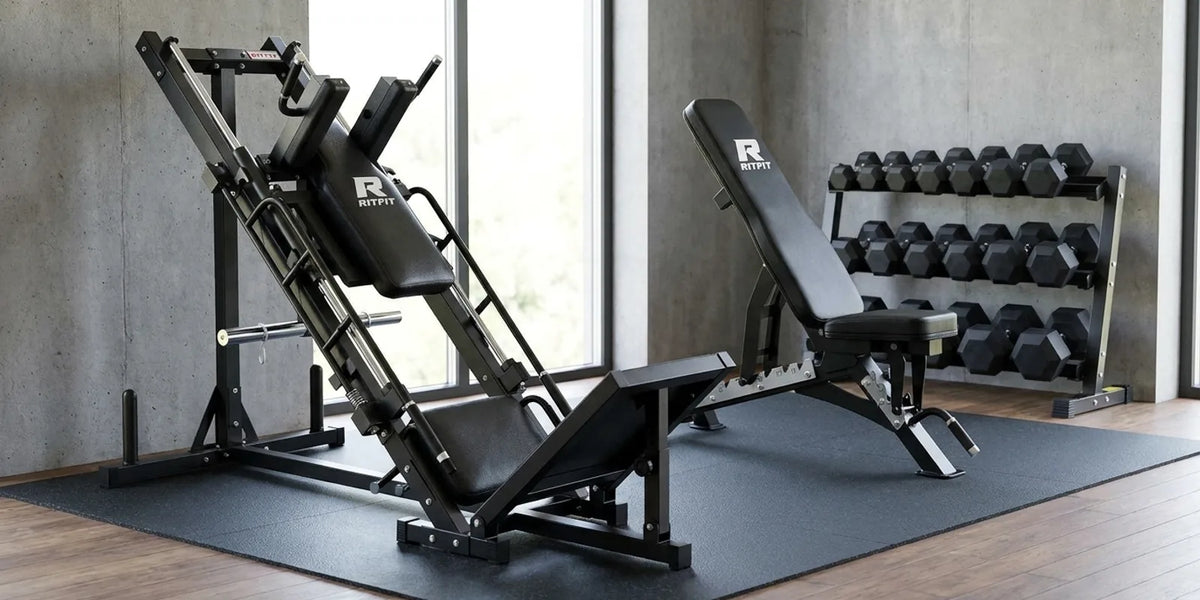
A home hack squat machine such as the RitFit BLP01 3-in-1 Leg Press and Hack Squat Machine combines this movement with a leg press, so you can run a full lower-body day without a barbell, rack, or spotter.
How to Do a Hack Squat
Set your feet shoulder-width on the platform, lower your shoulders under the pads, release the safety, and descend by bending your knees until your thighs reach parallel or below, then drive through your heels to return to the top. Adjust the machine first so your knees track over your toes without strain.
- Setup: Adjust the back pad and footboard so your knees track over your toes without strain.
- Descent: Bend your knees and let your hips sink until your thighs reach at least parallel, keeping your heels flat.
- Drive: Push through the middle of your foot and extend your knees and hips together to return to the start.
- Control: Keep the descent smooth and pause briefly at the bottom before pressing up.
For a step-by-step walkthrough of setup and switching between positions, see our guide on how to use a leg press hack squat machine.
Which Muscles Does a Hack Squat Work?
The hack squat primarily works the quadriceps, with the glutes and hamstrings as secondary muscles and the calves, core, and spinal erectors assisting as stabilizers. Foot placement and depth shift the emphasis, so a lower foot position drives more quad work and a higher placement adds more glute and hamstring involvement.
- Quadriceps: The upright torso and deep knee flexion put the quads under a long stretch, which is why the hack squat is a top quad builder.
- Glutes and hamstrings: These engage more as you descend below parallel or place your feet higher on the platform.
- Calves and core: Calves assist during full extension, and the core works to keep your position stable against the pad.
- EMG support: In one EMG comparison, vastus medialis and vastus lateralis activity was greater during the hack squat than during the leg press at 70% and 90% of one-repetition maximum.
"The best quad exercise in the world is going to be your hack squats. You're always going to get more press on the front thighs. If you can get into a hack squat machine and it does not hurt, this is the ultimate exercise to build those frontal thighs."
Jay Cutler, Four-time Mr. Olympia, Cutler Nutrition, Jay Cutler Shares the Best Quad Exercise in the World to Build Size
How Is a Hack Squat Different From a Leg Press?
A hack squat keeps your torso upright against an angled pad while you squat under shoulder pads, whereas a leg press has you reclined and pushing a sled with your feet, with your back fully supported. The hack squat mimics a squat pattern with deeper knee flexion, while the leg press allows heavier, more back-friendly loads.
| Feature | Hack Squat | Leg Press |
|---|---|---|
| Movement | Weight on back, upright torso, angled track | Reclined sled push, back fully supported |
| Primary movers | Quads, then glutes and hamstrings | Quads, glutes, hamstrings |
| Quad emphasis | Very high, deep knee flexion | High, adjustable via foot position |
| Core and lower back | Moderate stabilisation | Minimal, back supported |
| Max load | Moderate to high | Very high |
| Best for | Quad-focused development, squat carryover | Overall leg mass, back-friendly heavy loading |
Comparisons are general movement characteristics. Individual results vary by machine setup, foot placement, and training experience.
Machine geometry also explains part of the load gap. One study calculated leg press effective load by adding the moving seat weight and external stacks to body weight[1].
Another determined total leg press load as the loaded plates plus the sled weight itself[2]. The machine weight always adds to what you lift, which is one reason you can usually leg press more than you hack squat.
For a deeper look at the leg press side of this comparison, see our guide on leg press muscles worked and browse the full leg press machine collection.
Which Should You Use: Hack Squat or Leg Press?
Choose the hack squat when quad development is your main goal or you want a squat-pattern movement with less lower-back demand, and choose the leg press when you want heavy, back-supported volume or need to bias the glutes and hamstrings with a higher foot placement. Most programs use both across a training week.
- Pick the hack squat for: quad growth, squat carryover, and a deeper range of motion.
- Pick the leg press for: maximal loading, a beginner-friendly setup, and lower-back-friendly volume.
- Use both: Pair them so the hack squat handles quad-focused work and the leg press covers volume and glute emphasis.
Both exercises are excellent leg builders, and the choice comes down to your priority. If your quads are lagging, the hack squat is the stronger tool, and the RitFit Gazelle Pro 3-in-1 Leg Press and Hack Squat Machine lets you train both patterns at home.
Why Add a Hack Squat to a Home Gym?
A home hack squat machine gives you a safe squat pattern without a barbell, rack, or spotter, so you can train heavy leg work in a small space. A 3-in-1 machine such as the RitFit BLP01 or RitFit Gazelle Pro adds a leg press and calf raise to the same footprint.
- Safer than a barbell: The machine guides the path and catches the load, so you can train to failure without a spotter.
- Back-friendly: The angled pad supports your torso, which cuts lower-back strain versus a free-weight squat.
- Space saving: A 3-in-1 unit replaces several machines in about 20 square feet of floor space.
- Consistency: One pilot study found that home-based resistance training improved well-being in middle-aged adults over eight weeks.[3]
For a compact setup, the RitFit BLP01 fits a garage corner, while the RitFit Gazelle 3-in-1 adds more adjustability for taller lifters.
How to Choose the Right Hack Squat Machine for Your Home
Choose a home hack squat machine by matching its footprint, weight capacity, and adjustability to your space and training level. A 3-in-1 unit that combines leg press, hack squat, and calf raise gives you the most lower-body coverage per square foot.
- Footprint: Confirm the machine fits your room with space to load plates and clearance above the top position.
- Weight capacity: Match the machine rating to your working weights and leave headroom for progress.
- Adjustability: Look for a movable back pad and adjustable footboard so the machine fits your height and stance.
- Versatility: A 3-in-1 machine lets you switch between leg press, hack squat, and calf raise in seconds.
For a full leg setup, the RitFit BLP01 Full Leg Workout Package bundles everything in one order, and the RitFit BLP01 Pink matches a design-led home gym.
How Many Sets and Reps Should You Do?
Start with the empty carriage to learn the range of motion, then build up over several sessions. For hypertrophy, 3 to 5 sets of 8 to 12 reps with 60 to 90 seconds of rest works well, while 3 to 4 sets of 5 to 8 reps suits strength work.
- Start light: Begin with the empty carriage and add small plates once the movement feels stable.
- Rep ranges: Use 8 to 12 reps for muscle growth and 5 to 8 reps for strength and loading practice.
- Frequency: Train the hack squat 1 to 2 times per week, allowing 48 hours between lower-body sessions.
- Add weight: Increase the load when you complete the top of the rep range with clean form on every set.
Progression is about control, not speed. Add weight in small steps and keep your working weight well below what you could leg press, especially in the first weeks.
Common Hack Squat Mistakes to Avoid
The most common hack squat mistakes are dropping too fast, lifting your heels, cutting depth short, and adding weight before the pattern is stable. Each one reduces quad work or loads your knees unnecessarily.
- Bouncing at the bottom: Descend under control and pause briefly instead of rebounding out of the hole.
- Heels lifting: Keep your feet flat so the load stays over the middle of your foot.
- Half reps: Take your thighs to at least parallel to get the full quad range.
- Going too heavy too soon: Build the pattern first, then add load in small steps.
- Ignoring knee pain: Stop and reduce depth if you feel sharp knee pain, and check your foot position.
FAQs About the Hack Squat
What is a hack squat?
A hack squat is a machine leg exercise where you squat down and up on a fixed angled track with a padded back support and shoulder pads holding the weight. It mimics a barbell back squat pattern with the balance and spinal loading demands removed.
What muscles does a hack squat work?
The hack squat primarily works the quadriceps, with the glutes and hamstrings as secondary muscles. Calves, core, and spinal erectors assist as stabilizers. Foot placement and depth shift the emphasis. A lower foot position drives more quad work, while a higher placement adds more glute and hamstring involvement.
Is a hack squat better than a leg press?
For quad development the hack squat is generally the better choice because its upright torso and deeper knee flexion put the quads under more stretch. The leg press allows heavier, more back-friendly loads and spreads work across the whole leg, so most programs use both.
Is the hack squat harder than the leg press?
Most lifters find the hack squat harder per rep because it requires more core activation and a deeper range of motion. You can typically leg press more weight, since the reclined leg press supports the back and shares the load across more muscles.
Can I do hack squats at home?
Yes. A home hack squat machine such as the RitFit BLP01 or Gazelle Pro combines leg press and hack squat in one footprint. You can train the squat pattern safely at home without a barbell, rack, or spotter. The machine guides the movement, so setup is simpler than learning free-weight squats.
How much weight should I start with on a hack squat?
Start with the empty carriage to learn the range of motion, then add small plates as you feel stable. Progress with controlled reps rather than big jumps, and keep working weight well below what you could leg press, especially at first.
Conclusion
This guide explained what a hack squat is, which muscles it works, and how it differs from a leg press.
The hack squat is the most quad-dominant machine leg exercise, while the leg press suits heavier, back-friendly loading.
A 3-in-1 home machine such as the RitFit BLP01 covers both movements in one footprint.
Start light, build your depth, and add weight steadily. Pair the hack squat with a leg press and calf raise for a complete lower-body day, then check the RitFit discount guide for current offers before you buy.
Disclaimer
This article is for general education only and does not replace professional medical, fitness, or safety advice. Consult a qualified trainer or healthcare provider before starting a new exercise program, especially if you have existing knee, back, or joint conditions.
References
1. Migliaccio GM, Dello Iacono A, Ardigo LP, et al. Leg Press vs. Smith Machine: Quadriceps Activation and Overall Perceived Effort Profiles. Front Physiol. 2018;9:1481. PMCID: PMC6206431
2. Effects of Different Types of Lower Body Resistance Exercise on Upper-body Strength in Men and Women, with Special Reference to Anabolic Hormones. Int J Exerc Sci. 2021;14(3):1052-1069. PMCID: PMC8439705
3. Kikuchi N, Ohta T, Hashimoto Y, et al. Effect of Online Home-Based Resistance Exercise Training on Physical Fitness, Depression, Stress, and Well-Being in Middle-Aged Persons: A Pilot Study. Int J Environ Res Public Health. 2023;20(3). doi:10.3390/ijerph20031769. PMCID: PMC9914297