








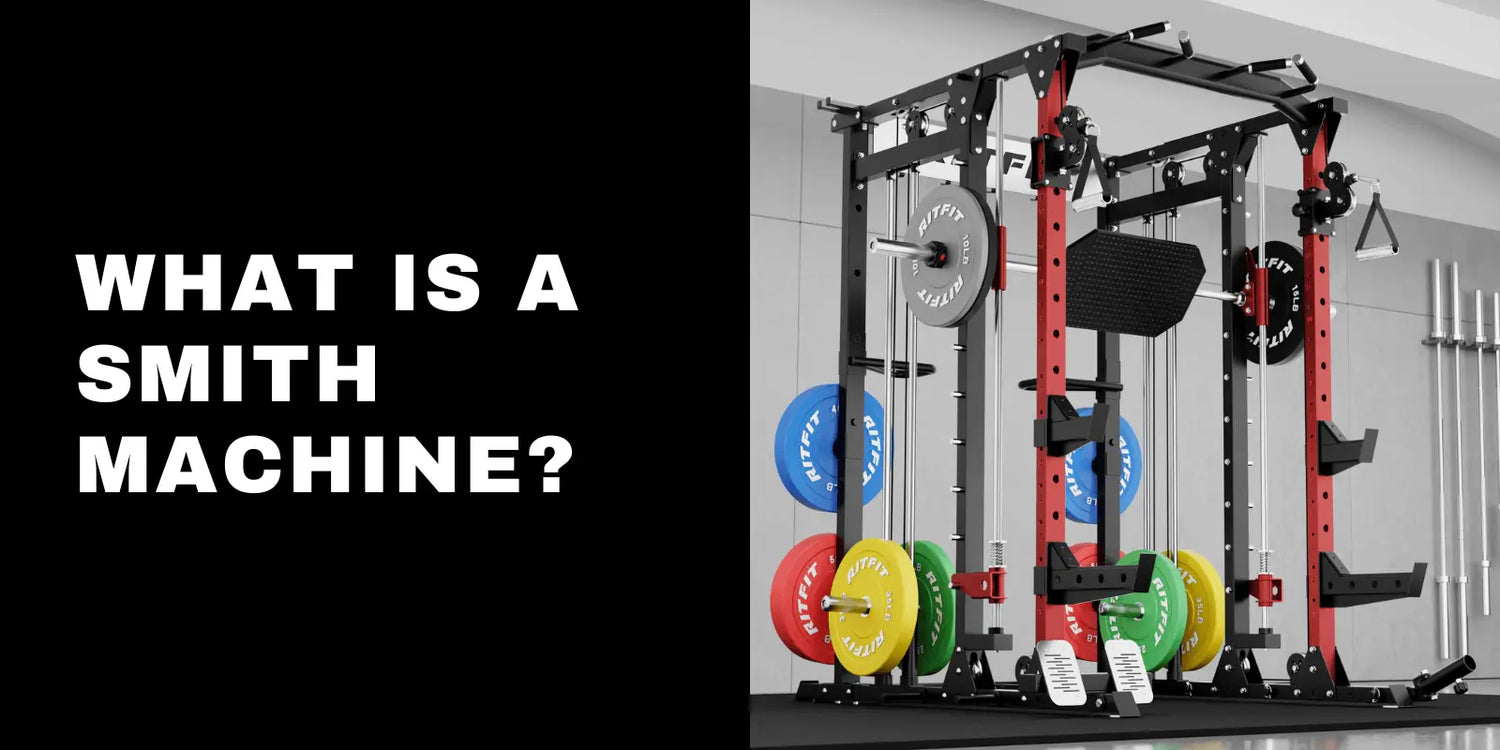
A Smith machine is a barbell that rides on steel guide rails, so it moves on a fixed vertical or angled path instead of drifting freely like a barbell in a power rack. That one design choice shapes everything the machine does well, from solo training safety to repeatable hypertrophy work.
So what is a Smith machine in practice, and does it belong in your home gym? This guide covers how the rail system works, how it compares with a power rack and free barbell, and which RitFit model fits your space and goals.
Quick Answer: A Smith machine is a weight training machine that holds a barbell on fixed guide rails with locking hooks, letting you train heavy barbell-style lifts alone with a repeatable bar path. It is especially useful for hypertrophy presses, squats, split squats, calf raises, and hip thrusts, while free weights still build more balance and stabilization skill.
Key Takeaways
- Guided Bar Path: The rails fix the bar path, cutting balance demands so you can train hard without a spotter.
- Muscle Activation: One 2009 electromyography study reported about 43% greater average lower body activation in free weight squats, so treat the Smith machine as a complement rather than a full replacement.
- Real Results: Both free weight and machine based training build strength and hypertrophy across matched programs, and the Smith machine is especially strong for presses, hip thrusts, and calf raises.
- Setup Sensitivity: Rail direction, foot placement, and bench position decide whether the machine feels natural or awkward, so test the empty bar path before loading plates.
- Home Gym Choice: Compare the RitFit M1 PRO, M2, and Buffalo on bar path type, listed capacity, cable system, and footprint before you buy one station for your space.
What Is a Smith Machine?
A Smith machine is a barbell fixed to guide rails that moves on a controlled path instead of moving freely. The rails remove the balance work of a free barbell, and the locking hooks let you secure the bar at any height, which is why solo lifters and home gym owners rely on it.
Main Components of a Smith Machine
The core parts are the guided bar, the guide rails, the locking hooks, and the adjustable safeties, with some models adding a counterbalance system that changes the unloaded starting feel.
- Guided bar and rails: The bar rides on linear bearings or bushings along fixed steel rails, which changes balance demands and setup strategy compared with a free barbell.
- Locking hooks: A quick wrist twist seats the hooks into slotted steel posts, so you can rerack or stop the bar at any point in the rep without walking it back to a stand.
- Adjustable safeties: Most models add blocks, pegs, or stops that halt the bar at a preset minimum height, giving every heavy set a built in floor.
- Counterbalance and starting resistance: Some Smith bars feel lighter than a standard 45 lb barbell because counterweights offset part of the bar mass, so the unloaded starting feel varies by model.
- Rack points and adjustments: More height settings make the machine easier to fit to different lifters, benches, and exercises.
Fixed, Angled, and 3D Bar Paths
Not every Smith machine moves the same way, and the bar path type changes how each exercise feels.
- Fixed vertical path: The classic design gives the bar one degree of freedom, straight up and down travel on the rail.
- Angled rails: Some models set the rails on a slight incline, which shifts where your feet or bench need to sit for a natural press or squat.
- 3D Smith machines: Some variant designs add a second degree of freedom, forward and back, while still keeping the bar from rotating or drifting side to side.
If you want to see how these path types show up in real products, start with the RitFit Smith Machine collection and compare footprint, attachments, and training priorities before anything else.
Where Did the Smith Machine Come From?
The Smith machine traces back to the 1950s, when Jack LaLanne rigged up a sliding barbell apparatus in his gym. Rudy Smith spotted the apparatus, commissioned Paul Martin to improve it, and installed the modified model in Vic Tanny's gym in Los Angeles, which is how the machine got its name.
- Origin: Fitness history accounts trace the machine to LaLanne's 1950s sliding apparatus, built so lifters could work hard without a spotter for every set.
- Spread: By the end of the 1950s, Rudy Smith was an executive in Vic Tanny's gym chain, and the machine was being manufactured and sold more widely.
- Modern evolution: Today's home gym versions fold in cable stations, pull up bars, plate storage, and rack features, turning the guided bar into a broader training station.
The core idea has not changed since, which is to give lifters a barbell experience that does not require a spotter, while the hardware around the rails keeps evolving.
How Does a Smith Machine Work?
A Smith machine works by guiding the bar along a fixed track, so your body organizes itself around the path. On most designs the bar locks into slotted steel posts with a quick wrist twist, and adjustable stops can catch the bar at a height you choose before the set starts.
Vertical vs. Angled Smith Machines
Vertical rails usually let you set up closer to a traditional straight up and down bar path, while angled rails change where your feet or bench need to sit.
- Vertical rails: Often easier to map to standard squats, presses, rows, and split squats.
- Angled rails: May feel better for some movements, but usually require more deliberate foot placement or bench adjustment.
- Quick test: Unlock the empty bar and guide it through the path before loading plates, then position yourself to match the path instead of forcing a free barbell setup.
What Does Science Say About Smith Machine Training?
Across matched programs, free weight and machine based training both build maximal strength and hypertrophy, and carryover tends to be strongest for the style you practice most.[1] That means a Smith machine carries real training value as long as you respect what the fixed path does.
- Guided practice: The machine rewards repeatable setup, controlled tempo, and direct focus on the target muscle.
- Specificity: If your main goal is free barbell skill, the free barbell still needs its own practice time.
- Fatigue management: Rails make near failure sets easier to manage alone, which suits hypertrophy blocks.
Lower Body Exercises
Lower body Smith machine work is usually most effective when the lift benefits from stability, a repeatable stance, and easy reracking.
- Smith machine squats, including back squats, front squats, and box squats
- Smith machine split squats and lunges
- Smith machine Romanian deadlifts and stiff leg deadlifts
- Smith machine calf raises
- Smith machine hip thrusts and glute bridges
For step by step tutorials, see how to do the Smith machine front squat, the Smith machine hip thrust, and the Smith machine Romanian deadlift.
Upper Body Exercises
Upper body Smith machine work is often best when you want a stable press or row that lets you push effort without balancing the bar, which matters for home lifters without a spotter.
- Smith machine bench press, including flat, incline, and decline variations
- Smith machine shoulder press
- Smith machine bent-over row
- Smith machine upright row
- Smith machine shrug
For movement specific setup help, read how to do the Smith machine shoulder press.
Other Smith Machine Exercises
Some of the best Smith machine movements are modified exercises that benefit from the fixed rail, including accessory patterns that are easy to repeat and easy to progress.
- Smith machine inverted rows
- Close-grip bench press
- Overhead triceps extensions
How Does a Smith Machine Compare With a Power Rack and Free Barbell?
A Smith machine trades bar path freedom for solo safety and repeatability, while a power rack keeps the bar free. The right choice depends on whether you value guided confidence or unrestricted barbell skill, and each tool handles balance work differently.
| Feature | Smith Machine | Power Rack | Free Barbell |
|---|---|---|---|
| Bar path | Fixed vertical or angled rail path | Free within the rack uprights | Completely free in space |
| Stabilizer demand | Low, the rails guide the bar | High, you balance the load | Highest |
| Solo safety | Wrist twist hooks plus adjustable stops | Adjustable safety pins or straps | Depends on a spotter or controlled bail |
| Skill carryover | Strongest to guided lifting | Strongest to free barbell skill | Strongest to free barbell skill |
| Space and setup | One station, fast transitions | Open frame, needs side clearance | Needs open floor and plates |
| Best fit | Solo home lifters, hypertrophy focus | Strength focused free weight lifters | Lifters with spotters or full safety setups |
Comparison reflects typical design categories rather than any single model.
Muscle recruitment differs as well. A 2009 electromyography study found about 43% greater average lower body muscle activation during free weight squats than during Smith machine squats.[2]
"Fantastic bar! This was my first barbell that I bought from RitFit, and similar to the PowerCage and Smith Machine Attachment, I was immediately impressed by the attention to detail and the overall quality. It came with very nice wrapping package, very nice knurling and whip, love it."
Xin F. Verified Buyer, RitFit 7FT Olympic Barbell Bar 2'' Weight Lifting Bar
What Are the Pros of Using a Smith Machine?
The biggest Smith machine pros are solo training confidence, repeatable setup, and focused hypertrophy work in one compact station. It can reduce decision fatigue in a home gym because one footprint covers guided lifts, accessory work, and high effort sets with less setup friction.
- Safer feeling solo training: The hooks and safeties make it easier to train hard without relying on a spotter.
- More repeatable setup: The fixed path makes it easy to reproduce stance, bench position, and working range from session to session.
- Stronger hypertrophy use case: Stability lets many lifters focus more directly on the target muscle during presses, split squats, calf raises, and hip thrusts.
- Faster exercise transitions: Home gym users often value speed and convenience as much as load potential, especially in mixed full body sessions.
- Broader station coverage: A Smith machine with cables can replace several accessory stations in one footprint, which is one reason the RitFit M1 Smith Machine home gym package is popular among home gym owners.
"The smith machine is great because it's going to take a lot of the pressure out of your shoulders because it's supporting itself and you can do a little bit more weight on here. So it can help you break some barriers too, and also if you don't have a spotter you can utilize the tabs, put that right here so if you drop it it'll just bounce and then you won't hurt yourself."
Jeff Cavaliere, MSPT, CSCS, Physical Therapist and Strength Coach, former Head Physical Therapist for the NY Mets, Athlean-X
What Are the Cons of Using a Smith Machine?
The main Smith machine cons are reduced stabilizer demand, weaker free barbell carryover, and setup sensitivity to the rail path. It can also feel awkward when the fixed path does not match your natural proportions, squat style, or pressing angle.
- Less stabilizer demand: The machine helps guide the bar, so your body does less balance work than it would with a free barbell.
- Less free weight specificity: If you want better free barbell skill, you still need to practice free barbell skill.
- Not every squat pattern fits well: Some lifters feel great on Smith squats, while others prefer split squats, front squats, or free weight options.
- Model differences matter: Rail feel, starting resistance, and overall smoothness vary more than many buyers expect, so checking the RitFit PSR05 Smith machine or a comparable model before buying is recommended.
- Log keeping friction: Manufacturers rarely publish Smith bar weights, so the same plate load can mean different true totals on different machines.
Are Smith Machines Actually Safer Than Free Weights?
Smith machines are safer for solo training because hooks and stops catch the bar, but they are not risk free. The safety gain is real and specific, it removes the balance and bail out problem, and it does not remove the danger of having a heavy bar over your body.
- How the lockout works: Behind each vertical post is a series of slots, and a quick wrist twist seats the hooks so the bar stops at any point in the rep.
- Adjustable stops: Most models add blocks, pegs, or catches that halt the bar at a preset minimum height, which protects you when a squat or press fails mid rep.
- Honest limits: Equipment references caution that the guided setup can instill a false sense of confidence, because the safety features do not fully eliminate the inherent danger of a heavy load.
- Bench press caution: If you fail a heavy bench press alone, you cannot roll or tip the bar off sideways the way you can with a free barbell, so keep the stops set and avoid true limit attempts without a backup.
- Safeties only work when set: A Smith machine is only safer than free weights when the hooks and stops are actually adjusted before the set starts.
Who Is the Smith Machine Best For?
The Smith machine best serves beginners, solo home lifters, and hypertrophy focused trainees who value controlled, repeatable loading. Novice trainees can improve with machines, free weights, or a mix when the plan is progressive, which makes the Smith machine a useful entry point instead of a dead end.[3]
- Beginners: A Smith machine lowers the coordination barrier and can make first barbell-style sessions feel less intimidating.
- Home gym owners: It covers a lot of exercises in one station and helps solo training feel practical, especially when paired with a leg machine for lower body variety.
- Hypertrophy-focused lifters: It is strong for repeatable setup, controlled tempo, and near failure sets.
- Busy lifters: It shortens setup time and helps one station do more work per session.
- Less ideal as a complete replacement: If your main goal is unrestricted barbell skill, a Smith machine should complement, not replace, free weights.
What Smith Machine Workouts Can You Do?
The best Smith machine workouts match the machine to your goal, using rails for control and other tools for freedom. Build your session around the lifts that feel natural on the rail path, then fill the gaps with cables, dumbbells, or bodyweight work.
Full Body Smith Machine Workout
This beginner friendly format works well when you want simple exercise flow, stable setup, and broad muscle coverage in one session.
- Smith machine squat or box squat: 3 sets of 8 to 12 reps
- Smith machine flat bench press: 3 sets of 8 to 12 reps
- Smith machine bent-over row: 3 sets of 8 to 12 reps
- Smith machine shoulder press: 3 sets of 10 to 15 reps
- Smith machine Romanian deadlift: 3 sets of 10 to 15 reps
- Smith machine standing calf raise: 3 sets of 15 to 20 reps
Run it 2 to 3 times per week on nonconsecutive days and keep 1 to 3 reps in reserve on early sets.
Upper Lower Smith Machine Workout Plan
This split works well when you want slightly more weekly volume without turning every workout into a long full body session.
- Upper Day: Incline bench press, shoulder press, bent-over row, shrug or upright row, then arm work if your setup allows it.
- Lower Day: Squat variation, split squat or lunge, Romanian deadlift, hip thrust, then standing calf raise.
- Target volume: Use 3 to 4 work sets on primary lifts and 2 to 3 work sets on secondary lifts, alternating upper and lower days once or twice each per week.
Smith Machine Accessory Day
This format works best for lifters who already do free barbell work and want the Smith machine to make accessory training more efficient.
- Front foot elevated split squat: 3 sets of 10 to 12 reps per leg
- Close-grip bench press: 3 sets of 8 to 12 reps
- Inverted row: 3 sets close to technical failure
- Hip thrust or glute bridge: 3 sets of 12 to 15 reps
- Standing calf raise: 3 sets of 15 to 20 reps
Use it after your main strength day or on a separate hypertrophy day with shorter rest periods.
How Do You Choose the Right Smith Machine?
The right Smith machine matches your rail preference, stability needs, cable priorities, and space, not just the attachment count. Focus first on rail feel, frame strength, safety design, cable usefulness, and whether the machine supports the lifts you actually perform.
- Rail style: Vertical rails usually feel more neutral, while angled rails may require more setup adjustment, and 3D paths add forward and back travel.
- Frame stability: A wider base, stronger uprights, and smoother carriage travel usually feel better under load.
- Safety system: Easy hooks and usable safeties matter more than flashy extras.
- Cable value: A Smith machine with cables can replace more accessory stations and make the footprint work harder, so a cable machine integration is worth prioritizing.
- Space planning: Measure height, width, depth, and plate storage clearance before you buy, especially for low ceiling home gyms.
RitFit M1 Pro
The M1 PRO is the all around pick for lifters who want a Smith machine, rack function, and cable training in one station with a listed 20.1 square foot footprint. RitFit lists a 352 lb Smith capacity on an 11 position bar, a 33 lb Smith bar, and a 2 to 1 pulley system rated for 420 lb per side.
- Durability in practice: RitFit lists 2x2 in 14 gauge uprights with a 1600 lb maximum capacity and a 575 lb safety arm rating, which keeps heavy squats and presses planted when you load the bar near your limit.
- Versatility in practice: The guided bar, rack points, pull up station, landmine work, and dual cable stations cover warm ups, compound lifts, and accessories without moving between machines.
- Value in practice: It carries the lower listed base price in RitFit's own Smith machine lineup comparison, which matters when you are building a garage gym around one station.
- Best fit: General home gym lifters who want one setup to handle most weekly sessions, including guided lifts, free weight work, and cable work.
Choose the RitFit M1 PRO Smith machine when you want one station for guided lifts, rack work, and cable training with minimal compromise.
"Few pieces of equipment in the home exercise industry are as comprehensive and versatile as this all-in-one gym system. The robust system provides a natural, centered bar path for compound lifts like squats, presses, and rows, and incorporates a dual cable crossover station with a full rack of precision-engineered attachments."
Tom Eskey, CF-L1, CPT, Home Gym Equipment Reviewer, Garage Gym Revisited
"Great product smith machine is butter smooth. Rack is very sturdy."
Bryan M. Verified Buyer, RitFit M1 PRO Multi-Functional Smith Machine with Cable Crossover System and Squat Rack for Home Gym
"Our clients love the new set up and get great workouts with the M1 Pro!"
Charles J. Verified Buyer, RitFit Pink M1 PRO Multi-Functional Smith Machine Home Gym Package
RitFit M2
The M2 is the modular pick, and it is the only model in RitFit's current M series lineup with an available 3D Smith bar path that moves both vertically and horizontally. Configurations differ by cable resistance style, so you can choose plate loaded cables or built in dual weight stacks that make cable work faster.
- 3D path in practice: The bar can travel forward and back as well as up and down, which lets your natural squat or press path guide the rep instead of forcing a fixed line.
- Versatility in practice: A dual pulley layout plus a growing attachment ecosystem covers lat pulldowns, low rows, and arm work as your training evolves.
- Best fit: Intermediate trainees and physique focused lifters who want accessory friendly training and room to expand.
See the RitFit M2 multi functional Smith machine for the current configurations before you decide between plate loaded and weight stack packages.
"The RITFIT M2 3D Pro is a solid budget-friendly all-in-one home gym that works as a half-rack, a dual-cable functional trainer, lat-pulldown / low row machine, and perhaps the most unique feature: A 3D smith machine that can be used in 3D mode or as a standard fixed smith machine."
Eugene, Home Gym Equipment Reviewer, RITFIT M2 3D Pro Modular Home Gym Review
"The 3d motion is smooth and feels like one is being spoiled. Cables glide over the pulleys and appreciate how they keep releasing new accessories to expand it's versatility."
Lawrence n. Verified Buyer, RitFit M2 Multi-Functional Modular Home Gym Smith Machine Tailored to All Fitness Levels
RitFit Buffalo
The Buffalo is the heavy duty pick for lifters who prioritize frame strength and bigger loads over compactness. RitFit lists 2x3 in 13 gauge uprights, a 1800 lb maximum capacity, a 1300 lb safety arm rating, and a 30.75 lb Smith bar with 9 height settings.
- Durability in practice: The thicker 13 gauge uprights and 478 lb rack weight keep the frame planted under repeated heavy sessions, which suits low rep strength work.
- Versatility in practice: Lat pulldown, cable crossover, and a modular vertical leg press attachment ship with the package, so lower body pressing has its own station.
- Best fit: Advanced lifters and heavier trainees who want a solid platform under bigger loads.
"For $1,800, this machine delivers a combination of build quality, stability, and versatility that is rare at this price. The BUFFALO is not a machine that excels at one thing. It is a platform that lets you program an entire training week without ever stepping off the frame."
BJ Nelson, Head of Field Testing, The Iron Clinic
"Super fast shipping! Awesome quality machine! Definitely requires two people to put together it's very well built and heavy! Didn't take long to put together but labeling each piece would be helpful for newbies. Loving this machine so far!!"
Betsy W. Verified Buyer, RitFit BUFFALO Smith Machine Home Gym Package with Lat Pull Down and Cable Crossover
Quick Comparison
The best model depends on which training friction you want to remove from your week, so compare bar path, listed capacity, and cable style side by side. For a deeper two model dive, read the full RitFit M1 PRO vs Buffalo comparison.
| Feature | RitFit M1 PRO | RitFit M2 | RitFit Buffalo |
|---|---|---|---|
| Bar path | Fixed vertical | Available 3D, vertical plus horizontal | Fixed vertical |
| Uprights, listed | 2x2 in 14 gauge | Varies by configuration | 2x3 in 13 gauge |
| Maximum listed capacity | 1600 lb | Varies by configuration | 1800 lb |
| Smith capacity and bar | 352 lb, 33 lb bar, 11 settings | Varies by configuration | 352 lb, 30.75 lb bar, 9 settings |
| Safety arm rating | 575 lb | Varies by configuration | 1300 lb |
| Cable system | 420 lb per side, 2 to 1 | Dual pulley, weight stacks optional | 310 lb per side, 2 to 1 |
| Listed footprint and rack weight | 20.1 sq ft, 339 lb | Varies by configuration | Robust frame, 478 lb |
| Ideal user | General home gym lifter | Modular accessory focused lifter | Advanced strength focused lifter |
Specifications are RitFit listed values from RitFit's published Smith machine lineup comparisons, reviewed July 15, 2026. M2 specifications vary by configuration, so confirm the exact live package before purchasing.
How Do You Train Safely on a Smith Machine?
Safe Smith machine training means matching your body to the rail path, setting safeties, and testing the empty bar. Setup matters more than many lifters realize because stance, torso angle, and rail direction all change how the lift feels.[4]
General Setup Guidelines
Following a consistent setup routine helps you get the most out of every Smith machine session while reducing unnecessary joint stress.
- Set the bar height first: You should be able to unrack and rerack without tiptoeing, shrugging, or twisting awkwardly.
- Match your body to the rail path: Do not force a free barbell setup if the rails ask for a different foot or bench position.
- Use the safeties every time: A Smith machine is only safer when the safety setup is actually in place.
- Test the empty bar: Run one or two unloaded reps before you commit to working weight.
Exercise-Specific Cues
The best cue is usually the one that improves joint comfort while keeping tension on the target muscle.
- Squats: Keep your feet where the rail path lets you descend smoothly without collapsing forward or jamming the knees.
- Bench press: Set the bench so the bar descends to a comfortable line over the chest, not just wherever the bench first lands.
- Shoulder press: Use a grip width that lets the elbows move naturally and avoid painful top end positions.
- Rows: Keep your torso set, pull with the back, and avoid turning the movement into a loose shrug.
If a variation keeps feeling wrong after setup changes, switch the variation instead of forcing the rep pattern.
How Should You Program Smith Machine Training?
Program the Smith machine as one tool inside a broader plan, not as your only training stimulus. Muscle can be built across a broad loading range when sets are challenging and technique stays consistent, which lets the machine serve both moderate rep hypertrophy work and heavier controlled sets.[5]
- Use the machine where it adds value: Choose it for stable presses, split squats, calf raises, hip thrusts, and other lifts where repeatable setup helps.
- Keep some free movement in the week: Dumbbells, cables, bodyweight work, or barbells help fill the gaps that a fixed rail path leaves behind.
- Progress with intent: Add load, reps, or cleaner execution over time instead of chasing random fatigue.
- Manage weekly volume: Higher weekly hard set volume can support more hypertrophy in trained lifters, although strength gains do not always rise in the same proportion.[6]
- Avoid common mistakes: Do not assume all Smith machines feel the same, do not copy free barbell setup blindly, and do not skip safeties because the machine feels controlled.
FAQs About Smith Machines
What is a Smith machine best used for?
A Smith machine is best used for controlled barbell-style training, especially when you want more stability, repeatable setup, and safer solo lifting. It works especially well for hypertrophy-focused presses, squats, split squats, calf raises, and hip thrusts, where setup consistency matters.
Is a Smith machine good for beginners?
Yes.
A Smith machine can be very good for beginners because the guided bar path reduces balance demands and makes setup easier to learn.
It still requires good positioning, controlled range of motion, and proper safety setup, so it should support learning, not replace basic technique awareness.
Why do Smith machine squats feel awkward for some lifters?
Smith machine squats can feel awkward because the fixed rail path may not match your natural squat pattern, limb lengths, or torso angle. Small changes in foot placement, stance width, and bar position often improve comfort, but some lifters still prefer free weight or split squat variations.
Can a Smith machine build real muscle and strength?
Yes.
A Smith machine can build real muscle and meaningful strength when you train hard, progress over time, and use exercises that fit your structure.
It is especially effective for hypertrophy work, but free weights may still be better if your main goal is maximum coordination and bar control.
How much does a Smith machine bar weigh?
A Smith machine bar does not have one universal starting weight because designs vary by manufacturer and counterbalance system. Some bars feel much lighter than a standard barbell, so you should always check the product specifications or test the unloaded bar before tracking your training load.
Should you buy a Smith machine or a power rack first?
You should buy a Smith machine first if you value guided lifting, solo training confidence, and all-in-one convenience. You should buy a power rack first if your priority is unrestricted barbell practice, broader free weight carryover, and a more traditional strength training setup.
What should you check before buying a Smith machine for a home gym?
You should check the Smith machine footprint, height, rail style, pulley system, safety design, and attachment options before buying. You should also confirm ceiling clearance, storage layout, starting resistance, and how well the machine supports the lifts you actually plan to use.
Does a Smith machine work for lower body exercises like leg presses?
A Smith machine can support many lower body exercises, but it does not replace a dedicated leg press. If you want a machine designed specifically for lower body isolation, consider adding a leg press machine to your home gym for exercises the Smith machine cannot replicate.
Are Smith machines safer than free weights?
Smith machines can feel safer because the bar locks into the rails with a quick wrist twist, and adjustable stops can catch the bar at a set height, which helps when you train alone. The guided path lowers balance demands but does not remove all risk, so you should still set the safeties, keep controlled form, and never assume the hooks replace a spotter on limit bench presses.
Are Smith machine squats bad for your back?
Smith machine squats are not inherently bad for your back, but the fixed bar path asks your spine, hips, and knees to adapt to the rail instead of the other way around. If your stance or foot placement does not match the path, some lifters feel extra pressure in the lower back or knees, so adjust your setup, use a comfortable range of motion, and switch variations if discomfort continues.
Conclusion
The Smith machine is best seen as a practical training tool, not as a magic fix and not as a lesser version of free weights. It shines when you want stability, solo training confidence, and efficient muscle-focused work in a home gym.
If you match the machine to your body, your goals, and your space, it can become one of the most productive pieces of equipment in your program. Use it strategically and let it complement the other tools that round out your training.
Disclaimer
This article is for general educational purposes only and is not medical advice. If you have pain, recent injury, surgery, numbness, weakness, or dizziness, consult a qualified clinician or coach before training.
References
1. Haugen ME, Vårvik FT, Larsen S, Haugen AS, van den Tillaar R, Bjørnsen T. Effect of free-weight vs. machine-based strength training on maximal strength, hypertrophy and jump performance - a systematic review and meta-analysis. BMC Sports Sci Med Rehabil. 2023;15(1):103. doi:10.1186/s13102-023-00713-4. PMCID: PMC10426227
2. Schwanbeck S, Chilibeck PD, Binsted G. A comparison of free weight squat to Smith machine squat using electromyography. J Strength Cond Res. 2009;23(9):2588-2591. doi:10.1519/JSC.0b013e3181b1b181.
3. Aerenhouts D, D'Hondt E. Using Machines or Free Weights for Resistance Training in Novice Males? A Randomized Parallel Trial. Int J Environ Res Public Health. 2020;17(21). doi:10.3390/ijerph17217848. PMCID: PMC7662789
4. Straub RK, Powers CM. A Biomechanical Review of the Squat Exercise: Implications for Clinical Practice. Int J Sports Phys Ther. 2024;19(4):490-501. doi:10.26603/001c.94600. PMCID: PMC10987311
5. Schoenfeld BJ, Grgic J, Van Every DW, Plotkin DL. Loading Recommendations for Muscle Strength, Hypertrophy, and Local Endurance: A Re-Examination of the Repetition Continuum. Sports (Basel). 2021;9(2). doi:10.3390/sports9020032. PMCID: PMC7927075
6. Schoenfeld BJ, Contreras B, Krieger J, et al. Resistance Training Volume Enhances Muscle Hypertrophy but Not Strength in Trained Men. Med Sci Sports Exerc. 2019;51(1):94-103. doi:10.1249/MSS.0000000000001764. PMCID: PMC6303131





