








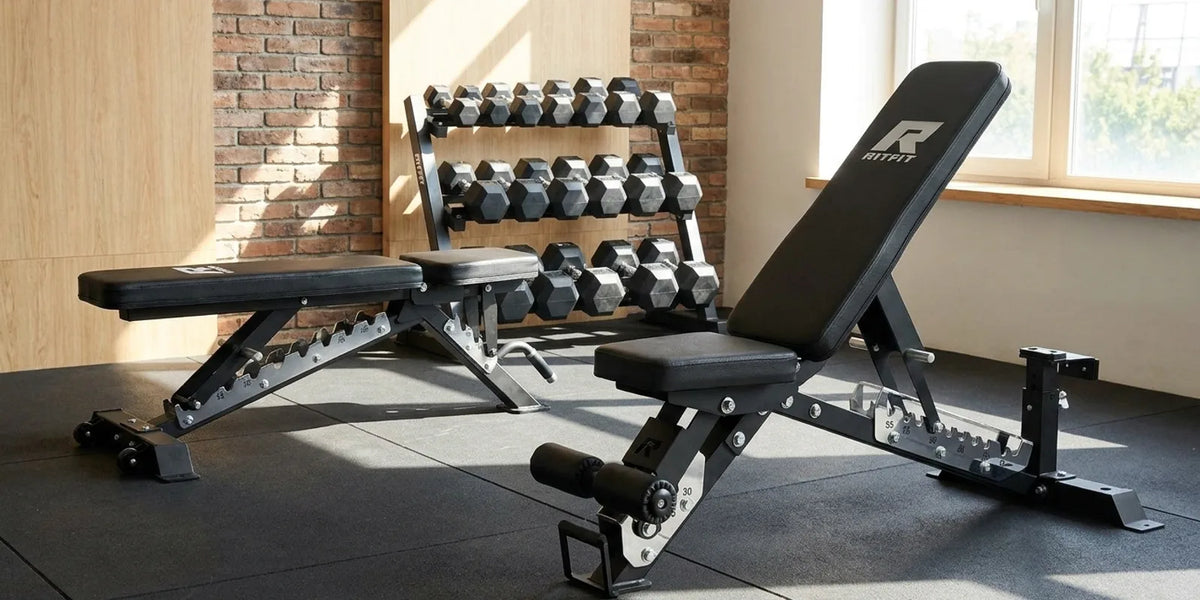
An adjustable weight bench is a strength-training bench with a hinged backrest that moves from flat through incline angles, and on FID models into decline, so a single frame handles flat presses, incline work, seated shoulder presses, and decline moves.
This guide explains what an adjustable weight bench is, how much capacity you need at your body weight, what each angle does, and which specs to check before you buy.
Quick Answer: An adjustable weight bench is a strength bench with a hinged backrest that moves from flat through incline angles, and on FID models into decline, so one frame covers flat pressing, incline work, seated shoulder presses, and decline moves. Its rating counts your body weight plus the loaded bar, and quality home models are typically rated 600 to 1,000 lb.
Key Takeaways
- Definition: An adjustable weight bench uses a hinged backrest to move from flat through incline, and on FID models into decline, covering far more exercises than a flat bench.
- Angles: A 30 to 45 degree incline targets the upper chest, while flat supports heavier pressing and decline works the lower chest and core.
- Capacity: The rating counts your body weight plus the loaded bar, not the plates alone, and quality home models are typically rated 600 to 1,000 lb.
- Body weight: If you weigh 200 lb or more, aim for a 700 lb rating or higher so a loaded barbell still leaves headroom.
- Shared benches: Two users do not add their body weights together, because the rating applies to one person on the pad at a time.
- Key specs: Weight capacity, pad width and gap, pad height, frame gauge, and adjustment mechanism matter more than price or looks.
What Is an Adjustable Weight Bench?
An adjustable weight bench is a strength bench with a hinged backrest that moves from a flat position through several incline angles, and on FID models into a decline position, so a single frame replaces multiple pressing stations.
It is the most common bench type for home gyms because one frame covers flat benches, incline benches, and often a decline setup.
- Flat position: 0 degrees, used for barbell bench press and flat dumbbell work.
- Incline positions: typically 15 to 85 degrees, used for incline press, seated shoulder press, and chest-supported rows.
- Decline position (FID): around minus 15 to minus 30 degrees, used for decline press and core work.
- Seat adjustment: the seat tilts with the backrest on most models to keep your hips level through the range.
If you press with a barbell and dumbbells and want upper-chest and shoulder work on one frame, an adjustable bench covers angles a flat bench cannot reach. Models like the RitFit 1300LB Adjustable Weight Bench put that full range on a single hinged platform.
Adjustable vs Flat vs FID Bench: Which Type Do You Need?
A flat bench has a fixed horizontal pad and is the most stable choice for barbell pressing, an adjustable bench moves from flat through incline, and an FID bench adds decline to cover the widest exercise range.
For most home gyms an adjustable or FID bench delivers the best mix of versatility and value on one frame.
| Bench Type | Backrest | Exercise Range | Best For |
|---|---|---|---|
| Flat | Fixed, 0 degrees | Barbell press, flat dumbbell work | Lifters who almost exclusively barbell press |
| Adjustable | Flat to incline, up to about 85 degrees | Incline press, shoulder press, supported rows | Most home gym owners |
| FID | Flat, incline, and decline | Adds decline press and decline core work | Lifters who want the widest range on one bench |
Flat benches are the most stable, while adjustable and FID benches cover more angles on one frame.
- Pick a flat bench if: you almost exclusively barbell press and want maximum stability.
- Pick an adjustable bench if: you use dumbbells or structured programs and want incline and seated work.
- Pick an FID bench if: you want decline for chest and core without buying a second bench.
An adjustable bench does everything a flat bench does, then adds incline, decline, and seated work, so for most owners the extra cost is worth it. Only choose a dedicated flat bench if you will never train at an angle.
Adjustable Bench Angles: What Should You Set for Flat, Incline, and Decline?
Your bench angle decides which region of the chest and shoulders carries the load, and a 30 to 45 degree incline is the setting that keeps the upper chest working without handing the press to your shoulders.
Steeper settings turn the movement into a seated shoulder press, while flat and decline settings shift the work down the chest and into the core.
- Flat (0 degrees): the strongest position for barbell pressing with your feet planted.
- Low incline (15 to 30 degrees): a middle ground that shifts emphasis off the lower chest.
- Mid incline (30 to 45 degrees): the sweet spot for the upper chest.
- High incline (60 to 85 degrees): closer to a seated shoulder press than a chest press.
- Decline (minus 15 to minus 30 degrees): works the lower chest and turns the bench into a decline sit-up station.
| Backrest Setting | Primary Target | Where It Fits in a Session |
|---|---|---|
| 0 degrees | Whole chest, heaviest loads | Barbell bench press for top sets |
| 15 to 30 degrees | Upper chest with lower-chest help | Dumbbell press as a second chest movement |
| 30 to 45 degrees | Upper chest | The default angle for incline pressing |
| 60 to 85 degrees | Front delts | Seated shoulder press inside a rack |
| Minus 15 to minus 30 degrees | Lower chest and abs | Decline press and decline sit-ups |
Angle ranges follow the incline and decline positions listed above for adjustable and FID benches.
So which one, 30 or 45 degrees?
Both sit inside the useful upper-chest range and the difference between them is small.
Start at 30 degrees if your shoulders take over on incline pressing, and move to 45 degrees when you want a shorter, more vertical press that leans on the front delts.
Above 60 degrees you are doing a seated shoulder press rather than a chest press.
A systematic umbrella review notes that progressive resistance training prescription builds muscle mass and strength in healthy adults, so rotating angles and loads on your bench is part of a sound plan.[1] Another study ties repetitions in reserve to lifting velocity as a valid way to monitor resistance training and manage fatigue.[2]
For practical programming, rotate flat, incline, and decline across your week instead of pressing only flat, so every chest region gets its own stimulus.
How Much Weight Capacity Does an Adjustable Weight Bench Need?
A weight bench rating counts everything resting on the frame at once: your body weight, the bar, and the plates. A 200 lb lifter pressing a loaded 225 lb barbell puts about 425 lb on the bench, so the rating needs real headroom above that number.
Quality home adjustable benches are typically rated 600 to 1,000 lb, and heavier lifters should stay in the upper half of that range.
- Body weight plus load: the rating covers your body weight plus the bar and plates on top of it, not the plates alone.
- 600 to 1,000 lb: the typical range for quality home adjustable models.
- Higher ratings: commercial-spec frames with wider bases suit heavier or more frequent use.
The number you actually need depends on your body weight, so pick your band before you compare brands.
- Under 150 lb body weight: a 600 lb rating leaves a wide margin for barbell and dumbbell work.
- 150 to 200 lb: aim for 700 lb or more so a loaded barbell still leaves headroom.
- 200 to 250 lb: look at 800 lb and above, ideally a frame rated 1,300 lb or more.
- 250 lb and above: choose a commercial-spec frame with a wider base and thicker steel.
The most common confusion is what happens when a bench is shared.
- Two users: the rating applies to one person on the pad at a time, so two users do not add their body weights together.
- What does change: a shared bench runs more sessions per week, so the pivot, the bolts, and the pad wear faster.
- What to check: confirm each user clears the rating on their own, then inspect the frame and pad more often.
One bench can carry a beginner and an experienced lifter, provided the rating clears the heavier of the two.
- Nervous starter: a 600 lb frame comfortably covers body weight plus light dumbbells, and the flat and low incline settings are the easiest to control.
- Seasoned lifter: the same frame keeps working until body weight plus a heavy barbell approaches the rating, at which point the frame becomes the limit rather than the angle range.
- What to watch: the weaker link is almost always the pad and the seat joint, not the steel.
The rating itself does not fade over time, but the parts around it do.
- The frame rating holds: a steel frame rated at 700 lb is still a 700 lb frame in year three, because steel does not lose strength through normal use.
- What does wear: pad foam compresses, bolts loosen, and the backrest pivot develops play after heavy use.
- What to do: inspect the pivot and retighten the bolts each season, and replace the pad once it compresses permanently.
Capacity is the first spec to check, because it is the one you cannot work around later. A narrow pad or a stiff adjustment pin is an annoyance, but an overloaded frame is a safety problem.
A bench press study notes that barbell load and lifting velocity influence exercise volume and perceived exertion, which is one reason a capacity rating should leave headroom for your working sets.[3] The RitFit 1300LB Adjustable Weight Bench is rated 1,300 lb, well above the typical home range.
If your body weight plus the heaviest load from your Weights setup comes close to the rating, step up to a higher capacity bench rather than pushing the limit.
Key Specs to Check: Pad, Frame, and Adjustment Quality
Weight capacity, pad width, pad gap, pad height, frame gauge, and the adjustment mechanism decide how stable and comfortable a bench feels, and they matter far more than any cosmetic feature.
Look for a pad width of roughly 11 to 12 inches, a small seat-to-back gap, and 11 to 12 gauge steel for a rigid frame.
- Weight capacity: aim for 700 lb or more so the rating clears your body weight plus the bar.
- Pad width: 11 to 12 inches supports the shoulders without limiting arm movement.
- Pad gap: a small seat-to-back gap keeps you from sinking in during incline or decline work.
- Pad height: around 17 to 17.5 inches suits bench pressing and lets most lifters plant their feet flat.
- Frame gauge: lower gauge numbers mean thicker, more rigid steel tubing.
- Adjustment mechanism: ladder-style pin systems are simpler and more durable than pop-pin systems.
- Stability under load: check the base width and test for wobble at the seat joint, because a frame that shifts near your working weight is a safety problem rather than an inconvenience.
The RitFit Gator Adjustable Weight Bench is built with 14-gauge steel and rated to 1,600 lb, with 10 back pad angles and a five-way adjustable head rest, so it clears every baseline above for serious home pressing.
"Built with 14-gauge steel, the RitFit Gator Adjustable Weight Bench offers a robust weight capacity of 1,600 pounds. With 10 back pad angles, three seat pad positions, three decline settings, and a five-way adjustable head rest, you have ample options to support your strength and muscle building goals."
Stephen Sheehan, CPT, CNC, Certified Personal Trainer and Nutritionist, Garage Gym Reviews, RitFit Gator Adjustable Weight Bench Review
How to Choose an Adjustable Bench for Your Home Gym
Choose an adjustable bench by matching capacity, angle range, and footprint to your training style and floor space, then pick the highest spec your budget allows.
Start with bench type, then specs, then space, and only then compare models within the brand.
| If You Want | RitFit Bench to Consider | Why It Fits |
|---|---|---|
| Max capacity and a wide angle range | Gator Adjustable Weight Bench | Rated 1,600 lb with 10 back angles and decline settings |
| A core adjustable bench for press work | RitFit 1300LB Adjustable Weight Bench | Rated 1,300 lb at a more accessible price point |
| A pink finish for a styled gym | Gator Pink or BWB01 Pink variants | Same steel and angle range in a Pink colorway |
This decision matrix compares only RitFit adjustable bench models within the same product line.
- Measure first: check floor footprint and overhead clearance before you buy, then confirm rack fit.
- Pair with dumbbells: an adjustable bench with Adjustable Dumbbells unlocks incline press, curls, and supported rows.
- Plan for upgrades: a capacity that clears your body weight plus a loaded bar leaves room to grow.
- Check storage: if space is tight, look for a bench that folds or stands upright when not in use, such as the RitFit PWB01 Adjustable Foldable Weight Bench.
- Confirm the warranty terms: check what the frame warranty covers and how long it runs, because a frame claim is the expensive failure.
- Replacing a worn bench: note which part failed first, whether that was the pad, the pivot, or the frame, so the replacement fixes the real problem.
Filling a spare room usually comes down to footprint, door width, and whether the bench can fold away between sessions. If the room doubles as a guest space, measure the fold-down height before you commit to a heavy commercial frame.
Browse the Benches collection to compare capacity and angle ranges side by side. For audience-focused picks, read the Best Adjustable Weight Bench for Men and Best Adjustable Weight Bench for Women guides, and for space planning start with the Best Adjustable Weight Bench for Garage Gym guide.
What Are the Most Common Adjustable Bench Buying Mistakes?
The most common mistake is buying on price and looks instead of capacity, stability, and fit, because a wobbling or undersized bench limits training and feels unsafe under load.
Avoid these seven errors when you shop.
- Ignoring weight capacity: a low rating leaves no margin for your body weight, the bar, and plates.
- Reading the rating as plates alone: your body weight counts toward the number, so compare the rating against your weight plus the bar and plates.
- Overlooking the pad gap: a large seat-to-back gap lets you sink in awkwardly on incline and decline.
- Skipping the space check: measure footprint and clearance before you buy, not after.
- Forgetting rack fit: a bench that is too tall or too long will not position correctly under your rack uprights.
- Pressing only flat: owning an adjustable bench but never inclining wastes the versatility you paid for.
- Buying the cheapest option: a bench that shifts under a loaded bar is a safety problem, not an inconvenience.
FAQs About Adjustable Weight Benches
What is an adjustable weight bench?
An adjustable weight bench is a bench with a hinged backrest that moves from a flat position through several incline angles and, on FID models, into decline, so a single frame supports flat pressing, incline pressing, seated shoulder work, chest-supported rows, and decline core movements in one home setup.
What is the difference between a flat and an adjustable bench?
A flat bench has a fixed horizontal pad and is the most stable choice for barbell pressing, while an adjustable bench moves from flat to incline, and often decline, covering more exercises and muscle groups on one frame, which makes it the more versatile option for most home gyms.
What angle should I set an adjustable bench to for upper chest?
Set the backrest to an incline between 30 and 45 degrees to target the upper chest while keeping your shoulders from taking over, and lower the angle if the press starts to feel entirely like a shoulder movement during the lift.
How much weight should an adjustable bench hold?
Quality home adjustable benches are typically rated for 600 to 1,000 lb, which comfortably covers your body weight plus a loaded bar and plates, and a higher rating gives a safer margin if you press heavy weights on a regular basis.
Can I barbell bench press on an adjustable bench?
Yes, set the backrest fully flat and the bench works like a fixed flat bench, so check the bench height and load rating to keep your feet planted flat and your shoulders well supported while you press under the bar.
Is an adjustable bench worth it over a flat bench?
For most home gym owners yes, because a single adjustable bench replaces several stations by adding incline, decline, and seated shoulder work, and that versatility generally outweighs the slight stability edge of a fixed flat bench for lifters who train more than one angle.
Is the capacity on an adjustable weight bench enough for somebody over two hundred pounds?
Yes for most models. A 200 lb lifter sits inside a 600 to 1,000 lb rating once the bar and plates are counted, though a 250 lb lifter pressing a loaded barbell should move to a frame rated 1,300 lb or higher. Check the number against your body weight plus your heaviest working load.
Does the capacity change if two people use the same adjustable weight bench?
No. The rating applies to one person on the pad at a time, so two users do not add their body weights together. What changes is wear, because a shared bench runs more sessions per week, so check the pad and the pivot bolts more often than you would on a personal bench.
Does the weight range on an adjustable bench cover both a nervous starter and a seasoned lifter?
Yes, as long as the rating clears the heavier lifter. A beginner using body weight and light dumbbells stays far below a 600 lb rating, while an experienced lifter pressing a heavy barbell is limited by the frame rating and not by the angle range, so start with a 700 lb frame or higher.
Will the capacity on an adjustable weight bench still hold after a couple of years?
Yes. A steel frame rated at 700 lb is still rated at 700 lb in year three, because steel does not lose strength with use. What does change is the pad foam, the pivot play, and bolt tightness, so inspect those parts each season and replace the pad if it compresses permanently.
Conclusion
An adjustable weight bench is the most versatile bench for a home gym because one hinged frame handles flat, incline, and decline work. Judge a bench on weight capacity, angle range, pad specs, and frame gauge, and match the rating to your body weight plus the heaviest load you press.
If you are building your first home gym, start with an adjustable model and pair it with dumbbells and plates to complete the setup. Check the RitFit discount guide before you buy to lower the total cost of your first bench and its accessories.
Disclaimer
Strength training involves inherent risk, and the information in this guide is general education, not personal training or medical advice. Consult a qualified professional before starting a new training program or if you have an injury or a medical condition.
References
1. Currier BS, Lowisz CV, Phillips SM. The influence of resistance exercise training prescription variables on skeletal muscle mass, strength, and physical function in healthy adults: An umbrella review. J Sport Health Sci. 2024;13(1):47-60. PMCID: PMC10818109
2. Jukic I, Prnjak K, Helms ER, McGuigan MR. Modeling the repetitions-in-reserve-velocity relationship: a valid method for resistance training monitoring and prescription, and fatigue management. Physiol Rep. 2024;12(5):e15955. PMCID: PMC10901726
3. Ferri Marini C, Shoaei V, Micheli L, et al. Barbell load distribution and lifting velocity affect bench press exercise volume and perceived exertion. PLoS One. 2022;17(12):e0278909. PMCID: PMC9733861





