








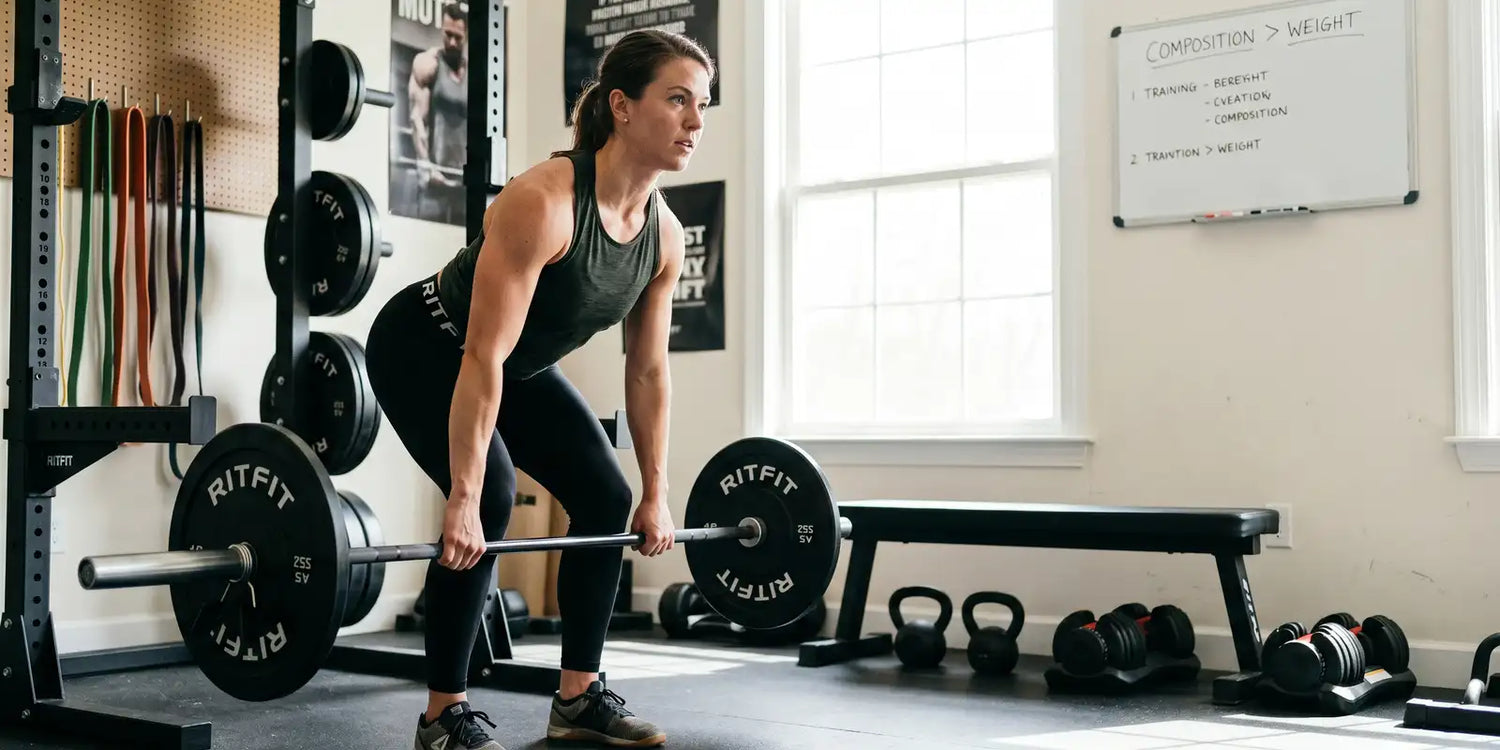
Body composition is the proportion of your body made up of fat versus fat-free mass such as muscle, bone, water, and organs. It explains why two people at the same weight can look and perform completely differently.
This guide breaks down what body composition means, how it differs from weight and BMI, the common ways to measure it, and how training and nutrition slowly shift it over time.
Table of Contents
Key Takeaways
- Definition: Body composition is the ratio of fat mass to fat-free mass, not how heavy you are.
- Beyond the scale: Two people of identical weight and BMI can have very different bodies and health profiles.
- Measurement varies: No single method is a perfect gold standard, so each trades accuracy for convenience.
- No magic number: There is no single universal healthy body fat percentage, and ranges differ by age and sex.
- It is changeable: Resistance training plus adequate protein can build muscle and reduce fat over time.
What Is Body Composition?
Body composition is the relative proportion of fat and fat-free mass that makes up your total body weight. Fat-free mass includes bones, organs, tissues, muscle, and water.[1]
In other words, it tells you what your weight is actually made of rather than just how much you weigh. This is one of the 5 components of physical fitness used to assess overall health.
The short video above from The Cooper Institute offers a clear visual overview before we dig into each component.
Body Composition vs. Body Weight and BMI
Body weight reflects the combined mass of all your tissues, while body composition shows the split between fat and lean mass. The scale alone cannot tell those apart.
- The scale problem: A pound of muscle and a pound of fat weigh the same but occupy very different space and have different effects on health.
- The BMI problem: Body mass index uses only height and weight, so it can label a lean, muscular person as overweight.
The Limits of BMI
Percent body fat, defined as fat mass divided by total weight, is a more accurate picture of obesity risk than BMI for most active people, as outlined by fitness educators at The Cooper Institute.
People of the same age, height, and weight, and therefore the same BMI, can still have different body shapes, energy needs, and metabolic profiles, which is why body composition independently influences health.[1]
The Key Components: Fat Mass, Lean Body Mass, and Muscle
Body composition is most often divided into two broad buckets, fat mass and fat-free mass. Understanding each helps you interpret any test result.
- Fat mass: All the fat in your body, including the essential fat needed for normal hormone and organ function.
- Fat-free mass: Everything that is not fat, including bone, water, organs, and muscle.
- Lean body mass: According to the Obesity Action Coalition, lean body mass is slightly larger than muscle mass because it also includes water.
- Skeletal muscle: The muscle you train at the gym, and the main lever you can pull to reshape your composition.
This is where strength training terms matter, so it helps to know what RM means in fitness when planning workouts that build lean mass.
How Body Composition Is Measured
Several methods estimate body composition, and they range from cheap home tools to facility-based scans. Available techniques can measure fat, fat-free mass, bone mineral content, total body water, and skeletal muscle.[1]
- Bioelectrical impedance analysis (BIA): Sends a small current through the body and estimates fat-free mass by assuming roughly 73 percent hydration of that mass.[1]
- DXA scans: Use low-level X-rays to separate fat, bone, and lean tissue across body regions.
- Skinfold calipers: Pinch fat at set sites to estimate body fat at low cost and high convenience.
- Hydrostatic weighing and Bod Pod: Estimate body density from water or air displacement to derive fat percentage.
A narrative review notes that no single in-vivo technique meets the highest accuracy criteria, so a four-compartment model combining body volume, total body water, and bone mineral content is treated as the most accurate reference.[2]
Choosing a Method: Accuracy vs. Convenience
A review comparing methods explains that skinfolds and portable BIA are inexpensive and home usable, while DXA, hydrostatic weighing, and air displacement plethysmography are more accurate but require facilities.[3]
What Is a Healthy Body Fat Percentage?
According to the Obesity Action Coalition, there is no single universally defined healthy body fat percentage. Both very high and very low body fat carry health risks.
- Some fat is essential: A baseline level of body fat supports hormones, temperature regulation, and organ protection.
- Ranges differ: Healthy ranges vary by age, sex, and individual goals, so context matters more than a single target.
Rather than chasing one number, track gradual change over time. This is one reason fitness for women often emphasizes composition trends instead of scale weight.
Why Body Composition Matters
Body composition often predicts health and performance better than weight alone. A higher proportion of lean mass tends to support strength, mobility, and metabolic health.
- Health context: The same weight can carry different health implications depending on the fat-to-lean ratio behind it.
- Aging: Lean mass and muscle tend to decline with age, which is why older adults benefit from tracking composition, supported by the right fitness accessories for seniors.
Understanding training intensity also helps here, so learning RIR, or reps in reserve, can make muscle-building work more effective.
How to Improve Your Body Composition
Improving body composition usually means building or preserving muscle while reducing fat, a process often called body recomposition. Consistency matters more than any single workout.
- Lift regularly: Resistance training several times a week gives muscle a reason to grow and adapt.
- Eat enough protein: Adequate protein supports muscle repair while you manage overall calorie intake.
- Be patient: The scale may barely move because muscle is denser than fat, so progress photos and measurements tell a fuller story.
Keeping records helps you see slow change, which is why understanding the purpose of a fitness log can keep you motivated through plateaus.
FAQs About Body Composition in Fitness
What is body composition in simple terms?
Body composition is the proportion of your body made up of fat versus fat-free mass such as muscle, bone, water, and organs. Two people can weigh exactly the same yet look and perform very differently because their ratio of fat to lean tissue differs. It tells you what your weight is actually made of.
Is body composition the same as BMI?
No. BMI uses only your height and weight, so it cannot tell fat from muscle and may label a lean, muscular person as overweight. Body composition directly estimates how much of your weight is fat versus lean mass, giving a far clearer picture of health and fitness than BMI alone provides for most active people.
What is the most accurate way to measure body composition?
Research indicates no single in-vivo method is a perfect gold standard. A four-compartment model that combines body volume, total body water, and bone mineral content is considered the most accurate reference. For everyday use, DXA scans, Bod Pod, and hydrostatic weighing are highly accurate, while home BIA scales and skinfold calipers are convenient but less precise.
Can you change your body composition?
Yes. Combining regular resistance training with adequate protein and sensible calorie intake helps you build or preserve lean muscle while reducing fat, a process often called body recomposition. The bathroom scale may barely move during this process because muscle is denser than fat, which is exactly why tracking body composition matters more than weight alone.
What is a healthy body fat percentage?
There is no single universally defined healthy body fat percentage, and ranges differ by age, sex, and individual. Both very high and very low body fat carry health risks, since some fat is essential for normal hormone and organ function. Rather than chasing one number, focus on gradual, sustainable changes guided by a qualified professional when needed.
Conclusion
Body composition tells you what your weight is made of, splitting it into fat mass and the muscle, bone, water, and organs that form fat-free mass. That insight matters more than the scale or BMI for most people.
If you are starting out, pick one consistent measurement method, train with resistance, eat enough protein, and judge progress over months rather than days.
Disclaimer
This article is for general educational purposes only and does not provide medical, diagnostic, or personalized fitness advice. Consult a qualified healthcare or fitness professional before making changes to your training, nutrition, or body composition goals.
References
1. Lemos T, Gallagher D. Current body composition measurement techniques. Curr Opin Endocrinol Diabetes Obes. 2017;24(5):310-314. https://pmc.ncbi.nlm.nih.gov/articles/PMC5771660/
2. Campa F, Toselli S, Mazzilli M, Gobbo LA, Coratella G. Assessment of Body Composition in Athletes: A Narrative Review of Available Methods with Special Reference to Quantitative and Qualitative Bioimpedance Analysis. Nutrients. 2021;13(5). https://pmc.ncbi.nlm.nih.gov/articles/PMC8150618/
3. Duren DL, Sherwood RJ, Czerwinski SA, et al. Body composition methods: comparisons and interpretation. J Diabetes Sci Technol. 2008;2(6):1139-1146. https://pmc.ncbi.nlm.nih.gov/articles/PMC2769821/





