The multi-stage fitness test is a 20-meter shuttle run that estimates your aerobic capacity by making you run back and forth in time with audio beeps that get faster every level. It is the same test many people call the beep test, bleep test, or PACER.
This guide explains where the test came from, how to set it up and run it, how scoring works, how your score becomes a VO2 max estimate, and how to train for a higher result.
Table of Contents
Key Takeaways
- One test, many names: The multi-stage fitness test, beep test, bleep test, 20m shuttle run, and PACER all describe the same progressive shuttle run.
- How it works: You run 20 meters back and forth in time with beeps that speed up each level until you can no longer keep pace.
- Scoring: Results are written in level.shuttle format, such as 9.5, and the last shuttle you complete in time is your score.
- VO2 max is estimated: Your level is converted to a predicted VO2 max, which is a useful estimate but not a laboratory measurement.
- You can improve it: Aerobic base work, interval running, sharp turns, and consistent retesting all help raise your level.
What Is the Multi-Stage Fitness Test?
The multi-stage fitness test (MSFT) is a progressive running test that estimates aerobic capacity, or VO2 max. It is also called the beep test, bleep test, PACER test (progressive aerobic cardiovascular endurance run), and the 20m shuttle run test.
All these names describe the same idea, running 20 meters back and forth in time with beeps that get faster.
- What it measures: Cardiovascular endurance, expressed as an estimated VO2 max or a level reached.
- Who uses it: Sports clubs, schools, and police or military recruiters as a quick, low-cost fitness screen.
- How it differs from strength tests: This is an aerobic field test, unlike a strength measure such as what RM means in strength training.
If you want a broader fitness battery instead of a single aerobic test, the Presidential Fitness Test covers several components at once.
Where the Beep Test Came From
The test was first described by Canadian sport scientist Luc Leger. The 20m shuttle run version was first published by Leger and Lambert in 1982 using 2-minute stages.
It was later modified to 1-minute stages in 1988, which is the version most people run today.
- Starting speed: The original 1-minute protocol begins at about 8.5 km/h.
- Progression: Speed increases by roughly 0.5 km/h at each new level, signaled by a level-change cue.
- Why it spread: It needs minimal equipment and can run indoors in a small space, making it easy to use with groups.
Because it is simple and repeatable, the test became a standard tool for measuring aerobic fitness across many sports and age groups.
What You Need to Run the Test
You need very little gear, which is part of why the test is so popular. A measured 20-meter space and an audio track are the core requirements.
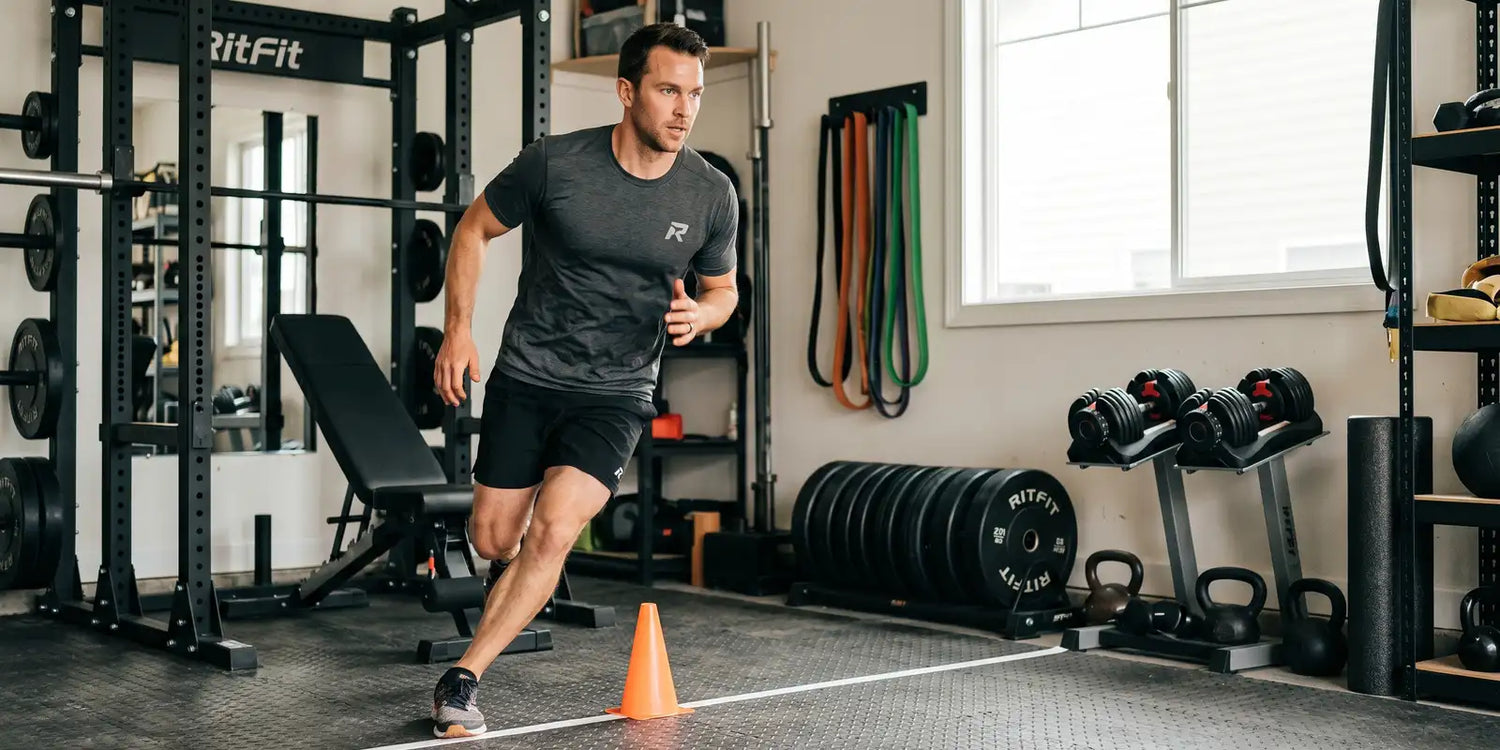
- A 20m course: Two lines or cone channels set exactly 20 meters apart on a flat, non-slip surface.
- Markers: Cones or tape for the start and turn lines, plus a clear lane if testing several people.
- Audio: A beep test track and a speaker loud enough to hear every beep over a group.
- Footwear and recording: Running shoes with good grip for sharp turns, plus a sheet to record each runner's score.
Tracking your results over time is easier when you log them, so consider keeping a fitness log of each attempt.
How to Do the Multi-Stage Fitness Test Step by Step
Line up behind the start line facing the opposite marker, then begin on the first audio cue. The goal is to reach the far line before each beep sounds.
- Start: On the first beep, run 20 meters to the opposite line, touching it with at least one foot.
- Turn and return: Wait for the next beep, then run back, pivoting tightly on the line rather than making wide turns.
- Level changes: A double beep or voice cue signals a new level, and the required pace gets faster.
- Warnings: Failing to reach the line in time earns a warning, and two consecutive misses end your test.
The video below demonstrates the full sequence, from the starting beep to the warnings and the moment the test ends.
Practicing the format until your turns and pacing feel automatic is one of the simplest ways to protect your score on test day.
How the Beep Test Is Scored
Your score is recorded in level.shuttle format, such as 9.5, which means level 9 plus five completed shuttles. The number you keep is the last shuttle you finished in time with the beep.
The test ends after two consecutive misses, so your most recent completed shuttle stands as the final result.
- Reading the score: A result of 10.2 means you reached level 10 and completed two shuttles into it.
- What counts: A shuttle only counts if you touch the line in time, so partial shuttles do not add to your score.
- Comparing results: Different versions use different structures, so compare scores only within the same test format.
Some standards are reported as laps instead of level.shuttle, which is common in school-based versions, so always confirm the format you are being tested against.
Converting Your Score to VO2 Max
VO2 max is the maximum rate at which your body can use oxygen during exercise, and a higher value reflects better aerobic fitness. Your beep test level is converted to an estimated VO2 max using a prediction equation.
This was designed as a convenient alternative to lab testing, since one coaching guide notes a laboratory VO2 max test can cost around 150 to 250 dollars and take an hour of lab time.
- Estimate, not measurement: The number is predicted from your final speed or level, not measured directly like a lab test.
- Equation matters: Several published equations exist, and they can produce different VO2 max values from the same score.
- Best for tracking: Use the same test version and conditions each time so your retests stay comparable.
How Accurate Is the VO2 Max Estimate?
The estimate is useful for tracking trends but should be treated with caution at the individual level. A study of 30 active young men found the test was repeatable yet routinely underestimated laboratory-measured VO2 max, and under a stricter analysis it did not provide valid predictions in that group.[1]
- Equation choice is critical: In 65 NCAA Division I women collegiate field hockey athletes, only the Ramsbottom and Flouris equations validly predicted VO2 max, while several others overestimated it, and even the valid equations had wide limits of agreement.[2]
- Reliability is strong: A modified 20m shuttle protocol in 161 Korean adolescents was valid and reliable, with high test-retest reliability for laps and a prediction equation that correlated well with treadmill VO2 max.[3]
In short, the test repeats well, so it is good for tracking your own progress, but treat any single VO2 max figure as an approximate value rather than an exact one.
How to Improve Your Beep Test Score
Improving your score combines building aerobic fitness with practicing the test itself. Both your engine and your technique decide how far you get before exhaustion.
- Build an aerobic base: Steady continuous runs raise the endurance that carries you through the early and middle levels.
- Add interval running: Intervals that mimic the rising pace train your body to handle the faster later levels.
- Sharpen your turns: Tight pivots on the line save fractions of a second and energy on every shuttle.
- Support with strength: Lower-body and core strength aids running economy, and you can build supporting strength at home between runs.
Tracking progress numerically helps too, much like understanding reps in reserve (RIR) guides strength training, and tools in the world of interactive fitness can make pacing practice more engaging.
FAQs About the Multi-Stage Fitness Test
Is the multi-stage fitness test the same as the beep test?
Yes, they are the same test. The multi-stage fitness test is also called the beep test, bleep test, 20m shuttle run test, and PACER test. All of them involve running 20 meters back and forth in time with audio beeps that get faster each level, and they estimate your aerobic capacity or VO2 max.
How is the beep test scored?
Your score is written in level.shuttle format, such as 9.5, which means you completed level 9 and five shuttles into the next stage. The score recorded is the last shuttle you fully finished in time with the beep. The test ends after you fail to reach the line on two consecutive beeps, so your most recent completed shuttle stands.
What is a good multi-stage fitness test score?
A good score depends heavily on your age, sex, and sport. Many recruit and team standards sit somewhere in the level 7 to level 10 range, while elite endurance athletes go far higher. Because targets vary by organisation, always check the specific standard you are being tested against rather than comparing to a generic chart you found online.
How accurate is the VO2 max estimate from the beep test?
It is a useful estimate, not a lab measurement. The score is converted using prediction equations, and the equation you pick can over or underestimate true VO2 max depending on the population being tested. For tracking your own progress, keep the test version and conditions the same each time so your results stay comparable across retests.
How can I improve my beep test score?
Train your aerobic base with steady runs, then add interval running that mimics the test's increasing pace. Practice the 20m format so your turns and pacing feel automatic, since sharp pivots save time and energy. Consistent training, good footwear with grip, and a proper warm-up all help you reach a higher level before exhaustion sets in.
Conclusion
The multi-stage fitness test is a simple, repeatable way to gauge aerobic endurance using a 20-meter shuttle run and rising beeps. Run it correctly, record your level.shuttle score, and treat the VO2 max figure as a helpful estimate rather than an exact value.
To improve, build your aerobic base, practice the format, and retest under the same conditions so your progress is clear over time.
Disclaimer
This article is for general fitness information only and does not replace professional medical or coaching advice. Consult a qualified professional before starting a new test or training program, especially if you have any health concerns.
References
1. Cooper SM, Baker JS, Tong RJ, Roberts E, Hanford M. The repeatability and criterion related validity of the 20 m multistage fitness test as a predictor of maximal oxygen uptake in active young men. British Journal of Sports Medicine. 2005;39(4):e19. https://pmc.ncbi.nlm.nih.gov/articles/PMC1725188/
2. Magee MK, White JB, Merrigan JJ, Jones MT. Does the Multistage 20-m Shuttle Run Test Accurately Predict VO2max in NCAA Division I Women Collegiate Field Hockey Athletes? Sports (Basel). 2021;9(6):86. https://pmc.ncbi.nlm.nih.gov/articles/PMC8229670/
3. Lee SH, Song JR, Kim YJ, et al. New 20 m Progressive Shuttle Test Protocol and Equation for Predicting the Maximal Oxygen Uptake of Korean Adolescents Aged 13-18 Years. International Journal of Environmental Research and Public Health. 2019;16(13):2265. https://pmc.ncbi.nlm.nih.gov/articles/PMC6650926/