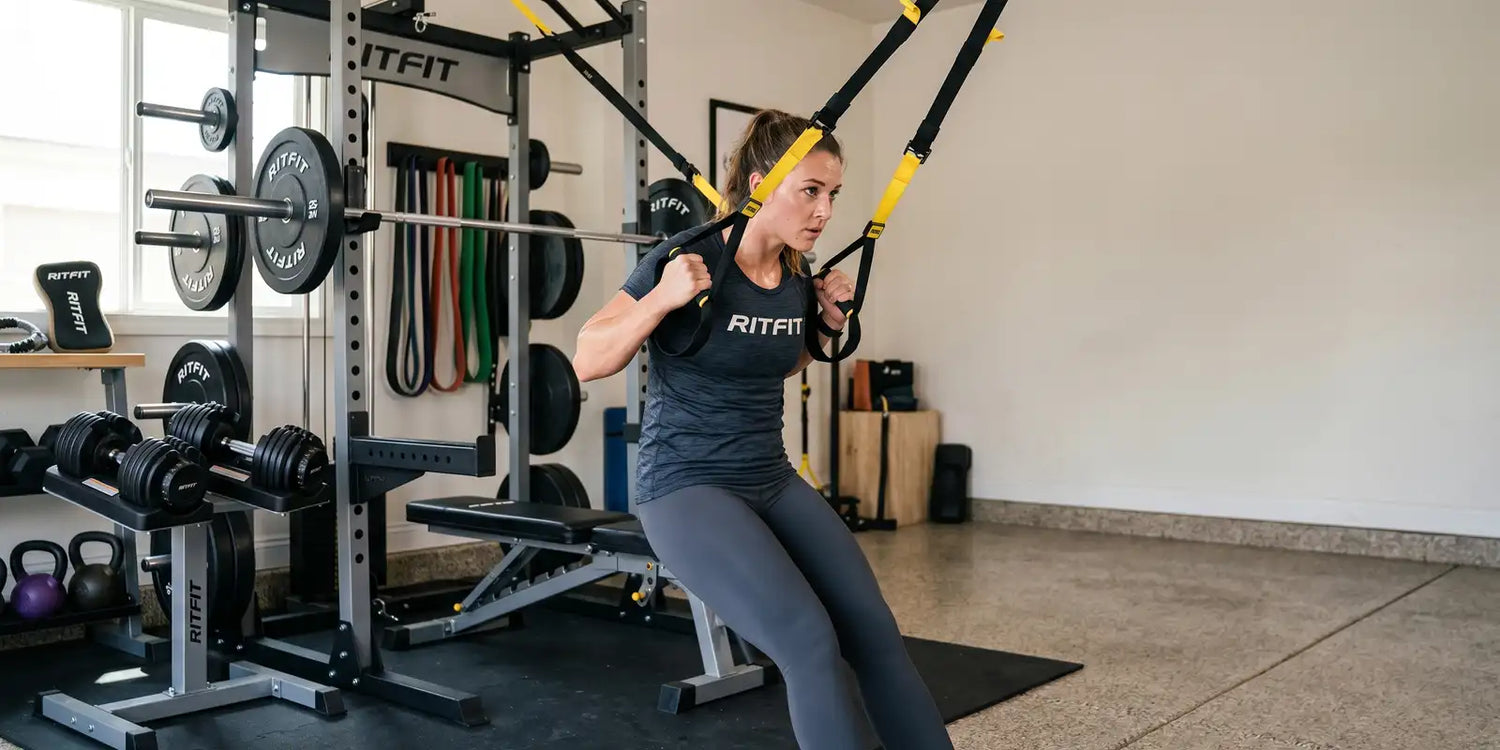
A TRX workout is a form of suspension training that turns your own body weight into resistance using two adjustable straps anchored to a single point. With one lightweight tool you can train your whole body almost anywhere.
This guide explains what TRX is, how it works, who it suits, the foundational beginner moves, and how to scale difficulty safely so you can decide whether to start.
Table of Contents
Key Takeaways
- What it is: TRX stands for Total Resistance Exercise, a suspension training style using two straps and your body weight.
- How it works: You change difficulty by adjusting your body angle to the anchor, not by adding weight.
- Who it suits: It scales from true beginners to advanced athletes, runners, and small-space trainers.
- Core focus: The unstable straps force your core to work on nearly every exercise.
- Getting started: You need a trainer, a secure anchor, and a clear space of roughly eight by six feet.
What Is a TRX Workout?
A TRX workout is a bodyweight training method that uses a single pair of adjustable straps to load, move, and control your body through exercises. TRX stands for Total Resistance Exercise, and the broader method is called suspension training.
The system was created by former Navy SEAL Randy Hetrick, who built an early version from parachute webbing to train without equipment on deployment.
- One tool, full body: Rows, squats, presses, lunges, and planks all use the same straps.
- Portable: The trainer is light enough to pack and use at home, in a gym, or outdoors.
If you want variable resistance to complement strap work, pairing it with resistance bands adds another scalable option.
How Does TRX Suspension Training Work?
TRX suspension training works by using gravity and your body weight against a single anchor point, which creates an unstable environment that recruits many muscles at once. The two straps share one attachment, giving 360 degrees of movement space.
Because the straps move, your body must constantly stabilize, so smaller muscles and the core engage more than they would on a fixed surface.
- Body angle sets intensity: Standing closer to the anchor is easier, stepping farther away is harder.
- Seven basic patterns: Push, pull, plank, rotate, hinge, lunge, and squat cover most movements.
This angle-based scaling is why one trainer can serve many fitness levels without swapping equipment.
Who Is TRX For?
TRX is for almost anyone who wants scalable, full-body training in a small space, from beginners to advanced athletes. Because difficulty depends on your stance and angle, the same move can be made gentle or demanding.
It is also popular with people who want a break from heavy impact while still challenging their muscles.
- Runners and endurance athletes: Build hip control, trunk stability, and balance.
- Small-space and travel users: Train fully with one packable tool.
- Lifters seeking variety: Add control and tempo work without more equipment.
Is TRX Good for Beginners?
Yes, TRX suits beginners because you control intensity through body position, though new users should learn proper form first and progress gradually to stay safe.
What Do You Need to Get Started?
To start a TRX workout you need a suspension trainer and a secure anchor that can support your weight, such as a door anchor, beam, or sturdy bar. A clear space of roughly eight feet long by six feet wide is enough for most exercises.
Set the anchor so the straps hang about six feet from the ground, which is the ideal height for nearly all movements.
- Weight-test first: Pull hard on the straps before each session to confirm the anchor is secure.
- Check your space: Review a home gym size guide if you are unsure about clearance.
For a broader plan, the home gym guide shows how strap training fits with other gear.
What Are the Foundational Beginner TRX Exercises?
The foundational beginner TRX exercises are the row, squat, chest press, and plank, which together train the back, legs, chest, and core. These four moves teach the bracing and angle control that every other TRX exercise builds on.
Start with a few controlled reps of each, keep a neutral spine, and brace your core before every repetition.
- TRX Row: Face the anchor, lean back, and pull your chest toward your hands to work the back.
- TRX Squat: Hold the straps for light support while you sit back and drive up through your legs.
- TRX Chest Press: Face away, hinge at the body, and press back up like a standing push-up.
- TRX Plank: Place your feet in the cradles and hold a strong, level plank for core work.
The video below walks through a full-body beginner flow so you can see the setup and form in action.
A bodyweight pushing move like the dips workout pairs well with TRX presses once your form is solid.
How Do You Adjust Difficulty Safely?
You adjust TRX difficulty by changing your body angle and foot position rather than adding weight, and one study confirmed that moving your base farther from the anchor significantly increased trunk muscle activation.[3]
What Are the Proven Benefits of TRX Training?
The proven benefits of TRX training center on core engagement, full-body strength, and balance, because the unstable straps recruit stabilizing muscles on nearly every move. One study found that suspension versions of common exercises produced significantly greater muscle activation in at least one muscle group, with the plank increasing oblique activation.[1]
Suspension work also targets the deep core in measurable ways depending on the exercise.
- Core activation: One study reported that hip abduction in plank most activated the abdominals, while the hamstring curl most activated the paraspinal muscles.[2]
- Balance and control: Constant stabilizing demand improves coordination and joint stability.
For more variable-resistance training ideas, see what resistance bands help with as a complement.
How Does TRX Fit Into a Home Gym Setup?
TRX fits into a home gym as a space-efficient anchor-based tool that complements larger equipment rather than replacing it. It covers bodyweight strength, mobility, and core work in a corner, then pairs with stations for heavier loading.
Many home exercisers use straps for control and tempo, then a fixed station for progressive overload.
- Pair with a station: A multi-functional home gym adds loaded strength alongside strap work.
- Mix training styles: Combine TRX with intervals like a Tabata workout or metcon workouts for conditioning.
Strap training also travels well, so your routine stays consistent away from home.
What Common Beginner Mistakes Should You Avoid?
The most common beginner TRX mistakes are starting at too steep an angle, letting the core sag, and rushing reps before form is solid. Each one reduces results and raises injury risk, so build a base before chasing intensity.
Listen to your body and stop any movement that causes sharp or joint pain.
- Going too hard too soon: Begin near the anchor and increase the angle gradually.
- Loose core: Brace your midsection so your hips do not drop or pike.
- Avoiding band errors too: If you add bands, review common resistance band mistakes first.
Slow, controlled reps with good form will progress you faster than sloppy, ambitious ones.
FAQs About TRX Workouts
What does TRX stand for?
TRX stands for Total Resistance Exercise, and the workout style is called suspension training. It uses a pair of adjustable straps anchored to a single point, so you leverage your own body weight and gravity to create resistance. You can train every major muscle group with one lightweight, portable piece of equipment at home or outdoors.
Is TRX good for beginners?
Yes, TRX can work well for beginners because difficulty scales with your body angle rather than added weight. Walking closer to the anchor makes a move easier, while stepping farther away makes it harder. Beginners should start with simple rows and squats, focus on a neutral spine and braced core, and consider learning proper form from a coach first.
What muscles does a TRX workout train?
Because the straps are unstable, almost every TRX exercise challenges your core while you also work the target muscles. Rows train the back and biceps, chest presses train the chest, squats and lunges train the legs, and planks heavily load the abdominals. Research found suspension versions of common moves increased core and upper body activation.
What equipment and space do I need for TRX?
You need a TRX suspension trainer and a secure anchor such as a door anchor, beam, or sturdy bar that can hold your weight. A clear area of roughly eight feet long by six feet wide is enough for most exercises. The anchor point should sit about six feet off the ground, and you should always weight-test the straps before training.
How do you make a TRX exercise harder or easier?
You adjust intensity by changing your body angle and foot position rather than adding weight. The steeper your angle relative to the anchor, the harder the exercise becomes. Research confirmed that moving farther from the anchor increased muscle activation. Beginners should progress gradually and stop any movement that causes sharp pain.
Conclusion
A TRX workout gives you scalable, full-body suspension training from one portable tool, with difficulty controlled by your body angle instead of added weight. It suits beginners and advanced athletes alike.
Start with rows, squats, presses, and planks, learn proper form, and progress gradually as your core and balance improve.
Disclaimer
This article is for general educational purposes only and is not medical advice. Consult a qualified healthcare or fitness professional before beginning any new exercise program, especially if you have an injury or health condition.
References
1. Harris S, Ruffin E, Brewer W, Ortiz A. Muscle Activation Patterns During Suspension Training Exercises. International Journal of Sports Physical Therapy. 2017;12(1):42-52. https://pmc.ncbi.nlm.nih.gov/articles/PMC5294946/
2. Fong SS, Tam YT, Macfarlane DJ, et al. Core Muscle Activity during TRX Suspension Exercises with and without Kinesiology Taping in Adults with Chronic Low Back Pain: Implications for Rehabilitation. Evidence-Based Complementary and Alternative Medicine. 2015;2015:910168. https://pmc.ncbi.nlm.nih.gov/articles/PMC4491390/
3. Morat T, Holzer D, Trumpf R. Trunk Muscle Activation During Dynamic Sling Training Exercises. International Journal of Exercise Science. 2019;12(1):590-601. https://pmc.ncbi.nlm.nih.gov/articles/PMC6533092/