








A good back day should include one vertical pull, one horizontal row, one hip hinge, and one rear delt or upper back movement. This structure trains back width, back thickness, posture, and lower back strength without turning your workout into random pulling exercises.
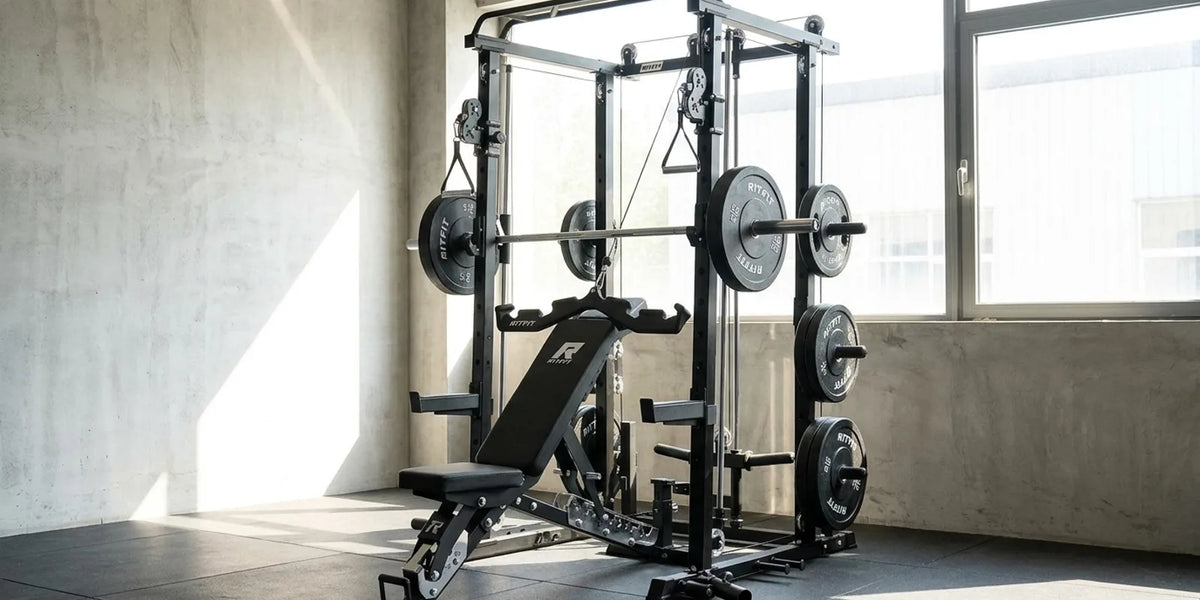
For home gym users, the best back day can be built with a cable system, dumbbells, an adjustable bench, and a Smith machine. The goal is to train your lats, traps, rhomboids, rear delts, and spinal erectors with controlled form and progressive overload.
Key Takeaways
- Start with the big pattern: A complete back day should include vertical pulling, horizontal rowing, hip hinge work, and rear delt training.
- Train more than your lats: Your workout should also target traps, rhomboids, rear delts, and spinal erectors.
- Use 4 to 6 exercises: Most lifters do not need endless variations if each movement has a clear purpose.
- Control every rep: Full range, steady tempo, and shoulder blade control matter more than swinging heavy weight.
- Build a home version: A RitFit Smith machine, cable setup, dumbbells, and bench can cover most back day needs.
What Should You Do on Back Day?
On back day, you should train your back with a balanced mix of pulling angles and spinal support movements. The simplest formula is lat pulldown, row, dumbbell row, hip hinge, and face pull.
This structure helps you build width through the lats, thickness through rows, posture through upper back work, and resilience through lower back training. A review on resistance training variables suggests that weekly volume, load, frequency, tempo, and contraction type can all influence hypertrophy outcomes, with at least 10 weekly sets per muscle group being a useful target for growth focused lifters.[1]
Back Muscles You Need to Train
A strong back is not built by one exercise alone. You need movements that train the large pulling muscles, the upper back stabilizers, and the lower back extensors.
| Back Muscle | Main Role | Best Exercise Examples |
|---|---|---|
| Latissimus dorsi | Builds back width and pulling power. | Lat pulldown, pull up, straight arm pulldown. |
| Trapezius | Adds upper back thickness and shoulder stability. | Shrug, high row, face pull. |
| Rhomboids | Helps pull the shoulder blades together. | Seated row, chest supported row, Smith machine row. |
| Rear delts | Supports posture and balanced shoulder development. | Face pull, rear delt fly, cable rear delt row. |
| Spinal erectors | Supports hip hinge strength and lower back control. | Romanian deadlift, back extension, good morning. |
How to Structure a Back Day Workout
The best back day starts with demanding compound movements and finishes with controlled isolation work. This helps you use the most energy on the exercises that require the most coordination and stability.
- Step 1: Start with a vertical pull such as a pull up or lat pulldown to target back width.
- Step 2: Add a horizontal row such as a cable row, dumbbell row, or Smith machine row to build back thickness.
- Step 3: Include a hip hinge such as a Romanian deadlift if your lower back and hamstrings can recover well.
- Step 4: Finish with face pulls, rear delt flys, or straight arm pulldowns for control and detail.
- Step 5: Track load, reps, and form quality so your back day improves over time.
Best Back Day Workouts
The best workout depends on your training level, equipment, and recovery. Choose one plan below and run it for 4 to 6 weeks before changing too many variables.
Beginner Back Day Workout
This beginner plan uses simple movements that teach lat control, rowing mechanics, and basic lower back endurance.
| Exercise | Sets | Reps | Rest |
|---|---|---|---|
| Lat Pulldown | 3 | 10 to 12 | 60 to 90 sec |
| Seated Cable Row | 3 | 10 to 12 | 60 to 90 sec |
| Single Arm Dumbbell Row | 2 | 10 each side | 60 sec |
| Face Pull | 2 | 12 to 15 | 45 to 60 sec |
Muscle Growth Back Day Workout
This plan adds more volume and heavier rowing to support back width, thickness, and progressive overload.
| Exercise | Sets | Reps | Goal |
|---|---|---|---|
| Pull Up or Lat Pulldown | 4 | 6 to 10 | Lat strength and width |
| Smith Machine Bent Over Row | 4 | 8 to 10 | Mid back thickness |
| One Arm Cable Row | 3 | 10 to 12 | Side to side balance |
| Straight Arm Pulldown | 3 | 12 to 15 | Lat isolation |
| Face Pull | 3 | 12 to 20 | Rear delt and posture |
Home Gym Back Day Workout
This home gym version works well if you train with a Smith machine, cable system, dumbbells, and bench.
| Exercise | Equipment | Sets | Reps |
|---|---|---|---|
| Lat Pulldown | Cable system | 3 | 10 to 12 |
| Smith Machine Row | Smith machine | 3 | 8 to 10 |
| Single Arm Dumbbell Row | Dumbbell and bench | 3 | 10 each side |
| Cable Face Pull | Cable attachment | 3 | 12 to 15 |
Best Back Exercises to Include
The best back exercises are not all the same. Each one should earn its place by targeting a different muscle, angle, or training goal.
Lat Pulldown
The lat pulldown is one of the best back day exercises for building width. Keep your chest tall, pull your elbows down toward your ribs, and learn the setup in this Smith machine lat pulldown guide.
Seated Cable Row
The seated cable row builds mid back thickness by training the lats, rhomboids, and traps together. Pull your elbows back without leaning too far, and pause briefly when your shoulder blades come together.
Single Arm Dumbbell Row
The single arm dumbbell row helps correct side to side imbalances and improves lat connection. Use a stable bench, keep your torso braced, and follow this single arm dumbbell row tutorial if you need form guidance.
Smith Machine Row
The Smith machine row can make heavy rowing more repeatable for home gym users. Start with a hip hinge, keep your torso controlled, and compare variations in this Smith machine row guide.
Face Pull
The face pull is a high value finisher for rear delts, traps, and shoulder health. Use light to moderate weight, pull toward eye level, and keep the movement controlled from start to finish.
Romanian Deadlift
The Romanian deadlift trains the posterior chain and helps support lower back strength when performed correctly. Keep the bar close, hinge at the hips, and stop the set if your lower back takes over.
Best Back Day Equipment for Home Gyms
You do not need a commercial gym to build a strong back. A smart home setup should give you vertical pulling, rowing, free weight support, and adjustable body positioning.
- Smith machine with cable system: A RitFit M1 Smith Machine with Cable Crossover System can support cable pulls, rows, and Smith machine rowing patterns in one home gym station.
- Dumbbells: A pair of RitFit dumbbells helps you train single arm rows, rear delt flys, pullovers, and unilateral back work.
- Adjustable bench: A stable RitFit adjustable bench supports dumbbell rows, chest supported rows, and incline rear delt training.
- Lat pulldown attachment: A dedicated attachment helps you train vertical pulling if you do not have space for a separate commercial lat pulldown machine.
- Back workout education: For more exercise ideas, use the RitFit Smith machine back workouts guide.
Common Back Day Mistakes to Avoid
Most back day mistakes happen when lifters chase load before control. Better form usually creates better tension, safer joints, and more useful progression.
- Using too much momentum: Swinging the weight shifts tension away from the back and toward the arms, hips, and lower back.
- Only doing pulldowns: Pulldowns are useful, but rows are needed for back thickness and shoulder blade control.
- Ignoring rear delts: Rear delt and upper back work helps balance pressing volume and support posture.
- Rounding the lower back: Rows and hip hinges should be performed with a braced torso and controlled spinal position.
- Changing exercises too often: Keep your core movements stable long enough to measure progress.
How to Progress Your Back Day Over Time
Progress your back day by adding reps first, then load, then extra sets if recovery is still good. Different loads can support hypertrophy when sets are taken close to failure, but heavier loading is generally more specific to maximal strength.[4]
- Week 1: Choose weights you can control with clean form and 2 to 3 reps in reserve.
- Week 2: Add 1 to 2 reps per set where technique stays stable.
- Week 3: Add a small amount of weight to your main row or pulldown.
- Week 4: Repeat the same exercises and compare performance to Week 1.
- Week 5: Add one set to your main lat or row movement if recovery is strong.
Back Day Form and Safety Tips
Good back training should feel controlled, not chaotic. Full range resistance training may offer muscle development benefits over partial range training in some contexts, so use the longest pain free range you can control.[3]
- Brace before every pull: Set your ribs and pelvis before the weight moves.
- Lead with your elbows: Pull through the elbows instead of curling the weight with your hands.
- Control the negative: Lower the weight slowly enough to keep tension on the target muscle.
- Avoid sharp pain: Stop the movement if you feel sharp pain in the shoulder, neck, or lower back.
- Train recovery too: Protein supplementation can support resistance training induced gains in lean mass and strength when paired with a proper program.[2]
Frequently Asked Questions
What should I do first on back day?
Start with a vertical pull, then add a horizontal row, a hip hinge, and a rear delt movement. This order covers back width, back thickness, lower back strength, and shoulder balance without wasting energy on too many similar exercises for most lifters.
How many exercises should I do on back day?
Most back day workouts need four to six exercises. Beginners can use four movements, while experienced lifters may add one or two isolation exercises for lats, traps, rear delts, or lower back control when recovery and form stay consistent.
Can I train back at home without a full gym?
Yes. You can train back at home with dumbbells, a bench, a cable system, or a Smith machine. Focus on rows, pulldowns, face pulls, and hip hinge movements so you cover both width and thickness without needing a commercial gym setup.
Is lat pulldown enough for back day?
No. Lat pulldowns are excellent for back width, but they do not fully replace rows, rear delt work, or lower back training. A better back day pairs pulldowns with cable rows, dumbbell rows, face pulls, and controlled hinge movements.
Should I do deadlifts on back day?
Yes, if your technique and recovery support them. Deadlifts and Romanian deadlifts train the posterior chain and spinal erectors, but they create more fatigue than pulldowns or rows, so place them early and avoid pushing sloppy reps.
How do I feel my lats during back exercises?
Use a controlled pull, keep your chest stable, and drive your elbows toward your ribs. Reduce the weight if your biceps take over, then slow the lowering phase so your lats stay under tension through the full movement.
What is the best back day workout for beginners?
The best beginner back day includes lat pulldown, seated cable row, single arm dumbbell row, and face pull. This mix teaches basic pulling patterns, trains the main back muscles, and keeps fatigue manageable while technique is still developing.
How long should a back day workout be?
A focused back day usually takes 45 to 75 minutes. Shorter sessions work well with four exercises and controlled rest, while longer sessions may include extra rowing, rear delt work, or lower back training for advanced lifters.
Conclusion
The best thing to do for back day is train every major pulling pattern with purpose. Build your plan around a vertical pull, a row, a hip hinge, and rear delt work, then progress slowly with clean form.
If you train at home, RitFit equipment can help you cover back width, thickness, posture, and strength without needing a commercial gym. Keep the workout simple, repeatable, and measurable.
Disclaimer
This content is for general fitness education only and is not medical advice. If you have back pain, shoulder pain, a previous injury, or a medical condition, consult a qualified healthcare professional or certified trainer before starting a new back day workout.
References
- Bernárdez-Vázquez R, Raya-González J, Castillo D, Beato M. Resistance Training Variables for Optimization of Muscle Hypertrophy: An Umbrella Review. Front Sports Act Living. 2022;4:949021. doi:10.3389/fspor.2022.949021
- Morton RW, Murphy KT, McKellar SR, et al. A systematic review, meta analysis and meta regression of the effect of protein supplementation on resistance training induced gains in muscle mass and strength in healthy adults. Br J Sports Med. 2018;52(6):376-384. doi:10.1136/bjsports-2017-097608
- Schoenfeld BJ, Grgic J. Effects of range of motion on muscle development during resistance training interventions: A systematic review. SAGE Open Med. 2020;8:2050312120901559. doi:10.1177/2050312120901559
- Lopez P, Radaelli R, Taaffe DR, et al. Resistance Training Load Effects on Muscle Hypertrophy and Strength Gain: Systematic Review and Network Meta analysis. Med Sci Sports Exerc. 2021;53(6):1206-1216. doi:10.1249/MSS.0000000000002585





