Use dumbbells that let you complete about 10 to 15 clean reps, with the last 2 to 3 reps feeling challenging but still controlled. For many beginners, 10 lb dumbbells work well for curls and presses, but they may be too heavy for raises and too light for stronger pulling moves.
Key Takeaways
- Best starting rule: Choose a dumbbell weight that lets you complete 10 to 15 controlled reps with the final reps feeling difficult.
- 10 lb dumbbells can work: They are often useful for curls, hammer curls, and shoulder presses, but not ideal for every arm exercise.
- Form decides the weight: If you swing, shrug, arch your back, or bend your wrists, the dumbbell is too heavy for that movement.
- Progression matters: Add reps, sets, slower tempo, or heavier dumbbells once your current weight feels easy.
- Arm definition is not spot reduction: Visible tone comes from resistance training, overall body fat management, nutrition, and recovery.
What Does Toning Arms Really Mean?
Toning your arms means building enough lean muscle to create shape while lowering enough overall body fat for that muscle to show. It is not a separate type of muscle change caused by very light weights.
Your biceps, triceps, shoulders, and forearms need a training stimulus strong enough to adapt. Research comparing resistance training loads suggests muscle growth can occur across a range of loads when effort is high enough, while heavier loads are more specific to strength gains.[1]
Factors That Determine the Right Dumbbell Weight
The right dumbbell weight depends on your strength, exercise choice, training goal, and joint comfort. A weight that is perfect for biceps curls may be too heavy for lateral raises.
- Current strength level: Beginners should start with a weight they can control without swinging. Intermediate users may need several dumbbell sizes to keep each exercise challenging.
- Exercise difficulty: Curls, hammer curls, and presses often allow more weight than lateral raises or triceps kickbacks. Smaller muscle groups usually need lighter loads.
- Target rep range: For arm tone, 10 to 15 reps is a practical starting zone. Higher reps can support local muscular endurance, while moderate ranges are commonly used for hypertrophy focused training.[2]
- Joint comfort: Shoulder, elbow, and wrist discomfort means you should reduce the load or change the movement. Muscle fatigue is expected, but sharp joint pain is not.
- Available equipment: One pair of dumbbells can work at first, but a small range of weights is more useful for complete arm training. You can browse dumbbells for home arm workouts if you need multiple options.
Are 10 lb Dumbbells Good for Toning Arms?
Yes, 10 lb dumbbells can help tone your arms if they challenge you in the right rep range without breaking form. They are most useful when the final reps feel hard but still look controlled.
For many people, 10 lb dumbbells are a strong starting point for biceps curls, hammer curls, and shoulder presses. For lateral raises, front raises, and triceps kickbacks, they may be too heavy unless you already have good shoulder and elbow control.
- Good fit: You can complete 10 to 15 reps with steady posture and no swinging.
- Too light: You can complete more than 20 reps and still feel like you could keep going.
- Too heavy: You cannot reach 8 clean reps, or you need momentum to move the weight.
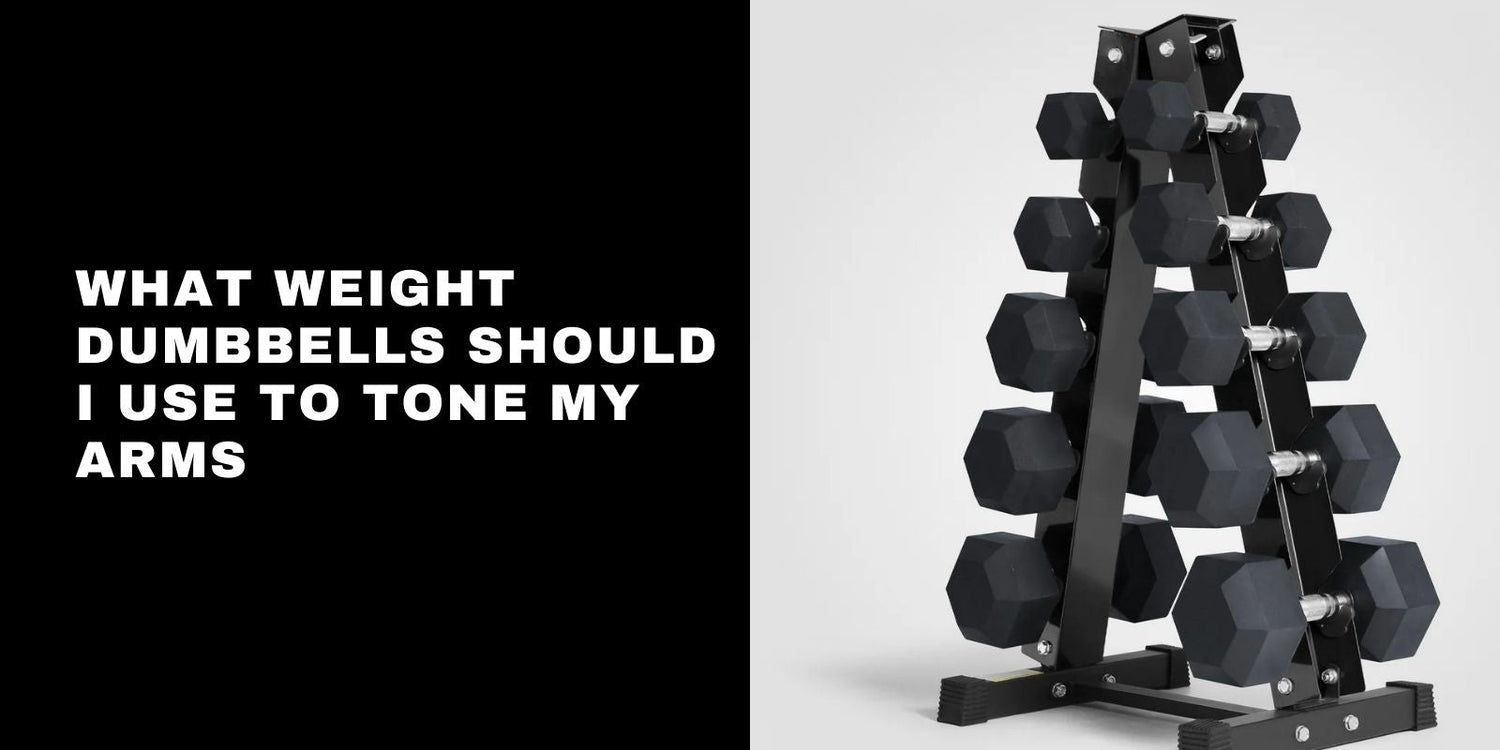
- Best buying choice: A set gives you more flexibility than one fixed pair. The PVC coated dumbbells set with rack is a relevant option for users who want several weights in one home gym setup.
How to Choose the Right Dumbbell Weight
Choose your dumbbell weight by testing your form, not by copying someone else's number. The best weight lets you train the target muscle without shifting stress into your joints or lower back.
- Step 1: Pick a weight and perform 10 slow biceps curls. Keep your elbows close to your sides and avoid leaning back.
- Step 2: Check the last 2 to 3 reps. They should feel hard, but you should still control the lifting and lowering phase.
- Step 3: Stop before form breaks down. If your body swings or your wrists bend, use a lighter pair.
- Step 4: Repeat the test with a smaller movement like lateral raises. Many users need a lighter weight for shoulder isolation than for curls.
- Step 5: Progress only when the weight feels easy for all planned sets. Add reps first, then sets, then a heavier pair.
If you prefer fixed dumbbells by pair, PVC coated dumbbells in pairs can help you build a gradual weight range. If you want a more traditional strength training feel, rubber hex dumbbells for strength training are another relevant choice.
Dumbbell Weight Guide for Arm Exercises
The table below gives practical starting ranges, but your form should always override the number. Use the lower end if you are new, returning from a break, or managing joint sensitivity.
| Exercise | Common Starting Range | Is 10 lb Usually Useful? | Best Form Check |
|---|---|---|---|
| Biceps Curl | 5 to 15 lb | Often yes | Elbows stay still and torso does not swing |
| Hammer Curl | 8 to 20 lb | Often yes | Wrists stay neutral through the full rep |
| Triceps Kickback | 3 to 10 lb | Sometimes | Upper arm stays fixed and elbow fully extends |
| Overhead Triceps Extension | 5 to 15 lb | Often yes | Ribs stay down and elbows point forward |
| Lateral Raise | 3 to 10 lb | Often heavy for beginners | Shoulders stay down and arms stop near shoulder height |
| Shoulder Press | 5 to 20 lb | Often yes | Core stays braced and lower back does not arch |
Sample Arm Toning Routine With Dumbbells
This routine works best if your dumbbells feel challenging within the target rep range. Train arms 2 to 3 times per week on nonconsecutive days.
Warm up: Do 5 minutes of light cardio, arm circles, shoulder rolls, and easy unloaded curls before your first working set.
- Shoulder Press: 3 sets of 10 to 12 reps with a braced core and steady wrists.
- Biceps Curl: 3 sets of 10 to 15 reps with elbows close to your sides.
- Hammer Curl: 2 to 3 sets of 12 to 15 reps with palms facing each other.
- Overhead Triceps Extension: 3 sets of 10 to 15 reps with controlled lowering.
- Triceps Kickback: 2 to 3 sets of 12 to 15 reps per arm with no shoulder swinging.
- Lateral Raise: 2 to 3 sets of 12 to 15 reps with lighter dumbbells if 10 lb changes your form.
Move slowly enough to feel the target muscle working through the full range of motion. Movement tempo can influence time under tension and the training stimulus, so rushing every rep may reduce the quality of the set.[5]
If your home gym includes several dumbbell pairs, keep them organized with a 3 tier dumbbell rack for home gym storage. Clean storage makes it easier to switch weights without interrupting your workout flow.
Technique and Safety Tips
Good form matters more than the number printed on the dumbbell. A lighter weight with strict control will usually build better arm definition than a heavier weight moved with momentum.
- Keep wrists neutral: Do not let your wrists bend backward during curls, presses, or triceps work.
- Control the lowering phase: Lower the dumbbell slowly instead of dropping it into the next rep.
- Avoid shoulder shrugging: If your neck tightens during raises, reduce the weight and reset your posture.
- Brace your core: Keep your ribs down during overhead work to avoid excessive lower back arching.
- Stop for sharp pain: Muscle fatigue is normal, but sharp shoulder, elbow, wrist, or back pain is a signal to stop.
- Use support when useful: Pairing dumbbells with a stable bench can improve setup for presses, seated curls, and supported arm work. You can view weight benches for home strength training or the GATOR adjustable weight bench for a more complete upper body setup.
Other Factors That Affect Arm Definition
Arm definition depends on more than dumbbell weight. Your visible results come from muscle stimulus, total training consistency, nutrition, body composition, and recovery.
- Body fat: You cannot spot reduce fat from your arms. Resistance training can support body composition improvements, but visible definition still depends on overall fat loss and lean mass retention.[3]
- Protein intake: Adequate dietary protein supports muscle remodeling after resistance exercise. Protein works best when paired with consistent training and enough total nutrition for recovery.[4]
- Full body training: Rows, presses, push ups, and lower body movements support a stronger overall training effect than arm isolation alone.
- Progressive overload: Increase reps, sets, tempo control, or weight over time. If every session feels easy, your arms have little reason to adapt.
- Recovery: Sleep and rest days help your muscles repair. Training sore joints every day can slow progress and raise irritation risk.
- Equipment variety: A broader dumbbell range helps match each movement to the correct load. The PVC coated dumbbells collection is useful for lighter and moderate home training options.
Frequently Asked Questions
What weight dumbbells should I use to tone my arms?
Use a dumbbell weight that lets you complete 10 to 15 clean reps with the final reps feeling hard but controlled. If your body swings, your wrists bend, or your shoulders shrug, choose a lighter pair and build control first.
Are 10 lb dumbbells good for toning arms?
Yes. 10 lb dumbbells can tone arms if they challenge your biceps, triceps, and shoulders in the target rep range. They often work well for curls and presses, but many beginners need lighter weights for lateral raises and triceps kickbacks.
Can 5 lb dumbbells tone arms?
Yes. 5 lb dumbbells can tone arms when they are difficult enough for controlled high rep sets. They are especially useful for lateral raises, front raises, triceps kickbacks, warm ups, beginners, and users rebuilding shoulder or elbow control.
How do I know if my dumbbells are too light?
Your dumbbells are too light if you can complete more than 20 clean reps and still feel little muscle fatigue. You can progress by slowing the tempo, adding sets, shortening rest, or moving to a heavier pair when form stays stable.
How do I know if my dumbbells are too heavy?
Your dumbbells are too heavy if you cannot reach 8 clean reps without swinging, leaning, shrugging, or losing wrist position. A heavy weight that shifts stress into your joints is less useful for arm tone than a lighter weight you control.
Should I use different dumbbell weights for different arm exercises?
Yes. Different arm exercises need different dumbbell weights because each movement uses different muscles and leverage. Curls may handle more weight than lateral raises, while overhead triceps extensions may need a different load than kickbacks.
Do dumbbells reduce arm fat?
No. Dumbbells do not directly reduce fat from only your arms. They build muscle that can improve shape, while overall fat loss depends on nutrition, total activity, full body training, sleep, and a sustainable calorie balance.
When should I move up from 10 lb dumbbells?
Move up from 10 lb dumbbells when you can complete all planned sets with clean form and the final reps no longer feel challenging. Increase gradually, usually by choosing the next available pair and retesting your 10 to 15 rep range.
Conclusion
The best dumbbell weight for toning arms is the one that challenges you for 10 to 15 clean reps without forcing momentum. For many users, 10 lb dumbbells are useful for curls and presses, but a range of lighter and heavier options gives better results across biceps, triceps, shoulders, and full body training.
Disclaimer
This article is for general fitness education only and is not medical advice. If you have shoulder, elbow, wrist, neck, or back pain, a recent injury or surgery, numbness, tingling, dizziness, or unexplained weakness, consult a qualified clinician before starting or changing your training routine.
References
- Lopez P Radaelli R Taaffe DR Newton RU Galvão DA Trajano GS et al. Resistance training load effects on muscle hypertrophy and strength gain: systematic review and network meta-analysis. Med Sci Sports Exerc. 2021;53(6):1206-1216. doi:10.1249/MSS.0000000000002585
- Schoenfeld BJ Grgic J Van Every DW Plotkin DL. Loading recommendations for muscle strength, hypertrophy, and local endurance: a re-examination of the repetition continuum. Sports (Basel). 2021;9(2):32. doi:10.3390/sports9020032
- Lopez P Taaffe DR Galvão DA Newton RU Nonemacher ER Wendt VM et al. Resistance training effectiveness on body composition and body weight outcomes in individuals with overweight and obesity across the lifespan: a systematic review and meta-analysis. Obes Rev. 2022;23(5):e13428. doi:10.1111/obr.13428
- Stokes T Hector AJ Morton RW McGlory C Phillips SM. Recent perspectives regarding the role of dietary protein for the promotion of muscle hypertrophy with resistance exercise training. Nutrients. 2018;10(2):180. doi:10.3390/nu10020180
- Wilk M Zajac A Tufano JJ. The influence of movement tempo during resistance training on muscular strength and hypertrophy responses: a review. Sports Med. 2021;51(8):1629-1650. doi:10.1007/s40279-021-01465-2