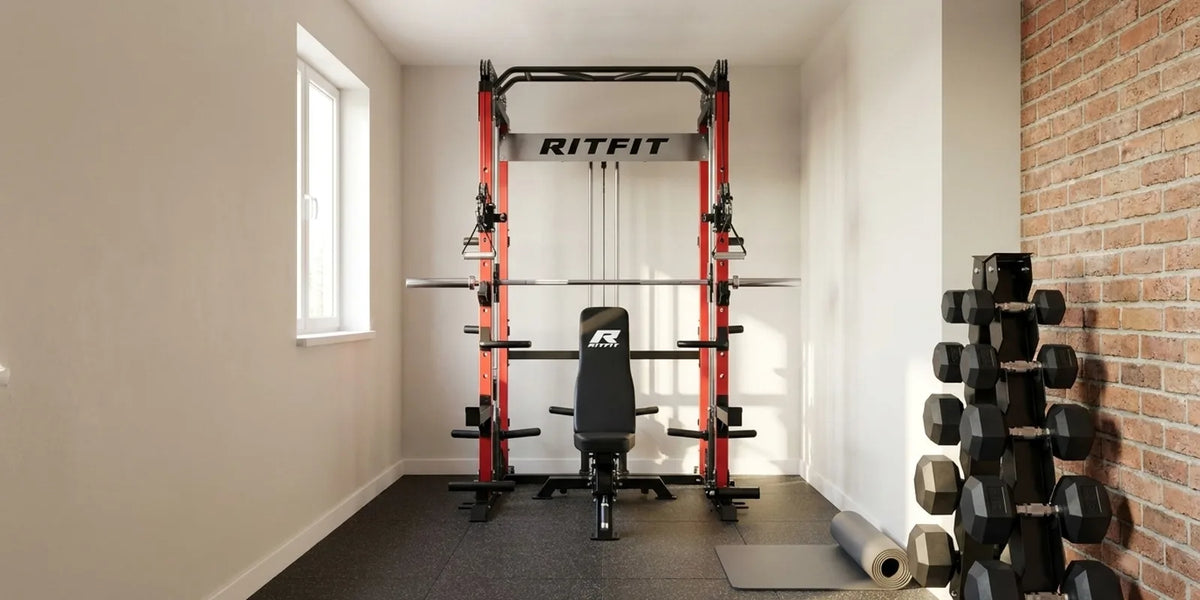
A 10x15 ft home gym is a narrow rectangle, and the 10 ft width, not the 150 square feet, decides what fits. The room is 120 inches across and 180 inches long, so every placement question is really a width question.
This guide measures the narrow axis first, shows where a Smith machine still leaves a usable aisle on each wall, and explains why two stations never sit abreast. It is written for the 10 by 15 room specifically, not for square rooms or larger spaces.
Quick Answer: A 10x15 ft home gym works best as a single linear run along one wall, because the 10 ft width cannot hold two training stations side by side. Place the all-in-one machine on a short wall when the door allows it, subtract the published machine width from 120 inches, and keep at least a 24 inch aisle in front.
Key Takeaways
- Width is the constraint: a 10x15 ft room is 120 inches wide, so the 10 ft wall, not the 150 square feet, sets what can be placed.
- Short wall first: the M1 PRO is published at 63 inches wide, which leaves about 57 inches of aisle against a 10 ft wall.
- Depth is the trade: along the 15 ft wall the same machine is published at 79.1 inches long and leaves about 41 inches in front.
- One station, not two: 63 inches of machine plus a bench lane already exceeds 120 inches, so side by side placement fails.
- Narrower option: the PSR05 2.0 is published at 46.3 inches wide with a 14.91 square foot footprint, the tightest fit for a 10 ft wall.
- Stop rule: if the aisle in front of your machine drops below 24 inches, stop adding equipment.
How to Measure a 10x15 ft Room Before You Buy Equipment
A 10x15 ft home gym should be measured on its narrow axis first, because the 120 inch width is the number that decides every placement. Start with the short wall, subtract the door swing and any return wall, then tape the machine footprint and its clearance lane on the floor before ordering.
Step 1 - Measure the 10 ft wall first, not the square footage
Width is what runs out in a narrow room, so the 10 ft wall sets the ceiling on what you can place. A 10x15 ft room offers 150 square feet of total floor, yet only the 120 inch dimension tells you whether a machine and a bench can share the space.
Step 2 - Subtract the door swing and the walkway you actually use
Plan a walkway of 24 to 36 inches wherever you stand, step back, or load plates, then remove the door swing from the same wall. The home gym size guide lists the reference bands by room size if you want the numbers before you measure.
Step 3 - Tape the machine footprint and its clearance lane
Tape the machine base and the lane you train in, then walk every lift with a broom handle standing in for the bar. Marking the working zones first is what keeps a narrow room usable instead of merely full.
If your room is not a 10x15 ft rectangle, the layout changes with the shape: see the square plan for 100 square feet in a home gym, a home gym within 200 square feet for a wider 10 by 20 space, or the 12x12 home gym layout guide for a wider square room.
Why the 10 ft Width Decides a 10x15 ft Home Gym Layout
A 10x15 ft home gym layout is decided by the 10 ft width because two training stations cannot share 120 inches. Every square foot beyond the first station sits behind the machine rather than beside it, so a narrow room becomes one linear run along the long wall instead of a cluster in the middle.
The arithmetic is unforgiving. A power rack and a cable tower each need their own working width plus a bench lane, and those numbers together pass 120 inches before a single inch of aisle is counted.
A qualitative study examined the enablers and barriers toward home-based resistance exercise among adults who completed a structured program.[1] In a cramped room the layout itself becomes one of those enablers or barriers, because every session starts with moving equipment out of the way.
Seeing a one machine setup built inside a real room makes the linear layout easier to picture before you tape your own floor.
Which Wall Should Your Smith Machine Sit Against in a 10x15 ft Room?
Which wall a Smith machine sits against in a 10x15 ft room comes down to which published dimension eats your aisle. Place the machine against a short 10 ft wall and its width consumes the 120 inches, while placing it along the 15 ft wall sends its depth into the room instead.
Against a short wall, machine width leaves the aisle
The RitFit M1 PRO Multi-Functional Smith Machine is published at 63 inches wide, so a short wall leaves about 57 inches of aisle beside it. The narrower RitFit PSR05 2.0 Smith Machine Home Gym Package is published at 46.3 inches wide and leaves about 73.7 inches on the same wall.
Along the 15 ft wall, machine depth leaves the aisle
The M1 PRO is published at 79.1 inches long including the Smith bar, so a long wall placement leaves about 41 inches of floor in front of the frame. The PSR05 2.0 is published at 70.8 inches long and leaves about 49 inches on the same layout.
What changes if the only door is on a long wall
A door on a long wall removes floor from the one run you were relying on, so the machine has to move to a short wall or the room loses its walkway. Measure the door swing before anything else, because it is the most common reason a narrow room layout fails after delivery.
Whichever wall you choose, keep both ends of the loading path clear so plates come on and off without stepping around the frame.
Choose the M1 Multi-Functional Smith Machine for a Narrow Room
A narrow room rewards one all-in-one machine over two single purpose stations, and the RitFit M1 PRO Multi-Functional Smith Machine is the model most 10x15 ft rooms are measured against. It carries a Smith bar, a cable crossover, and a squat position on one frame, so it retires the separate clearance rings a power rack, a cable tower, and a lat pulldown station would each claim.
| All-in-one | Width | Length with Smith bar | Height | Footprint |
|---|---|---|---|---|
| RitFit M1 PRO | 63 inches | 79.1 inches | 85.3 inches | 20.9 sq ft |
| RitFit PSR05 2.0 | 46.3 inches | 70.8 inches | 82 inches | 14.91 sq ft |
Width, length, height and footprint are the published specifications on the RitFit product pages, checked in 2026. The aisle figures used in this guide are 120 inches minus those published widths and depths.
The narrower all-in-one for a 10 ft wall
The PSR05 2.0 is published at 46.3 inches wide with a 14.91 square foot footprint, which is the difference between a comfortable aisle and a tight one on a 10 ft wall. Its published rack height of 82 inches also clears an 8 ft ceiling with room for a full pull-up hang.
Bench, storage and dumbbells that do not eat the aisle
Accessories decide whether the single run stays walkable, so choose pieces that fold or stand against a wall. The RitFit PWB01 Adjustable Foldable Weight Bench folds out of the lane, and the RitFit A-Frame Dumbbell Rack stores dumbbells vertically instead of across the floor.
- Frame: the M1 PRO uses 2 by 2 inch 14-gauge steel with a published 1,600 lb frame capacity and a 20.9 square foot footprint.
- Adjustment: the M1 PRO lists 11 Smith height settings and 15 cable positions, so one frame covers pressing, squatting, and cable work.
- Smoothness: the Smith bar runs on linear bearings and the cable system uses a 2:1 pulley ratio on stainless steel rails.
- Warranty: RitFit states a 3-year warranty on the frame and welding, with 1-year coverage on bolts and pulleys.
"Few pieces of equipment in the home exercise industry are as comprehensive and versatile as this all-in-one gym system. The robust system provides a natural, centered bar path for compound lifts like squats, presses, and rows, and incorporates a dual cable crossover station with a full rack of precision-engineered attachments."
Garage Gym Revisited, Home Gym Equipment Reviewer, RitFit M1 Multi-functional Smith Machine - Our Review
"Really solid product especially for the price. Some minor bends in the smith bars that don't affect functionality much. Fit perfectly in my space when I flipped the pullup bar upside down. Just need to buy myself some more floor mats and get some attachment storage."
Mason N. Verified Buyer, RitFit M1 PRO Multi-Functional Smith Machine with Cable Crossover System and Squat Rack for Home Gym
What Fits Alongside a Smith Machine in a 10 ft Wide Room?
A folding bench, one pair of adjustable dumbbells, and vertical storage are what fit alongside a Smith machine in a 10 ft wide room. The room can hold a second piece only if it sits deeper into the 15 ft run, never beside the machine.
One pilot study of home-based resistance training reported effects on physical fitness and well-being in middle-aged adults, which is the case for buying one versatile machine rather than filling a narrow room with single purpose stations.[2]
- Folding bench: stows against a wall between sessions so the aisle comes back for walking and loading.
- Adjustable dumbbells: one pair covers press, row, and accessory work in the width of a single footprint.
- Vertical storage: a stand or wall hooks keep plates and dumbbells off the training lane.
- Flooring: interlocking mats protect the floor under the frame and along the plate loading path.
If you add only one accessory, make it a pair of adjustable dumbbells, which replace a full fixed dumbbell rack in the depth of one shelf.
Watching a compact RitFit build come together in a garage shows how much floor a single station really leaves free.
Common Mistakes That Make a 10x15 ft Home Gym Unusable
The mistakes that wreck a 10x15 ft home gym all come from planning by square footage instead of by width. A room can hold 150 square feet of equipment on paper and still be unusable once the aisle, the door swing, and the loading path are counted together.
- Buying by square feet: a 20.9 square foot footprint sounds modest until its 63 inch width lands on a 120 inch wall.
- Placing two stations abreast: a machine plus a bench lane passes the 10 ft width before any aisle is added.
- Ignoring the door swing: a door that opens into the run removes the floor you planned to train on.
- Blocking the loading end: a standard Olympic barbell runs a little over 7 feet, so the plate ends need clear space on both sides of the frame.
- Skipping the ceiling check: an 85.3 inch rack needs roughly 8 ft of ceiling after joists and light fixtures, and the low ceiling home gym tips cover that measurement.
- Leaving no place to put things down: without vertical storage, dumbbells and plates drift into the walkway within a week.
When to Stop Adding Equipment to a Narrow Home Gym
Stop adding equipment to a narrow home gym when the aisle in front of your machine drops below 24 inches. The same rule applies when a new piece forces you to move the machine before you can use it, because that layout no longer works. Every extra station in a 10 ft wide room is paid for with the floor you actually train on.
One study examined a daily 5-minute home-based eccentric exercise program and its effects on physical fitness and body composition in sedentary people.[3] The training that matters can happen in a very small footprint, which is the argument for keeping the room walkable instead of filling it.
Set the stop rule before you shop. If a purchase would push the walkway under 24 inches or block the plate loading path, the answer is a different accessory rather than one more machine, and the home gym buying guide is the place to compare options.
FAQs About a 10x15 ft Home Gym
How much floor space does a 10x15 ft home gym actually give you?
A 10x15 ft room gives you 150 square feet of floor, but usable space is smaller. Subtract a 24 to 36 inch walkway and the door swing, and about 90 to 110 square feet remain for equipment and training zones. The 10 ft width, not the total area, decides what fits.
Which wall should a Smith machine sit against in a 10 by 15 room?
Place the machine against a short 10 ft wall when the door is on a long wall, because the machine width is the smaller of its two dimensions. Against the 15 ft wall the machine depth runs into the room and leaves a tighter aisle. Check both against the door swing before you decide.
Why can two stations not sit side by side in a 10 ft wide room?
Because 120 inches of width cannot hold two working stations. The M1 PRO is 63 inches wide and a bench lane needs roughly 48 inches of length plus standing room, which already exceeds the wall. Two abreast placements leave no aisle, so a narrow room wants one all-in-one instead.
How much clearance do you need in front of a Smith machine?
Plan for a walkway of at least 24 to 36 inches in front of the machine and behind the bar path. In a 10 ft wide room that means subtracting the published machine depth from 120 inches first. Whatever number remains is the aisle you actually train and load plates in.
What ceiling height does a narrow home gym need for a Smith machine?
Check the published rack height before anything else, since the M1 PRO stands 85.3 inches tall and the PSR05 2.0 stands 82 inches tall. Both need roughly 8 ft of ceiling plus a few inches of headroom for pull-ups and overhead work, and basement joists or door tracks often cut into that.
When should you stop adding equipment to a narrow home gym?
Stop when the aisle in front of your machine drops below 24 inches or when a new piece forces you to move the machine out of its working position. If every lift now needs a reshuffle, the layout has failed. Trade equipment for clear floor instead of squeezing in one more station.
Conclusion
A 10x15 ft home gym is solved on the 10 ft width, not the 150 square feet, by measuring the short wall, subtracting the published machine width or depth from 120 inches, and keeping the run along one wall instead of across it.
Sketch the tape lines on your floor this week, then compare the M1 PRO against the narrower PSR05 2.0 before your next order, and check the RitFit discount guide for current offers.
Disclaimer
This guide offers general layout and equipment guidance for home fitness spaces and is not medical advice. Consult a qualified professional before starting a new training program, and follow the manufacturer instructions for assembly and load limits.
References
1. Alsowail AT, Malkova D, Ryde GC, Gray SR. Enablers and barriers toward home-based resistance exercise among older adults who completed a structured program: qualitative study using reflexive thematic analysis. BMC Geriatr. 2026;26(1):231. doi:10.1186/s12877-026-06986-x. PMCID: PMC12911215
2. Kikuchi N, Ohta T, Hashimoto Y, et al. Effect of Online Home-Based Resistance Exercise Training on Physical Fitness, Depression, Stress, and Well-Being in Middle-Aged Persons: A Pilot Study. Int J Environ Res Public Health. 2023;20(3). doi:10.3390/ijerph20031769. PMCID: PMC9914297
3. Kirk BJC, Mavropalias G, Blazevich AJ, Cochrane-Wilkie JL, Molan A, Nosaka K. Effects of a daily, home-based, 5-minute eccentric exercise program on physical fitness, body composition, and health in sedentary individuals. Eur J Appl Physiol. 2025;125(8):2241-2255. doi:10.1007/s00421-025-05757-7. PMCID: PMC12354585