How to set up a home gym within 200 square feet is a measurement problem, not a shopping problem. A 10 by 20 foot room gives you 200 square feet of floor, but only about 120 of those square feet can hold equipment once walkways and training clearance are subtracted.
This guide converts that number into a zone budget, a fits or does not fit table, and a clear stopping point. Measure first, and a single bay garage can hold a rack, a bench, dumbbells, and one cardio piece without feeling crowded.
Quick Answer: You can set up a home gym within 200 square feet by giving the strength station about half the floor, storing dumbbells vertically, and limiting cardio to one foldable machine. A 10 by 20 foot room holds a rack or an all-in-one station, a bench, dumbbells, and one cardio piece with room left to train safely.
Key Takeaways
- Usable floor area: Only about 120 of the 200 square feet can hold equipment once a perimeter walkway and a 24 to 36 inch clearance ring are removed.
- Zone budget: Give the strength station roughly half the room, the dumbbell and accessory wall about a third, and the leftover strip to cardio and stretching.
- What fits: One rack or all-in-one station, a bench, one adjustable dumbbell pair, and one folding cardio machine fit a 10 by 20 foot room. Pick the package the room has to be built around: the RitFit combo routes below cover a self-contained all-in-one, the default M1 PRO package, and a free-bar power cage.
- Ceiling limit: Overhead pressing and pull-ups want about 8 feet of ceiling, and wall-mounted folding racks ask for 95 inches or more.
- Stop rule: If you cannot keep a 30 inch walking path to every station, the room is full no matter how much unclaimed floor is left.
Which RitFit Setup Fits a 200 Square Foot Home Gym?
A 200 square foot home gym holds one main machine, a bench, a plate or dumbbell set, and a mat, so the real choice is which package the room is built around rather than which four items to buy separately. RitFit sells three routes into that footprint, and the right one depends on how you train.
All three fit the same 200 square feet and each spends it differently. Pick by training style, then confirm the height and the training lane before you order.
RitFit BPC06 All-In-One Smith Machine Home Gym Package
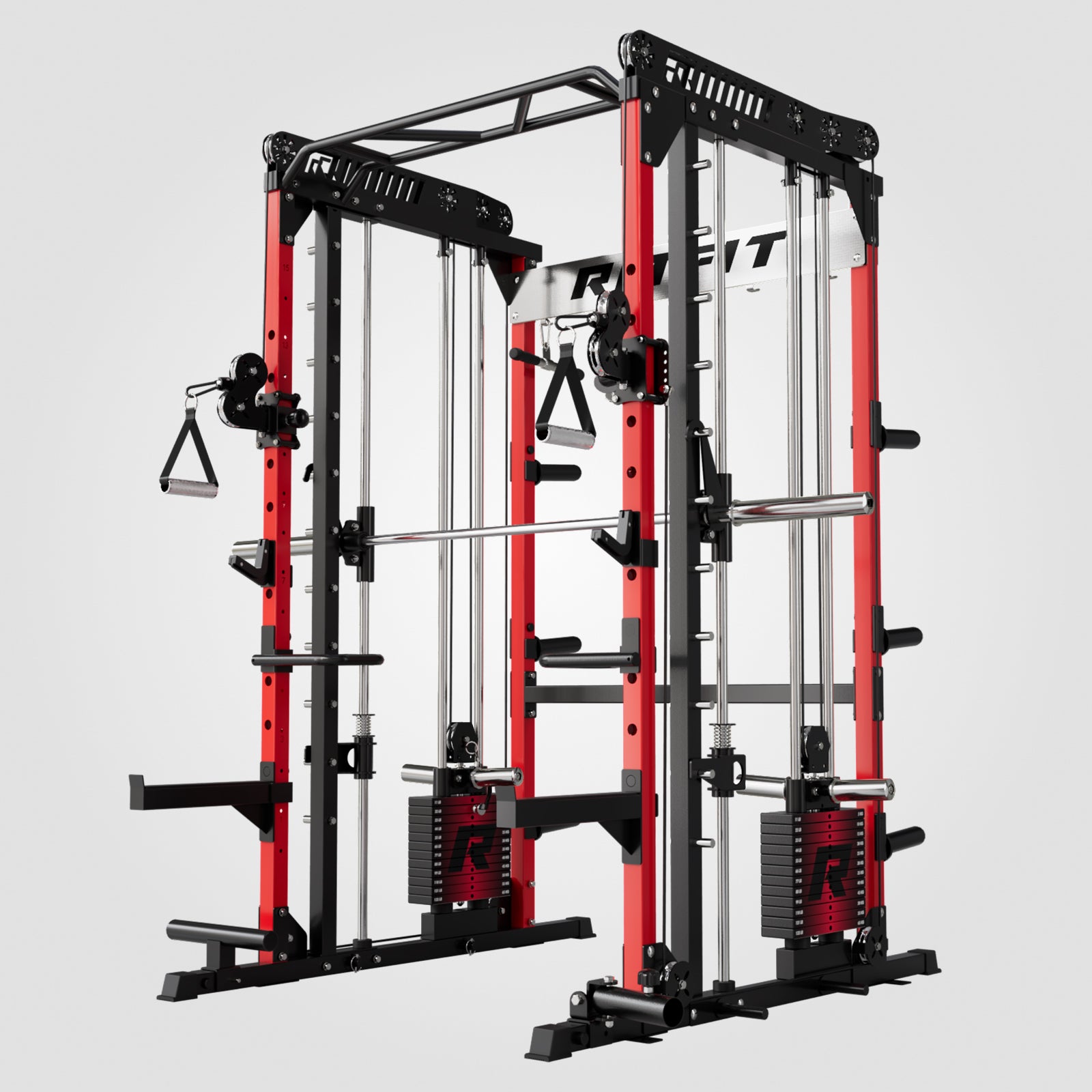
What is included: the package is built on the RitFit BPC06 all-in-one Smith machine, which carries a 260 lb adjustable weight stack, 130 lb per side across 13 plates of 10 lb each, and a 17 position aluminum cable pulley system at a 1:1 ratio. The package adds a BWB01 or BWB02 adjustable bench and a bumper plate set in 320 lb, 370 lb, or 420 lb, and the frame supplies six fixed plate sleeves plus two Olympic bar storage tubes.
Floor and height: the published base footprint is 27.2 square feet, with the rack measuring 79.9 inches long including the Smith bar, 53.9 inches wide, and 87.1 inches tall. Budget the base plus a bench lane in front, and check clearance above an 87.1 inch frame before you place it under a joist or a garage door track.
Who it suits: a shared room where the machine has to be most of the gym. The stack, the plate sleeves, and the bar tubes all ride on the frame, so plates and bars never claim their own patch of floor.
Trade-off in 200 square feet: you spend ceiling margin as well as floor, because the 87.1 inch frame is taller than the P3 cage and the 27.2 square foot base is larger than the P3 base. Protect the walkways and the dumbbell wall, since the machine covers the rest.
"I love this machine. Not having to commute to the gym is worth every penny. I hope they can make an attachment for leg curls though. I have seen other racks with a leg curl attachment and would love to get one. I would buy this machine all over again, it's that great."
Christopher r. Verified Buyer, RitFit BPC06 All-In-One Smith Machine Home Gym Package
RitFit M1 PRO All-In-One Smith Machine Home Gym Package
What is included: the RitFit M1 PRO Smith Machine Home Gym Package pairs the M1 PRO machine with a BWB01 bench and a bumper plate set in 260 lb, 320 lb, or 370 lb. The listing specifies a cable crossover system with 15 adjustable positions on a 2:1 pulley ratio, a Smith attachment rated to 1500 lbs with 11 height settings, 12 adjustable upright holes for J-hooks, safety bars, and dip bars, a 28 mm multi-grip pull-up bar, and storage for three Olympic bars plus six weight plate holders.
Floor and height: plan a training lane about 4 feet wide and 8 feet deep, roughly 32 square feet of working area, and allow about 8 feet of ceiling for overhead pressing and pull-ups.
Who it suits: the lifter who wants one station to cover lower body, upper body, and cable work. It suits a room where a rack plus a separate cable tower would need two lanes.
Trade-off in 200 square feet: this is the middle route on floor and the broadest on stations, and the 4 by 8 foot lane is the price. It leaves the dumbbell wall and the cardio strip roughly the shares the zone budget above already sets aside.
"I've been very impressed with the RitFit M1 PRO Smith Machine Home Gym Package. It offers an incredible variety of exercises in one compact setup, making it easy to train every major muscle group without needing multiple machines. The Smith machine, cable system, and power rack all operate smoothly, and the overall frame feels sturdy and stable during workouts. Assembly does take some time, but the instructions are straightforward if you work through them step by step. Once it's set up, the machine feels like a complete home gym. The included attachments add a lot of versatility, allowing me to perform everything from squats and bench presses to cable flyes, lat pulldowns, and rows. For the price, the quality and features exceeded my expectations. It's a great investment for anyone looking to build a home gym without spending commercial-gym prices. I would definitely recommend the RitFit M1 PRO to beginners and experienced lifters alike who want a reliable, all-in-one workout system."
Tiffany L. Verified Buyer, RitFit M1 PRO Smith Machine Home Gym Package Comprehensive All-In-One Workout System
RitFit P3 Power Cage 1200lbs Home Gym Package
What is included: the package is built on the RitFit P3 Power Cage, a 2 by 2 inch 14 gauge steel frame rated to 1200 lbs static load with a dual-pulley cable system running 21 all-aluminum pulleys at a 2:1 ratio, a multi-grip pull-up bar, storage pegs, and a landmine attachment. It takes both 1 inch and 2 inch plates, and the package adds a BWB01 bench and a bumper plate set in 260 lb, 320 lb, or 370 lb.
Floor and height: the published cage measures 67.2 inches long, 59.1 inches wide, and 81 inches high, with a base footprint of 17.5 square feet, the smallest published base of the three. The number that decides the layout is the open lane, because barbell squats and bench press need clear floor in front of the cage.
Who it suits: anyone who wants a free barbell instead of a guided Smith bar and will trade the built-in stack for it. The RitFit P3 Power Cage small space guide walks through how that lane behaves in a tight room.
Trade-off in 200 square feet: the smallest base still asks for the largest training lane, so treat the front lane as part of the walkway rather than a second zone. The 81 inch frame also leaves more ceiling margin than the BPC06 package.
| Machine | Who it suits | Trade-off in 200 square feet |
|---|---|---|
| RitFit BPC06 All-In-One Smith Machine Home Gym Package | A shared room where the machine has to be most of the gym | Stack, plates, and bar storage all ride on the frame, but the base takes 27.2 square feet and the frame tops out at 87.1 inches |
| RitFit M1 PRO All-In-One Smith Machine Home Gym Package | One station for lower body, upper body, and cable work | Middle route on floor and the broadest on stations, with a training lane of about 4 by 8 feet |
| RitFit P3 Power Cage 1200lbs Home Gym Package | Free barbell squats and bench press | Smallest published base at 17.5 square feet and the largest open lane demand, but its 81 inch frame beats the BPC06 on ceiling room |
Base footprints and heights are published listing figures. They exclude the training lane each package needs, which is the part of the 200 square foot budget the zone plan above spends.
If you would rather add stations over time, the RitFit M2 SERIES Multi-Functional Modular Home Gym Package is the expandable version of the same idea. Start with the frame and the cable platform, then add attachments as the room allows.
"Nice little setup. Great for home gym and basic needs. Easy to set up."
Abby B. Verified Buyer, RitFit P3 Power Cage 1200lbs Home Gym Package
How Much Usable Floor Space Do You Actually Get in a 200 Square Foot Home Gym?
A 200 square foot home gym leaves about 120 square feet of equipment-ready floor. The remaining area disappears into a perimeter walkway, the door swing, and the clearance each machine needs for loading and for safe entry and exit.
Measure the room before you measure any machine
Four numbers decide the whole layout, and all four come from the room rather than from a product page.
- Length and width: A single garage bay is commonly about 10 by 20 feet, which is exactly 200 square feet of gross floor area.
- Ceiling height: Measure from the finished floor, not the slab, and measure under any joist, duct, or garage door track.
- Fixed obstacles: Note the door swing, the water heater, the window sill, and any step between the slab and the house.
- Slab condition: A level, dry slab takes interlocking rubber gym flooring directly, while a damp or sloped slab needs a subfloor decision first.
A 12 by 12 foot room gives you 144 square feet, so 200 square feet carries roughly a third more equipment-ready area, not a third more equipment. The extra room buys clearance around stations rather than a second full training zone.
The clearance ring that eats your square footage
Every station owns more floor than its own base, because you have to stand, load, and step away from it.
- Inside the rack: Leave at least 24 inches on each side of a rack so plates and spotter arms clear the walls.
- In front of and behind the rack: Budget 36 inches as a training lane, which is where the lift, the spot, and the walk-out all happen.
- Dumbbell wall: Leave enough room to bend and pick up a pair, which is roughly the depth of your own shoulders plus an arm.
- Walkways: Keep one continuous 30 inch path from the door to every station so the room still works when two people train together.
A peer-reviewed review notes that compact micro-gyms, meaning small dedicated training spaces, are a practical way to fit exercise into limited floor area and to keep people training consistently.[1] One published 200 square foot floor plan treats the room as 10 by 20 feet and notes that a wall-mounted folding squat rack projects only about 4 inches from the wall while needing at least 95 inches of ceiling height.
If 200 square feet is more room than you can free up, the 144 square foot home gym layout covers the tier below this one.
How Should You Zone 200 Square Feet for Strength, Dumbbells, and Cardio?
Zoning a 200 square foot home gym means giving the strength station about half the floor. The dumbbell and accessory wall takes about a third, and the leftover strip belongs to cardio and stretching.
Zones stop a small room from turning into a pile of equipment with no place to stand.
A three zone budget that survives real training
Treat the room as three claims on the floor, then check the walkway before you buy anything.
| Zone | Share of the floor | What it holds | Gross area in a 10 by 20 room |
|---|---|---|---|
| Strength station | About half | All-in-one Smith machine, rack, or power cage plus its training lane | Roughly 100 square feet |
| Dumbbell and accessory wall | About a third | Bench, adjustable dumbbells, bands, and vertical storage | Roughly 66 square feet |
| Cardio and stretch strip | The remainder | One folding bike, rower, or treadmill, plus a mat | Roughly 34 square feet |
Shares are planning proportions for a 10 by 20 foot room and describe gross floor area, not the smaller net area that remains after clearance.
Small setups still produce real adaptation, so an honest zone budget beats an aspirational one. In one 4-week home-based training study, 12 older adults completed 8 exercises at 3 sets of 12 repetitions daily and their leg muscle power rose from 276.7 W to 323.4 W with no specialist equipment.[2]
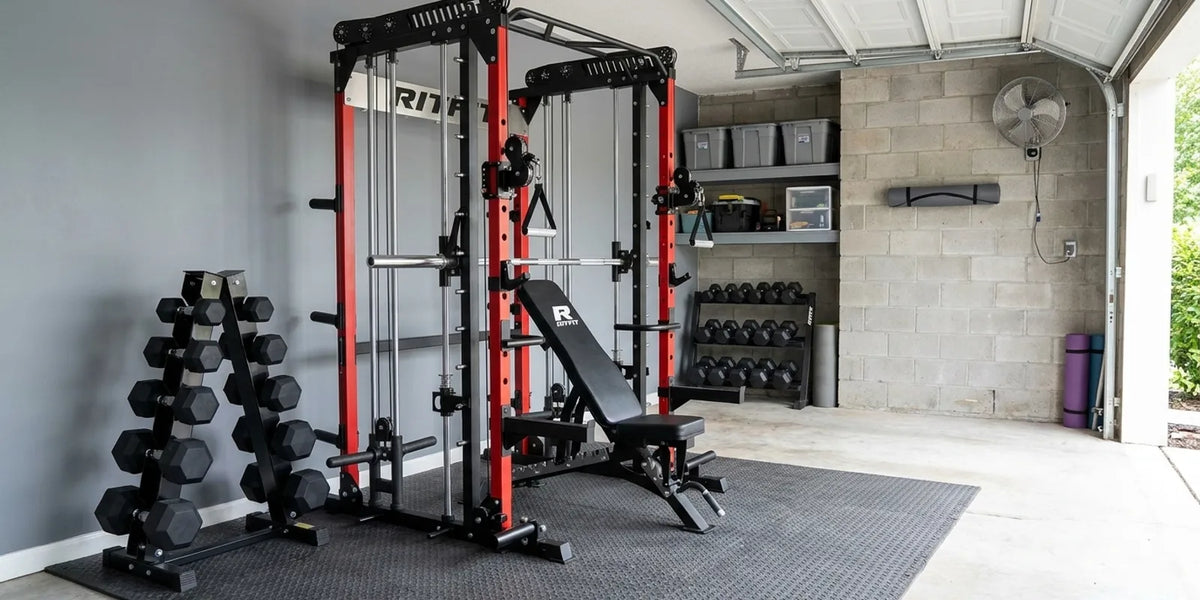
Standing storage is how the dumbbell zone pays for itself. A five pair rack on the floor and a two tier rack against a wall hold the same dumbbells, and the wall version returns several square feet to the bench area.
Keep the bench and the RitFit A-Frame Dumbbell Rack on the same wall as your dumbbells, because carrying a pair across the room to press is how people start skipping sets.
"Amazing addition to my home gym. I needed something to hold a few extra dumbbells, and this delivered! Easy installation and a clean rack!"
Anthony, Verified Buyer, RitFit A-Frame Dumbbell Storage Rack Stand
What Fits in a 200 Square Foot Home Gym and What Does Not?
A 200 square foot home gym fits one rack or all-in-one station and a bench. It does not fit a full power cage alongside two cardio machines once every clearance is measured honestly.
Fits without compromise
- All-in-one station: One upright that carries a Smith bar, a cable crossover, and a squat position replaces three separate stations and three separate clearance rings.
- Squat stand or folding rack: A 70 inch squat stand runs about a 49 by 48 inch footprint, and a folding wall rack clears the floor between sessions.
- Adjustable dumbbell pair: One pair covers the range of several fixed pairs and frees the wall for a rack or a mat.
- Bench: A folding or upright storing bench keeps the strength lane open when you are not pressing.
- One cardio machine: Pick the one you will actually use, and choose a model that folds or stands upright.
- Vertical storage: Bands, handles, collars, and jump ropes belong on wall posts, not in floor bins.
Does not fit once clearance is counted
- Full power cage plus two cardio machines: Each claim alone is reasonable, and together they consume both the strength lane and the cardio strip.
- Multiple bodybuilding machines: Single station chest, shoulder, and leg machines each carry their own clearance ring, so three machines can claim most of the room.
- Power cage under a low ceiling: A tall cage under a joist or a garage door track leaves no legal place to press, which no floor plan can fix.
- A second bar and a lifting platform: A standard bar runs a little over 7 feet long, so a platform plus a rack plus a bench needs more width than a 10 foot wall offers with clearance.
A 200 square foot room where the cage is the priority looks different from one where cardio is the priority, and the RitFit P3 Power Cage belongs in the first version. Benches drive the second decision, and the best weight bench for small spaces comparison walks through that trade.
"The standard bar length is a little over 7 feet, has '2-inch'/50mm diameter sleeves for loading the plates on, and weighs 20kg/44.1lbs. For home gym purposes, a 28.5 or 29mm bar will be the most durable and provide the best service over time."
Mark Rippetoe, Strength Coach and Author of Starting Strength, Starting Strength, How to Build a Home Gym
How Much Floor Space Does a RitFit M1 PRO Smith Machine Need in 200 Square Feet?
A RitFit M1 PRO Smith Machine needs a training lane rather than a large footprint. Its bar, cable, and rack positions share one upright, so a single station retires three separate clearance rings.
Footprint plus training clearance for an all-in-one station
Plan the station as a lane roughly 4 feet wide and 8 feet deep, which is 32 square feet of usable working area before the machine base is added.
- Load and unload: Keep at least 24 inches at each side so plates go on and come off without twisting against a wall.
- Bar travel: The Smith bar rides in fixed tracks, so the lane depth is set by your bench position, not by a free bar path.
- Bench in and out: Leave room to roll a bench in and out of the Smith position without dismantling the seat.
- Ceiling: Check the top of the frame plus any pull-up bar against your measured ceiling before you commit the lane.
- Room to grow: Cable work happens in the same lane, so a second accessory does not need a second clearance ring.
This is the trade the RitFit M1 PRO Smith Machine makes for a small room: you give up the open floor a free weight rack leaves behind and gain back the footprint three separate stations would have claimed.
Verified owners describe the fit directly: the machine works as a shared family setup and fits the space it was measured for, while accessory and weight storage keeps the room from spilling over.
"This is the perfect home gym for my family to use and fits great in our space. Exceptional customer service throughout the selection process. They were very responsive to questions with quick follow up. Would recommend to anyone."
Daniel T. Verified Buyer, RitFit M1 PRO Multi-Functional Smith Machine
How Do You Choose an All-in-One Machine When Floor Space Is the Binding Constraint?
Choosing an all-in-one machine for a small gym comes down to how many stations it replaces. A feature list tells you what a machine can do, while a footprint plus clearance tells you whether you can actually use it.
Four selection criteria that beat a feature list
- Stations replaced per footprint: Count the separate pieces the machine removes. One upright that covers pressing, squatting, cable rows, and pull-ups retires three clearance rings at once.
- Adjustment range across users: A shared room needs seat, back pad, and bar heights that move between a shorter and a taller lifter in one turn.
- Attachment compatibility: The cheaper path in a small room is one cable platform plus a growing set of handles and bars, rather than a new machine per movement.
- Working height against your ceiling: Compare the tallest configuration, including a pull-up bar, to the ceiling you measured under the joists.
The modular route suits rooms that will grow in stages. The RitFit M2 Series Modular Home Gym Package and the RitFit BPC06 All-in-One Smith Machine both trade the open floor of a standalone rack for a single usable lane.
Comparing the Smith machine collection against a rack and bench pair is the fastest way to see which trade your room can absorb.
"If you have a limited space, then if you just have one even just one selectorized cable attachment you can buy tons of different bars for it and essentially multiply with every new bar."
Dr. Mike Israetel, PhD, PhD in Sport Physiology, Co-founder, Renaissance Periodization, My Home Gym Tour - See My Insane Workout Setup!
"Really solid product especially for the price. Some minor bends in the smith bars that don't affect functionality much. Fit perfectly in my space when I flipped the pullup bar upside down. Just need to buy myself some more floor mats and get some attachment storage."
Mason N. Verified Buyer, RitFit M1 PRO Multi-Functional Smith Machine with Cable Crossover System and Squat Rack for Home Gym
What Are the Most Common Mistakes When Setting Up a 200 Square Foot Gym?
The most common 200 square foot gym mistake is buying equipment before measuring the room. A room that meets the published footprint of four machines can still be unusable once clearance and walkways are counted.
- Buying cardio first: A treadmill is the largest single claim in the room and the hardest to store, so it should be the last purchase, not the first.
- Using the published footprint: A base dimension is not a working dimension, so add the training lane before you compare machines.
- Ignoring the door swing: A 36 inch door that swings into the room removes floor area that no product page accounts for.
- Skipping the ceiling check: Overhead press, pull-ups, and wall-mounted racks all fail on height, not on floor area.
- Storing on the floor: Bins, bands, and spare plates on the ground quietly convert training lane into junk storage.
- No walkway plan: If the path between two stations is blocked while one person is training, the room only works solo.
Simplicity is what keeps a home setup in use. A qualitative study of home-based resistance exercise found that participants described the flexibility and simplicity of the program as enablers, while having to learn the exercises and plain procrastination were the barriers.[3]
A room where every station is already set up removes most of that friction.
When Should You Stop Adding Equipment to a 200 Square Foot Home Gym?
Stop adding equipment to a 200 square foot home gym when a walkway drops below 30 inches. At that point the room still contains floor space, but it no longer contains usable floor space.
- Walkway closes: When you have to turn sideways or move a bench to reach a machine, the next purchase is storage, not equipment.
- Setup time grows: If a set now needs two minutes of rearranging, the room is training you instead of the other way around.
- Clearance disappears: Never let a new machine borrow the space in front of the rack, because that lane is the safety zone for a missed lift.
- Two people cannot train: In a shared room, if a second person cannot complete a full movement at the same time, the layout has hit its limit.
- Ceiling becomes the constraint: Once every height-dependent movement is pinned to the lowest joist, added equipment cannot buy back any capability.
At that point the honest upgrade is a better version of what you already own, not one more station. That is the same logic the home gym size guide uses when it maps room size to equipment tier.
FAQs About Setting Up a Home Gym within 200 Square Feet
Can a 200 square foot home gym fit a full power cage?
Yes, a 200 square foot room can hold a full power cage if you give up the cardio zone. A cage takes roughly 49 by 48 inches of floor plus a training lane in front, so it needs about 40 square feet of your net usable area. Readers who want a bike or rower in the same room usually choose a folding rack or an all-in-one station instead.
How much clearance should you leave around a squat rack?
Plan about 24 inches on the sides and at least 36 inches in front of and behind a squat rack. The front space is where you stand, spot, and step back after a lift, so it cannot double as storage. That clearance ring is why a machine with a small footprint can still claim a large share of the room.
Is 200 square feet enough for both strength training and cardio?
Yes, but only if the cardio piece folds or rolls. One cardio machine plus a rack, bench, and dumbbells fits a 10 by 20 foot room when the cardio equipment stores against a wall. Adding a second cardio machine is the point where the room stops being walkable, so pick the one you will really use.
What ceiling height does a home gym need?
Allow about 8 feet for most racks and for overhead pressing, and 95 inches or more for wall-mounted folding racks that deploy upward. Measure from the finished floor rather than the slab, and remember that a pull-up bar adds height at the top of any rack. Low ceilings are a hard limit that no layout can fix.
How do you fit dumbbells into a 200 square foot gym?
Use one adjustable dumbbell pair or a small A-frame rack instead of a full dumbbell set. A floor rack holding five pairs eats roughly 6 square feet, while a two tier rack against the wall frees that area back to your bench. Vertical storage is the cheapest square footage you can buy back in a small room.
What should you put on the floor of a home gym?
Use interlocking rubber tiles or stall mats over a level, dry slab. Rubber protects the concrete from dropped plates, cuts the noise that reaches the rest of the house, and marks the edge of the training zone. Avoid bare carpet, which slides under a bench, and thin foam, which compresses under a rack.
Conclusion
A 200 square foot home gym works when the room gets a zone budget before the equipment gets a shopping cart. Measure the floor, subtract the clearance ring, and give the strength station about half of what remains.
Then add one station at a time and stop when the walkway closes. If your room is closer to 12 by 12, read the home gym size guide and size down before you buy.
Disclaimer
Measure your own space, ceiling height, and slab before you buy any equipment, and follow the manufacturer's assembly and load limits for every machine. Consult a qualified professional about any injury, medical condition, or training limitation before you start a new program.
References
1. Mózes N, Árva D, Major D, et al. Micro-gyms as a catalyst for healthy aging in university and healthcare settings: applications for the Semmelweis-EUniWell Workplace Health Promotion Model Program. Geroscience. 2025;47(4):5559-5575. doi:10.1007/s11357-025-01595-9. PMCID: PMC12397000
2. Cegielski J, Brook MS, Quinlan JI, et al. A 4-week, lifestyle-integrated, home-based exercise training program elicits improvements in physical function and lean mass in older men and women: a pilot study. F1000Res. 2017;6:1235. doi:10.12688/f1000research.11894.2. PMCID: PMC5680536
3. Alsowail AT, Malkova D, Ryde GC, Gray SR. Enablers and barriers toward home-based resistance exercise among older adults who completed a structured program: qualitative study using reflexive thematic analysis. BMC Geriatr. 2026;26(1):231. doi:10.1186/s12877-026-06986-x. PMCID: PMC12911215