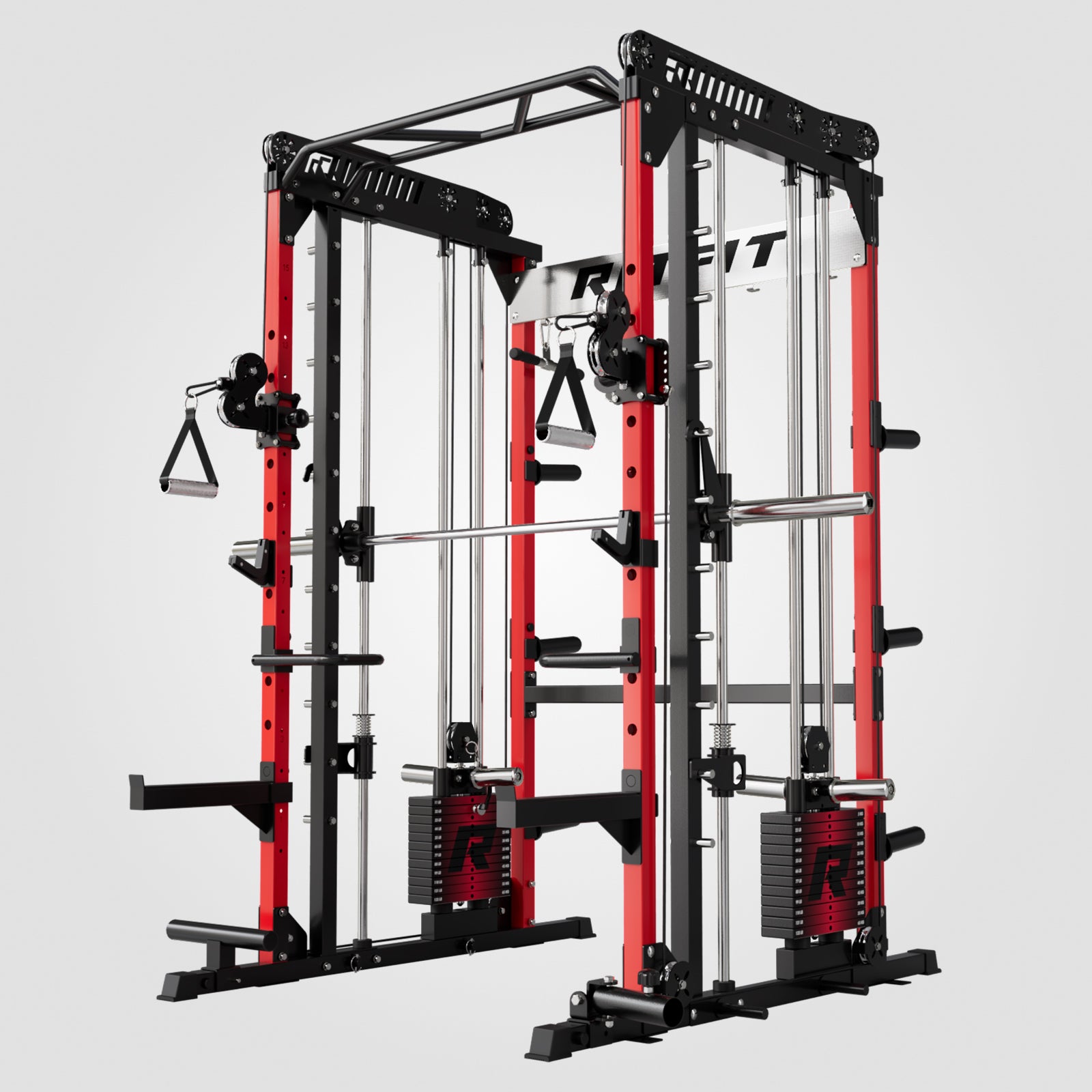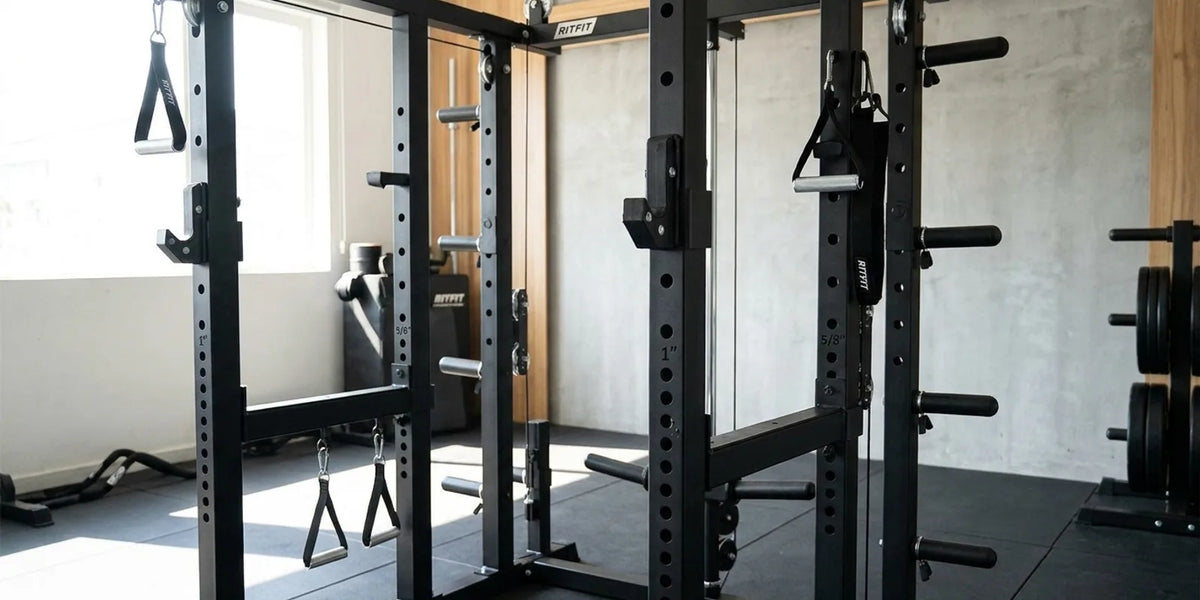
The 5/8 vs 1 inch power rack hole spacing question is usually asked about spacing, yet both numbers are hole diameters. Spacing is a separate measurement taken from the center of one hole to the center of the next.
This guide separates the two specs, shows what each one changes about attachment fit, safety pin placement and adjustment precision, and gives a simple way to check your own rack before buying parts.
Quick Answer: The 5/8 vs 1 inch power rack hole spacing labels describe hole diameter, not spacing. Diameter decides which attachment family fits your uprights, while spacing decides how finely you can set J-hooks and safety pins. Buy for the attachments you plan to use, then confirm diameter and spacing before ordering.
Key Takeaways
- Two specs, not one: The 5/8 inch and 1 inch figures are hole and peg diameters, while spacing is measured on center between neighboring holes.
- Diameter sets your attachment pool: Hardware and peg diameters across rack brands run from 1/2 inch up to 1 inch, and the larger family carries more heavy duty options.
- Spacing sets precision: Two inch on center spacing is becoming the standard, and Westside spacing adds a 1 inch band of holes for bench press safety work.
- Locking pins are the strict test: Two hole attachments are where metric and imperial racks clash, with an offset starting near 1/16 inch per hole.
- Measure before you buy: Check the diameter inside a single hole and the center to center spacing on your own rack first.
What Is the Difference Between Rack Hole Spacing and Hole Diameter?
Rack hole diameter is the width of a single hole, while hole spacing is the center to center distance between holes. The two are unrelated measurements, so a rack can have large holes with tight spacing or small holes with wide spacing.
| Spec | What it measures | What it changes |
|---|---|---|
| 5/8 inch hole (about 16 mm) | Hole and peg diameter | Accepts 5/8 inch hardware, common on 2x2 and 2x3 uprights |
| 1 inch hole (about 25 mm) | Hole and peg diameter | Accepts 1 inch hardware, common on 3x3 uprights |
| 1 inch spacing | Hole center to hole center | Finest height adjustment, used in the Westside pattern |
| 2 inch spacing | Hole center to hole center | Current standard, fewer positions but faster to scan |
Diameter and spacing figures describe current industry practice, and hardware diameters across brands run from 1/2 inch to 1 inch.
- Hole diameter: The figure most listings quote, commonly 5/8 inch or 1 inch, and it sets the peg size your attachments must use.
- Hole spacing: Measured on center, usually 1 inch or 2 inches, and it sets how many height positions you get along an upright.
- Upright tubing size: The third spec, such as 2x2, 2x3 or 3x3, and it decides whether an attachment bracket fits over the post at all.
Checking your own rack takes two quick measurements.
- Diameter: Measure across the widest point inside a single hole.
- Spacing: Measure from the center of one hole to the center of the next hole up.
Compare both figures with the attachment listing before you order, because a peg that is one size off will not seat properly in the hole.
One compatibility guide explains that going by peg diameter is more consistent across brands than going by hole size, because holes are cut somewhat larger than the peg that goes into them.
Why the 5/8 Inch and 1 Inch Numbers Describe Diameter
Metric nominals sit close to the inch figures, so about 16 mm is the nearest equivalent of 5/8 inch and about 25 mm is the nearest equivalent of 1 inch. RitFit publishes a J-hooks and rack attachments technical specification sheet for buyers who want to confirm hardware details before ordering.
How Do 5/8 Inch and 1 Inch Holes Change Attachment Compatibility?
Hole diameter decides which peg size an attachment must have, so a 5/8 inch rack and a 1 inch rack generally draw from different attachment catalogs. Spacing only enters the picture once an attachment uses a second hole and a locking pin.
- Cross fit parts: RitFit lists the RitFit AT02A Hack Squat Rack Attachment and the RitFit AT03 Belt Squat Attachment for 2x2, 2x3 and 3x3 racks.
- Model specific parts: Other hardware is tied to one machine, such as the RitFit PAT01 Hip Thrust and Bicep Curl Attachment listed for the P3 cage.
- Locking pin parts: Spotter arms and similar two hole attachments are the strictest test of whether a peg, a bracket and a second hole all line up.
One compatibility guide points out that hole spacing only changes fit for attachments that use a second hole and a locking pin. Where metric and imperial spacing meet, the same guide reports an offset starting near 1/16 inch per hole that widens cumulatively as you move up the upright.
The full Rack Attachments catalog is the fastest place to confirm what a given upright size accepts.
Does the RitFit P3 Power Cage Fit These Attachments?
The RitFit P3 Power Cage is rated to 1200 lbs and pairs a cable system with aluminum pulleys, and its attachment list is the first place to check fit before ordering anything for a cable based rack.
"Great rack for my first time building a home gym. I use this weekly and have no major complaints. Shipping was quick and everything came at the same time. Not a huge fan of the plastic on the hooks but they seem to hold up fine with minor wear on them. Happy with this purchase."
Caitlyn L. Verified Buyer, RitFit P3 Power Cage 1200lbs with Smooth Cable System & Aluminum Pulleys
Why Does Hole Spacing Matter for Safety Pin Height and Setup Precision?
Hole spacing controls how close the safety pins can sit to the height where a lift would fail, so finer spacing gives you a tighter catch point. It also changes how precisely you can set J-hooks for your own body position.
Two inch on center spacing is becoming the standard, and Westside spacing puts 1 inch spaced holes across a limited height range with 2 inch spacing above and below it. That narrow band usually covers the bench press heights where a failed rep needs to be caught close to the chest.
A study compared the safety-bar, high-bar and low-bar squat around the sticking region, which is the same range where a rack's safety hardware either saves a rep or does not.[1]
Load bearing parts such as the RitFit Upgraded J Hook Attachment for 2x2 Racks are built for a specific peg family, so the hardware and the hole have to match before height precision matters at all.
A loose attachment is the real risk, because a part that can rattle and tip under load behaves differently from one that sits snug in its hole.
"The smith machine is great because it's going to take a lot of the pressure out of your shoulders because it's supporting itself and you can do a little bit more weight on here. So it can help you break some barriers too, and also if you don't have a spotter you can utilize the tabs ... so if you drop it it'll just bounce and then you won't hurt yourself."
Jeff Cavaliere, MSPT, CSCS, Physical Therapist and Strength Coach, Athlean-X, Smith Machine Bench Press
Which Hole Spacing Should a Home Gym Choose?
Home gym buyers should start with hole diameter, because the 1 inch family carries more heavy duty attachment options than the 5/8 inch family. Spacing then decides how precisely you can place safety pins for the lifts you actually train.
- Train alone: Prioritize finer spacing, because you rely on the safeties rather than a spotter.
- Plan to add attachments: Prioritize the 1 inch diameter family so you keep access to the widest hardware pool.
- Tight budget: A 5/8 inch rack with 2 inch spacing still covers squats, presses and pull ups, as long as you accept a smaller attachment pool.
- Check rack depth: One universal dip attachment design needs at least 21 inches between the front and back uprights and does not depend on hole spacing at all.
A study examined how stance width and barbell placement change kinematics, kinetics and muscle activity in the back squat, which is why being able to reposition hardware in small steps has practical value.[2]
Most home setups start from a Power Rack Package, which keeps the rack, bar and bench in one purchase instead of three separate orders.
What Does a Wider Attachment Range Change in Your Training?
A wider attachment range on one rack adds exercise variety without adding floor space, because the same uprights carry leg, back, chest and arm attachments. That matters in a garage or spare room where a second machine is not an option.
Typical examples include hack squat, belt squat and landmine stations, along with a RitFit Rack Attachment Aluminum Pulley Set for cable work.
An eight week randomised trial compared resistance training with barbell half squats and trap bar deadlifts for maximal strength, power performance and lean mass in recreationally active females, which is the kind of barbell programming a rack based home gym supports.[3]
Upgrading later usually means moving to a rack with a broader attachment line, such as the RitFit M3 Power Rack Cable Crossover, so the hardware you already own keeps working.
What Are the Most Common Hole Spacing Mistakes?
The most common mistake is reading the 5/8 inch or 1 inch figure as a spacing measurement, then ordering an attachment that cannot lock into the rack. The second is assuming a heavier frame makes more parts fit.
- Mixing diameter with spacing: A 1 inch hole says nothing about how far apart the rest of the holes sit.
- Forcing a loose fit: J-hooks and safety arms should sit snug, and shims are the usual fix when a bracket is slightly loose.
- Buying by tubing size only: Tube size gets the bracket over the post, but the peg still has to match the hole.
- Expecting gauge to fix fit: One compatibility guide notes that steel gauge does not change attachment compatibility, because rack tubing is fabricated to an outside dimension.
- Skipping the locking pin: If a second hole will not line up, the attachment is not secured the way it was designed to be.
It also helps to review the attachment options for 2x2 racks first, because that upright size has the smallest attachment pool and shows fit problems earliest.
FAQs About Power Rack Hole Spacing
Is 1 inch hole spacing better than 5/8 inch for a home gym?
Neither is automatically better, because the two numbers describe different things. A 5/8 inch or 1 inch figure is the hole diameter, while spacing is the distance between holes on center. One inch hardware opens access to more heavy duty attachments, so lifters planning big loads usually prefer it.
Can I use 1 inch attachments in a 5/8 inch rack?
Not without adapters, and the fit is rarely ideal. A peg made for a 1 inch hole will not seat in a 5/8 inch hole, and a 5/8 inch peg left loose in a 1 inch hole can rattle and tip. Load bearing parts such as J-hooks and safety arms should never sit loose.
What is Westside hole spacing?
Westside spacing is a pattern that places 1 inch spaced holes across a limited height range and 2 inch spacing above and below it. The fine section lines up with typical bench press and squat heights, so safety bars can sit closer to the position where a failed rep actually stops.
Does hole spacing affect how much weight a rack can hold?
Not directly. A rack's load rating comes from its steel, upright size and joint design, while hole spacing only decides where you can mount hardware. Spacing does affect how well an attachment locks in, and a loose attachment can move under load even on a strong frame.
How do I measure my rack's hole spacing and hole size?
Measure the hole diameter first, using the widest point inside a single hole. Then measure spacing from the center of one hole to the center of the next one up. Both figures must match the attachment listing, so check them before you order anything.
Do I need numbered holes on a power rack?
Numbered holes are a convenience rather than a safety feature. They let you return to a known position instead of counting from the top each session. If your rack has plain holes, a marker pen gives you the same reference points in a few minutes.
Conclusion
Hole spacing and hole diameter are two different specs, and only the diameter decides whether an attachment fits your rack. Check the diameter first, then the spacing, then the upright size, and the 5/8 vs 1 inch power rack hole spacing question stops being confusing.
Measure your own uprights before you buy anything, then match hardware to those numbers. Our RitFit discount guide covers current offers, and the Racks Package collection shows how racks, bars and attachments are bundled together.
Disclaimer
This article covers equipment specifications and general training setup, not medical advice. Consult a qualified professional before starting a new training program or if you have an injury or health condition.
References
1. Kristiansen E, Larsen S, Haugen ME, Helms E, van den Tillaar R. A Biomechanical Comparison of the Safety-Bar, High-Bar and Low-Bar Squat around the Sticking Region among Recreationally Resistance-Trained Men and Women. Int J Environ Res Public Health. 2021;18(16). doi:10.3390/ijerph18168351. PMCID: PMC8392107
2. Larsen S, Kristiansen E, Helms E, van den Tillaar R. Effects of Stance Width and Barbell Placement on Kinematics, Kinetics, and Myoelectric Activity in Back Squats. Front Sports Act Living. 2021;3:719013. doi:10.3389/fspor.2021.719013. PMCID: PMC8440835
3. Hagerupsen K, Pedersen S, Giller NB, et al. Comparison of resistance training using barbell half squats and trap bar deadlifts on maximal strength, power performance, and lean mass in recreationally active females: an eight-week randomised trial. BMC Sports Sci Med Rehabil. 2024;16(1):124. doi:10.1186/s13102-024-00911-8. PMCID: PMC11140948