How to add more weight to a cable machine comes down to three supported options: extra plates on the top of the stack, fractional weights that close the gap between stack increments, and a larger stack set rated for your model.
A stock stack is sized for the average user, so the top plate arrives long before your back and arm work stops progressing. This guide walks through each route in order of cost and effort, then marks the limit the frame, cable and pulleys actually allow.
Quick Answer: You add more weight to a cable machine with add-on plates that attach to the top plate, fractional weights that add 1.25 lb to 5 lb, or a stack set rated higher for your model. Never hang loose plates from the cable, and never exceed the capacity printed on the machine.
Key Takeaways
- The stack is the first ceiling: A selectorized stack maxes out at its plate count, and the selector pin can never reach past the last plate.
- Add-on plates are the cheapest step: Adder pins, adapter plates and magnetic bricks raise the top plate by 2.5 lb to 10 lb at a time.
- Fractional weights fix the jump problem: Pieces of 1.25 lb to 5 lb let you progress without a full 10 lb stack step, and one study found lighter initial loads produced similar strength gains when progression was programmed.[1]
- Upgrades belong to specific models: RitFit lists a 264 lb stack set for the M1 and 286 lb sets for the M2, M2 3D and BUFFALO, so match the set to your machine.
- Hardware sets the real line: The lowest rating among frame, cable, pulleys and stack hardware is your true limit, not the number on the cage.
How Do You Add More Weight to a Cable Machine?
You can add more weight to a cable machine in four supported ways. The right one depends on your stack size, your machine rating and how much resistance you still need.
- Use the full pin range first: The selector pin already gives you every plate in the stack, so confirm you are not leaving plates below the pin before you buy anything.
- Load the top plate: Add-on plates and adder pins attach to the top plate and raise the ceiling by 2.5 lb to 10 lb at a time.
- Close the increment gap: Fractional weights of 1.25 lb to 5 lb let you progress without jumping a whole stack step.
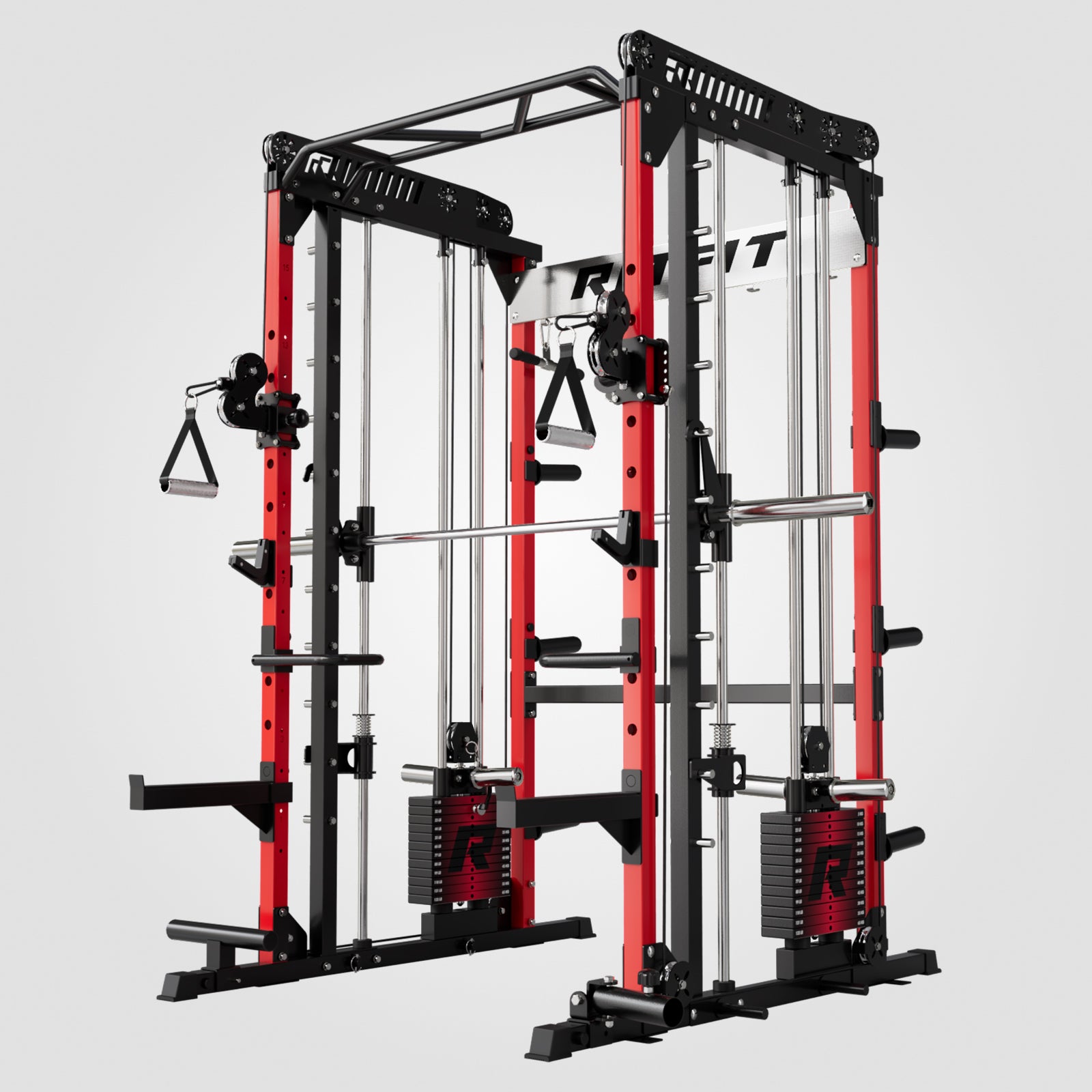
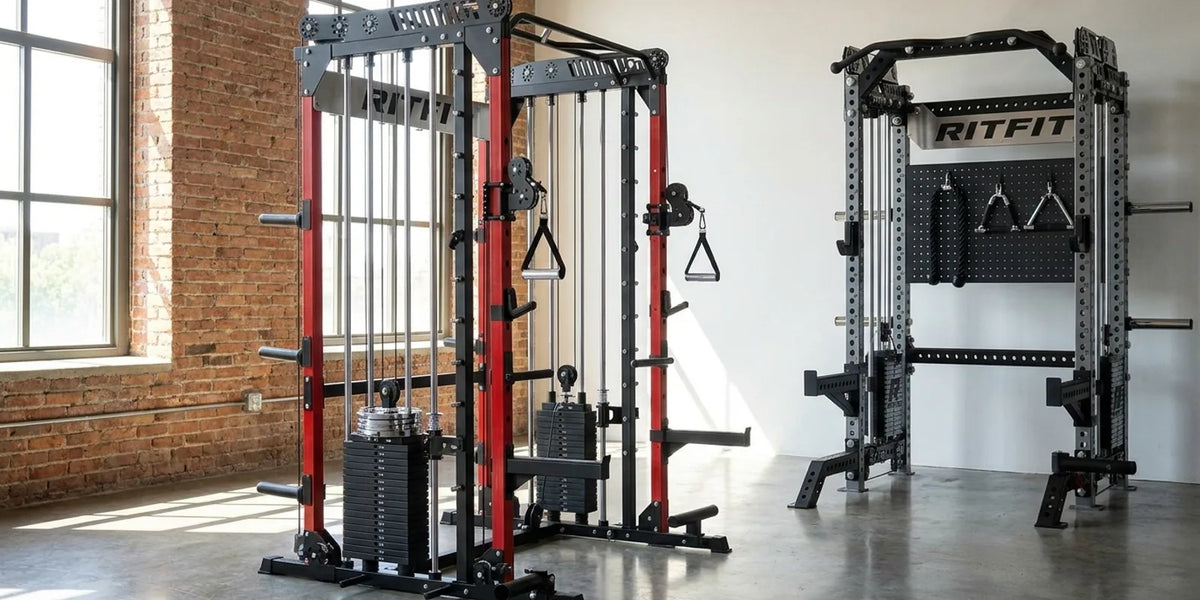
- Upgrade the stack or the machine: A larger stack set moves the ceiling in one purchase, and a dual cable crossover machine gives you two stacks to work with.
Most home gym owners should work down that list in order, because each step costs more and commits you further. A machine built around a plate-loaded versus weight stack design adds resistance through loaded plates instead, so match your shopping list to the system you own.
What Are Add-On Plates and Fractional Weights for a Cable Stack?
Add-on plates are small weights that attach to the top of a selectorized stack. They raise the load by a fixed amount without changing the plate count, and they are the cheapest way to add extra weight to a cable machine.
- Adder pin: A threaded pin with a plate on the end that drops through the top plate. Most add 2.5 lb or 5 lb per pin and are sold in pairs.
- Adapter plate: A plate that sits flat on the top plate and accepts a hanging peg, which suits stacks with a mounting hole in the first plate.
- Magnetic brick: A 2.5 lb to 10 lb magnet that clamps to the side of the stack. Fast to swap, but it only grips steel plates.
- Fractional weight: A 1.25 lb to 5 lb piece used for micro-loading, so the next step up is a small one instead of a full plate.
Small increments are not a gimmick. One study in trained lifters found that lighter and heavier initial loads produced similar gains in strength when the program used progressive wave loading.[1]
Fractional weights matter more on a cable stack than on a barbell, because a worn stack can jump 10 lb or 15 lb per plate while a barbell moves in 2.5 lb steps per side. Add-on plates designed for a home stack are usually rated for exactly this job, and a replacement weight stack set covers the larger jump when you need one.
"In our own testing, we found that the weight carriage system is one of the strengths of this product. It has a low start weight of 2 pounds per side, which is ideal for rehab and prehab exercises."
Coop Mitchell, Founder and Equipment Expert, Garage Gym Reviews, RitFit Power Cage Review (2026)
When Should You Increase the Weight on a Cable Machine?
Increase the weight when you hit the top of your rep range with clean form twice in a row. Reps first and load second keeps progression measurable instead of guesswork.
Muscle adaptation follows the volume load you add across a training block rather than any single heavy day.[2] A systematic review of load prescription found that both percentage based and repetition maximum based methods can develop maximal strength when they are applied and progressed consistently.[3]
Load still shapes the outcome. A network meta-analysis found that training loads at or above roughly 60% of your one-rep max produce greater strength gains than lighter loads, while hypertrophy gains are comparable across a wide load range when sets are taken close to failure.[4]
For cable work, double progression is the simplest rule to follow. Stay at the same load until every set reaches the top of your range, then add the smallest increment your machine supports.
Adjusting Resistance Without Adding Plates
Tempo and leverage raise difficulty without touching the stack, which is useful when you cannot add another plate safely.
- Tempo: A slow lowering phase of 3 seconds raises time under tension at the same load.
- Unilateral work: One arm or one leg at a time sends the whole stack load through one side, which makes a light stack feel far heavier.
- Mechanical drop sets: Move to a stronger joint angle as you fatigue instead of lowering the pin.
- Pulley ratio: A dual ratio kit changes how much of the stack load you feel, shifting effective resistance without new plates.
What Limits How Much Weight a Cable Machine Can Hold?
The limit on a cable machine is the lowest rating among its frame, cable, pulleys and stack hardware. A cage rating describes the frame, not the cable, so the two numbers are not interchangeable.
- Frame and cage rating: What the uprights, crossmembers and bolts can carry, usually printed on the machine and often far above the stack itself.
- Cable rating: The working load of the coated steel cable, which is the fastest wearing part and usually the first one to fail.
- Pulley rating: Every pulley has its own working load, and one that binds under extra weight adds heat and wear to the cable.
- Stack hardware: The top plate, guide rods and selector pin decide how much load your add-ons can safely sit on.
Read your own label before you buy parts. The RitFit P3 power cage is rated for 1200 lb and runs a smooth cable system with aluminum pulleys, and that 1200 lb figure describes the cage rather than the cable resistance you can add.
| Stack set | Rated weight | Fits |
|---|---|---|
| RitFit WSM1 weight stack set | 264 lb | M1 |
| RitFit WSM2 weight stack set | 286 lb | M2 and M2 3D |
| RitFit WSBFL weight stack set | 286 lb | BUFFALO |
Rated weights are the published figures for the listed RitFit stack sets. Check the label on your own machine before loading add-ons.
A stack upgrade settles the question in one purchase. The RitFit WSM2 weight stack set takes the M2 and M2 3D to 286 lb, the WSBFL weight stack set does the same for the BUFFALO, and a RitFit M1 PRO Smith machine package shows what a factory matched stack looks like.
"Nice little setup. Great for home gym and basic needs. Easy to set up."
Abby B. Verified Buyer, RitFit P3 Power Cage 1200lbs Home Gym Package
Does a Double Stack Cable Machine Give You More Weight?
A double stack cable machine gives you two independent weight columns, not double the load on one handle. Each column keeps its own rating, so the resistance you feel per handle stays the same.
What changes is the work you can program. Two columns let you run a cable crossover, pair a press with a row, or train two people at once without swapping pins.
That layout is standard on all-in-one machines. The RitFit BPC06 pairs 260 lb weight stacks with a cable crossover station, and the M3 power rack cable crossover builds the same idea into a rack frame.
If you are still comparing hardware, the cable machine collection gathers the models that run on a stack so you can compare frames and stack options side by side.
How Do You Add Weight Safely Without Overloading the Machine?
Add weight safely by staying inside the capacity printed on your machine and checking the cable before every session. Most cable failures begin as a frayed sheath or a pulley that no longer spins freely.
Common Mistakes When Adding Weight to a Cable Machine
Most overload problems come from loading the wrong part of the machine rather than from loading too much.
- Hanging plates from the cable: Plates should never hang from a carabiner or a handle, because that pulls the hardware sideways and can drop a plate.
- Stacking add-ons past the rating: Two magnetic bricks plus an adder pin can push past what the top plate and guide rods were built to hold.
- Mixing parts that do not seat: A brick that does not sit flat on the top plate shifts the load onto one edge.
- Ignoring a new wobble: Extra load exposes a loose bolt or a bent guide rod that felt fine at the factory weight.
Stop the session if the cable sheath is cut, the pulley binds or squeals, the frame flexes, or the machine walks across the floor. Those are signs the load is past the hardware, not past your strength.
When you outgrow the stack, upgrading the machine is safer than stretching the stack. A weight plate set is the right answer for a plate-loaded carriage, while a frame with a higher ceiling takes the load on the cable side.
If you are buying rather than upgrading, the smith machine with weight stack guide shows how each model stores and steps its stack.
FAQs About Adding Weight to a Cable Machine
Can you add more weight to a cable machine with a full stack?
Yes, but only with parts the machine was built to accept. A selectorized stack tops out at its plate count, so the practical options are add-on plates on the top plate, fractional weights for smaller jumps, or a larger stack set rated for your model. Hanging loose plates on the cable is not a supported method.
What are add-on plates for a cable machine?
Add-on plates are small weights that attach to the top of a selectorized stack so you can load more resistance than the pins allow. Common designs are an adder pin that threads through the top plate and a magnetic brick that clamps to the side of the stack. Most add between 2.5 lb and 10 lb per piece.
Are fractional weights worth it on a cable machine?
Yes, because a cable stack often jumps in 10 lb or 15 lb increments, which is a large step for small muscles. Fractional weights of 1.25 lb to 5 lb let you add resistance without changing your rep range. This is the same micro-loading logic lifters use with fractional plates on a barbell.
How much weight can a home cable machine stack hold?
It depends on the model, and the number you should trust is the one printed on your machine rather than a general figure. Home stacks commonly ship around 200 lb, while upgrade sets reach 264 lb or 286 lb on specific RitFit models. The frame, cable and pulleys set that ceiling.
Is it safe to hang extra plates on a cable machine?
No, plates should not be hung from a cable, carabiner or handle. That puts the load on hardware that was never rated for a side pull and can damage the cable sheath or send a plate falling. Use the stack add-on points your machine provides, and stop if the cable frays or the pulley binds.
Does a double stack cable machine give you more resistance?
Not on a single movement. A double stack gives you two independent weight columns, so each side has its own rating and the cables can be used separately or together. Total resistance per handle stays at the rating of that column, and crossover movements use one column per side.
Conclusion
Adding more weight to a cable machine is a hardware question before it is a training question. Start with the pin range you already own, add plates or fractional weights for the last few pounds, and move to a larger stack set only when your model supports it.
Measure your stack, note the rating on both the frame and the cable, and let the smallest increment your machine allows drive your progression. If you are ready to upgrade the whole setup, start with the RitFit discount guide before you order.
Disclaimer
This article provides general fitness and equipment information and is not medical advice. Consult a qualified healthcare professional before starting a new training program or if you have an injury.
References
1. Wood PP, Goodwin JE, Cleather DJ. Lighter and heavier initial loads yield similar gains in strength when employing a progressive wave loading scheme. Biol Sport. 2016;33(3):257-61. doi:10.5604/20831862.1201912. PMCID: PMC4993141
2. Peterson MD, Pistilli E, Haff GG, Hoffman EP, Gordon PM. Progression of volume load and muscular adaptation during resistance exercise. Eur J Appl Physiol. 2011;111(6):1063-71. doi:10.1007/s00421-010-1735-9. PMCID: PMC4215195
3. Thompson SW, Rogerson D, Ruddock A, Barnes A. The Effectiveness of Two Methods of Prescribing Load on Maximal Strength Development: A Systematic Review. Sports Med. 2020;50(5):919-938. doi:10.1007/s40279-019-01241-3. PMCID: PMC7142036
4. Lopez P, Radaelli R, Taaffe DR, et al. Resistance Training Load Effects on Muscle Hypertrophy and Strength Gain: Systematic Review and Network Meta-analysis. Med Sci Sports Exerc. 2021;53(6):1206-1216. doi:10.1249/MSS.0000000000002585. PMCID: PMC8126497